
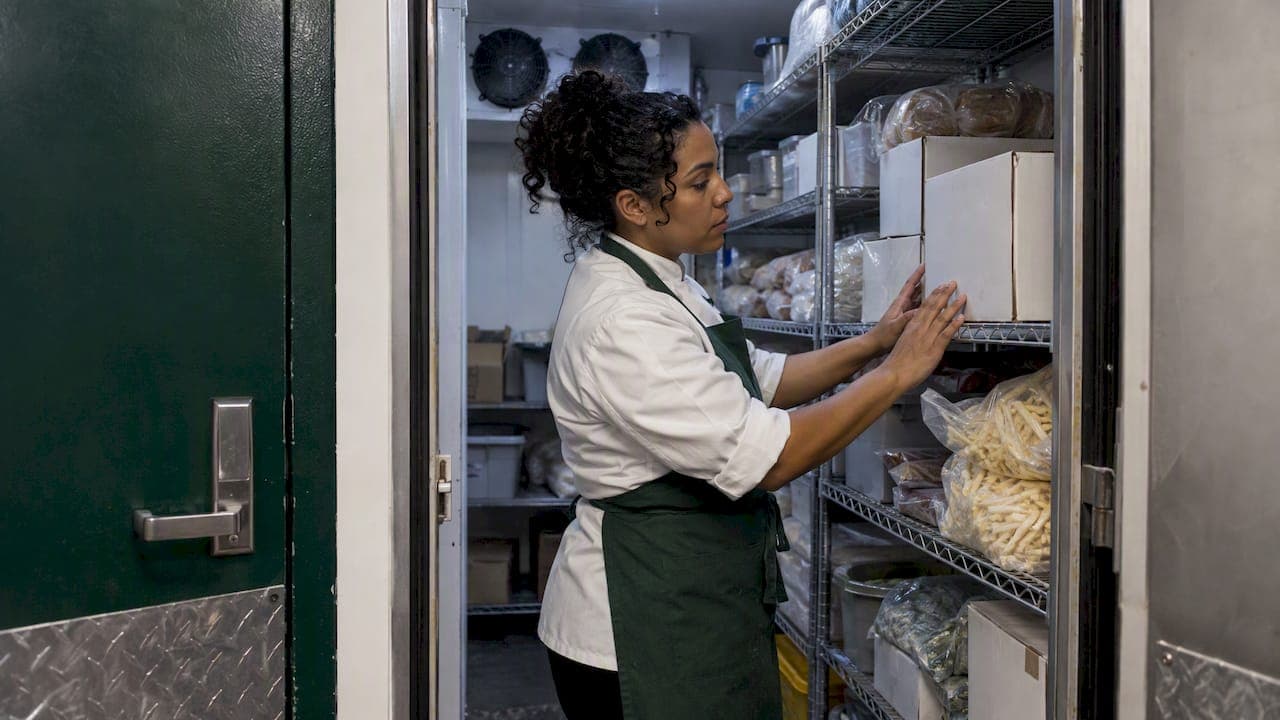
The reorder point formula is: reorder point = (average daily usage × lead time in days) + safety stock. When the stock on hand of an ingredient drops to that number, you place the order. Do it right and the delivery lands just as your buffer is about to be touched, not after the shelf is bare on a Friday night.
This guide shows the calculation step by step, then applies it to the things Australian venues actually buy: milk, coffee, chips, kegs and proteins. It also covers how to set safety stock, how a reorder point differs from a par level and from EOQ, and where the maths breaks down in a real kitchen.
TL;DR
- Reorder point = (average daily usage × supplier lead time) + safety stock. Order when on-hand stock hits that number.
- Keep the time unit the same throughout. If usage is per day, lead time is in days.
- Safety stock is emergency cover for demand spikes and late deliveries, not extra working stock. Raise it when usage or delivery times are unpredictable.
- A reorder point says when to order. A par level says how much you want on hand. EOQ says how much to order at a time.
- Recalculate each item every few weeks. A reorder point is not fixed once usage, lead time or safety stock changes.
Table of Contents
- What a reorder point is
- The reorder point formula, step by step
- Reorder point examples for Australian venues
- How much safety stock should you hold?
- When to adjust the number
- Reorder point vs par level
- Reorder point vs EOQ
- Where the formula falls short in a kitchen
- Our perspective: set the number once, then let the system watch it
- Put reorder points on autopilot
- FAQ
- Sources
What a reorder point is
A reorder point (ROP) is the stock level at which you place a new order. It sits above zero because suppliers do not deliver the moment you ring. Between ordering and the truck arriving, you keep selling, and the reorder point has to cover that gap.
The formula has two parts:
- Demand during lead time. What you expect to use while you wait for the delivery.
- Safety stock. A buffer for the days when usage runs hot or the delivery runs late.
Add them together and you get the trigger number. This is the same two-part structure retail and warehouse guides use, for example ShipBob's reorder point guide, which writes it as demand during lead time plus safety stock. A kitchen just applies it to perishables, small shelves and shorter lead times.
The reorder point formula, step by step
Step 1: Pick one item and one unit
Do not calculate for "dairy". Calculate for full-cream milk in litres, or for 20 kg cartons of frozen chips. A reorder point only works when the unit matches the way you count stock and the way the supplier sells it.
Step 2: Work out average daily usage
Take usage over a representative period. Opening stock plus deliveries, minus closing stock, divided by the days trading. Use at least two to four weeks, and keep weekday and weekend patterns in mind. A pub that moves three times as much lager on a Saturday should not average in a dead Tuesday without noticing it.
Step 3: Confirm the real lead time
Lead time is the gap between placing the order and having the stock on the shelf, ready to use. Not the promised time, the actual time. If your supplier's cut-off is 2 pm for next-day delivery and you usually order at 4 pm, your lead time is two days, not one.
Step 4: Add safety stock
Start simple (more on methods below), then add it to demand during lead time.
Step 5: Compare against stock on hand
When the count reaches or drops below the reorder point, order. If you already have an order on its way, count it: what matters is stock on hand plus stock on order.
The worked example in Thomasnet's reorder point guide shows the pattern clearly: 20 units of average daily usage, 13 days of average lead time and 120 units of safety stock gives (20 × 13) + 120 = 380 units. Swap the units for litres or kilograms and the arithmetic is identical.

Reorder point examples for Australian venues
These are illustrations with made-up numbers. Use your own counts and supplier terms.
Example 1: Milk in a café
A café uses an average of 30 L of milk a day. Its dairy supplier delivers two days after the order. The owner wants one extra day of cover.
- Demand during lead time: 30 L × 2 days = 60 L
- Safety stock: 30 L × 1 day = 30 L
- Reorder point: 60 + 30 = 90 L
When the fridge count says 90 L, the order goes in. If nothing goes wrong, the delivery arrives with about 30 L still on hand.
Example 2: Keg lager in a pub
A pub sells 8 kegs of house lager a week on average and its supplier takes a week from order to delivery. It sets safety stock at 2 kegs.
- Demand during lead time: 8 kegs × 1 week = 8 kegs
- Safety stock: 2 kegs
- Reorder point: 10 kegs
Notice the time unit here is weeks, used consistently. Mixing "8 kegs a week" with a lead time in days is the most common arithmetic slip.
Example 3: Frozen chips in a fish and chip shop
A shop uses 6 cartons of frozen chips a day on average. The distributor delivers in three days. A big Friday or a school holiday can double usage, so the owner uses a maximum-based safety stock (see below).
- Average daily usage: 6 cartons
- Maximum daily usage: 12 cartons
- Average lead time: 3 days; maximum lead time: 4 days
- Safety stock: (12 × 4) − (6 × 3) = 48 − 18 = 30 cartons
- Reorder point: (6 × 3) + 30 = 48 cartons
That is a lot of buffer, and the example makes a point: a maximum-based buffer is generous. Use it for items where a stockout shuts down a menu line, not for everything.
A quick view of all three
| Item | Avg usage | Lead time | Safety stock | Reorder point |
|---|---|---|---|---|
| Milk (café) | 30 L/day | 2 days | 30 L | 90 L |
| House lager (pub) | 8 kegs/week | 1 week | 2 kegs | 10 kegs |
| Frozen chips (fish and chip shop) | 6 cartons/day | 3 days | 30 cartons | 48 cartons |
How much safety stock should you hold?
Safety stock is the part of the formula that takes judgement. There are three common approaches, from simplest to most precise.
Days of cover
Pick a number of days of average usage, such as one day for stable items and two or three for items your menu cannot do without. This is fast, easy to explain to a new chef and good enough for most dry goods and drinks.
Maximum versus average
Safety stock = (maximum daily usage × maximum lead time) − (average daily usage × average lead time). This is the method in Example 3. It protects you against the worst case you have actually seen, so it errs high.
Statistical method
If you have a few months of clean usage data, you can set the buffer to a service level. Amazon Business's safety stock guide gives the formula as Z × demand standard deviation × √lead time, and notes that a 95% service level corresponds to a Z value of about 1.65. With a daily demand standard deviation of 5 units and a nine-day lead time, safety stock comes to about 25 units.
A kitchen version: if daily milk usage swings by a standard deviation of 6 L and lead time is 4 days, safety stock at 95% is 1.65 × 6 × √4 = 1.65 × 6 × 2 ≈ 20 L. The same guide explains that safety stock should rise when demand or lead-time variability rises, or when you want a higher service level.
For a hospitality-flavoured take on forecasting what you will need, this guide on forecasting textile needs walks through the same demand-planning logic for linen and tableware. Our own walk-through of buffer stock with two venue examples is in Stop Friday Night Stockouts: Safety Stock for Restaurants.
Why buffer stock is not working stock
Thomasnet's guide advises treating safety stock as emergency protection, because dipping into it unnecessarily creates extra replenishment cost and delay. In a kitchen that means the buffer should not be what the team routinely cooks from. If you find yourself living in safety stock, the reorder point is too low or the order is going in too late.
When to adjust the number
The reorder point is not a set-and-forget figure. Thomasnet's guide is explicit that it moves whenever usage, lead time or safety stock changes. In hospitality, that happens often:
- Seasonality. Summer beer and ice, winter soups and braises, school holidays at a seaside takeaway.
- Menu changes. A new dish adds usage to some ingredients and takes it from others.
- Supplier changes. A new delivery day or a new cut-off time changes your lead time overnight.
- Events. Footy finals, Melbourne Cup lunches, Christmas functions and a booked wedding all change demand for a few days.
- Public holidays. Lead times stretch when suppliers do not deliver. Raise the reorder point before long weekends rather than after.
A good rhythm is to review your top 20 items by spend every month, and the rest each quarter. For why lead time deserves a closer look than most operators give it, this piece on reorder points and lead time is a short, practical read on how a delivery delay quietly eats the buffer.
Reorder point vs par level
Operators use these terms interchangeably, and they are not the same thing.
- Par level is how much you want on hand when stock is full, the level you order up to.
- Reorder point is the level at which you trigger the order.
Par answers "how much do we want?" and the reorder point answers "when do we order?" Some venues set par equal to the reorder point for simplicity, which works for items you order every day in small amounts. For anything else, they are two numbers.
Here is a café coffee example (illustrative figures). Usage is 5 kg a day, lead time is 3 days, and safety stock is 2 days of cover.
- Reorder point: (5 × 3) + (5 × 2) = 25 kg
- The café orders weekly, so it wants enough on hand to cover the 7 days between orders. Par (order-up-to level) = 25 kg + (5 kg × 7 days) = 60 kg
- When the count hits 25 kg, the café orders enough to bring stock back up to 60 kg, allowing for what is still to be used before the truck arrives.
| Reorder point | Par level | |
|---|---|---|
| Question it answers | When do I order? | How much should I have? |
| Type of number | Trigger | Target |
| Moves with | Usage, lead time, safety stock | Usage, order frequency, storage space |
| Typical use | Items with irregular ordering | Items counted and topped up on a schedule |
If your team counts stock at set times and tops up to a target, par levels are the natural tool. If you order whenever something runs low, reorder points are. Most venues use both, depending on the item.
Reorder point vs EOQ
EOQ, or economic order quantity, is a different calculation. It finds the order size that minimises the combined cost of ordering and holding stock. ShipBob's guide puts it this way: reorder points find the lowest adequate inventory level without stocking out, while EOQ finds the order quantity that minimises cost.
So the reorder point tells you when, and EOQ tells you how much. In a restaurant, EOQ matters less than in a warehouse, because the constraints are usually shelf life, fridge space, supplier minimums and delivery days rather than a clean cost curve. A pack of fresh herbs does not benefit from being ordered in an "optimal" quantity if half of it wilts. Use EOQ thinking for dry goods, packaging and spirits, where holding costs are mostly cash and shelf space.

Where the formula falls short in a kitchen
The formula is sound, but a kitchen is not a warehouse. Watch for these.
Shared ingredients
Onion goes into six dishes. Usage is driven by the menu mix, not by one product. This is why ingredient-level tracking matters: if you only track what you buy and not what each dish consumes, your average daily usage is a guess. We cover that in Ingredient-Level Stock Tracking for Restaurants and in Recipe First: 7 Steps to Track Ingredient Usage.
Shelf life
A reorder point with a big buffer is a bad fit for fresh fish or leafy greens. Shorter, more frequent orders with a small buffer beat a large one that ends up in the bin. Pair the formula with a maximum stock level so a high reorder point never turns into overstock.
Counting errors
The formula assumes your stock on hand is right. If the count is a week old or taken in a rush, the trigger fires late. Our guide to tracking stock levels daily in hospitality covers how often to count which items, and Common Inventory Mistakes Restaurants Make lists the habits that undermine numbers like these.
Too many items
Nobody calculates 400 reorder points by hand and keeps them current. Start with the items that hurt most when they run out or that cost most to hold. Then work down. For dry stores, the dry goods management checklist is a good place to organise what you hold, and bar managers can see how this applies to spirits, kegs and mixers in How to Manage Bar Inventory Efficiently.
Our perspective: set the number once, then let the system watch it
We built PantryHub with chefs, and the pattern we see is consistent: the formula is easy, the follow-through is hard. Operators calculate a reorder point on a Sunday night with good intentions, tape it to the dry store door, and by the second month usage has shifted and nobody has updated it. Meanwhile the numbers on a whiteboard cannot tell you that you are at 88 L of milk and a public holiday is coming.
Our view is that a reorder point is only useful if three things are true. The count is current. The number reflects real usage, not last season's. And someone is alerted at the moment the line is crossed, not when the chef opens an empty fridge. That is why we focus on real-time stock tracking, low-stock alerts and supplier ordering in one place, so the trigger and the order sit together instead of in a spreadsheet and a text thread.
If you are starting from scratch, do not wait for perfect data. Pick your 10 most important items, use days of cover for safety stock, and review the numbers after a month. A rough reorder point you actually follow beats a perfect one you do not.
— Admin
Put reorder points on autopilot
PantryHub is built for Australian cafés, restaurants, pubs, clubs and commercial kitchens, with AUD pricing and low-stock alerts so you hear about a problem before service, not during it. It tracks stock across one venue or several, and lets you order from your suppliers without leaving the app.
Plans are $39 AUD per month (Starter), $69 AUD per month (Regular) and $99 AUD per month (Pro), and you can see what each includes on the pricing page. Want to see it with your own items first? Start your free trial and set up your first reorder levels today.
If your team is still working from spreadsheets and memory, our 7 signs your kitchen needs inventory software will tell you whether it is time. For more on ordering, see how to automate café stock ordering and cut waste, and browse more practical guides on the Aussie Kitchen Tips blog.
FAQ
Is reorder point the same as safety stock?
No. Safety stock is one part of the reorder point. The reorder point is the expected demand during lead time plus safety stock, so it is always higher than the buffer alone. Safety stock is the cushion you aim not to use.
Can the reorder point be higher than the order quantity?
Yes. If your lead time is long or your buffer is large, the reorder point can exceed the quantity you order each time. In that case you place a new order before the last one has arrived, so count stock on order as well as stock on hand.
How often should I recalculate reorder points?
Review your highest-spend and most critical items monthly, and everything else each quarter. Recalculate straight away when you change a supplier, change the menu or head into a busy season, because usage or lead time has probably moved.
What if my usage is very uneven across the week?
Use the weekday and weekend averages separately, or base safety stock on your peak days using the maximum-usage method. A pub or fish and chip shop with a big Friday and Saturday should not set one flat number from a seven-day average.
Do I need software to use the reorder point formula?
No, a spreadsheet works for a handful of items. Software helps once you have dozens of items, several suppliers or more than one venue, because it keeps usage current and alerts you when stock crosses the line.
Sources
- How to Use the Reorder Point Formula to Better Manage Your Inventory (Thomasnet)
- Safety stock: the formula, calculation, and examples (Amazon Business)
- How to Calculate Reorder Points with the ROP Formula (ShipBob)
- How to Forecast Textile Needs for Hotels and Restaurants
- Reorder point and lead time