

A restaurant dry goods management checklist is a structured tool that controls how your kitchen stores, rotates, counts, and monitors every non-perishable item from flour and rice to canned goods and spices. Restaurants that implement this kind of systematic inventory control, often called dry goods inventory control in professional kitchens, reduce food costs by 3–8% annually. That margin improvement comes directly from less waste, fewer emergency orders, and tighter stock visibility. The checklist standardizes the procedures that protect product quality, keep you compliant with food safety codes, and give your team a clear daily routine to follow.
1. How to build your restaurant dry goods management checklist
Start with a complete catalog of every dry good your kitchen uses. Group items by category: grains and starches, canned goods, oils and vinegars, spices and seasonings, baking ingredients, and dry condiments. Each category becomes a section on your checklist, with columns for item name, unit of measure, par level, current count, and variance. This structure mirrors the physical layout of your dry storage room, which matters more than most managers realize. Zone-based inventory lists that mirror physical storage layout prevent backtracking and limit missed items during counts.
Your checklist also needs columns for delivery date, use-by date, and storage location. Without those fields, FIFO rotation and compliance checks become guesswork. A free kitchen inventory checklist template can give you a working starting point before you customize it for your specific menu and supplier schedule.
2. How to organize your dry storage area
Physical organization is the foundation of any reliable restaurant supply checklist. A disorganized storeroom produces inaccurate counts, missed expiry dates, and wasted labor every single shift.
Follow these layout rules without exception:
- Store all items at least 6 inches (15 cm) off the floor to meet regulatory hygiene codes and allow cleaning underneath shelves.
- Keep items at least 18 inches from the ceiling to support airflow and fire suppression access.
- Use metal or plastic shelving, never wood. Wood absorbs moisture, harbors bacteria, and warps over time.
- Group products by category and by frequency of use. Items pulled daily belong at eye level. Bulk backup stock goes on lower or higher shelves.
- Keep chemicals, cleaning products, and pest control supplies in a completely separate locked area, away from all food products.
- Label every shelf location, not just the product. If a product runs out, the empty shelf still tells your team where it belongs.
Pro Tip: Use gravity-flow shelving for high-turnover items like rice, flour, and sugar. New stock loads from the back, and older stock feeds forward automatically, enforcing FIFO without any extra effort from your team.
3. Implementing FIFO and labeling for stock rotation
FIFO, which stands for First In, First Out, is the standard stock rotation method required by most food safety regulations and endorsed by HACCP guidelines. The principle is simple: the oldest stock gets used first. Proper labels prevent stock from expiring unnoticed, which is the single most common cause of avoidable dry goods waste in commercial kitchens.
Your labeling system needs to capture three data points on every item:
- Delivery date: When the product arrived at your kitchen.
- Date opened: When a sealed container was first opened.
- Use-by date: The manufacturer's expiry or your kitchen's internal use-by standard.
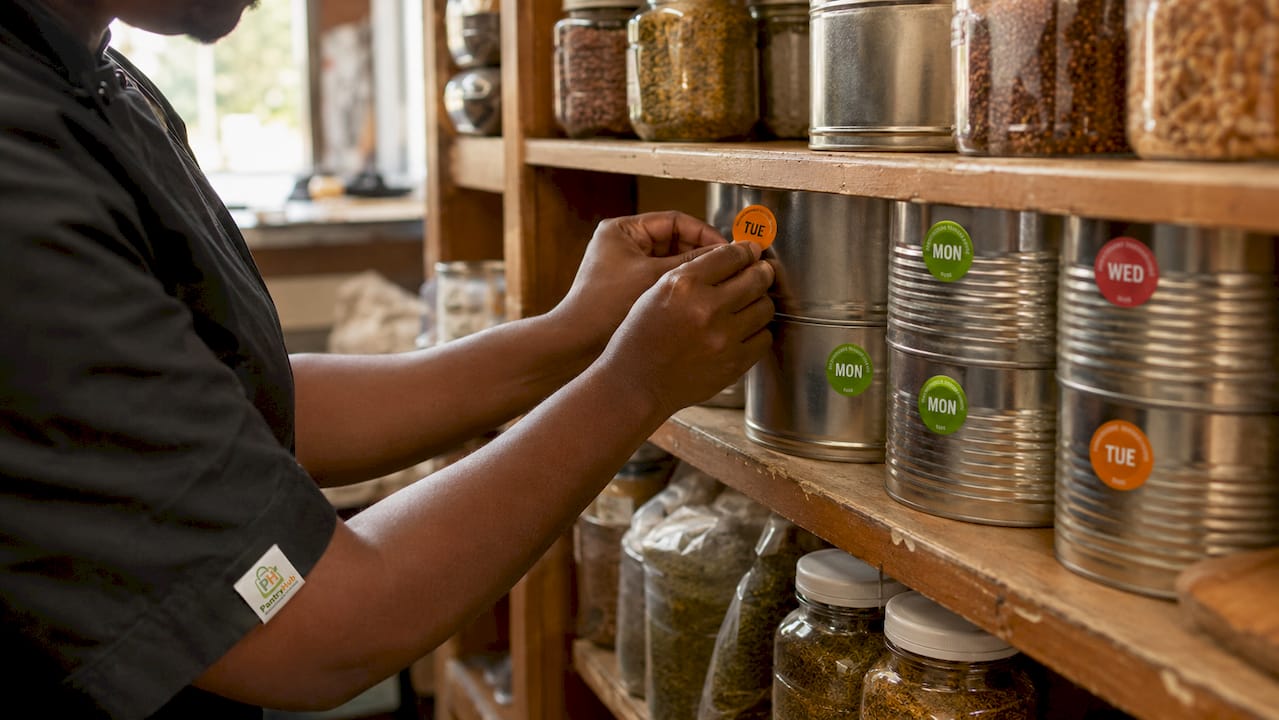
Daily shelf maintenance keeps FIFO working. At the start of each shift, a designated team member checks that new deliveries are placed behind existing stock, not in front of it. Older items move to the front. Any item without a visible label gets pulled and checked before it goes back on the shelf.
The most common FIFO failure is a delivery driver or new staff member placing fresh stock directly in front of older stock because it is faster. Labeling and FIFO adherence drastically reduce waste and improve stock turnover when the whole team follows the same procedure every time.
Pro Tip: Use color-coded day-dot labels for opened items. Assign a different color to each day of the week so any team member can instantly see how old an opened container is without reading a date.
4. Conducting accurate inventory counts
Accurate counts are the core of any working inventory management checklist. Without them, par levels are guesses, variance reports are meaningless, and ordering decisions cost you money.
Follow this counting procedure:
- Count at the same time, on the same day, every period. Inventory is most accurate when the same person counts at the same time each period. Consistency is what makes trend data reliable.
- Use a two-person counting system. One person counts physically while the other records. This separation of tasks reduces errors significantly, especially in cramped or busy dry stores.
- Count by physical location, not alphabetically. Move through the room from top-left to bottom-right, shelf by shelf. This mirrors your zone-based checklist and prevents you from skipping items.
- Never round your counts. If you have 3.5 cases of pasta, record 3.5. Rounding errors accumulate and obscure real problems like theft, over-portioning, or supplier short-shipping.
- Reconcile counts against your system data immediately. Any variance above your threshold needs a corrective action, not just a note. Inventory data triggers corrective action within 30 minutes in well-run kitchens, not the next morning.
- Categorize items by count frequency. High-cost, high-turnover items (A items) get counted weekly or daily. Mid-range items (B items) get counted weekly. Low-cost bulk items (C items) get counted monthly.
Pro Tip: Assign a specific staff member as the inventory owner for dry goods. Most inventory failures result from unclear ownership, not from software limitations. One name on the checklist means one person accountable for accuracy.
5. Temperature and humidity monitoring
Dry storage is not self-managing. Temperature and humidity directly affect product shelf life, texture, and safety. Regulations require dry goods storage environments to stay between 15°C and 21°C (59°F and 70°F) with humidity below 60%.
| Condition | Target Range | Action if Out of Range |
|---|---|---|
| Temperature | 15–21°C (59–70°F) | Inspect seals, check HVAC, move sensitive products |
| Humidity | Below 60% | Run dehumidifier, check for leaks or condensation |
| Floor clearance | Minimum 6 inches | Reposition all items immediately |
| Wall clearance | Minimum 2 inches | Pull shelving away from walls for airflow |
Your daily monitoring routine should include:
- Check and log temperature and humidity at the start of every shift.
- Record the date, time, reading, and the name of the person checking.
- Flag any reading outside the target range and document the corrective action taken.
- Inspect door seals, vents, and shelving for damage or blockages weekly.
Daily logging of dry storage temperatures keeps you within regulatory compliance and preserves product integrity. A wall-mounted thermometer and a digital hygrometer cost very little and eliminate the guesswork entirely.
Pro Tip: Place your thermometer and hygrometer at mid-shelf height in the center of the room. Readings near the door or ceiling do not reflect actual storage conditions for most of your products.
6. Common mistakes in dry goods management
Most dry goods problems are predictable. They repeat because no one has assigned clear ownership or built a correction process into the daily routine.
Watch for these errors:
- Skipping FIFO on busy delivery days. New stock gets stacked in front because it is faster. This is the leading cause of expired dry goods in restaurant kitchens.
- Inconsistent or missing labels. An unlabeled container is an unknown risk. Train every team member to label before they store, without exception.
- Counting by memory or estimation. Guessed counts produce false par levels and incorrect orders. Physical counts with a two-person system are the only reliable method.
- Storing chemicals near food products. This violates food safety codes and creates contamination risk. Chemicals belong in a locked, separate area at all times.
- Skipping temperature and humidity logs. A single week of missed logs can hide a failing HVAC unit until product damage is already done.
- No assigned inventory owner. When everyone is responsible, no one is. Assign one person per shift to own the dry goods checklist and hold them accountable by name.
Poor item-master data and unclear staff ownership are the two root causes of inventory failure in most kitchens. Fix those two things before you invest in any new system or process.
Key takeaways
A disciplined restaurant dry goods management checklist reduces food costs, prevents waste, and keeps your kitchen compliant with food safety regulations every single day.
| Point | Details |
|---|---|
| Build a zone-based checklist | Mirror your physical storage layout to prevent missed items during counts. |
| Enforce FIFO with labels | Label every item with delivery date, date opened, and use-by date to prevent waste. |
| Use a two-person count system | Separate counting and recording tasks to reduce errors and improve accuracy. |
| Monitor temperature and humidity daily | Log readings every shift and act on any deviation from the 15–21°C and below 60% humidity targets. |
| Assign clear ownership | Name one staff member as the dry goods inventory owner to ensure accountability. |
Why checklist discipline is the real competitive edge
The restaurants I have seen struggle most with food costs are not the ones with the worst suppliers or the smallest budgets. They are the ones where the dry store is treated as an afterthought. No labels, no rotation, no consistent counts. The checklist exists somewhere in a binder, but nobody owns it.
What actually changes a kitchen is the moment a manager assigns one person to own the dry goods process and holds that person accountable every week. Not a software platform, not a new shelving system. Ownership. I have watched kitchens cut their dry goods waste by a meaningful amount in under 60 days just by enforcing FIFO labeling and running consistent two-person counts. The inventory accuracy and profitability connection is not theoretical. It shows up in your food cost percentage within weeks.
Technology does accelerate this. Digital tracking removes the manual reconciliation step and flags variances automatically. But technology built on top of a broken process just produces bad data faster. Get the physical discipline right first. Then layer in digital tools to make it faster and more visible. The checklist is not a bureaucratic exercise. It is the operating system your kitchen runs on.
— Admin
Pantryhub makes dry goods tracking faster and more accurate
Running a paper-based dry goods checklist works until it does not. Missed counts, illegible logs, and lost variance data cost real money every week. Pantryhub is built specifically for restaurant and kitchen teams who need real-time stock visibility without the administrative burden.
With Pantryhub's hospitality inventory software, you can digitize your dry goods checklist, set par-level alerts, track variances automatically, and give every team member a clear view of what is in stock and what needs ordering. The platform supports multi-location visibility, supplier integration, and reporting that turns your count data into ordering decisions. Restaurant managers who want to move beyond spreadsheets and paper logs can view Pantryhub's pricing plans and get started from A$39 per month.
FAQ
What is a restaurant dry goods management checklist?
A restaurant dry goods management checklist is a structured document that tracks storage conditions, stock rotation, inventory counts, and labeling for all non-perishable kitchen items. It standardizes daily procedures to reduce waste, prevent spoilage, and maintain food safety compliance.
How often should dry goods inventory be counted?
High-cost, high-turnover items should be counted weekly or daily, mid-range items weekly, and low-cost bulk items monthly. Consistency matters more than frequency: counting at the same time, on the same day, by the same person produces the most reliable trend data.
What temperature should a dry storage room be kept at?
Dry storage rooms should stay between 15°C and 21°C (59°F and 70°F) with humidity below 60%. Daily temperature and humidity logs are required for regulatory compliance and product integrity.
What is FIFO and why does it matter for dry goods?
FIFO stands for First In, First Out. It means the oldest stock gets used before newer stock. Strict FIFO with visible date labels prevents dry goods from expiring unnoticed, which is the most common cause of avoidable waste in restaurant dry stores.
How does a two-person counting system improve inventory accuracy?
One person counts physically while the other records the numbers. This separation of tasks catches errors that a single counter misses, especially in busy or cramped storage areas where distractions lead to miscounts.