
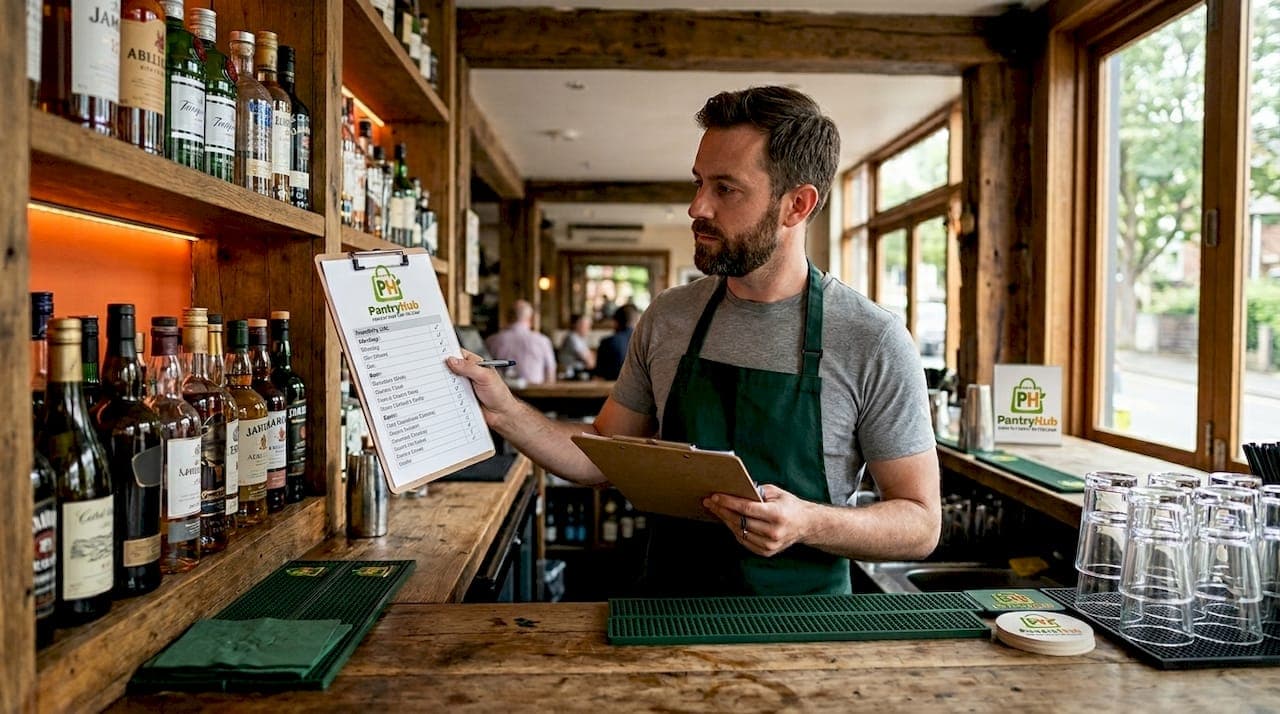
Inventory shrinkage is quietly draining your bar's profits right now. Whether you run a craft cocktail lounge or a high-volume sports bar, shrinkage averages 15 to 20% per month across the industry, yet most of that loss is preventable. To manage bar inventory efficiently, you need more than a weekly count on a yellow notepad. You need a system: clear processes, the right technology, and a team that understands why accuracy matters. This guide walks you through exactly that, from foundational setup to troubleshooting real problems.
Table of Contents
- Key takeaways
- How to manage bar inventory efficiently: the fundamentals
- Taking accurate counts: a step-by-step process
- Technology that makes stock control faster and smarter
- Best practices for reducing waste and protecting margins
- Troubleshooting common inventory challenges
- My take on what actually moves the needle
- See how Pantryhub handles bar inventory for you
- FAQ
Key takeaways
| Point | Details |
|---|---|
| Shrinkage is solvable | Bars that fix inventory systems can cut losses and improve profit by 5 to 10%. |
| Layered counting works best | Combine weekly full counts with daily spot checks on high-value items for the sharpest accuracy. |
| Technology saves time | POS-integrated inventory software can save up to 20 hours of manual work per month. |
| FIFO reduces waste | First-in, first-out rotation prevents spoilage and is critical for perishables like wine. |
| Staff accountability matters | Training your team to log spillages and comped drinks directly shapes your shrinkage rate. |
How to manage bar inventory efficiently: the fundamentals
Before you build any system, you need to understand what you are actually managing. Bar inventory, formally known as beverage cost control or bar stock control, covers every product that moves through your bar: spirits, beer, wine, mixers, garnishes, and supplies like cocktail napkins and straws.
Categorize before you count. Most operators split inventory into four main groups:
- Spirits and liqueurs (highest value, highest theft risk)
- Beer and cider (volume-driven, easier to count by unit)
- Wine (partial bottles require decimal measurement)
- Non-alcoholic mixers, syrups, and garnishes (often overlooked, but they add up)
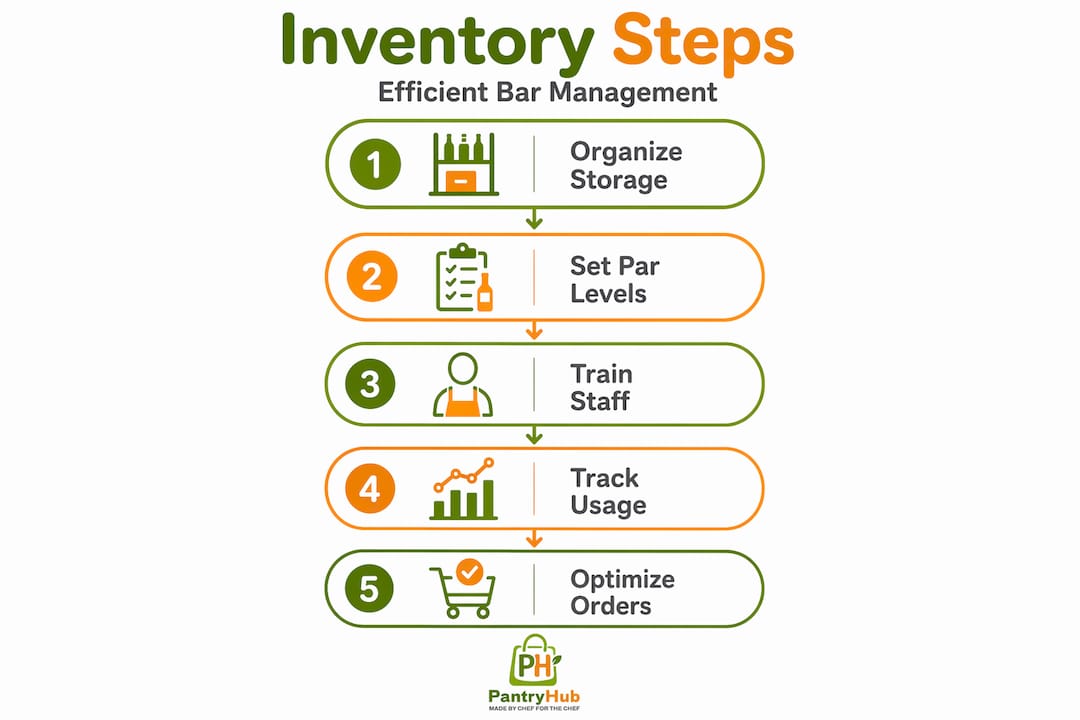
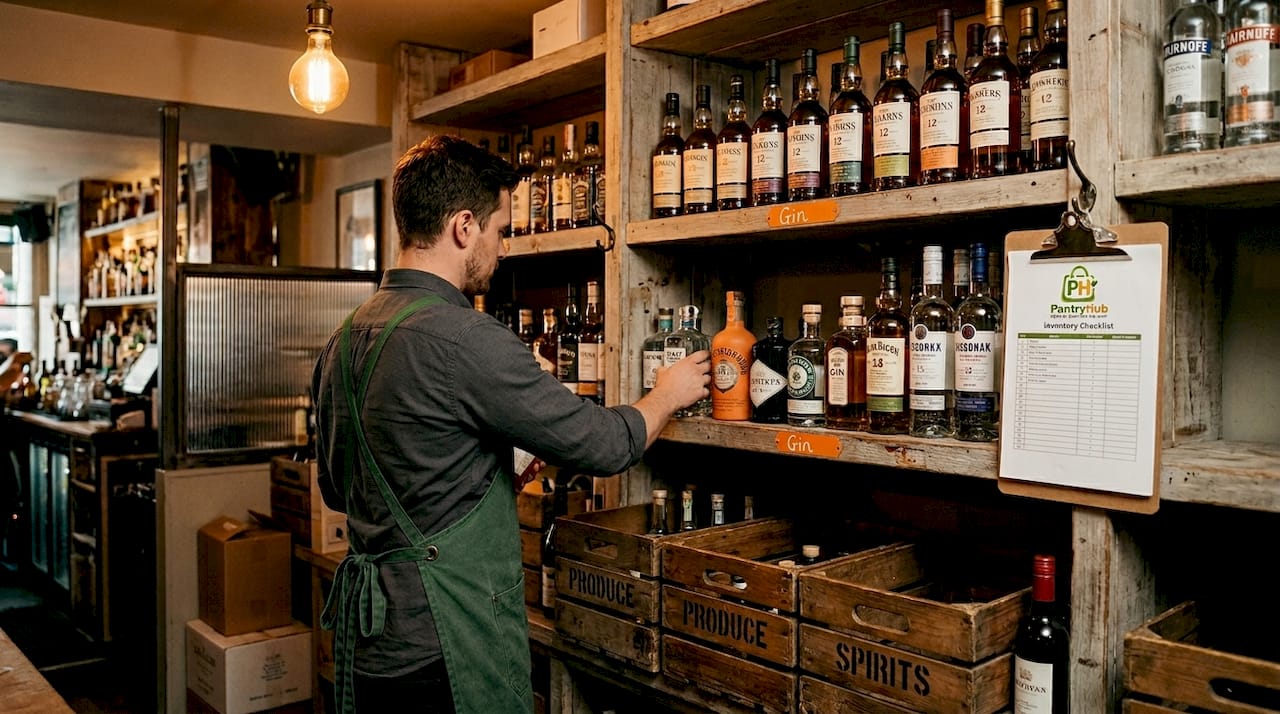
Getting your storage organized to match these categories is not optional. When everything has a designated location and items are grouped by type, counts go faster, errors drop, and receiving new deliveries becomes less chaotic.
You also need to establish par levels before counting means anything. A par level is the minimum quantity of each item you need on hand to get through a defined period, typically one week, without running short. Setting par levels requires looking at your actual sales history, not guessing. Once you know what you sell, you can set a reorder point, the quantity at which you place a new order, calculated to arrive before you hit the par floor.
Here is a simple reference for the tools most bar managers use at different stages of growth:
| Tool | Best for | Drawback |
|---|---|---|
| Spreadsheet | Small bars, low SKU count | Time-consuming, error-prone at scale |
| Barcode scanner + spreadsheet | Mid-size bars with diverse stock | Requires manual reconciliation |
| Inventory management software | Any bar serious about profit control | Upfront setup investment |
| POS-integrated platform | Multi-location or high-volume venues | Needs POS compatibility |
Staff training is the piece most managers underestimate at this stage. Your system is only as accurate as the people using it. Assign clear roles: who counts, who records, who verifies. Every person on that rotation needs to count the same way every time.
Taking accurate counts: a step-by-step process
Consistency is the single most important variable in bar inventory accuracy. Your count should follow the same physical sequence every session, starting at the same spot and ending at the same spot. If one person counts left to right on the back bar and another counts right to left, you will never catch discrepancies cleanly.
Here is how a reliable count process works in practice:
- Close the bar or pause service. Count during a non-service window whenever possible. A count done mid-rush is a count you will have to redo.
- Start with the back bar, then move to wells, then walk-in coolers. Go section by section with no backtracking.
- Use decimals for partial bottles. A bottle that is roughly three-quarters full gets recorded as 0.75, not "almost full." Decimal measurement of partial bottles is the only way to produce usage calculations you can actually trust.
- Record full bottles separately from partials. Count full bottles first, then add the partial as a decimal. One full bottle plus one partial at 0.5 equals 1.5 units of that product.
- Reconcile against your sales data and deliveries. Once your count is logged, compare what you physically have against what your POS says you should have sold, adjusted for deliveries received since your last count.
- Flag discrepancies immediately. A variance of more than 2 to 3% on any category warrants investigation before the next count, not after.
Bars typically run weekly full counts plus daily spot checks on high-value items like top-shelf spirits. That layered approach gives you early warning on theft or over-pouring without burning your team out on full counts every day.
Pro Tip: Set up a dedicated inventory sheet template that mirrors the physical layout of your bar, not alphabetical order. Counting in the order your shelves are arranged cuts count time by 30% or more.
Technology that makes stock control faster and smarter
Manual counting will always have a role in bar inventory, but relying on it alone is leaving money on the table. Modern bar inventory software changes the math significantly.
The most impactful shift is POS integration. When your inventory system connects directly to your point-of-sale, every drink sold automatically deducts from your stock count in real time. POS-integrated inventory systems can save up to 20 hours per month in manual data entry alone, and they eliminate the class of errors that come from transcribing sales data by hand.
Here is what to look for when evaluating automated bar inventory solutions:
- Real-time stock deduction linked to each POS transaction
- Low-stock alerts that trigger at your defined reorder points, not when you notice the shelf is bare
- Mobile app access so you can record stock anywhere during the count instead of carrying clipboards and transcribing later
- Barcode or QR scanning to speed up counts and reduce item entry errors
- Reporting and analytics that surface your pour cost, shrinkage trends, and top-consuming products by period
The reporting piece is where inventory management software for bars moves from useful to transformative. When you can see that your house tequila pour cost jumped 4% in three weeks, you can investigate before it costs you a full month of margin. Without reporting, you find out when the period is already over.
Pro Tip: Before committing to any platform, verify that it integrates with your existing POS. A system that requires double-entry defeats half the purpose of automating in the first place.
Some newer platforms are adding AI-driven demand forecasting, which uses your historical sales data to predict what you will need for the coming week, accounting for seasonal shifts and upcoming events. For bars with seasonal menus or frequent specials, that kind of forward-looking data is genuinely useful, not just a marketing feature.
Best practices for reducing waste and protecting margins
Getting your system in place is the start. Keeping it working is where the best practices for bar inventory separate high-margin operations from everyone else.
Rotate with FIFO, every time. First-in, first-out means the oldest product always gets used first. FIFO rotation is non-negotiable for wine, fresh juices, and anything with an expiry date. Train every staff member who touches the walk-in or the back bar to check dates and rotate automatically.
Track spillage and comps in writing. Over-pouring and comped drinks are two of the biggest contributors to shrinkage that never gets explained. Tracking spillages and comped drinks accurately means your variance report reflects actual controllable loss, not a mysterious gap you cannot account for.
Set variance thresholds and take them seriously. A 1 to 2% variance on spirits in a given week might be acceptable. Anything above 3% needs a written explanation. When you document variance expectations and hold the team accountable to them, you change the culture around inventory accuracy.
Plan your orders around your calendar. Inventory shrinkage spikes around events and busy periods because managers over-order "just in case" and then fail to rotate properly. Plan specific order quantities for specific events rather than simply ordering more of everything.
Efficient bar stock control ties directly to your pour cost percentage, which is the ratio of what your ingredients cost versus what you charge for a drink. Most bars target a pour cost between 18 and 24%. When your inventory system is working, you have the data to calculate this accurately and adjust pricing or portion sizes when the number drifts.
Troubleshooting common inventory challenges
Even a well-built system will hit friction. Knowing what to expect makes the difference between a one-time problem and a persistent drain.
Book vs. physical discrepancies are the most common issue. When what your records say you have does not match what is on the shelf, the cause is almost always one of four things: over-pouring, theft, breakage, or administrative errors. Work through each possibility methodically before drawing conclusions.
- Review recent delivery records to confirm every received item was logged
- Check the spillage and comp log for unrecorded losses
- Pull POS sales data and compare drink by drink if the variance is large enough to justify the time
- Look at camera footage if theft is suspected
Staff turnover disrupts consistency more than most managers expect. When a new person joins the count rotation, re-train from scratch. Do not assume they will pick it up by watching once. Documented procedures, not verbal instructions, are what survive turnover.
Multi-location bars face the added challenge of keeping processes consistent across sites. The answer is standardization: one counting template, one software platform, one reporting format. When your hospitality inventory software gives you visibility across all locations in a single dashboard, you can spot when one venue's shrinkage is trending differently from the others.
Pro Tip: Use your inventory data to inform your menu engineering decisions. If a product has high usage but thin margins, your inventory reports will surface that before your profit-and-loss statement does.
My take on what actually moves the needle
I have spent a lot of time looking at how bars approach inventory, and the pattern I see repeatedly is that operators think the problem is counting frequency when the real problem is counting quality. Running a full count every day with inconsistent methods produces worse data than running a weekly count with strict procedures.
The layered approach, where you do weekly full counts and daily micro-checks on your top 10 highest-value items, works precisely because it focuses your daily attention where the financial risk is highest. You do not need to check your paper napkin count every morning. You do need to know if your top-shelf bourbon is moving faster than your POS says it should.
The second thing I would push back on is the idea that technology replaces hands-on oversight. It does not. What good inventory tracking software does is make your oversight faster, more targeted, and harder to manipulate. The manager still needs to walk the floor, verify the numbers, and ask questions when something looks off.
Training and accountability are the variables that determine whether your system works or not. You can have the best software on the market and still have a 20% shrinkage rate if your team does not understand why accuracy matters and what happens when it slips.
— Admin
See how Pantryhub handles bar inventory for you
Pantryhub is built specifically for bars and hospitality venues that are serious about controlling costs. With real-time stock tracking, POS integration, low-stock alerts, and mobile-friendly counting tools, it gives your team everything needed to run accurate counts and catch shrinkage before it compounds.
The bar inventory platform connects your pour cost data, your supplier ordering, and your stocktake results in one place, so you are not stitching together three different spreadsheets at the end of the week. Pantryhub is designed for Australian hospitality venues, with local support and pricing starting from A$39 per month. If you want to see what it looks like in practice, explore pricing and plans and start a free trial without a credit card.
FAQ
What is a good shrinkage rate for a bar?
Most bars experience shrinkage between 15 and 20% without active systems in place. Well-managed operations reduce this significantly, and controlling shrinkage typically improves profit by 5 to 10%.
How often should a bar do a full inventory count?
Weekly full counts combined with daily spot checks on high-value items is the industry standard for bars that want accurate data without overloading staff.
What causes the most inventory shrinkage in bars?
The most common causes are over-pouring, theft, breakage, and administrative errors. Structured counting procedures, spillage logs, and staff training address all four.
Do I need software to manage bar inventory?
You can start with spreadsheets, but inventory management software for bars saves significant time, reduces errors, and provides analytics you cannot replicate manually once your volume grows.
What is FIFO and why does it matter for bars?
FIFO stands for first-in, first-out. It means using older stock before newer stock, which prevents spoilage and reduces waste, especially for wine, fresh citrus, and other perishables.