

Poor inventory control for restaurants is the single most predictable cause of margin erosion in food service operations. The common inventory mistakes restaurants make follow a clear pattern: inconsistent counts, stale recipe costs, ignored invoice details, static par levels, and zero variance reporting. Food costs rose for 92% of restaurant operators over the past year. That number means inventory errors are no longer a back-office nuisance. They are a direct threat to staying open.
1. Counting inventory too infrequently
Infrequent counts are the root cause of most inventory management errors in restaurants. When you count stock only once a month, you give problems a 30-day window to grow before you notice them. Monthly vs. weekly counts make variance more noise than signal and delay problem recognition by 30 days. A spoiled case of protein, a theft pattern, or a supplier short-ship can quietly drain your margins for weeks before a monthly count surfaces it.
Weekly counts, done on the same day and at the same time, give you a clean data set to act on. The consistency matters as much as the frequency. Weekly counts done the same way by the same person reduce variance noise and expose root causes rather than just symptoms. Rotating who counts and when you count destroys the baseline you need to spot real problems.

Pro Tip: Assign one person to own each count category, such as proteins, dry goods, and beverages, and lock in a fixed schedule. Consistency in personnel and timing is what turns raw count data into a reliable signal.
2. Letting two people count the same items
Splitting count responsibility between multiple people without clear ownership creates overlaps and gaps. One person assumes the other counted the walk-in. Neither did. The result is phantom stock on paper and a real shortage on the line during service.
The fix is role clarity, not more counters. Assign each team member a specific zone or category and hold them to it every single count. A stock count sheet with pre-assigned sections removes ambiguity and creates a paper trail for accountability. When counts go wrong, you can trace the error to a specific zone and a specific person.
3. Ignoring employee theft in your shrinkage math
Approximately 75% of inventory shrinkage comes from internal theft, with employee theft alone accounting for 36% of losses. Independent operators lose 3–5% of inventory to this cause. Those numbers mean theft is not an edge case. It is a standard operating cost that most managers fail to account for in their inventory control systems.
Two-person counts on high-value items like proteins and spirits are a direct countermeasure. When two people verify the same number independently, the opportunity for manipulation drops sharply. Separating who orders, who receives, and who counts is the structural fix that makes theft significantly harder to execute without detection.
4. Setting par levels on average days instead of peak days
Par levels define the minimum stock quantity that triggers a reorder. Most operators set them based on average daily use, which sounds logical until a Friday night rush clears your salmon and you are 86-ing your top seller at 7:00 PM. Operators who set pars on average use rather than peak usage cause frequent stockouts on busy days.
The correct method is to calculate par levels using your highest-volume day as the baseline, then add a safety buffer. Par levels should reflect peak daily usage plus a safety buffer of 20–25%, with tighter buffers for perishables and looser ones for shelf-stable items. A case of canned tomatoes can sit for weeks. Fresh fish cannot. Your par logic needs to reflect that difference.
Signs your par levels need adjustment:
- You run out of the same item repeatedly on weekends
- You throw away the same perishable every Tuesday after a slow Monday
- Your ordering feels reactive rather than planned
- You carry excess stock of slow-moving shelf items while running short on high-velocity ones
Pro Tip: Review par levels every time you change your menu or enter a new season. A summer menu with fresh produce has completely different par requirements than a winter menu built around braises and root vegetables.
5. Skipping line-item invoice verification
Receiving a delivery and signing off on the total without checking individual line items is one of the most costly common stock issues in restaurants. Vendors may increase prices on specific line items without notice. If you only match invoices at the gross total level, those increases go undetected for months. This is what operators call "mystery food cost creep," and it compounds quietly.
Failing to capture invoice line-item details prevents early detection of price increases and causes unseen margin erosion. The fix is straightforward: check every line item at the point of receiving, not in the office two days later. Compare the delivered price against your last confirmed price for each product. A 4% increase on your top protein, missed for three months, can erase a meaningful portion of your net margin.
Pro Tip: Train your receiving staff to flag any price variance above a set threshold, such as 3%, before signing the delivery. That one habit catches most invoice errors before they enter your cost data.
6. Using stale recipe cards for food cost calculations
Recipe costing is the foundation of theoretical inventory. When ingredient prices change but your recipe cards do not, your theoretical food cost becomes fiction. You think a dish costs $8.40 to produce. It actually costs $10.20. That gap multiplied across hundreds of covers per week is a serious problem.
POS systems assume perfect portioning and sales tracking, but real kitchens have untracked waste and comps that cause theoretical and actual inventory to drift apart. Stale recipe cards make that drift worse because they start the calculation with wrong numbers. Update recipe costs every time a key ingredient price changes, and audit your top 10 highest-cost dishes at minimum once per quarter.
Connecting your recipe costs to your invoice data closes the feedback loop. When a supplier raises the price of chicken thighs, that change should flow directly into your recipe cost calculation, not sit unnoticed in a paper invoice file.
7. Treating inventory and accounting as separate systems
A reactive approach caused by a disconnect between inventory and accounting systems delays cost correction. Connecting inventory and accounting systems tightens feedback loops and enables faster interventions. When these systems do not talk to each other, you are always looking at last week's problem with this week's data.
The practical consequence is that you make ordering decisions based on cost data that is already outdated. You over-order because you do not know what you actually spent. You under-order because you do not know what you actually have. Both outcomes cost money. Integrating your inventory records with your accounting gives you a real-time picture of food cost percentage, which is the number that actually tells you whether your kitchen is profitable.
8. Ignoring variance reports entirely
Variance reporting compares what your inventory should show based on sales against what it actually shows on a count. The gap between those two numbers tells you where your operation is leaking. Most restaurants either do not run variance reports at all or run them so infrequently that the data is useless by the time they look at it.
Addressing five primary inventory failure points can recover 2–4% of Cost of Goods Sold within 90 days. Variance reporting is the tool that identifies which failure points are active in your kitchen right now. A consistent variance on proteins points to portioning or theft. A consistent variance on beverages points to free-pouring or unlogged comps. The pattern in the variance tells you exactly where to look.
Separating ordering, receiving, and counting roles improves accuracy and reduces theft opportunity. When the person who orders is also the person who counts, there is no independent check on their work. Role separation is the structural equivalent of a variance report. It creates accountability at every stage of the inventory cycle.
9. Logging spoilage after the fact instead of in real time
Inventory shrinkage from small human habits like unlogged spoilage and free-pouring accumulates into significant losses. The problem is not that spoilage happens. It is that it goes unrecorded until the next count, at which point the variance looks like theft or a counting error. Real-time waste logging changes that.
A simple waste log posted in the walk-in or prep area, where staff record every item thrown away with a quantity and reason, gives you accurate spoilage data. That data feeds directly into your variance calculation and removes the noise from your theft detection. When spoilage is logged, a genuine theft variance stands out clearly. When it is not, everything looks like a counting error and nothing gets fixed.
Key Takeaways
The most damaging inventory management errors in restaurants are structural, not accidental. Fixing count frequency, par logic, and role separation recovers measurable margin within weeks.
| Point | Details |
|---|---|
| Count weekly, not monthly | Monthly counts delay problem detection by up to 30 days and hide theft and waste patterns. |
| Set pars on peak days | Use your highest-volume day plus a 20–25% buffer to avoid stockouts on busy service. |
| Verify every invoice line | Check individual line-item prices at receiving to catch supplier price increases before they erode margins. |
| Separate ordering and counting roles | Role separation reduces fraud opportunity and improves count accuracy across the full inventory cycle. |
| Run variance reports regularly | Consistent variance patterns identify portioning errors, theft, and spoilage before they compound. |
The discipline comes before the software
Here is the uncomfortable truth I have seen play out repeatedly: restaurants buy inventory software expecting it to fix their process problems, and it does not. Software is a multiplier. If your count discipline is weak, software gives you faster access to bad data. If your par levels are wrong, automated reordering just locks in your mistakes at scale.
The operators who get the most out of any inventory system, including Pantryhub, are the ones who already have a manual routine in place. They know which day they count. They know who owns each section. They have a waste log that staff actually use. When they add software on top of that foundation, the results are immediate and measurable.
The habits most operators overlook are the small ones. Signing off on deliveries without checking line items. Letting the same person order and count. Updating recipe cards once a year instead of every time a price changes. None of these feel urgent until you look at your food cost percentage at the end of the month and cannot explain why it moved.
Start with one change this week. Pick a fixed count day. Assign zones. Make it non-negotiable. That single habit, done consistently for four weeks, will surface more useful information than any software dashboard you have ever looked at.
— Admin
How Pantryhub supports tighter inventory control
Fixing the process gaps covered in this article gets significantly easier when your tools are built for the job.
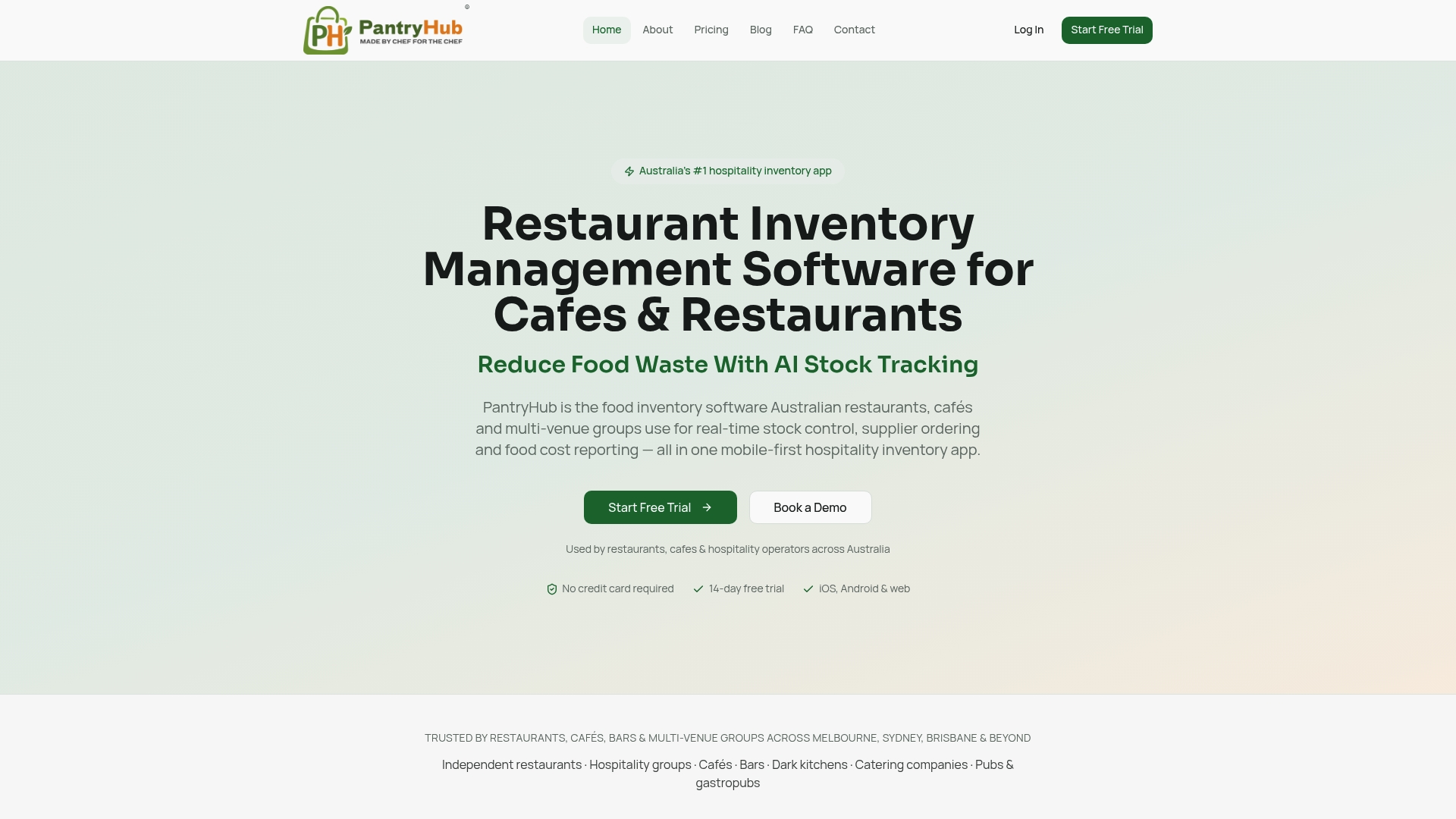
Pantryhub is built specifically for restaurants, cafés, bars, and commercial kitchens. It captures invoice line items at the point of receiving, tracks stock in real time, and sends low-stock alerts before you hit a stockout. Variance reporting is built in, so you can see the gap between theoretical and actual inventory without building a spreadsheet. Par level monitoring flags items that need reordering based on your own usage data, not a generic formula. For operators running more than one location, Pantryhub gives you multi-location stock visibility from a single dashboard. When your process is solid, hospitality inventory software like Pantryhub turns that discipline into measurable savings.
FAQ
What are the most common inventory mistakes restaurants make?
The most common errors are infrequent counts, static par levels based on average rather than peak usage, skipping line-item invoice verification, and failing to run variance reports. Each one causes a different type of financial loss, from stockouts to undetected theft.
How often should restaurants count inventory?
Weekly counts are the standard for effective inventory control. Counting on the same day, at the same time, by the same person reduces variance noise and makes it possible to identify problems within days rather than weeks.
What is a par level and why does it matter?
A par level is the minimum stock quantity that triggers a reorder. Setting pars too low causes stockouts on busy days. Setting them too high ties up cash in excess stock. The correct par uses peak daily usage plus a 20–25% safety buffer, adjusted for perishability.
How does role separation reduce inventory errors?
When the same person orders, receives, and counts stock, there is no independent check on any step. Separating those roles means errors and theft must pass through multiple people, which significantly reduces both accidental mistakes and deliberate fraud.
Why do theoretical and actual inventory numbers drift apart?
POS systems assume perfect portioning and complete sales tracking, but real kitchens generate untracked waste, comps, and spoilage. Without real-time waste logging and regular variance reporting, that gap between theoretical and actual inventory grows undetected.