

Ingredient-level stock tracking is the process of monitoring inventory down to each individual ingredient, giving hospitality businesses precise control over usage, costs, and compliance. The role of ingredient-level stock tracking has moved from optional to non-negotiable in 2026, as operators face tighter food safety regulations, rising ingredient costs, and shrinking margins. Systems like Toast, Square, and Pantryhub now connect recipe cards directly to point-of-sale data, creating a live picture of what you have, what you've used, and what you need. The industry standard term for this practice is ingredient-level inventory management, and automation alone can reduce food waste by up to 30% when recipe cards are accurate.
How ingredient-level stock tracking improves inventory accuracy
Manual stocktakes tell you what you had at one point in time. Ingredient-level tracking tells you what you have right now, and why the number changed.
The mechanism is straightforward. Every time a dish is sold through your POS, the system deducts the exact quantities specified in that dish's recipe card from your on-hand stock. This is called real-time depletion tracking. When your recipe cards are accurate, POS depletion tracking achieves a 2–4% variance for key ingredients. Variances above 5% signal a recipe error, a portioning problem, or theft. That distinction matters because it turns a vague "we're losing stock" complaint into a specific, fixable problem.

Theoretical versus actual inventory variance is the core diagnostic tool in efficient ingredient tracking. Theoretical inventory is what your system calculates you should have based on sales. Actual inventory is what a physical count confirms. The gap between the two is your variance. Tools like MarketMan and BlueCart calculate this gap automatically and flag it for review.
Par-level alerts add another layer of control. Once you set a minimum stock level for each ingredient, the system triggers a reorder notification before you run out. Dynamic par levels adjust based on recent consumption patterns, so a busy Friday night doesn't leave you short on chicken thighs by Saturday morning.
- Set up accurate recipe cards for every menu item, including modifiers and substitutions.
- Integrate your POS with your inventory platform so depletion happens automatically on every sale.
- Define par levels for each ingredient based on lead time and average daily usage.
- Review variance reports daily to catch discrepancies before they compound.
- Investigate any variance above 5% immediately, not at the end of the month.
Pro Tip: Audit variances daily rather than monthly. Daily variance reports identify waste, theft, and portioning issues early, when the cost of correction is still low.
Why lot-level traceability is non-negotiable for compliance
Lot-level traceability is the practice of assigning a unique internal reference number to every batch of ingredients received, linking it to the supplier's lot number and the receipt date. This is not a feature upgrade. Under FSMA standards, traceability audits must be completed within 24 hours, and lot tracking is the only way to meet that window reliably.
The practical workflow looks like this. When a delivery arrives, your system logs the supplier lot number, assigns an internal lot ID, and records the receipt date. If a recall is issued for a specific batch of romaine lettuce, you can trace forward to every dish that used it and backward to the exact delivery it came from. Without lot tracking, that investigation takes days. With it, the same audit takes minutes.
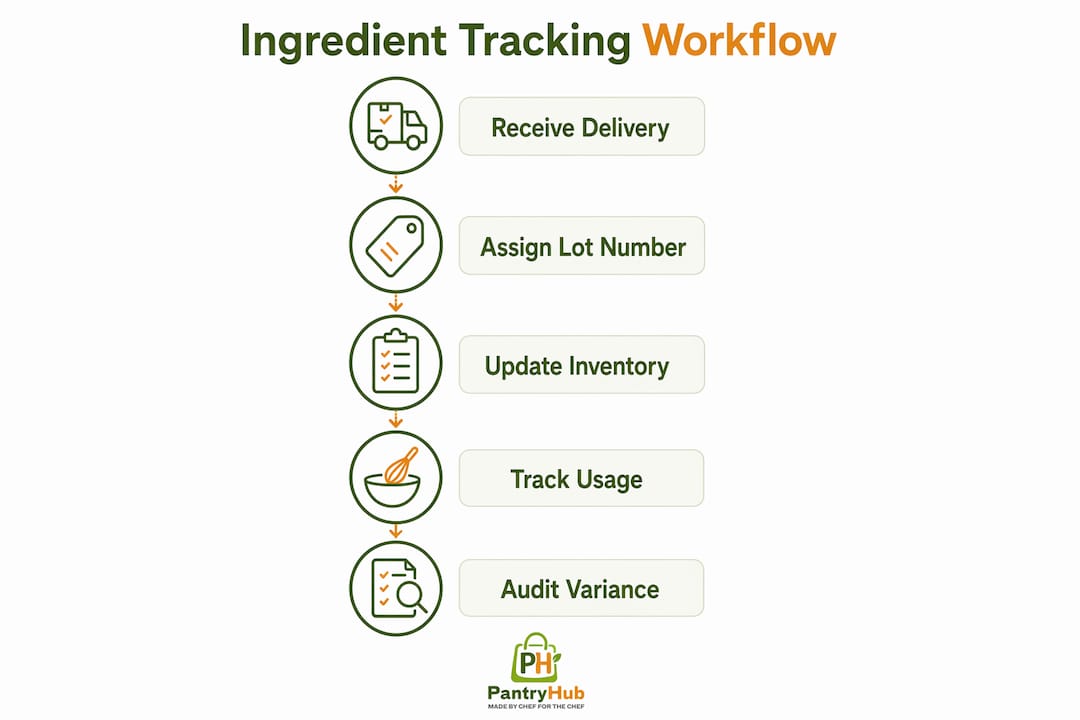
Expiry management is where lot tracking pays dividends beyond compliance. ERP systems like Odoo automatically enforce FIFO (first in, first out) and FEFO (first expired, first out) rotation rules, reducing human error and spoilage that manual rotation cannot prevent consistently. Automatic expiry alerts have been shown to reduce expired raw materials by 30–40% in operations that implement them correctly.
Key compliance capabilities to look for in any ingredient-level inventory system:
- Lot assignment at receipt: Links supplier lot IDs to internal reference numbers automatically.
- Forward traceability: Identifies every finished dish or batch that used a recalled ingredient.
- Backward traceability: Pinpoints the exact delivery and supplier for any ingredient in your kitchen.
- Automated rotation rules: Enforces FIFO and FEFO without relying on staff memory.
- Audit trail export: Generates compliance documentation for health inspections and recall events.
| Traceability Feature | Manual System | Automated ERP/Inventory System |
|---|---|---|
| Lot assignment | Paper-based, error-prone | Automatic at receipt via barcode scan |
| Recall audit time | Days | Minutes |
| Rotation enforcement | Staff-dependent | System-enforced FIFO/FEFO |
| Expiry alerts | None | Automated notifications |
| Compliance documentation | Manual compilation | One-click export |
How does ingredient tracking connect to menu pricing?
Ingredient-level data transforms menu pricing from a static quarterly review into a continuous optimization loop. Linking ingredient costs with POS sales data lets you calculate the true contribution margin of every dish in real time, not just when your accountant runs the numbers at quarter end.
Here is what that looks like in practice. Your grilled salmon dish has a recipe card that lists every ingredient and its cost. When salmon prices rise 15% after a supply disruption, your system recalculates the dish's margin automatically. Platforms like Restaurant365 and MarketMan send alerts when a dish's margin drops below a threshold you define. That alert gives you three choices: reprice the dish, substitute an ingredient, or accept the margin hit. Without the alert, you might not notice the problem for weeks.
The stock tracking benefits extend beyond individual dishes. Ingredient-level data identifies which menu items generate the most waste relative to their revenue. A dish that sells well but generates high trim waste may be less profitable than it appears. That insight is invisible without ingredient-level tracking.
Pro Tip: Use your ingredient cost data to review menu pricing monthly rather than quarterly. Ingredient prices shift faster than most operators realize, and a 30-day review cycle catches margin erosion before it becomes a structural problem.
Emerging AI-driven tools are beginning to suggest price adjustments automatically based on ingredient cost trends, competitor pricing, and demand patterns. This is the direction the industry is heading, and operators who already have clean ingredient-level data will adopt these tools far more easily than those starting from scratch.
What are the best practices for implementing ingredient tracking?
The importance of stock tracking at the ingredient level is clear. The harder question is how to implement it without disrupting daily operations. The answer is a phased approach that builds accuracy before adding complexity.
Start with recipe cards. Every ingredient-level system depends on accurate recipe cards. A recipe card that lists "chicken" without specifying the cut, weight, and trim percentage will produce useless variance data. Build cards for your top 20 items first, then expand. This is the single most common implementation failure point.
Integrate your POS before anything else. Square Restaurant Inventory by MarketMan provides real-time ingredient tracking and variance analysis fully integrated with Square POS. Toast offers similar functionality for larger operations. Pantryhub connects directly with your existing POS and supplier accounts, making it a practical choice for Australian restaurants and cafés that need a local solution with multi-location support.
Train staff on the why, not just the how. Staff who understand that variance reports identify theft and waste, not just errors, take the process more seriously. A 15-minute briefing on how the system works and what it catches changes behavior more than a policy memo.
Set realistic audit schedules. A kitchen stocktake process built around weekly physical counts, combined with daily automated variance checks, gives you the best balance of accuracy and operational efficiency.
Common pitfalls to avoid:
- Launching with incomplete recipe cards and then blaming the system for inaccurate data.
- Setting par levels once and never updating them as seasonal demand shifts.
- Ignoring variance reports because the numbers seem small. A 3% variance on a high-volume ingredient adds up fast.
- Skipping lot tracking setup because it feels like extra work. Compliance requirements make it mandatory, not optional.
For operations comparing platforms, the best inventory software for restaurants in 2026 all share three core capabilities: POS integration, automated variance reporting, and lot-level traceability. The difference between platforms is depth of reporting, ease of use, and pricing structure.
Key takeaways
Ingredient-level stock tracking delivers measurable waste reduction, compliance readiness, and margin visibility only when recipe cards are accurate and POS integration is active from day one.
| Point | Details |
|---|---|
| Waste reduction is quantifiable | Automated ingredient tracking reduces food waste by up to 30% when recipe cards are accurate. |
| Daily variance audits outperform monthly | Flagging variances daily catches theft, waste, and portioning errors before losses compound. |
| Lot tracking is a compliance requirement | FSMA standards require traceability audits within 24 hours, which only lot-level systems can deliver. |
| Ingredient data drives menu pricing | Real-time cost data lets you monitor dish margins continuously and reprice before losses accumulate. |
| Implementation starts with recipe cards | Every other feature depends on accurate, detailed recipe cards built before system launch. |
The part most operators get wrong about ingredient tracking
Most operators treat ingredient-level tracking as an inventory problem. It is actually a decision-making infrastructure problem. The data is only as useful as the decisions it informs.
I have seen kitchens with fully integrated POS systems and accurate recipe cards that still lose money because nobody reviews the variance reports. The system flags a 7% variance on beef tenderloin every Tuesday, and the report sits unread in an inbox. That is not a technology failure. That is a management failure.
The traceability angle is where I think the industry is most underinvested. Operators set up lot tracking to satisfy a compliance checkbox, then never use the forward and backward trace capabilities until a recall forces them to. The operators who practice recall simulations quarterly, running a mock trace on a random ingredient batch, discover gaps in their workflow before a real event exposes them publicly.
The real-time data advantage is also frequently undersold. Operators who check inventory data weekly are making decisions on stale information. Operators who check it daily are running a tighter ship. The technology exists to make daily review a five-minute task. The barrier is habit, not capability.
AI-driven procurement and demand forecasting are coming faster than most operators expect. The restaurants that will adopt those tools smoothly are the ones that already have clean, structured ingredient-level data. The ones that don't will spend six months cleaning up their data before they can use the new tools at all.
— Admin
Take control of your kitchen inventory with Pantryhub
Pantryhub is built specifically for restaurants, cafés, bars, and commercial kitchens that need ingredient-level visibility without the complexity of enterprise software.
With Pantryhub, you get real-time stock depletion linked to your POS, automated low-stock alerts, supplier ordering, and multi-location reporting in one platform. The system is designed by people who have worked in commercial kitchens, so the workflows match how your team actually operates. Whether you run a single café or a group of venues, Pantryhub gives you the ingredient-level control you need to cut waste, protect margins, and stay compliant. Explore hospitality inventory software built for the way Australian kitchens work.
FAQ
What is ingredient-level stock tracking?
Ingredient-level stock tracking is the practice of monitoring inventory at the individual ingredient level rather than by product category. It links recipe cards to POS sales data to calculate real-time stock depletion and variance.
How much can ingredient tracking reduce food waste?
Automated ingredient-level tracking can reduce food waste by up to 30% when recipe cards are accurate and POS integration is active. Theoretical-to-actual variance can be held within a 5% margin for high-velocity items.
What is lot-level traceability and why does it matter?
Lot-level traceability assigns a unique reference number to every ingredient batch received, enabling forward and backward trace in a recall event. FSMA compliance requires completing traceability audits within 24 hours, which manual systems cannot achieve reliably.
How often should restaurants audit ingredient variances?
Daily automated variance reporting is the recommended standard. Daily flagging identifies waste, theft, and portioning issues early, reducing the cost of correction compared to monthly stocktakes.
What software supports ingredient-level inventory management?
Platforms including Square Restaurant Inventory by MarketMan, Toast, Restaurant365, and Pantryhub all support ingredient-level tracking with POS integration, automated variance reporting, and compliance features suited to different operation sizes and budgets.