
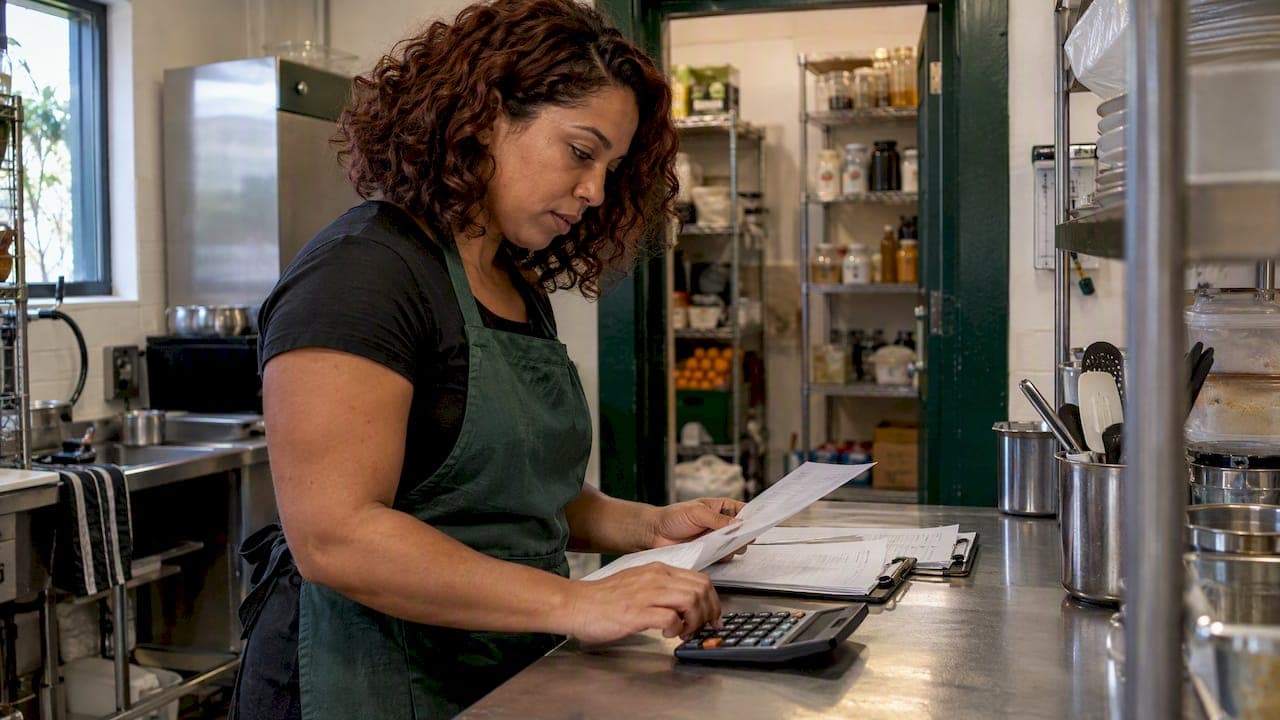
Inventory carrying cost is everything it costs you to hold stock you have not yet sold: the cash tied up in it, the space and power it uses, the insurance, the handling time, and the food that spoils or walks out the back door. Add those up over a year, divide by the average value of the stock you hold, and you have your carrying cost rate. For a restaurant, café or pub, that number is usually higher than owners expect, because fresh food loses value every day it sits on a shelf.
This guide shows you which costs to count, the formula, a worked example with real arithmetic, and the habits that bring the figure down.
TL;DR
- Carrying cost (also called holding cost) is the full annual expense of keeping unsold stock: capital, storage, labour, insurance, spoilage and theft.
- The formula is annual holding costs divided by average inventory value, times 100. General guides put the rate at roughly 20% to 30%, but venues with a lot of fresh stock can land well above that.
- Spoilage and over-ordering are the biggest controllable pieces for most kitchens. Par levels, reorder points and regular stocktakes shrink them.
- Packaging and consumables belong in the calculation, but they behave differently from food and are tracked best as their own category.
- Start with one honest number. You cannot cut a cost you have never measured.
Table of Contents
- What counts as carrying cost in a venue
- The carrying cost formula
- A worked example for a café
- What data you need to get this right
- Where packaging costs fit
- How to bring carrying costs down
- Our view: carrying cost is a visibility problem
- Put carrying cost under control with PantryHub
- FAQ
- Sources
What counts as carrying cost in a venue
Carrying costs are the expenses of holding and storing unsold goods. Investopedia lists warehousing, employee salaries, handling, taxes, insurance, depreciation, shrinkage and opportunity costs. For a kitchen or bar, that translates into five buckets.
1. Capital cost
Every dollar sitting in the coolroom is a dollar that is not in your bank account or paying down a loan. The cost is what that money would otherwise earn, or the interest you pay to finance it. Business Queensland includes financing and interest costs among the costs of managing stock. Academic guidance suggests using either a mean return-on-investment rate or the bank interest rate that applies to you, as ETH Zurich course material explains.
2. Storage cost
Coolrooms, freezers, dry stores and bar fridges all cost money to rent, power and maintain. Count the share of rent and electricity that your stock space uses, plus shelving, refrigeration servicing and pest control. Business Queensland lists warehousing and storage costs as a core stock expense.
3. Handling and labour cost
Someone orders, receives, puts away, rotates and counts the stock. Business Queensland says labour for ordering, storing, picking and packing should be included in your stock calculations. If your head chef spends four hours a week on spreadsheets and phone orders, that time belongs here.
4. Risk cost: spoilage, waste, damage and theft
This is the bucket that quietly eats into margins. Business Queensland names the cost of spoilage or disposing of wasted stock, and stocktakes help you find items that are lost, stolen, soiled or damaged. In a venue it is the lettuce that wilted, the dairy that passed its date, the case of spirits that never reached a sale.
5. Insurance and service cost
Stock is covered by your insurance, and the premium share attributable to it counts. Add any fees tied to holding stock, such as off-site storage.
One distinction matters. Ordering costs (labour, freight and admin each time you place and receive an order) are a separate category from holding costs, although the two trade off against each other: order less often and you pay less to order but hold more. For a deeper look at the basics, our guide on what hospitality inventory management involves covers the day-to-day mechanics.
The carrying cost formula
The standard formula is simple. FreshBooks describes it as the inventory holding sum divided by total annual inventory value, multiplied by 100.
Carrying cost rate (%) = (annual holding costs ÷ average inventory value) × 100
The holding sum is the total of every cost from the five buckets above. The inventory value should be your average stock on hand across the year, not a single snapshot. A simple way to get it: average your opening and closing stocktake values, or better, average your monthly counts.
The benchmark you will see most often is 20% to 30% of inventory value, which is what Investopedia reports, noting that it varies by industry and business size. Treat it as a sanity check, not a target. A venue with long-life dry goods will sit near it. A seafood restaurant with daily deliveries and heavy spoilage risk can sit far above it.
| Input | Where to find it |
|---|---|
| Average inventory value | Average of your monthly stocktake totals |
| Capital cost | Average stock value × your loan rate or expected return |
| Storage | Share of rent, power and refrigeration costs |
| Handling labour | Hours per week on ordering, receiving and counting × hourly cost |
| Spoilage, waste, theft | Write-offs and variances from stocktakes |
| Insurance | Share of premium covering stock |
A worked example for a café
The figures below are illustrative, not PantryHub customer data. Say a café holds an average of $20,000 of stock across the year (food, coffee, milk, packaging and drinks).
| Cost | Annual amount |
|---|---|
| Capital cost (8% of $20,000) | $1,600 |
| Storage share of rent, power and refrigeration | $3,000 |
| Spoilage and waste | $2,400 |
| Shrinkage and unexplained variance | $600 |
| Insurance share | $400 |
| Handling labour (about 4.5 hours a week, at an assumed $5.13 weighted over the year) | $1,200 |
| Total holding cost | $9,200 |
Carrying cost rate: $9,200 ÷ $20,000 × 100 = 46%.
That is well above the general 20% to 30% range, and it is plausible for a venue with perishables. It also tells you where to look. Spoilage, storage and capital together make up $7,000 of the $9,200, and all three respond to buying less, more often, and in the right quantities. Across a year the café is paying about $177 a week just to keep its stock on the shelves.
A per-item version
Sometimes you want the cost per unit. The New Zealand government's Business.govt.nz café example shows how: with 1,000 bags of coffee beans demanded each year, $2,000 of storage works out to $2 a bag, $3,000 of foregone sales to $3 a bag, and $1,000 of damaged or expired stock to $1 a bag. That gives a holding cost of $6 per bag per year. The method transfers directly to any hero item on your menu: divide each annual cost by annual usage.

What data you need to get this right
A carrying cost figure is only as good as your stock records. Business Queensland recommends tracking each item by unique SKU, storage location, cost price, quantity and source of supply, and recording anything lost, stolen, soiled or damaged. It also advises regular stocktakes, which reconcile what your records say you bought and sold with what is physically on the shelf.
For most venues, that means:
- Weekly counts of high-value and perishable lines, monthly for slower items.
- A written waste log with the item, quantity and reason.
- Supplier invoices captured at the point of delivery, with cost prices updated when they change.
- Consistent count sheets so two people count the same way. Our stock count sheet guide and kitchen stocktake process walk through this step by step.
If your counts and your invoices do not agree, the carrying cost number will be wrong in a way that hides the problem. Fix the reconciliation first. We cover that in five steps to reconcile inventory in a week.
Where packaging costs fit
Takeaway cups, lids, boxes, bags and napkins are inventory too, so they carry the same holding costs: cash tied up, shelf space, and handling. Two things make them different from food.
First, they rarely spoil. A box of 1,000 cups costs you capital and space but does not go off, so their carrying cost is mostly storage and cash. That also makes them the category most prone to overbuying, especially when a supplier offers a bulk discount. Run the maths before you accept it: the saving per unit has to beat the extra months of holding cost, plus the risk that you change a menu item or a brand design and the stock becomes obsolete.

Second, packaging is consumed per sale, not per recipe. Food cost is built from recipes, while packaging cost attaches to each order channel. A dine-in flat white uses a ceramic cup. The same drink for takeaway uses a cup, lid and sleeve. Track packaging as its own stock category, assign a cost per order type, and review it against your takeaway sales. When it is tracked separately, you can see whether delivery orders are really as profitable as they look.
How to bring carrying costs down
You are not trying to hold zero stock. Run out of a key item and you lose sales, annoy regulars and pay rush-delivery prices. The goal is the right amount of stock for each item.
Set par levels and reorder points
A par level is the quantity you want on hand after a delivery. A reorder point is the level at which you place the next order. Business.gov.au says reorder points let you know when to restock, and you can set them by considering usage rates and delivery times. In practice, check your last eight weeks of usage, add a small buffer for your supplier's lead time, and write the numbers on the count sheet.
Put your effort where the money is
The 80/20 rule, also known as the Pareto principle, suggests that about 20% of your stock accounts for about 80% of its value. QuickBooks Australia explains ABC analysis, where you rank items by value and count the top group, the A items, more often than the rest. For a pub, that is usually spirits, kegs and premium proteins. For a café, it might be coffee, dairy and a few pastry lines. Count those weekly, count the mid-value B items monthly, and leave the cheap C items to a quarterly check.
Order smaller and more often, within reason
Frequent small deliveries cut spoilage and free up cash, but each delivery has an ordering cost: freight, receiving time, admin. Your sweet spot is where the two meet. Fresh produce, dairy, bread and seafood usually favour frequent orders. Dry goods, canned lines and packaging usually favour fewer, larger ones.
Rotate stock and label everything
First in, first out, with date labels on every container. It costs almost nothing and directly reduces the spoilage bucket.
Cut the hidden handling time
Phoning orders through, retyping invoices and counting on paper all add labour to your holding cost. Moving orders and counts into one system takes that time back. Our article on common inventory mistakes restaurants make lists the habits that inflate it most.
Understand your risk exposure
Spoilage, theft and unsold seasonal lines all push the carrying rate up. Food businesses face a wide range of such risks, and the piece on the role of food in hospitality gives useful context on how losses build up when fresh menus and daily preparation meet unpredictable demand. Bar operators can add a tailored checklist, such as our Adelaide bar stock management checklist.
Our view: carrying cost is a visibility problem
We built PantryHub with chefs, and what we see again and again is that owners do not have a carrying cost problem so much as a visibility problem. The stock is there, the invoices are somewhere, the waste goes in the bin, and nobody has one view of it. When you can see what is on the shelf, what it cost and how fast it moves, over-ordering stops being a habit.
We think three things matter most. First, count the high-value items often, and make counting quick enough that people actually do it. Second, treat waste as data: a bin that is full of a particular item is telling you your par level is wrong. Third, connect ordering to real usage rather than gut feel. Gut feel works for a seasoned chef on a quiet week, and fails on the week you have a function, a long weekend and a new supplier all at once.
An accurate number beats a perfect one. Start with the buckets you can measure today, and refine as your records improve. For the link between accurate counts and profit, see our inventory accuracy and restaurant profitability guide.
— the author
Put carrying cost under control with PantryHub
PantryHub is a hospitality inventory and ordering platform built for Australian venues. You get real-time stock tracking, low-stock alerts, supplier ordering, waste and cost reporting, and multi-location visibility, with AUD pricing and GST-ready reporting. Plans are Starter at $39 a month, Regular at $69 a month and Pro at $99 a month, and you can start a free trial to see your own stock in the system before you commit. Read more on our hospitality inventory software page, or see how it works for venues in Melbourne, Sydney, Adelaide and Perth.
Want to see the savings on your own numbers? Start the free trial, or read how inventory control saves Australian hospitality businesses money.
FAQ
What is the formula for inventory carrying cost?
Add up all your annual holding costs (capital, storage, labour, insurance, spoilage and theft), divide by your average inventory value, then multiply by 100. The result is your carrying cost rate as a percentage. Use the average of your regular stocktakes for the inventory value, not one count.
What is a good carrying cost percentage for a restaurant?
General guidance puts carrying costs at around 20% to 30% of inventory value, but this varies by industry and size. Venues with fresh and perishable stock often run higher because of spoilage. Compare your own figure against last year's rather than chasing a universal benchmark.
Is inventory holding cost the same as carrying cost?
Yes, the terms are used interchangeably. Both describe what it costs to hold unsold stock over time. Ordering costs, such as freight and receiving labour, are a separate category, though the two are balanced against each other when you decide how often to order.
What is the 80/20 rule in inventory?
It is the Pareto principle applied to stock: roughly 20% of your items make up around 80% of your inventory value. You use it to decide where to focus. Count and manage that high-value group most closely, and give the long tail of cheap items less attention.
How often should I count stock to track carrying costs?
Count perishables and high-value lines weekly, slower lines monthly and low-value items quarterly. Business Queensland recommends regular stocktakes to line your records up with the physical stock. The more often you count your biggest-value items, the sooner you catch waste and shrinkage.
Sources
- What Is Inventory Carrying Cost? (Investopedia)
- Stock control: the basics (Business Queensland)
- Manage your inventory (business.gov.au)
- How much to order and when (Business.govt.nz)
- Carrying Cost (ETH Zurich course material)
- Inventory Carrying Cost formula (FreshBooks)
- ABC Analysis in Inventory Management (QuickBooks Australia)
- The Role of Food in Hospitality: 2026 Guide