

Centralized multi-venue inventory control is defined as a single, unified system that gives every location in your hospitality group real-time visibility into stock on hand, in-transit goods, open purchase orders, and demand patterns across all sites. When you centralise multi-venue inventory control properly, you eliminate the fragmented reconciliation that kills hours every week, reduce food waste at scale, and standardize workflows from receiving dock to kitchen pass. Tools like Winnow AI, FreshByte Software, and cloud ERP platforms have made this achievable for groups of any size. This guide walks you through the prerequisites, step-by-step execution, and the pitfalls that derail most centralisation projects before they deliver results.
What does it take to centralise multi-venue inventory control?
The foundation is a unified live platform that captures on-hand stock, in-transit goods, open purchase orders, and location-level demand in one place. Without that single source of truth, your team spends more time reconciling spreadsheets than managing actual inventory. That reconciliation gap is where errors compound and waste accelerates.
Before you deploy any software, four prerequisites must be in place:
- Standardized item masters. Every SKU needs a consistent name, unit of measure, and category code across all venues. A chicken breast cannot be "Chicken Breast 200g" at one site and "Chx Breast" at another. Inconsistent naming breaks every downstream report.
- Supplier governance. Define approved suppliers, pricing tiers, and ordering windows at the corporate level. Local teams can request exceptions, but the default list must be centrally managed.
- Lot and expiry date tracking. For perishables, lot-level expiration capture at receiving is non-negotiable. Without it, FEFO (First Expired, First Out) rotation is impossible to enforce automatically.
- Transaction controls. Every stock movement, from a receiving inspection to an inter-venue transfer, must be authorized and recorded within the system. Unrecorded movements are invisible losses.
On the technology side, cloud ERP platforms handle multi-venue reporting and new site onboarding at scale. Mobile stock management apps let floor staff count, request, and receive stock without returning to a desktop terminal. AI-powered waste tracking tools like Winnow integrate with inventory data to close the loop between what you ordered and what actually reached the plate.
Pro Tip: Before going live on any platform, audit your item master list. Remove duplicates, standardize units of measure, and assign every item to a category. A clean item master at launch saves weeks of cleanup later.

| Technology Layer | Primary Function | Example Tools |
|---|---|---|
| Cloud ERP | Centralized reporting, PO management, transfers | FreshByte Software, hospitality ERP platforms |
| Mobile stock app | Real-time counts, requests, receiving on the floor | Pantryhub mobile app |
| AI waste tracking | Measurement and reduction of plate and prep waste | Winnow AI |
| Barcode scanning | Enforces workflow discipline at receiving and issuing | Integrated scanner hardware |
How do you execute centralized inventory workflows step by step?
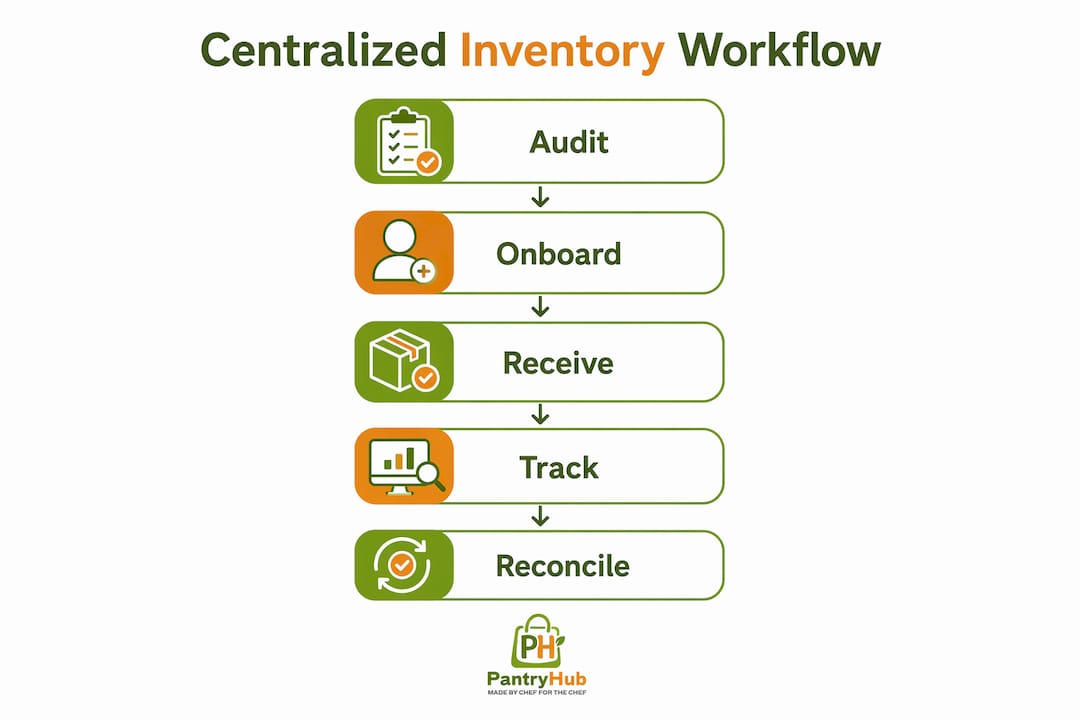
The inventory lifecycle in a multi-venue hospitality group has six distinct stages. Each stage must connect directly to the next, with no gaps in recording. Linking transactions immediately within an SOP-style workflow reduces manual reconciliation and the data gaps that typically plague multi-venue systems.
Here is the workflow sequence every venue should follow:
- Receiving inspection. When a delivery arrives, staff verify quantity, condition, and lot or expiry dates against the purchase order. Any variance is flagged in the system before the delivery is accepted. This step is where most centralisation projects fail. Skipping expiry capture here disables FEFO for the entire chain.
- Material requests. Kitchen sections or departments submit stock requests through the platform. Requests are approved against par levels and budget thresholds set at the corporate level. No verbal requests, no informal texts to the storeroom.
- Stock issues. The storeroom fulfills approved requests and records each issue in real time. The system deducts from the correct storage location, whether that is the main kitchen, the bar, or the banquet prep area.
- Returns. Unused or damaged stock returned to the storeroom is recorded as a return transaction, not simply placed back on the shelf. This keeps your on-hand figures accurate.
- Inter-venue transfers. When one location has surplus stock and another is running low, a transfer order is raised, approved, and recorded. Both venues see the movement in real time, so neither site shows phantom stock.
- Replenishment and confirmation. The system generates replenishment suggestions based on par levels and recent consumption. Purchase orders go to approved suppliers. Delivery confirmation closes the loop and updates on-hand figures instantly.
FEFO rotation sits inside steps 1 and 3. Accurate expiry date capture at receiving allows the system to automatically direct staff to pick from the soonest-expiring stock first. This is more complex than FIFO because it requires lot-level data, not just a delivery date. Barcode scanning at the point of issue enforces the pick sequence without relying on staff memory.
Pro Tip: Set a rule that no stock movement is complete until it is recorded in the system. Post this rule visibly in every storeroom. Culture follows visible standards.
The comparison below shows why connected workflows outperform fragmented ones:
| Workflow Type | Visibility | Error Rate | Reconciliation Time |
|---|---|---|---|
| Fragmented (spreadsheets, verbal) | Low, delayed | High | Hours per week |
| Connected SOP-based platform | Real-time, enterprise-wide | Low | Near zero |
How do you balance central control with local venue flexibility?
Centralized inventory governance does not mean every venue operates identically. Corporate standards should dictate global item masters, supplier governance, and approval thresholds, while venues retain controlled flexibility for their unique operational needs. This distinction is what separates a functional centralization from one that breeds workarounds.
At the corporate level, your team defines:
- The approved item master and any additions require a formal request
- Supplier contracts, pricing, and ordering windows
- Approval thresholds for purchase orders above a set dollar value
- Reporting standards and KPI definitions used across all venues
At the venue level, managers control:
- Par levels adjusted to their specific volume and storage capacity
- Approved substitutions when a primary item is unavailable
- Preferred delivery windows that fit their kitchen schedule
- Local storage location mapping within the system
A rooftop bar in a city hotel will have different par levels for spirits than a regional resort's poolside bar. A high-volume breakfast venue will cycle through dairy far faster than a fine-dining dinner service. Inventory visibility at the right granularity across kitchens, bars, banquet areas, and housekeeping storage points is what makes this flexibility possible without losing central oversight.
The mistake most groups make is applying one-size-fits-all par levels across all venues. This creates either chronic overstock at low-volume sites or constant stockouts at high-volume ones. Both outcomes cost money. The fix is to let the platform hold the governance rules while venue managers tune the parameters within those rules.
What common challenges arise and how do you fix them?
The most frequent failure point in cross-location inventory control is data quality at receiving. Master-data integrity and disciplined receiving are the first things to break in multi-venue centralisation, especially when FEFO perishable control is involved. When receiving teams skip lot or expiry capture, the entire automated pick sequence collapses downstream.
Common challenges and their fixes:
- Inconsistent receiving data. Train every receiving team on the exact attributes they must capture: quantity, unit of measure, lot number, and expiry date. Build these fields as mandatory in the system so the transaction cannot be saved without them.
- Spreadsheet consolidation traps. Groups that try to centralize by emailing spreadsheets between venues create a false sense of control. Spreadsheets do not link transactions. They capture a snapshot, not a live state. Replace them with a platform where every transaction updates the central record immediately.
- Gaps between workflow stages. Immediate recording of transactions at the moment of occurrence is the only way to maintain real-time visibility. A delivery received but not confirmed in the system for two hours creates a two-hour blind spot across the entire network.
- Undertrained receiving staff. Receiving is the least glamorous role in a kitchen operation, but it is the most data-critical. Invest in structured onboarding for receiving teams, not just chefs and managers.
- Waste not measured. Technology like Winnow AI helped Hilton reduce plate waste by 26% across 45 hotels and Mandarin Oriental by 36% in six months. Those results came from sustained measurement combined with operational action, not from a one-time audit.
Centralised control does not remove outlet autonomy. It unifies data and standardizes processes to improve visibility and coordination across venues. The goal is one source of truth, not one way of operating.
Software automation reduces manual errors, but it cannot compensate for process gaps. The platform enforces the rules you build into it. If your rules are weak, your data will be weak. Audit your workflow SOPs before you blame the software.
Key takeaways
Centralizing inventory across multiple hospitality venues requires a unified platform, disciplined receiving, and governance rules that allow local flexibility within corporate standards.
| Point | Details |
|---|---|
| Unified platform first | Deploy one system that captures all stock movements in real time before adding venues. |
| Receiving is the critical step | Capture lot numbers and expiry dates at receiving to enable FEFO and accurate reporting. |
| Connect every transaction | Record each stock movement immediately to prevent data gaps across the network. |
| Balance governance with flexibility | Corporate teams set rules; venue managers tune par levels and substitutions within those rules. |
| Measure waste to reduce it | Tools like Winnow AI prove that sustained measurement drives meaningful waste reduction at scale. |
What i've learned about centralization that most guides won't tell you
Most articles on multi-location inventory focus on the technology stack. The technology matters, but it is rarely the reason centralisation projects fail. In my experience, the real obstacle is culture.
Receiving staff who have worked a certain way for years will find shortcuts around mandatory fields if management does not reinforce the standard daily. Venue managers who feel their autonomy is threatened will build shadow spreadsheets alongside the new system. Both behaviors destroy the data quality that makes centralization worth doing.
The groups that succeed treat the go-live as the beginning of a culture shift, not the end of a project. They appoint an inventory champion at each venue, someone accountable for data quality at that site. They run weekly reports that show each venue's receiving compliance rate, not just their stock variance. Visibility creates accountability.
The other thing most guides skip is the measurement loop. Winnow's results with Hilton and Mandarin Oriental are not magic. They come from teams that looked at waste data every day and changed their prep quantities, their ordering patterns, and their menu portions in response. The technology made the measurement easy. The discipline made the reduction real.
Centralization gives you the data. What you do with it determines whether it pays off.
— Admin
How Pantryhub helps you take control across every venue
Running inventory across multiple venues does not have to mean juggling disconnected systems or chasing down stock counts by phone.
Pantryhub is built specifically for hospitality groups that need real-time visibility, purchase management, and waste tracking in one place. From mobile stock counts on the floor to automated low-stock alerts and supplier ordering, Pantryhub connects every stage of your inventory lifecycle across all your locations. Whether you manage two cafés or a ten-venue restaurant group, you get a complete picture of your stock from anywhere. Explore Pantryhub's hospitality inventory software to see how it fits your operation, or check out the kitchen inventory app for mobile-first stock management your team will actually use.
FAQ
What is centralized multi-venue inventory control?
Centralized multi-venue inventory control is a single platform that gives all locations in a hospitality group real-time visibility into stock levels, purchase orders, and transfers. It replaces fragmented spreadsheets and manual reconciliation with one connected source of truth.
How does FEFO differ from FIFO in hospitality inventory?
FEFO (First Expired, First Out) requires capturing expiry dates at receiving and automatically directing picks from the soonest-expiring stock. FIFO only tracks delivery order, making FEFO more precise for perishable management but more dependent on accurate inbound data.
What is the biggest risk when centralizing inventory across venues?
Poor data quality at receiving is the leading failure point. If lot numbers and expiry dates are not captured consistently, automated rotation and real-time reporting both break down across the entire network.
Can venues keep local control within a centralized system?
Yes. Corporate teams define item masters, supplier contracts, and approval thresholds, while venue managers control par levels, approved substitutions, and local storage mapping within those rules.
How much can centralized waste tracking reduce food costs?
Winnow AI's data shows Hilton reduced plate waste by 26% across 45 hotels and Mandarin Oriental cut waste by 36% in six months. Both results came from consistent measurement combined with daily operational adjustments.