

Inventory control is the process of regulating stock levels to keep the right products on hand at the right time, and for Australian hospitality businesses, it directly determines how much money stays in the business. What does inventory control save Australian business? The short answer: labor costs, carrying costs, spoilage losses, and tied-up capital that would otherwise sit idle on your shelves. For restaurants, cafés, and bars operating on thin margins, inventory is both the largest and most volatile asset on the balance sheet. Getting it right is not a back-office task. It is a profit strategy.
How does inventory control reduce costs for Australian businesses?
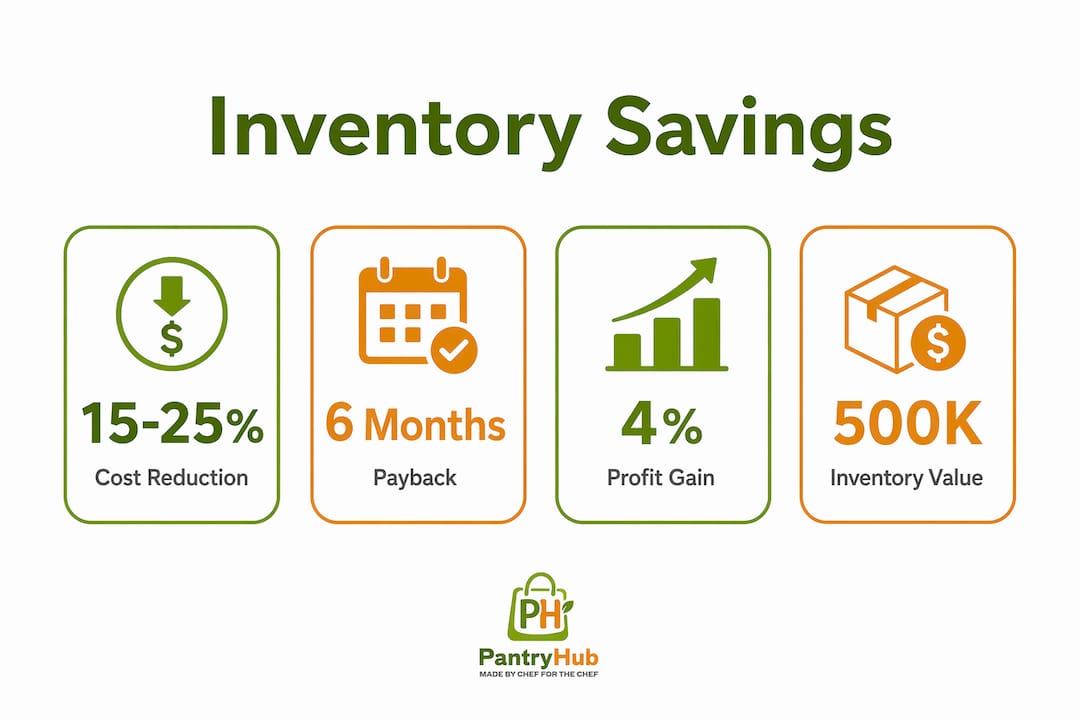
The financial case for tight inventory control is concrete. Implementing inventory management systems reduces operational costs by 15–25%, generating labor savings of A$30,000–A$50,000 and reducing carrying costs by 30–50% for Australian small businesses. Those are not marginal gains. For a café running on a 5–8% net margin, cutting carrying costs by even 20% can be the difference between a profitable quarter and a loss.

Carrying costs include storage, insurance, and depreciation on perishable stock. In hospitality, those costs compound fast because food and beverage inventory spoils. Every case of wine stored past its optimal rotation window, every tray of produce that goes soft before service, represents cash that left the business without generating revenue.
Labor savings come from automation. Manual stock checks take hours each week. When your team counts by hand and records on paper or spreadsheets, errors accumulate and reordering becomes reactive rather than planned. Automated systems set reorder points, flag low stock, and generate purchase orders without a manager having to walk the cool room at 6 a.m.
"Effective inventory control creates financial elasticity by freeing capital trapped in excess stock, enabling reinvestment or debt reduction."
Pro Tip: Start automation with your top five highest-cost ingredients first. Proving ROI on a pilot category takes weeks, not months, and builds team buy-in before a full rollout.
- Carrying costs drop when you hold less excess stock
- Labor hours shrink when reorder points replace manual checks
- Spoilage falls when stock rotation is tracked in real time
- Cash flow improves when capital is not frozen in overstock
What are the consequences of poor inventory control in Australian hospitality?
Poor inventory control does not just create inconvenience. It erodes profit in ways that are hard to trace until the damage is done. Australian wholesalers with 15% excess stock face a direct 4% annual net profit reduction. For a venue turning over A$1 million per year, that is A$40,000 in lost profit from one inefficiency alone.
The consequences stack up across four common failure points:
- Excess stock and tied-up capital. Overstocking low-turnover items freezes cash that could fund payroll, marketing, or equipment. A bar holding three months of slow-moving spirits is effectively giving an interest-free loan to its supplier.
- Stockouts and lost revenue. Running out of a signature dish ingredient mid-service does not just cost one sale. It damages the guest experience and pushes customers toward competitors. Stockouts caused by poor tracking are entirely preventable.
- Data inaccuracy and shadow spreadsheets. Inventory accuracy below 95% undermines staff trust and causes workers to create their own shadow spreadsheets. Those unofficial records then conflict with the system of record, creating ordering errors and financial discrepancies.
- Cash flow pressure. When capital is tied up in overstock, meeting supplier payment terms becomes harder. Late payments damage supplier relationships and can result in lost credit terms, which further tightens cash flow.
Small to mid-sized venues using spreadsheets are most exposed. A spreadsheet cannot alert you to a discrepancy between what was ordered and what arrived. It cannot flag that your avocado usage spiked 40% this week. Real-time systems can.
How do modern inventory management systems improve efficiency and savings?
Modern inventory platforms do more than count stock. They connect purchasing, finance, and operations into one data stream, which is where the real efficiency gains come from. Automated inventory systems integrated with procurement reduce manual errors, stockouts, and maverick spend while improving real-time insights across finance, operations, and purchasing teams.
One of the most underrated features is cycle counting. Instead of shutting down for an annual stocktake, cycle counting rotates through inventory categories on a rolling schedule. Discipline in recurring cycle counting achieves 98%+ accuracy and eliminates the trust gap that causes staff to work around the system. Annual stocktakes are disruptive and produce a snapshot that is already outdated by the time the count is complete.
Pro Tip: Schedule cycle counts by category on a weekly rotation. Proteins one week, dry goods the next. You will catch discrepancies faster and avoid the chaos of a full annual count.
For Australian hospitality businesses choosing software, the decision often comes down to scale. Xero's built-in inventory system serves businesses well up to 500 SKUs and simple stock needs. Beyond that threshold, or when managing multiple locations, dedicated inventory solutions offering FIFO costing, barcode scanning, and multi-location support become necessary.
| Feature | Accounting software (e.g., Xero) | Dedicated inventory platform |
|---|---|---|
| Stock tracking | Basic, up to ~500 SKUs | Advanced, unlimited SKUs |
| Cycle counting | Not supported | Built-in, rolling schedules |
| Multi-location | Limited | Full support |
| FIFO costing | Not available | Standard feature |
| Supplier integration | Partial | Full procurement workflows |
| Real-time alerts | Not available | Low-stock and variance alerts |
Australian SMBs typically achieve payback on inventory software within about six months through recovered working capital and reduced stockouts. That timeline makes the investment decision straightforward for most venues with more than A$200,000 in annual food and beverage spend.
What practical steps can Australian hospitality managers take right now?
The most effective inventory control strategies in hospitality start small and build discipline before adding technology. Starting with pilot projects in critical categories demonstrates ROI within weeks, which is far more persuasive to ownership than a business case built on projections.
Here is a practical sequence for hospitality managers ready to tighten control:
- Identify your top 20 highest-cost ingredients. These are your priority. Accurate tracking here delivers the fastest financial return.
- Set reorder points for each priority item. A reorder point is the stock level that triggers a purchase order. Setting these removes guesswork and prevents both stockouts and overbuying.
- Run weekly cycle counts on rotating categories. Do not wait for month-end. Catching a variance on Tuesday means you can investigate and correct before the weekend service rush.
- Train staff on data entry discipline. A system is only as accurate as the data going in. Every team member who receives a delivery or transfers stock between sections needs to record it correctly, every time.
- Use mobile stock management tools for on-the-go updates. A kitchen hand counting stock on a tablet during prep time is faster and more accurate than writing on a clipboard and transcribing later.
- Review inventory reports weekly, not monthly. Weekly reporting surfaces trends, like a beverage category running 15% over budget, before they become a P&L problem.
- Establish purchase approval workflows. Require manager sign-off on orders above a set dollar threshold. This single step eliminates most maverick spend in hospitality kitchens.
The cultural shift matters as much as the tools. Inventory accuracy is a team habit, not a software feature. When staff understand that a missed count or an unrecorded transfer creates a real financial cost, compliance improves. Connecting data accuracy to business outcomes, like being able to afford new equipment or maintain staffing levels, makes the message land.
Key takeaways
Effective inventory control is the single most accessible profit lever available to Australian hospitality businesses, and it does not require a full system overhaul to start generating returns.
| Point | Details |
|---|---|
| Cost savings are immediate | Inventory systems cut operational costs by 15–25% and carrying costs by 30–50%. |
| Excess stock destroys profit | Holding 15% excess stock reduces annual net profit by 4% for Australian businesses. |
| Cycle counting beats stocktakes | Rolling cycle counts achieve 98%+ accuracy and avoid annual disruption. |
| Software scale matters | Xero suits businesses under 500 SKUs; dedicated platforms are needed beyond that. |
| Start with pilot categories | Piloting control on high-cost items delivers ROI within weeks, not quarters. |
The hidden cost most hospitality managers never calculate
Most hospitality managers I speak with think of inventory control as a counting problem. Count the stock, match it to the invoice, move on. That framing misses the real issue entirely.
Inventory is a coordination problem between purchasing, receiving, kitchen, and finance. When those four functions do not share the same real-time data, the gaps between them cost money every single day. A chef who does not know what was received this morning over-orders for tomorrow. A manager who cannot see last week's usage data reorders based on gut feel. A finance team reconciling invoices against a spreadsheet that is three days out of date is not doing financial management. They are doing archaeology.
The businesses I have seen turn inventory control into a genuine competitive advantage are not the ones with the most sophisticated software. They are the ones where the team treats data entry as non-negotiable and where managers review inventory reports every week without exception. The technology accelerates what good habits already do.
The other thing worth saying plainly: freeing capital trapped in excess stock is not just a cash flow improvement. It is a growth strategy. A venue that reduces its safety stock by 10% and frees A$50,000 in working capital has options. It can pay down a supplier account, fund a marketing push, or invest in equipment. A venue carrying 15% excess stock has none of those options. The money is sitting on a shelf, slowly expiring.
Start with one category. Build the habit. The financial returns follow.
— Admin
Pantryhub gives Australian hospitality businesses real control over costs
Running a tight kitchen means knowing exactly what you have, what you need, and what it costs, before service starts, not after the month-end reconciliation.
Pantryhub is built specifically for Australian restaurants, cafés, bars, and commercial kitchens. The platform delivers real-time stock visibility, automated low-stock alerts, supplier ordering integration, and reporting tools that surface cost variances before they become P&L problems. It connects directly with accounting platforms used across Australian hospitality, so your finance and operations teams work from the same numbers. For venues ready to move beyond spreadsheets, Pantryhub's hospitality inventory software is purpose-built for the complexity of food and beverage operations at any scale.
FAQ
What does inventory control save for Australian hospitality businesses?
Inventory control saves Australian hospitality businesses on labor, carrying costs, spoilage, and tied-up capital. Businesses that implement inventory management systems typically reduce operational costs by 15–25% and carrying costs by 30–50%.
How quickly do Australian businesses see a return on inventory software?
Australian SMBs typically achieve payback on inventory software within about six months through recovered working capital and fewer stockouts.
What is the financial impact of excess stock in hospitality?
Carrying 15% excess stock reduces annual net profit by 4%. For a venue with A$500,000 in inventory, reducing safety stock by 10% can add A$50,000 to available cash flow.
When should a hospitality business upgrade from Xero to dedicated inventory software?
Xero's built-in inventory works well for businesses with fewer than 500 SKUs and a single location. Once complexity grows beyond that, dedicated platforms with FIFO costing, barcode scanning, and multi-location support become necessary.
What is cycle counting and why does it matter for hospitality?
Cycle counting is a rolling stock count that checks different inventory categories on a regular schedule instead of one annual stocktake. It maintains inventory accuracy above 98% and catches discrepancies before they affect ordering or financial reporting.