

Inventory accuracy is defined as the degree to which your recorded stock levels match what is physically on your shelves. The role of inventory accuracy in restaurant profitability is direct and measurable: restaurants that track stock precisely reduce food waste, control cost of goods sold (COGS), and protect margins that most operators never recover. Industry data shows that weekly inventory cycles can recover 2 to 5 margin points, translating to $10,000 to $40,000 in annual profit for restaurants earning between $500,000 and $2,000,000 in revenue. That is not a rounding error. It is the difference between a profitable year and a break-even one.
How does inventory accuracy drive restaurant profitability?
Inventory accuracy is the foundation of every financial decision a restaurant makes. When your stock records are wrong, your COGS calculations are wrong. Wrong COGS means your menu pricing, purchasing decisions, and profit forecasts are all built on bad data.
Many operators accept 80–85% accuracy as normal. That acceptance is a costly mistake. At that accuracy level, the data noise is too high to isolate whether food costs are rising because of theft, spoilage, portion drift, or supplier errors. You cannot fix what you cannot see.
Accurate stock management turns inventory from a back-office chore into a profit lever. When your records reflect reality, you can negotiate better vendor terms, reduce emergency orders, and price your menu with confidence. Restaurants that treat inventory accounting as a weekly operational discipline, not an annual task, consistently outperform those that do not.

How does inventory accuracy reduce food waste and control costs?
Food waste is one of the largest leakage points in restaurant profitability. Effective inventory management directly reduces food waste and enables more accurate menu costing and vendor negotiations. Without precise tracking, waste hides in plain sight across three main categories:
- Spoilage: Overstocked perishables expire before use. Accurate counts prevent over-ordering.
- Portion drift: Staff unconsciously over-portion when no one is measuring. Variance reports expose this fast.
- Theft: Shrinkage from internal theft is nearly invisible without tight stock records. Frequent counts create accountability.
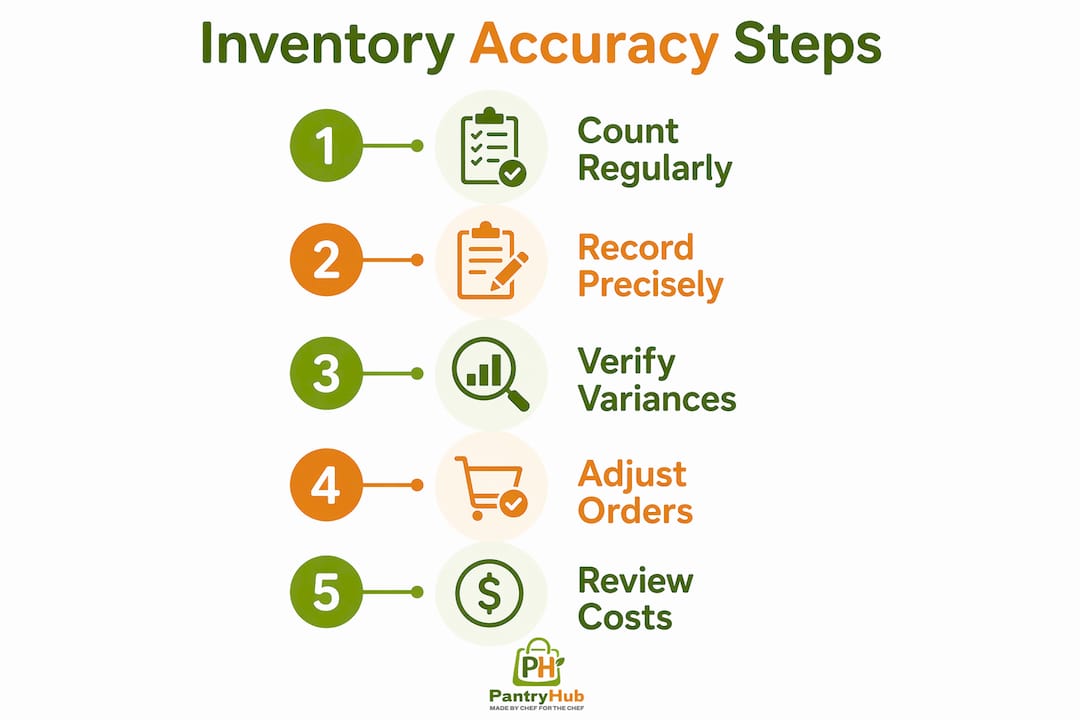
Cycle counting, done weekly or even daily for high-value items, catches these problems early. Inventory visibility prevents overstocking and obsolescence while ensuring sufficient stock to meet demand. That balance lowers carrying costs and eliminates lost sales from stockouts.
Pro Tip: Run a weekly variance report by category, not just by total dollar value. A $200 variance in proteins tells you something very different from a $200 variance in dry goods.
Ordering discipline follows directly from accurate counts. When you know exactly what you have, you order exactly what you need. That precision eliminates the twin costs of over-ordering (spoilage) and under-ordering (emergency purchases at premium prices).
What operational challenges impact inventory accuracy in restaurants?
The most common sources of inventory variance are not mysterious. They are predictable, process-driven failures that repeat until someone fixes the underlying system.
Receiving errors account for 30–40% of inventory variance in restaurants. A delivery arrives short, a case is mislabeled, or a staff member accepts a substitution without logging it. Each of these events creates a discrepancy that compounds over time. Enforcing barcode scanning and purchase order matching at the receiving dock can improve accuracy by 2 to 4 percentage points within 90 days.
Other common failure points include:
- Manual counting mistakes: Tired staff count fast and count wrong. Digital counting tools reduce this risk significantly.
- Data entry errors: Transcribing handwritten counts into a spreadsheet introduces errors at every step.
- No reason codes: When an adjustment is made without tagging a cause, the root problem never gets fixed.
Operations experts recommend tagging every inventory adjustment with a reason code and an owner. This practice shifts the focus from fixing numbers to fixing processes. A spoilage code on a weekly basis tells you whether your ordering is off. A waste code on a specific prep station tells you whether training is needed.
Pro Tip: Assign one person per shift as the inventory accountability lead. Ownership reduces errors faster than any software alone.
Transitioning from monthly counts to frequent cycle counts is the single most impactful process change most restaurants can make. Frequent cycle counting allows root cause tracing to specific deliveries or staff errors within 24 hours. Monthly counts bury problems for weeks.
How can technology and integrated systems enhance restaurant inventory accuracy?
Technology does not replace good process. It makes good process faster and more consistent. The most impactful technology investment for restaurant inventory control is POS integration.
Integrating POS data to automatically adjust stock levels reduces manual labor and human errors, decreasing revenue loss from stockouts and capital tied up in overstock. Every sale that rings through the POS should automatically deduct the corresponding ingredients from your stock records. Without that integration, your counts are always running behind reality.
Here is how technology improves accuracy across the key operational touchpoints:
- POS integration: Automatic stock deductions after every sale eliminate end-of-day manual adjustments.
- Barcode scanning at receiving: Scanned deliveries matched against purchase orders catch discrepancies before stock enters the kitchen.
- Real-time low-stock alerts: Automated alerts prevent both stockouts and panic ordering.
- Variance reporting: Software flags discrepancies by category, location, and time period, pointing directly to problem areas.
- Supplier integration: Direct ordering through the platform reduces transcription errors and speeds up reordering cycles.
| Technology Feature | Primary Benefit | Accuracy Impact |
|---|---|---|
| POS integration | Auto stock deductions | Eliminates daily manual entry |
| Barcode scanning | Verified receiving | Reduces receiving variance by 2–4 points |
| Real-time alerts | Prevents stockouts and overstock | Lowers carrying costs |
| Variance reporting | Identifies problem areas fast | Enables root cause analysis |
| Supplier integration | Faster, accurate reordering | Reduces order errors |
Platforms like Pantryhub are built specifically for this workflow. Pantryhub connects real-time inventory tracking with supplier ordering, POS synchronization, and multi-location visibility in one place. That kind of system view is what separates operators who know their numbers from those who guess at them.
What financial benefits do restaurants realize from improved inventory accuracy?
The financial case for accurate stock management is concrete. Restaurants earning $500,000 annually can recover $10,000 in profit simply by moving to weekly inventory cycles. At $2,000,000 in revenue, that recovery reaches $40,000. These are not theoretical gains. They come from reducing waste, tightening COGS, and eliminating the over-ordering that inflates food costs.
"Increasing inventory accounting frequency to weekly can recover 2 to 5 margin points, translating to $10,000 to $40,000 annual profit for restaurants with revenues between $500,000 and $2,000,000." — KoreFi Blog
The margin improvement shows up in three specific areas. First, accurate COGS reporting gives you a true picture of food cost percentage, which is the single most important number in restaurant financial performance. Second, waste reduction directly lowers the cost of goods without touching menu prices. Third, better forecasting reduces emergency purchasing, which typically carries a 10–20% price premium over planned orders.
| Revenue Level | Margin Points Recovered | Estimated Annual Profit Gain |
|---|---|---|
| $500,000 | 2–5 points | $10,000 |
| $1,000,000 | 2–5 points | $20,000 |
| $2,000,000 | 2–5 points | $40,000 |
Tax reporting also improves. Accurate inventory records produce accurate COGS figures, which flow directly into your profit and loss statement. Operators who rely on estimated or infrequent counts often overstate or understate COGS, creating tax exposure or missed deductions. Precise records protect you in both directions.
What are best practices for restaurant inventory control?
Sustained accuracy requires consistent process, not just good intentions. The restaurants that maintain high accuracy year over year share a common set of practices.
- Count frequently: Weekly cycle counts for most categories, daily counts for high-value proteins and spirits. Monthly counts are too slow to catch problems before they compound.
- Train staff on counting methods: Inconsistent counting technique produces inconsistent data. Standardize units, locations, and counting order across every shift.
- Use reason codes for every adjustment: Every variance needs a cause attached to it. Spoilage, waste, theft, and receiving errors each require different corrective actions.
- Match every delivery to a purchase order: Accepting deliveries without verification is where 30–40% of variance originates. Make PO matching non-negotiable.
- Review variance reports weekly: Data without review is useless. Schedule a weekly 15-minute review of variance by category with your kitchen manager.
- Integrate your systems: Manual data transfer between POS, inventory, and ordering creates errors. Connected systems eliminate that risk.
Pro Tip: Build your food waste reduction review into your weekly manager meeting. Treating it as a standing agenda item signals to staff that it matters.
The best practices above are not complex. They require discipline and ownership, not expensive consultants. The operators who execute them consistently are the ones who see the margin recovery that the data promises.
Key Takeaways
Accurate inventory control is the most direct path to recovering lost margin in a restaurant, and weekly counting cycles are the single fastest way to get there.
| Point | Details |
|---|---|
| Weekly counts recover margin | Moving to weekly inventory cycles can recover 2–5 margin points and $10,000–$40,000 annually. |
| Receiving errors dominate variance | 30–40% of inventory discrepancies originate at the receiving dock; PO matching fixes this fast. |
| Reason codes drive improvement | Tagging every adjustment with a cause and owner turns numbers into process fixes. |
| POS integration removes manual error | Automatic stock deductions after every sale eliminate the largest source of daily data entry errors. |
| Accuracy below 85% obscures root causes | Accepting low accuracy as normal prevents operators from identifying the true source of food cost problems. |
Why most operators underestimate inventory as a profit tool
Most restaurant operators I have worked with treat inventory as a compliance task. They count because they have to, not because they expect it to change their financial results. That mindset is the most expensive mistake in the business.
The operators who genuinely improve their margins do one thing differently. They treat every variance as a question, not just a number to reconcile. A $300 weekly variance in chicken is not just a line item. It is a signal pointing to a receiving error, a prep waste problem, or a portioning issue that will repeat every week until someone investigates it.
The technology argument also gets misunderstood. Operators often think they need a perfect system before they can start improving accuracy. The reality is the opposite. Start with frequent counts and reason codes. The data those practices generate will tell you exactly which technology features will deliver the most value for your specific operation. Buying software before you understand your variance patterns is like buying a GPS before you know where you are going.
The best inventory software for your restaurant is the one your team will actually use consistently. Complexity kills adoption. Simplicity drives compliance. And compliance is what produces the data that protects your margins.
— Admin
Pantryhub gives restaurants the accuracy tools that protect margins
Inventory accuracy does not happen by accident. It requires the right systems working together in real time.
Pantryhub is built specifically for restaurants, cafés, bars, and commercial kitchens that need real control over their stock. The platform connects real-time inventory tracking, barcode scanning at receiving, low-stock alerts, and direct supplier ordering in one place. POS synchronization means every sale automatically updates your stock records, eliminating the manual entry that creates variance. Whether you run one location or several, Pantryhub gives you the visibility to catch problems before they hit your margins. Explore Pantryhub's inventory software and see how it fits your operation.
FAQ
What is inventory accuracy in a restaurant?
Inventory accuracy is the percentage match between your recorded stock levels and what is physically present in your kitchen. Restaurants with accuracy below 85% cannot reliably identify the root causes of food cost problems.
How does inventory accuracy affect restaurant profitability?
Accurate inventory tracking reduces food waste, tightens COGS calculations, and prevents over-ordering. Weekly inventory cycles can recover 2 to 5 margin points, worth $10,000 to $40,000 annually depending on revenue size.
What causes inventory inaccuracies in restaurants?
Receiving errors account for 30–40% of inventory variance. Other causes include manual counting mistakes, missing reason codes on adjustments, and the absence of POS integration for automatic stock deductions.
How often should restaurants count inventory?
Weekly cycle counts are the minimum for most categories. High-value items like proteins and spirits benefit from daily counts. Frequent counting catches discrepancies within 24 hours, enabling faster root cause analysis.
How can technology improve restaurant inventory accuracy?
POS integration, barcode scanning at receiving, and real-time variance reporting each reduce a different category of error. Together, they create a connected system that minimizes manual data entry and surfaces problems before they compound.