

Hospitality inventory management is the process of tracking and controlling physical goods and room availability to maximize revenue, reduce waste, and deliver consistent guest experiences. It covers everything from kitchen ingredients and bar stock to hotel linens, toiletries, and the room nights that expire unsold every night. Unlike retail inventory, hospitality stock control operates across two distinct categories: tangible consumables and perishable room inventory, each requiring different methods and tools. Property management systems (PMS), enterprise resource planning (ERP) platforms, and point-of-sale (POS) systems are the standard technology backbone for managing both. Getting this right directly affects your bottom line and your guests' experience.
What is hospitality inventory management and why does it matter?
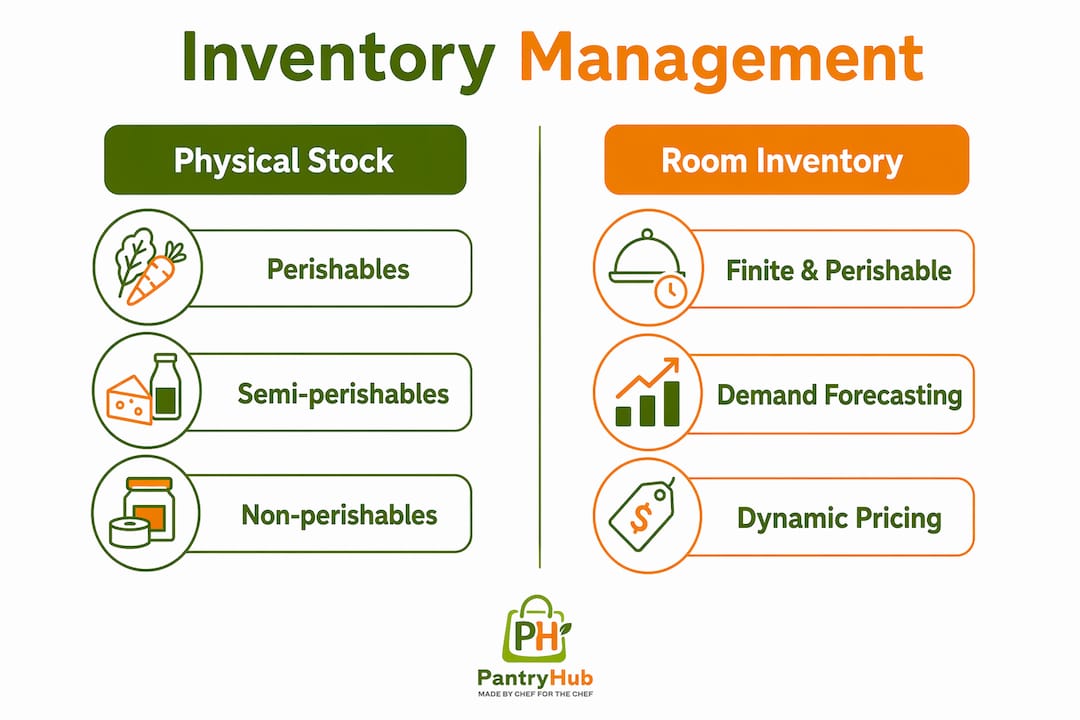
Hospitality inventory management covers two parallel disciplines. The first is physical stock control: managing food, beverages, cleaning supplies, linens, and operating equipment. The second is room inventory management: controlling the availability and pricing of hotel rooms across booking channels to maximize occupancy and revenue.
Both disciplines share one core objective. You align supply with demand to avoid two costly outcomes: running out of stock (which damages service quality) and overstocking (which drives up waste and tied-up capital). The importance of inventory management in hospitality is not abstract. A restaurant that runs out of its signature dish on a Friday night loses revenue and reputation simultaneously. A hotel that oversells rooms faces compensation costs and guest complaints that spread across review platforms.

Effective hospitality stock control also feeds financial accuracy. When your stock records are reliable, your cost-of-goods-sold figures are trustworthy, your purchasing decisions are grounded in data, and your gross profit margins reflect reality rather than guesswork.
How do hospitality businesses manage physical inventory effectively?
Physical inventory in hospitality spans perishables like produce and dairy, semi-perishables like dry goods and wine, and non-perishables like cleaning chemicals and guest amenity kits. Each category demands a different control frequency and rotation discipline.
The foundational tool is the PAR level (Periodic Automatic Replenishment). A PAR level sets the minimum working stock threshold for each item. When stock drops to or below that threshold, a reorder is triggered automatically or flagged for manual action. PAR and FIFO/FEFO methods are the standard practice in hospitality for optimizing stock levels and reducing spoilage. FIFO (First In, First Out) moves the oldest stock first. FEFO (First Expired, First Out) prioritizes items closest to their expiry date, which is critical for fresh food and dairy.
ABC analysis adds another layer of control. It segments your inventory into three tiers:
- A items: High-value, high-movement stock (premium spirits, proteins, specialty produce) that require daily or weekly cycle counts
- B items: Mid-value stock (dry goods, standard wines, cleaning supplies) counted weekly or bi-weekly
- C items: Low-value, slow-moving items (bulk condiments, paper goods) counted monthly
This tiered approach means your team spends time counting what actually matters financially, rather than treating a case of napkins with the same urgency as your prime beef.
Receiving, issuing, and transfer workflows complete the picture. Every delivery must be checked against the purchase order, weighed or counted, and recorded before it enters storage. Every issuance from the storeroom to a kitchen or bar must be logged. For properties managing multi-location inventory across multiple outlets or departments, inter-department transfers also need documentation to maintain accurate location-level stock records.
Pro Tip: Set your PAR levels based on three data points: average daily usage, supplier lead time, and a safety buffer for demand spikes. Review them quarterly, not annually. Seasonal shifts in a restaurant or hotel can make a PAR level set in January dangerously wrong by July.
What makes room inventory unique compared to physical stock?
Room inventory is fundamentally different from physical goods because it is both finite and perishable in a way no food item is. An unsold room night on Tuesday cannot be sold on Wednesday. That revenue is permanently gone. Hotel room inventory must be managed to prevent lost revenue from empty rooms and guest dissatisfaction from overbooking.
The management challenge is balancing two failure modes. Underbooking leaves rooms empty and revenue unrealized. Overbooking creates situations where confirmed guests arrive to find no room available, which triggers compensation costs, loyalty damage, and negative reviews. Neither outcome is acceptable at scale.
Revenue management systems (RMS) address this by combining demand forecasting with dynamic pricing. When occupancy forecasts are high, rates increase to capture maximum revenue per available room. When demand is soft, rates drop to stimulate bookings and fill capacity. Property management systems (PMS) like Oracle OPERA or Mews provide the real-time room availability data that feeds these pricing decisions. Distribution channel management, through online travel agencies (OTAs) like Booking.com and Expedia alongside direct booking channels, adds another layer of complexity. Rate parity, channel allocation, and last-room availability agreements all affect how room inventory is sold and at what price.
Pro Tip: Segment your room inventory by guest type before setting pricing strategy. A corporate traveler booking Monday through Thursday behaves differently from a leisure traveler booking a weekend. Applying the same dynamic pricing logic to both segments leaves revenue on the table.
What technologies support hospitality inventory management?
Technology is the difference between inventory management that works on paper and inventory management that works in practice. The core systems that support hospitality management software integration are PMS, ERP, POS, and dedicated inventory platforms.
Here is how each system contributes:
- PMS (Property Management System): Manages room inventory, reservations, and guest data. Feeds occupancy data into revenue management decisions.
- ERP (Enterprise Resource Planning): Handles procurement, finance, and supplier management. Connects purchasing to accounting for accurate cost tracking.
- POS (Point of Sale): Records sales transactions in real time. When integrated with inventory software, each sale automatically deducts stock from the relevant location.
- Dedicated inventory platforms: Manage physical stock counts, PAR-level alerts, receiving workflows, and waste tracking at the operational level.
Mobile-powered inventory tools integrated with ERP improve cycle counts, receiving accuracy, and reduce phantom stock. Phantom stock is the gap between what your system says you have and what is physically on the shelf. It is one of the most common and costly problems in hospitality stock control.
| System | Primary function | Inventory role |
|---|---|---|
| PMS | Room and guest management | Room availability and occupancy data |
| ERP | Finance and procurement | Purchase orders, supplier invoices, cost reporting |
| POS | Sales transaction recording | Real-time stock deduction per sale |
| Inventory platform | Physical stock control | Cycle counts, PAR alerts, waste tracking |
Real-time data analytics and automated replenishment alerts are the features that separate a modern hospitality inventory system from a spreadsheet. When your system flags a low-stock alert before service rather than during it, you have time to act. When it generates a variance report after every stocktake, you can identify shrinkage patterns before they become a financial problem.
How does inventory valuation affect financial performance?
Inventory valuation is the method your business uses to assign a cost to the stock it holds and the stock it consumes. The method you choose directly affects your reported cost of goods sold (COGS), gross profit, and tax position. Inventory valuation methods like FIFO and Weighted Average affect reported profits and influence hospitality financial decision-making.
The three methods used in hospitality are:
| Valuation method | How it works | Best suited for |
|---|---|---|
| FIFO (First In, First Out) | Oldest stock costs are expensed first | Perishable food, fresh produce, dairy |
| Weighted Average | Average cost across all units in stock | Bar stock, dry goods, indistinguishable items |
| Specific Identification | Actual cost of each specific item | High-value wines, premium spirits, unique items |
FIFO aligns naturally with physical stock rotation in a kitchen. When you rotate produce using FIFO, your accounting valuation matches your operational reality. This alignment matters because it prevents situations where your books show a profit that does not reflect actual food cost performance.
Weighted Average suits bar operations where individual bottle costs vary slightly across deliveries but the product is functionally identical. It smooths out cost fluctuations and simplifies reporting. Specific Identification is reserved for high-value items where the exact purchase cost of each unit is tracked, such as a vintage wine cellar.
Pro Tip: Align your physical rotation method with your accounting valuation method from day one. If your kitchen operates on FEFO but your accounts use Weighted Average, your COGS figures will diverge from operational reality during periods of price volatility. That gap makes cost control decisions unreliable.
What challenges do hospitality operators face in inventory management?
The most common inventory management failures in hospitality are not caused by bad software. Unreliable inventory data results from inconsistent process application, poor timing of stock movement recording, and lack of continuous control. The technology is rarely the problem. The process discipline is.
The specific challenges operators face most often include:
- Delayed recording: Stock is received, issued, or wasted but not logged until the end of a shift or the following day. This creates gaps between physical reality and system data that compound over time.
- Inconsistent cycle counts: Stocktakes happen monthly or only when a problem is noticed, rather than on a rolling schedule. By the time a variance is identified, tracing its source is nearly impossible.
- Shrinkage and unexplained variances: Theft, spillage, over-portioning, and spoilage all reduce stock without a corresponding sale. Without regular cycle counts and variance analysis, these losses accumulate invisibly.
- Uncoordinated processes across departments: A hotel with a restaurant, bar, and room service operation may have three teams managing stock with three different methods, making consolidated reporting unreliable.
The solution to all four challenges is the same: standardize the process, train the team, and count more frequently. A weekly cycle count on A-category items costs less in labor than the shrinkage it prevents. Standardized receiving checklists eliminate the "I thought someone else logged it" problem. And reducing food waste starts with knowing exactly what you have and what you are losing, which requires consistent daily recording rather than monthly reconciliations.
Key takeaways
Effective hospitality inventory management requires combining disciplined physical stock control with dynamic room inventory strategies, supported by integrated technology and consistent operational processes.
| Point | Details |
|---|---|
| Define both inventory types | Physical goods and room nights require separate but connected management approaches. |
| Use PAR levels and rotation | Set PAR thresholds and apply FIFO or FEFO rotation to reduce spoilage and avoid stockouts. |
| Align valuation with operations | Match your accounting valuation method to your physical rotation practice for accurate COGS reporting. |
| Invest in integrated technology | PMS, ERP, POS, and inventory platforms working together eliminate phantom stock and improve decision-making. |
| Fix process before fixing software | Inconsistent recording and infrequent counts cause more inventory failures than any technology gap. |
Where most operators get this wrong
I have worked with enough hospitality businesses to know that the conversation about inventory management almost always starts in the wrong place. Operators ask which software to buy before they have answered a more basic question: does your team actually record stock movements when they happen?
The most expensive inventory system in the world produces garbage data if a chef logs yesterday's waste this morning or a bar manager skips the receiving check because service is about to start. I have seen a city-center hotel with a sophisticated ERP platform and monthly variance reports that were essentially fiction, because the underlying recording discipline was absent. The fix was not a new system. It was a new process, enforced consistently, with weekly counts on high-value items and a clear accountability structure.
The other thing I would push back on is the tendency to treat room inventory and physical stock as completely separate problems managed by separate teams. In a hotel with food and beverage outlets, these two disciplines intersect constantly. Occupancy forecasts should drive food purchasing decisions. A sold-out weekend means your kitchen needs more stock, your bar needs more spirits, and your housekeeping team needs more linen. When revenue management and F&B purchasing are not talking to each other, you end up with a full hotel and an under-stocked kitchen. That is a guest experience failure hiding inside an inventory management failure.
Start with process. Then pick the technology that supports the process your team will actually follow.
— Admin
Take control of your stock with Pantryhub
Managing physical inventory across a restaurant, café, bar, or multi-location group is significantly easier when your tools are built for the job. Pantryhub is a hospitality inventory platform designed specifically for commercial kitchens and F&B operations, with real-time stock tracking, low-stock alerts, supplier ordering, and multi-location visibility built in.
Pantryhub integrates with your existing POS and supplier systems to give you a single source of truth for stock levels, waste tracking, and reorder timing. Whether you are managing hotel F&B inventory across multiple outlets or running a single café, Pantryhub gives you the data you need to make faster, more profitable purchasing decisions. You can also use it to support restaurant digitization efforts across your operation. Built by chefs, for chefs.
FAQ
What is hospitality inventory management?
Hospitality inventory management is the process of tracking and controlling physical goods (food, beverages, linens, supplies) and room availability to reduce waste, prevent shortages, and maximize revenue. It combines operational stock control with demand-driven room inventory strategies.
What are PAR levels in hospitality?
A PAR level (Periodic Automatic Replenishment) is the minimum stock quantity that triggers a reorder for a given item. Setting accurate PAR levels prevents both stockouts during service and overstocking that leads to spoilage.
What is the difference between FIFO and FEFO in stock rotation?
FIFO (First In, First Out) moves the oldest stock first based on purchase date. FEFO (First Expired, First Out) prioritizes items closest to their expiry date. FEFO is the preferred method for fresh food and dairy where expiry dates vary between deliveries.
Why does inventory valuation method matter for hospitality businesses?
The valuation method you choose, whether FIFO, Weighted Average, or Specific Identification, directly affects your cost of goods sold and gross profit figures. Misalignment between your physical rotation practice and your accounting method produces COGS figures that do not reflect actual operational performance.
What causes inventory variances in hotels and restaurants?
Inventory variances are most commonly caused by delayed stock movement recording, inconsistent cycle counts, shrinkage from theft or over-portioning, and uncoordinated processes across departments. Fixing the recording discipline and increasing count frequency resolves most variance problems before they require a technology change.