
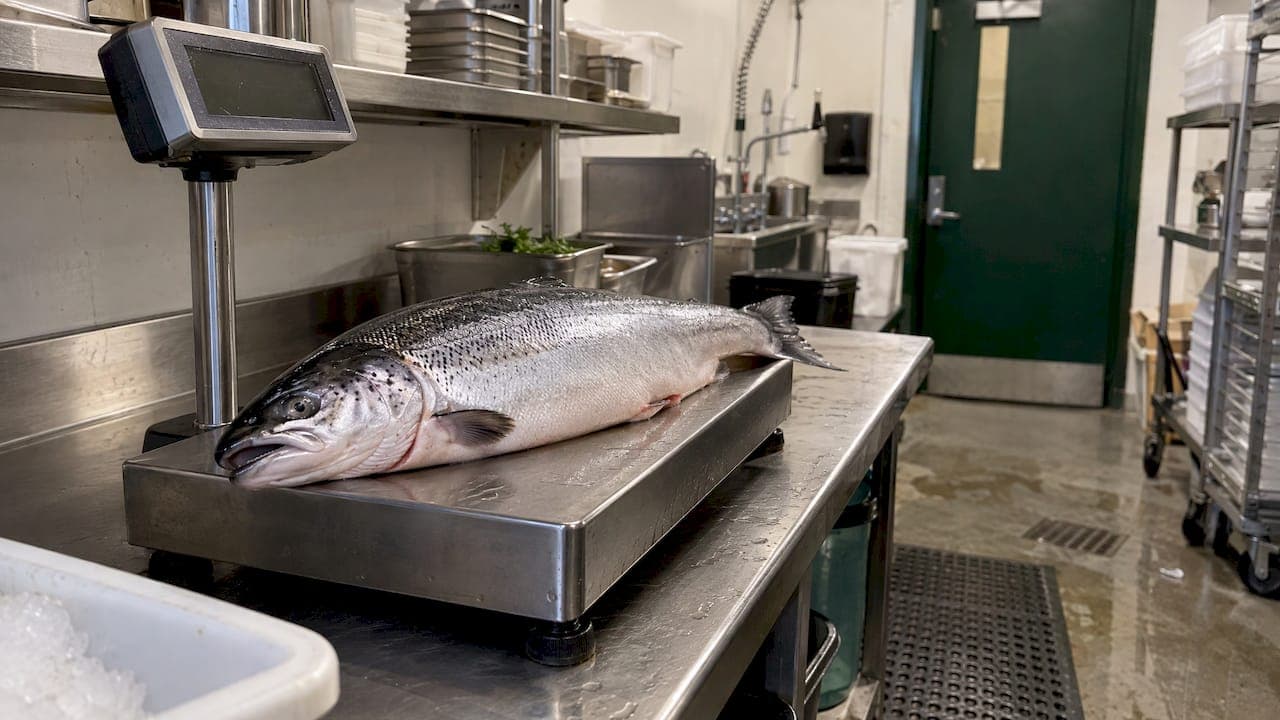
Catch weight management means tracking two numbers for every variable-weight item you buy: how many units you have (cartons, whole fish, sides of salmon) and what they actually weigh (kilograms). Do that at receiving, keep both numbers through storage and use, and your invoices, stock value and plate costs stop drifting apart. This guide shows how to set it up in a restaurant, café, pub or club kitchen, with no ERP system required.
TL;DR
- Catch weight items are bought by count but priced by actual weight, so you need a count unit and a weight unit for each one.
- Weigh at goods receipt and record the real kilograms against the invoice. Never rely on the label or an average.
- Convert recipes and portions to grams so usage deducts from stock in the same unit you cost in.
- Count catch weight lines more often than dry goods, because they carry the highest dollar value per shelf space.
- Choose inventory software that handles multiple units of measure per item and keeps supplier ordering linked to your counts.
Table of Contents
- What catch weight means in a kitchen
- Why two units of measure matter
- How variable weights hit your margins
- A practical catch weight workflow
- Worked example: a 20 kg seafood order
- Counting catch weight lines
- What to look for in inventory software
- Mistakes to avoid
- Our perspective
- Put catch weight under control with PantryHub
- FAQ
- Sources
What catch weight means in a kitchen
Catch weight is the actual measured weight of a single product unit, and it varies naturally from one unit to the next. A whole salmon, a lamb shoulder or a wheel of cheese will never weigh exactly what the order sheet says. A fixed-weight item is different: a 1 kg bag of rice or a 2 L bottle of oil is sold at a predetermined weight and price, while a catch weight item is priced on its individually measured mass.
That is why people searching for "variable weight items" and "catch weight inventory" are describing the same problem. You order "2 x 5 kg boxes of barramundi fillets" and the supplier delivers two boxes that weigh 5.4 kg and 4.8 kg. The invoice charges by the kilo. Your stock system, if it only counts boxes, says you have two.
Typical catch weight lines in a hospitality venue:
- Fresh and frozen meat: beef primals, lamb legs, pork bellies, whole chickens
- Seafood: whole fish, fillets sold by the box, prawns by the carton
- Cheese: wheels, blocks and logs cut from a larger piece
- Deli items: hams, smallgoods, cured meats
- Fruit and veg sold by the tray or bag with a nominal weight
Each of these shows up in the kitchen as a countable thing but is bought, valued and used by weight.
Why two units of measure matter
The core of catch weight management is simple. A count unit handles the stock, and a weight unit drives pricing, inventory valuation and other stock transactions. Enterprise systems formalise this with dual units of measure, and the same logic works in any kitchen stock system.
If you track only one unit, you lose something either way:
- Count only: You know you have six boxes, but not whether that is 30 kg or 34 kg. Your stock value is a guess, and so is your food cost.
- Weight only: You know the kilograms, but you cannot see how many cartons are in the coolroom, so ordering and receiving get harder.
Tracking both lets you price products according to their actual weight and avoid overpaying or losing money. It is the same discipline a supplier needs, applied to the buying side of the counter.
How variable weights hit your margins
The cost of ignoring catch weight rarely shows up as one big loss. It leaks out in small, repeated gaps.
Purchasing and invoices
When you order by the carton and are billed by the kilo, the invoice total can differ from what you expected even when the supplier is honest. If nobody weighs the delivery, you cannot check the invoice, and short-weight or over-weight cartons go unnoticed. Variable weights mean both units must be tracked to support pricing, inventory valuation and costing across purchasing, production and sales.
Stock valuation
A stocktake that multiplies box count by a standard weight and a standard price looks tidy but hides error. Ten boxes at a nominal 5 kg is 50 kg on paper. If the real average is 5.3 kg, you are under-valuing stock. If it is 4.7 kg, you are overvaluing it and your gross profit looks better than it is.
Portion costing
A recipe that calls for 180 g of rump per serve needs a cost per gram. That cost per gram comes from the invoice weight and price, not from the carton count. Using a stale or averaged figure makes every plate cost wrong by the same percentage, and the error repeats on every sale.
Waste and variance
When the numbers on paper do not match the coolroom, the gap gets blamed on waste, theft or portioning. Often it is simply that the weight was never recorded properly at the door. Our guide to common inventory mistakes restaurants make covers this kind of unexplained variance in more detail.
A practical catch weight workflow
You do not need a warehouse management system. You need a repeatable routine at five points.
1. Set up the item with two units
For each catch weight product, define a count unit (carton, whole fish, piece) and a weight unit (kg or g). Add a nominal weight for the count unit, such as 5 kg per carton. A nominal or standard weight lets a system check whether a recorded actual weight falls within tolerance, which flags a carton that is far lighter than it should be.
2. Order in the unit the supplier sells
Place the order the way your supplier takes it, usually by carton or by the kilo. Keep your par levels in a unit you can act on. For a protein, that is often kilograms on hand, with a note of how many cartons that equals.
3. Weigh at goods receipt
This is the step that matters most. Put the delivery on a scale, compare the weight to the delivery docket and invoice, and record the real figure. Recording actual weight at goods receipt helps stop inventory weight estimates drifting away from actual stock.
While the delivery is on the bench, do your food safety checks too. A clear walk-through of receiving fresh meat and fish pairs well with weighing, because both happen at the same moment and with the same product. Check temperature and condition, then weigh, then put away. Rejected or short-weight stock should be noted on the docket before the driver leaves.

4. Store with the real weight attached
Label cartons or tubs with the received weight and date. When a carton is broken down into smaller portions, record the weights of the portions so the original figure does not become fiction. A disciplined approach keeps each unit's catch weight aligned with the physical count, using real data rather than approximate or average weights.
5. Deduct usage in grams
Recipes should deduct in the same weight unit you cost in. If your recipe says "1 piece" and your stock is in kilograms, you will see phantom variance every week. Our article on converting recipes to ml and grams walks through the setup, and tracking ingredient usage from the recipe first shows how usage flows into stock.
Worked example: a 20 kg seafood order
Say a café orders four 5 kg boxes of barramundi fillets. The supplier charges per kilo.
| Box | Nominal weight | Weighed at receipt | Difference |
|---|---|---|---|
| 1 | 5.0 kg | 5.2 kg | +0.2 kg |
| 2 | 5.0 kg | 4.9 kg | -0.1 kg |
| 3 | 5.0 kg | 5.3 kg | +0.3 kg |
| 4 | 5.0 kg | 4.8 kg | -0.2 kg |
| Total | 20.0 kg | 20.2 kg | +0.2 kg |
The count says four boxes. The weight says 20.2 kg. Your invoice should bill 20.2 kg, and your stock should show 20.2 kg on hand, not 20. If you cost a 160 g portion from the invoice price per kilo, you get a plate cost that matches what you actually paid. Multiply that small 0.2 kg difference across every delivery in a year and it adds up to real money, in either direction.
Now imagine the supplier shipped 19.2 kg and billed for 20. Without a weigh-in at the door, that shortfall disappears into "usage".

Counting catch weight lines
Catch weight proteins and cheeses are high-value, so they deserve a tighter counting routine than flour or napkins. A few habits help:
- Count them on a short, frequent cycle instead of waiting for the monthly stocktake. Our cycle counting guide for restaurants explains how to rotate high-value items through the week.
- Weigh partial cartons and open portions during the count rather than estimating by eye.
- Keep your count sheet in the order of the coolroom shelves. A stock count sheet built for restaurants saves time and reduces missed lines.
- Track levels daily for the lines that move fastest. Daily stock tracking in hospitality is realistic when counts are quick and on a phone or tablet.
After each count, reconcile what the system says against what you found. A simple inventory reconciliation process with a checklist and a few KPIs gives you a consistent way to investigate gaps rather than argue about them.
What to look for in inventory software
Spreadsheets can handle catch weight if you are disciplined, but they strain under multiple suppliers, multiple venues and several staff entering numbers. When you assess software, look for the following.
- Multiple units of measure per item. You want software that supports multiple units of measure and automates weight capture and weighing where possible.
- Actual weight at receiving. Systems that record actual weights as goods are received reduce manual effort and errors.
- Recipe costing in grams. Costs per gram should flow from invoice data into recipes, so menu margins update when prices change.
- Supplier ordering tied to stock. Orders should start from par levels and current counts, not from memory.
- Mobile counting. Your team counts in coolrooms and storerooms, not at a desk.
- Multi-venue visibility. If you run more than one site, you need the same item set up once and counted everywhere.
- GST-ready reporting and AUD pricing, so your numbers line up with how Australian businesses actually report.
For a wider look at what is on offer, see our overview of digital stocktake tools in Australia. If you run a bar or pub with heavy kitchen volume, our page on bar inventory software covers pour cost and stocktake as well.
Mistakes to avoid
- Using the label weight as the truth. The label is nominal. The scale is the record.
- Averaging. An average weight per carton is fine for ordering estimates, but it should not replace the real figure in your valuation.
- Skipping partial cartons. Half-used boxes are where most stock-value error hides.
- Mixing units. Buying in kg, counting in cartons and costing in portions without conversion creates variance that looks like waste.
- Not checking the invoice. If the weight at the door never reaches the accounts, you are paying on trust.
- Treating every item the same. Not everything needs a scale. Focus on proteins, seafood and cheese first, then extend to other lines if they are costly.
For multi-outlet operations such as hotels, where food and beverage spans several kitchens, the same discipline applies. Our piece on hotel F&B inventory management in Australia shows how to scale it.
Our perspective
We built PantryHub by chefs for chefs, so we have stood at the back door with a delivery docket in one hand and a scale in the other. Catch weight is not an exotic problem. It is Tuesday morning.
Our view is simple: the most accurate food cost starts at receiving, and the best system is the one your team will actually use at 6 am. That means mobile-first counting, recipes that cost in grams and supplier ordering that starts from what is really on the shelf.
We design PantryHub for Australian venues, with AUD pricing, GST-ready reporting and local support. Whether you run one café or a group of restaurants, we want your stock, your orders and your recipe costs to talk to each other, so variable weights stop being a mystery and become a number you can manage.
the author
Put catch weight under control with PantryHub
PantryHub is an all-in-one inventory and ordering platform for restaurants, cafés, bars and commercial kitchens. It gives you real-time stock tracking, low-stock alerts, supplier ordering, recipe and pricing standardisation, and waste and cost reporting across one or many venues. Our hospitality inventory software page shows how it fits together.
Plans are published on our pricing page: Starter is $39 per month, Regular is $69 per month and Pro is $99 per month, all in AUD. You can start your free trial and set up your first few proteins and cheeses to see how ingredient-level tracking works in your own kitchen. For a deeper look, read our guide to ingredient-level stock tracking for restaurants.
FAQ
What does catch weight mean?
Catch weight is the actual weight of an individual product unit, which varies from unit to unit. It applies to items like meat, seafood and cheese that are handled by count but priced by weight. Each unit gets its own measured weight rather than a fixed label weight.
What is the difference between catch weight and fixed weight?
Fixed-weight items have a consistent, predetermined weight and a set price, such as a 1 kg packet of pasta. Catch weight items fluctuate in weight and are priced on each item's measured mass. That is why they need a weight recorded at receiving.
Do I need special software to manage catch weight?
Not to start. A scale, a receiving routine and a spreadsheet with a count column and a kilogram column will get you moving. As your supplier list, menu and venue count grow, inventory software that supports multiple units of measure saves time and reduces entry errors.
Which items should I weigh first?
Start with your highest-value lines: beef, lamb, seafood and cheese. They carry the largest dollar impact per delivery, so a weigh-in at the door pays back fastest. Extend to deli items and produce once the routine is habit.
How often should I count catch weight stock?
More often than dry goods. Many kitchens count proteins and cheese weekly or even daily on a rotating basis, and do a full stocktake less often. Match the frequency to how fast each line moves and how much it costs.
Sources
- AEB: What is catchweight management
- Infor M3: Catch Weight Management
- Local Line: Catch Weight vs Fixed Weight
- NexTec: How to Manage Catch Weight
- Aptean: Catch Weight introduction
- Beyond Cloud Consulting: Catch Weight for NetSuite