
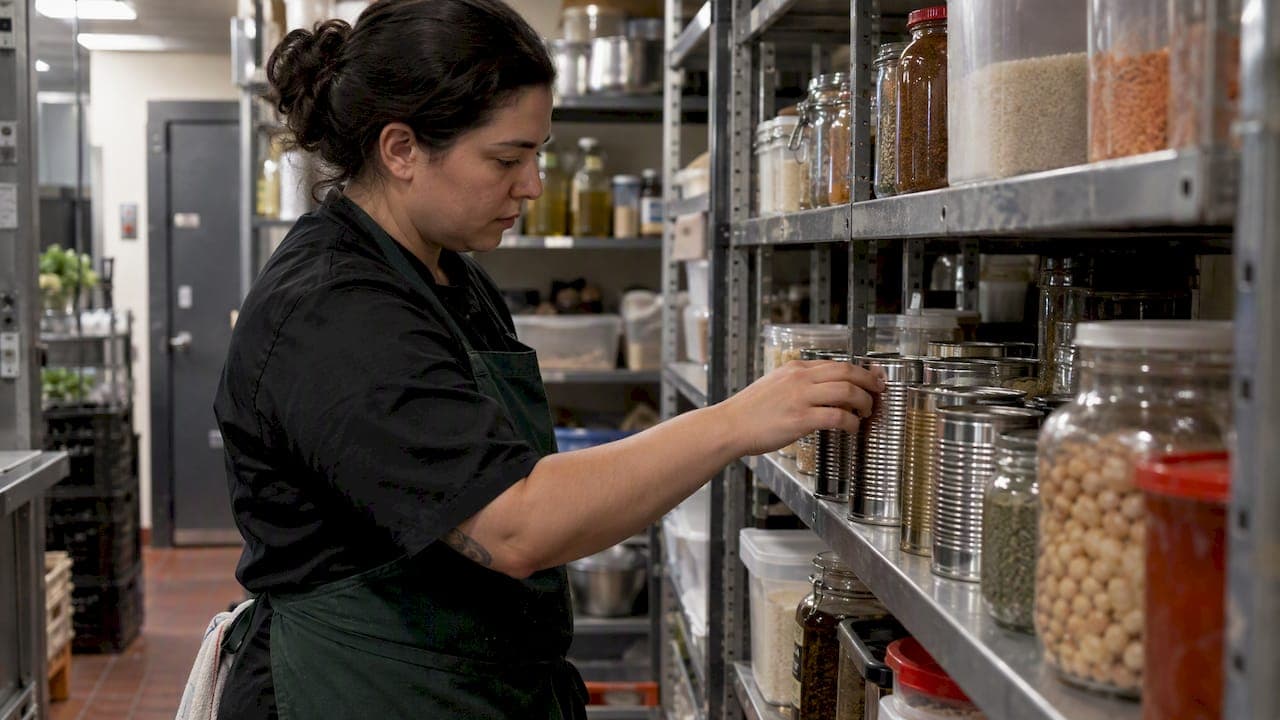
Cycle counting means counting a small, rotating slice of your stock on a regular schedule instead of shutting down to count everything at once. In a restaurant, café, pub or club, that means checking your most expensive and fastest-moving items weekly (or even daily), your mid-value items fortnightly, and your stable dry goods monthly. You find problems while they are small, and you order from real numbers instead of guesses.
This guide covers what to count and how often, a step-by-step routine you can run on a Tuesday afternoon, how to deal with variances, and the one situation where cycle counts do not replace a full stocktake.
TL;DR
- A cycle count checks a selected group of items or one storage area on a repeating schedule. A stocktake counts everything at a set point in time. You need both, for different jobs.
- Start with an ABC-style schedule: high-value and high-risk perishables most often, fast-moving consumables next, low-value dry goods least.
- Count in the same units you buy and cost recipes in, log deliveries, transfers and waste during the count, and code every variance instead of quietly adjusting it.
- Keep your full stocktake as at 30 June for EOFY, and for a sale of the business or an audit.
- Software that keeps a running (perpetual) record makes counts faster and variances easier to trace. A spreadsheet can still work for a small venue.
Table of Contents
- Cycle count vs stocktake: what each one is for
- What to count, and how often
- A cycle count routine you can run this week
- Count with food safety in mind
- Variances: find the cause, do not just fix the number
- Spreadsheet or software?
- What we have seen: our perspective on cycle counting
- When you still need a full stocktake
- Start counting with PantryHub
- A sample first month
- FAQ
- Sources
Cycle count vs stocktake: what each one is for
The two are often mixed up, and the difference is about scope and purpose.
| Cycle count | Full stocktake | |
|---|---|---|
| What is counted | A selected group of items or one storage area | All relevant stock |
| When | On a repeating schedule, during normal trade | At a defined point in time |
| Main job | Catch variances early, tighten ordering | Complete valuation and reconciliation |
| Typical rhythm | Daily, weekly or fortnightly by item group | Monthly or quarterly, plus year end |
This split follows Australian government guidance on inventory, which describes periodic systems (counted by hand, records updated manually) and perpetual systems (records updated as purchases and sales happen), and notes that most businesses run stocktakes monthly or quarterly.
The practical point: a perpetual record tells you what the system thinks is on the shelf. A count tells you what is actually there. Cycle counting is how you keep the two honest with each other between the big counts.
What to count, and how often
Do not count whatever is easiest to reach. Count what costs you the most when it goes wrong.
An ABC-style schedule is a sensible starting point for any Australian venue, from a fish and chip shop to a multi-site pub group:
- A items (count most often): high-value or high-risk stock. Think proteins, seafood, oils, spirits, coffee beans and fast-moving packaging. These are where a small percentage error is real money.
- B items (count fortnightly or so): fast-moving consumables such as dairy, produce, beer kegs and takeaway packaging.
- C items (count monthly): low-value, stable dry goods like flour, tinned goods and cleaning supplies.
Research comparing count prioritization methods in retail found that different prioritization rules detect different problems. In practice, that means counting high-activity and historically inaccurate items most often, then also doing a separate check on items the system says you have little of, because those can hide unrecorded stock-outs or wrong records.
Adjust the schedule to your venue
The same ABC list will not suit every kitchen. Tune it to:
- Supplier lead time. If your seafood arrives daily, a weekly count is plenty. If a specialty item takes two weeks to arrive, you need to know you are running low well before it runs out.
- Service volume. A busy Friday-to-Sunday pub kitchen burns through stock faster than a weekday café.
- Shelf life. Short-life perishables need frequent checks for use-by dates as well as quantity.
- Theft and loss exposure. Spirits, steaks and anything portable deserve a tighter loop.
The government guidance also recommends setting reorder points from usage, delivery time, seasonal demand and supplier reliability. Its example is simple: an item selling 10 units a week with a two-week delivery time gives a reorder point of 20 units. That is an illustration, not a universal restaurant formula, but the logic carries over. Your count gives you the usage data to set those numbers properly.
A cycle count routine you can run this week
This sequence follows the same logic as the business.gov.au stock-control guidance, adapted for a working kitchen.
- Prepare the count list. Pick today's item group (for example, walk-in fridge proteins and dairy). Print it or load it on a tablet in storage order, so the counter walks the room once.
- Set a count window and log movements. Pick a quiet time, such as mid-morning before prep. Any delivery, transfer, waste or staff meal that happens during the window gets written down, so it is not counted twice or missed.
- Count by storage zone. Work one shelf or one fridge at a time. Do not count from memory or from the invoice.
- Count in purchasing and recipe units. If you buy a 5 kg bag and cost your recipes per 100 g, decide up front how partial bags are recorded. Mixed units are the biggest source of false variances.
- Record condition as well as quantity. Separate sellable, opened, quarantined and expired stock. Note damaged packaging and items close to use-by.
- Compare with the system. Check the physical count against what your records say should be there.
- Investigate variances. Look at the biggest dollar gaps first, not the biggest unit gaps. A 2 kg shortfall in scotch fillet matters more than 20 missing lemons.
- Adjust with a reason. Whoever is authorized to change the record enters a cause code (see below).
- Set the next count date. Tomorrow's group, next week's group, or a recount if the gap was large.
A group of 15 to 30 items should take well under an hour for one person. If it takes longer, the list is too long or the storage is not organized to match it.
Count with food safety in mind
A count is also your regular chance to look at what is sitting in the store. The national training unit SITXINV006, Receive, store and maintain stock, covers checking deliveries, storing and rotating stock, and maintaining its quality, including storing perishables correctly. The older kitchen supplies unit, SITHCCC003A, applies to restaurants, hotels, clubs and other catering operations and covers receiving and storing kitchen supplies.
So while you are counting, ask four questions about each item:
- Is it in date?
- Is it stored correctly and at the right temperature?
- Is it rotated first in, first out (FIFO)?
- Is it protected from contamination, spoilage and pests?
Spoiled stock gets disposed of safely and recorded as waste. It does not get left on the shelf to inflate your numbers.
Variances: find the cause, do not just fix the number
The most common mistake is the quiet adjustment: the count says 8 kg, the system says 11 kg, someone types 8 and moves on. You have corrected the record and learned nothing.
Code every variance to one of these causes:
| Cause code | What it usually means |
|---|---|
| Receiving error | Delivered short, wrong item or unit, invoice not matched |
| Waste | Spoilage, spills, trim, over-prep, returns to the bin |
| Transfer | Stock moved between kitchens, bars or sites and not logged |
| Recipe or portion issue | Portions running heavy, recipe not matching reality |
| Theft | Unexplained loss in high-risk items |
| Unrecorded usage | Staff meals, comps, tastings, function stock |
After a few weeks, patterns show up. If the same item is short every Monday, look at weekend receiving. If one bar's spirits run short and the other's do not, look at pour practice or transfers. This is where cycle counting pays for itself.
The count-window trap
The most common operational trap is counting while deliveries, prep transfers, waste and staff meals are still being posted. A count taken mid-delivery will show a variance that is not real, and a real one can be masked. Fix it with a defined window and a simple rule: anything that moves during the window gets logged.

Spreadsheet or software?
Be honest about your venue. A single café with 60 stock lines can run cycle counts from a spreadsheet and a clipboard. It works as long as someone keeps it up.
The pain starts when you add a second site, a bigger menu, or a kitchen team that rotates. Then duplicate entry, version confusion and missed counts creep in. The government guidance notes that inventory software or point-of-sale (POS) systems can update records automatically after buying or selling, and that reorder alerts reduce guessing, over-ordering and shortages.
When you compare systems, check that they can:
- Hold your items in purchasing and recipe units.
- Let you build count lists by storage area or by item group.
- Show expected stock against counted stock, with a reason code for each gap.
- Link purchases, sales and waste so the expected figure is credible.
- Work on a phone, because counting happens in the walk-in, not the office.
- Report in AUD with GST in mind.
Drinks are a good example. If your fridges and bar are where stock quietly walks out, it helps to understand how smart cooler systems record what is taken and sold, because the principle is the same: a running record you can check against a physical count. If you want a wider look at the field, see our guide to the best inventory systems for Australian restaurants.
What we have seen: our perspective on cycle counting
PantryHub is built by the chef for the chef, so we start from the kitchen, not the spreadsheet. Here is how we see cycle counting.
Counting is only worth it if it changes a decision. If a count does not change what you order, how you portion or who you talk to about a loss, it is paperwork. We would rather you count 20 items that matter every week than 400 items once a quarter.
Keep two rhythms. Frequent cycle counts give you visibility. A complete, dated stocktake gives you valuation and year-end records. Treating them as interchangeable creates reconciliation headaches you do not need.

Make it a five-minute habit, not a Sunday-night project. That is why we built PantryHub mobile-first, with low-stock alerts, team access controls and supplier ordering in one place. The aim is to bin the spreadsheets and let the count flow straight into your next order. If you want to see what that saves, read what inventory control saves Australian hospitality businesses.
Silent margin leaks are usually small and repeated. A bit of over-portioning, a short delivery nobody checked, an unlogged transfer. None of them shout. A regular count is how you hear them.
— Admin
When you still need a full stocktake
Do not let rolling cycle counts replace a complete stocktake at the points where you need a full valuation.
Restaurant & Catering Australia's EOFY checklist for food business operators, dated 13 May 2026, tells operators to complete the stocktake as at 30 June and make sure valuations are accurate. A full count is also the right call when:
- you are buying or selling a venue or changing ownership;
- you are preparing for an audit;
- you are setting up a new system and need a trustworthy opening baseline.
A good rhythm is cycle counts all year, so the 30 June count is a confirmation rather than a surprise. Your accountant is the right person to confirm exactly what your records need to show for tax.
Start counting with PantryHub
If you want cycle counts, par levels and supplier ordering in one place, PantryHub is made for Australian hospitality: AUD pricing, GST-ready reporting, local support and a platform you can use from your phone. It suits a single café or a multi-site group, with plans at Starter A$39 per month, Regular A$69 per month and Pro A$99 per month. You can start a free trial and run your first count on the same day. We also have local pages for operators in Melbourne, Sydney, Adelaide and Perth, and an overview of our hospitality inventory software.
A sample first month
If you are starting from nothing, here is a simple plan.
Week 1: Baseline. Do one full count of everything and fix your units. Tag each item A, B or C by dollar value and risk.
Week 2: Start the A items. Count your top 15 to 20 high-value lines twice this week. Do not chase every gap yet. Just code them.
Week 3: Add B items and look for patterns. Review the codes. Which cause appears most? Fix that one first, whether it is receiving checks or portion control.
Week 4: Tighten ordering. Use what you have learned to set or adjust reorder points for your A and B items. Add C items to a monthly slot.
By the end of the month you will have a routine, a short list of real causes, and numbers to order from. You can find more kitchen-level ideas on our restaurant inventory blog.
FAQ
How do you do cycle counting in a restaurant?
Pick a defined group of items or one storage area, set a count window, and count by zone in your purchasing and recipe units. Compare the result with your records, code each variance by cause, and set the next count date. Repeat on a rotating schedule, with high-value and perishable items counted most often.
What is the difference between a cycle count and a stocktake?
A cycle count checks a selected group of items or an area on a repeating schedule during normal trade. A stocktake is a physical count of all relevant stock at a defined point. Cycle counts catch variances early, and stocktakes give a complete valuation, such as for 30 June.
How often should a restaurant count its inventory?
It depends on the item. Count high-value, high-risk and perishable items weekly or more often, fast-moving consumables about fortnightly, and stable dry goods monthly. Most businesses run full stocktakes monthly or quarterly, so cycle counts sit between those.
Can cycle counting replace the end-of-financial-year stocktake?
No. Restaurant & Catering Australia advises completing your stocktake as at 30 June with accurate valuations. Cycle counts make that count smoother, but they do not replace a complete, dated one. Check with your accountant for what your records need to show.
Sources
- Manage your inventory, business.gov.au
- SITXINV006 Receive, store and maintain stock, National Training Register
- SITHCCC003A Receive and store kitchen supplies
- Evaluating Count Prioritization Procedures for Improving Inventory Accuracy in Retail Stores
- EOFY Checklist for Food Business Operators, Restaurant & Catering Australia