
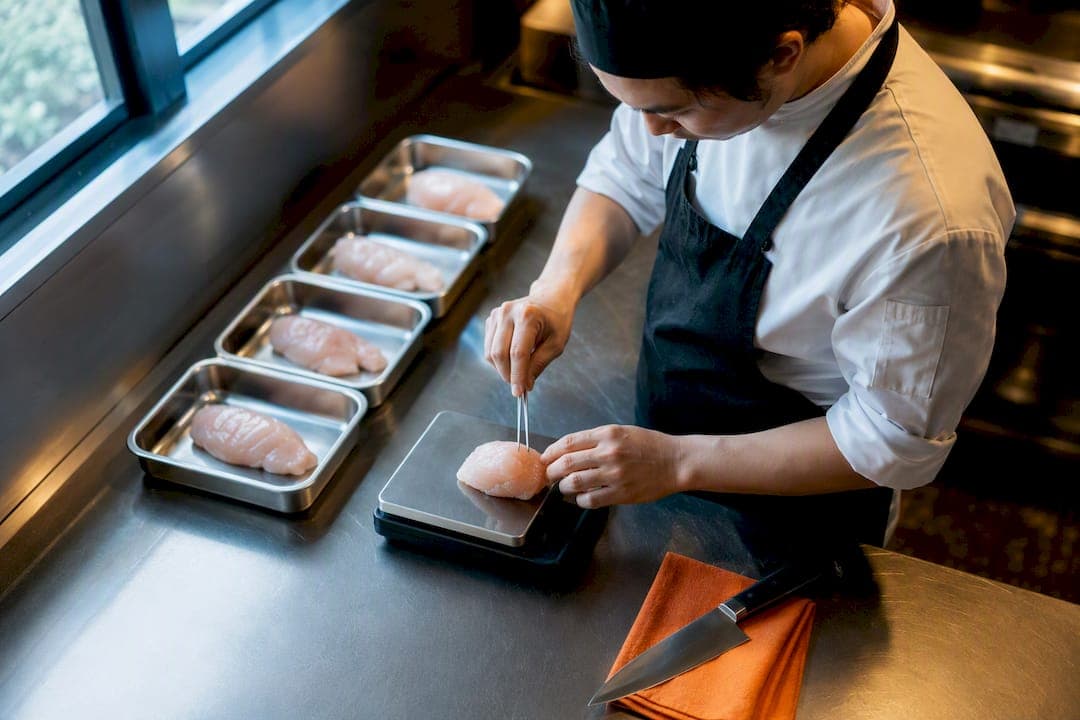
Standardize every high-volume dish to an explicit weight or volume target, hand your line cooks a measuring tool instead of a guess, and track the results for two weeks before you scale. That single move lowers food cost percentage, shrinks plate waste, and makes every plate leaving the kitchen look like the one before it. Platforms like PantryHub exist to help you enforce that standard without adding paperwork to your shift.
TL;DR:
- Standardizing portions with measured tools reduces food costs, minimizes plate waste, and ensures consistent presentation across dishes.
- Using calibrated scales, ladles, and recipe cards during prep improves adherence to portion targets and simplifies training.
- Offering reduced-size entrées at a proportional price can increase margins and attract consumers interested in flexible portion options.
- Tracking KPIs like food cost percentage, portion variance, and plate waste helps measure progress and identify areas needing adjustment.
- Linking recipe portions directly to inventory systems automates stock depletion, preventing margin leaks and streamlining cost control.
Table of Contents
- Why Portion Control Matters for Food Cost, Waste, and Consistency
- Practical Portion-Control Methods and Tools for the Kitchen
- Menu Sizing, Pricing, and Rollout Strategies for Flexible Portions
- Staff Training, SOPs, and Audits to Lock in Consistency
- KPIs and Simple Measurement Methods to Track Results
- How Inventory and Recipe Systems Close the Loop Between Portions and Cost
- Running a Two-Week Portion-Control Pilot
- A Faster Way to Connect Portions to Your Bottom Line
- Sources
Why Portion Control Matters for Food Cost, Waste, and Consistency
An extra ounce of protein on every plate sounds trivial until you multiply it by 200 covers a night. A single-ounce overage on a $12 protein cost, repeated across a busy dinner service, quietly erodes your food cost percentage by a point or more, and most operators never see it happen because nobody is watching the ladle.
That is the quiet math behind ReFED and Datassential's modeling, which estimates that offering multiple portion sizes across the foodservice sector could cut 2.35 million tons of food waste a year and save the industry roughly $547 million. That is not a rounding error. It is the collective weight of thousands of kitchens over-plating by habit rather than by design.
The clinical evidence backs the same conclusion at the plate level. A 2024 feasibility pilot on standardized restaurant portions found that reduced-size entrées, capped around 700 calories for lunch and dinner, were both operationally workable and well received by diners, accounting for a notable share of entrées selected once offered. A separate worksite and restaurant trial measured plate waste dropping from 77 grams to 45 grams per plate when reduced-size options were on the menu, alongside a meaningful drop in energy intake.
The number that should get your attention: Restaurants that add flexible portion sizes to the menu are part of a sector-wide shift ReFED and Datassential value at roughly $547 million in annual savings, driven mostly by less food hitting the trash after it has already been cooked.
None of that savings shows up automatically. It shows up when a kitchen decides that eyeballing is over and measuring is the standard. For a deeper look at where the waste actually accumulates in your operation, our guide on reducing food waste in restaurants breaks down the most common leak points beyond the plate itself.
Practical Portion-Control Methods and Tools for the Kitchen
Standardizing portions only works when the tools make it faster to do it right than to eyeball it. Every kitchen already has the basics; the trick is putting them where the line cook's hand naturally goes.
Kitchen scales for proteins. A $30 digital scale at the protein station stops the six-ounce steak from creeping to seven ounces on a busy Friday. Weigh raw portions during prep, not after cooking, so your food cost math stays accurate regardless of shrink rate.
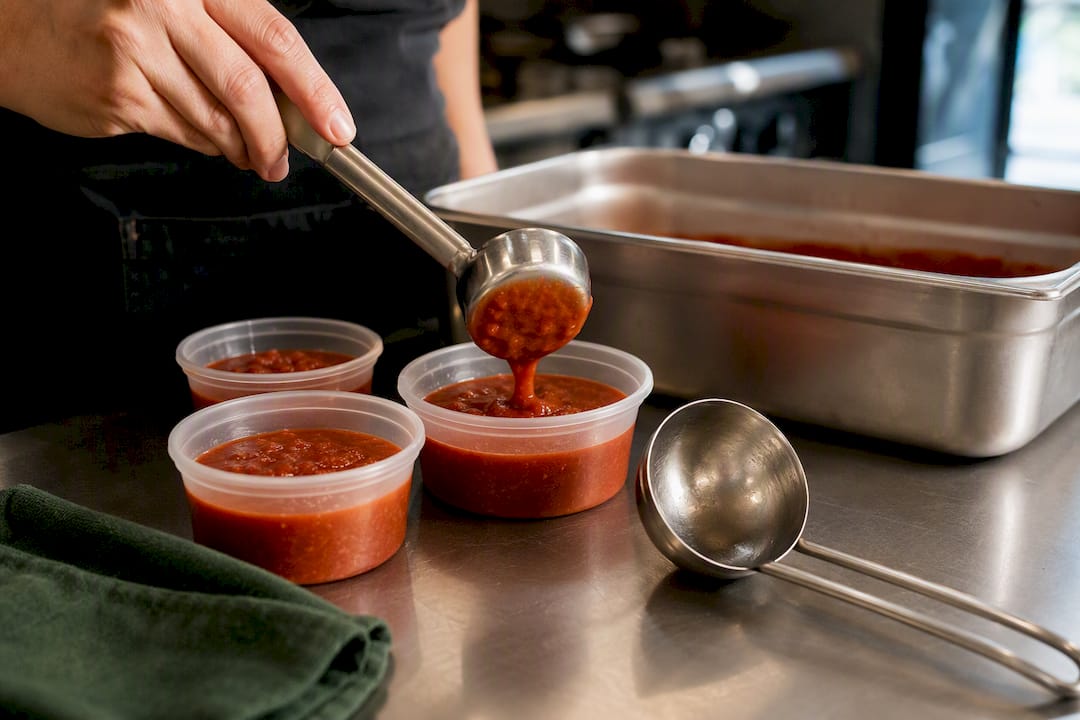
Calibrated ladles and scoops for rice, sauces, and starches. Color-coded ladles (a 2-ounce, 4-ounce, and 6-ounce set) remove the guesswork from grains and sauces. Once a cook learns "the red ladle is always the soup portion," the habit sticks faster than any written rule.
Portion spoons and squeeze bottles for dressings and condiments. These are the items that quietly bleed margin because nobody thinks of a dollop of aioli as a cost center. It is.
Recipe cards do the rest of the work. A card that lists "6 oz chicken breast, 4 oz rice, 3 oz sauce" alongside a plating photo removes ambiguity that words alone cannot. Kitchens using measuring cups and calibrated scales during training saw much stronger adherence to portion targets than kitchens relying on verbal instruction, because a photo settles arguments a paragraph never can.
Build the workflow around three habits:
- Pre-portion proteins and starches during prep shift, not during service, so line cooks are placing pre-weighed items rather than measuring under pressure.
- Label portioned containers by weight and date so any cook on any shift knows exactly what is inside without asking.
- Batch high-volume items (sauces, dressings, stocks) into standard-size containers that match your recipe card's serving unit.
Pro Tip: Standardize your five highest-volume dishes first. Trying to lock down portions on your entire menu in one week guarantees confusion; nailing the five dishes that make up most of your covers delivers most of the food-cost win in a fraction of the effort.
Menu Sizing, Pricing, and Rollout Strategies for Flexible Portions
Reduced portions do not have to mean reduced revenue, and pricing them wrong is the fastest way to convince yourself otherwise. Pilot data on standardized portions found that reduced-size entrées can carry a better margin than their full-size counterparts once priced correctly, because the ingredient savings outpace the discount you offer the customer.
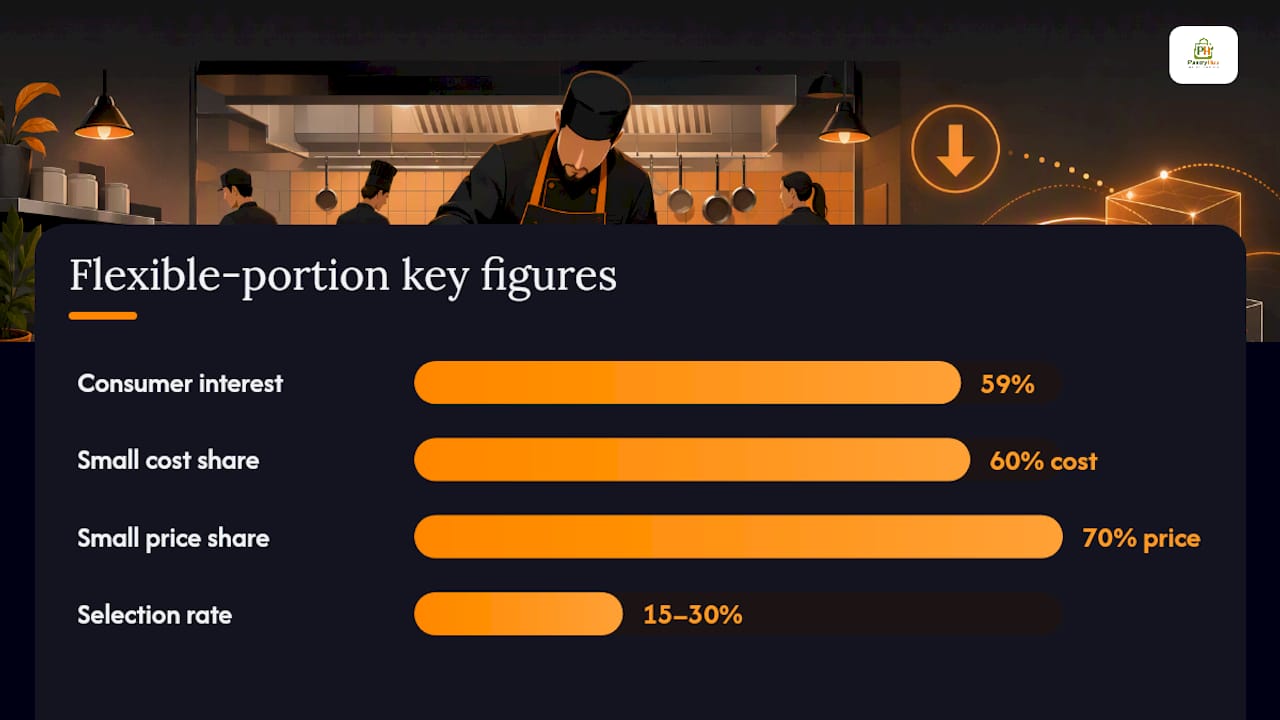
Consumer appetite for this is real. ReFED and Datassential found that 59% of consumers say they would be more likely to visit a restaurant that offers flexible portion sizes, with younger diners and people managing weight with GLP-1 medications showing even stronger interest.
Roll out flexible sizing in stages rather than rewriting the whole menu at once:
- Pick two or three candidate dishes with the highest ingredient cost or the most consistent over-portioning complaints from the kitchen.
- Offer a structured size ladder (small, regular, large) rather than a binary reduced or full option, since the middle tier usually captures the most orders.
- Price proportionally, not linearly. A small portion priced at 70% of the regular price, when it costs 60% as much to make, protects your margin while still feeling like a fair deal to the guest.
- Run a two- to four-week trial and track how often the reduced or split option gets ordered relative to the standard size.
- Read the selection-rate data honestly. If the reduced item is capturing 15% to 30% of orders on that dish, similar to the range seen in the 2024 restaurant pilot, you have a keeper. If it barely registers, drop it and try a different dish.
Split portions and tasting flights work well for shareable or higher-price items, especially in venues building out a wine pairing or tasting menu experience, where smaller structured pours or plates are already part of the format guests expect. Menu engineering choices around sizing tie directly into your broader pricing strategy, covered in more depth in our guide to menu engineering for restaurants.
Staff Training, SOPs, and Audits to Lock in Consistency
A recipe card only works if the person plating the dish has actually looked at it. Standards that live in a binder nobody opens are not standards, they are decoration.
Build your recipe cards around two things: a weight or volume target for every component, and a plating photo shot from the angle the expo will actually see the finished plate. Pilot programs that paired measuring tools with training sessions found kitchens adhered to portion guidelines far more consistently than those given verbal direction alone, because a photo resolves disputes a paragraph of text cannot.
Training does not need to be a seminar. A 15-minute walkthrough at the start of a shift, run against the recipe card and the actual plate, sign-off included, is enough to build the habit. Repeat it whenever a new dish launches or a recipe changes.
Audits keep the standard honest after training ends:
- Weigh a random sample of plates during service, once or twice a week, and compare against the recipe card target.
- Run occasional secret-shopper checks, either a manager ordering as a guest or a trusted regular giving feedback on portion consistency.
- Log any variance over 10% and address it the same shift, not at the next scheduled meeting.
Pro Tip: Assign one team member per shift as the portion-check point person. A single accountable set of eyes catches drift faster than a policy everyone is technically responsible for and nobody actually owns.
KPIs and Simple Measurement Methods to Track Results
Numbers, not opinions, tell you whether your portion-control rollout is working. Track a small set of KPIs consistently rather than a large set sporadically, and review them weekly during a pilot.
| KPI | What it measures | How to collect it | Target signal |
|---|---|---|---|
| Food cost % | Ingredient cost as a share of menu price | Pull from POS and inventory system weekly | Downward trend after standardization |
| Portion variance (grams) | Difference between served weight and recipe card target | Random plate weigh, 5 to 10 plates per shift | Variance under 10% of target |
| Plate waste (g/plate) | Food returned uneaten | Waste log at bussing station or plate scrape audit | Declining trend, benchmark against the 77g to 45g drop seen in restaurant trials |
| Selection rate (reduced items) | Share of orders choosing a smaller or split size | POS mix report | 15% to 30% range signals genuine demand |
| Cost per cover | Total food cost divided by covers served | Weekly POS and inventory reconciliation | Stable or falling week over week |
Sample plates two or three times a week during a pilot and daily if you suspect drift. If portion variance shrinks and plate waste falls while selection rate for reduced items holds steady or climbs, scale the standard across the rest of the menu. If variance stays flat despite training, the problem is usually the tool, not the cook. Go back to the measuring device before you go back to the staff. Our breakdown of restaurant cost control strategies covers how these KPIs fit into a broader margin-protection plan beyond portioning alone.
How Inventory and Recipe Systems Close the Loop Between Portions and Cost
Recipe cards and measuring tools get you most of the way there, but the manual audit still relies on someone remembering to weigh a plate. Linking recipe portion weights directly to your inventory system removes that dependency. Once a recipe's portion weight is set in the system, every sale automatically decrements stock by that exact amount, and any gap between expected and actual stock levels shows up as a variance alert rather than a surprise at month-end stocktake.
The workflow runs in a straightforward loop:
- A recipe is built with a fixed portion weight for each ingredient, matching the recipe card on the line.
- Every sale through POS triggers an automatic stock decrement based on that recipe.
- Variance between expected and actual stock use flags portion drift before it compounds across a full week of service.
- Cost-per-plate reporting updates in real time, so a manager can trace a margin problem back to a specific dish rather than guessing across the whole menu.
That structure turns a monthly stocktake headache into a rolling, self-correcting check, and it is the same logic covered in our guide to inventory accuracy and restaurant profitability. Operators who want to test this without overhauling their whole system usually start with their two or three highest-cost dishes, exactly like the pilot approach earlier in this article.
Running a Two-Week Portion-Control Pilot
Start small: pick three dishes that account for the most covers or the highest ingredient cost, set a weight or volume target for each, and choose one measuring tool per dish (scale, ladle, or portion spoon). Train a single shift on the new standard, run it for two weeks, and log portion variance and plate waste daily.
Expect early inconsistency in week one as habits form, then a noticeable tightening by week two. If variance stays stubborn on one dish, the tool is usually wrong for the job, not the cook.
— Admin
A Faster Way to Connect Portions to Your Bottom Line
Manually cross-checking recipe weights against stock counts works, until you are running six dishes across two locations and the spreadsheet stops keeping up. That is a gap some platforms aim to close: linking each recipe's portion weight directly to your stock levels, so a plate served automatically depletes inventory by the exact amount your standard calls for, not an estimate.
When actual usage drifts from the recipe target, low-stock and variance alerts flag it before it turns into a food cost surprise at month-end. That means less time spent recounting walk-ins to figure out where the margin leaked, and more time spent fixing the one dish that's actually the problem. The same system extends to the bar with pour cost and stocktake tools if beverage portioning is part of your cost puzzle too.
If you are running the two-week pilot described above and want the tracking to happen automatically instead of on a clipboard, take a look at PantryHub's inventory and recipe platform and see how it fits your kitchen before you scale the standard across your full menu.
Sources
- From Plate to Profit (ReFED / Datassential report, 2025)
- Feasibility and Acceptability of Standardizing Portions in Restaurants (PMC, 2024)