
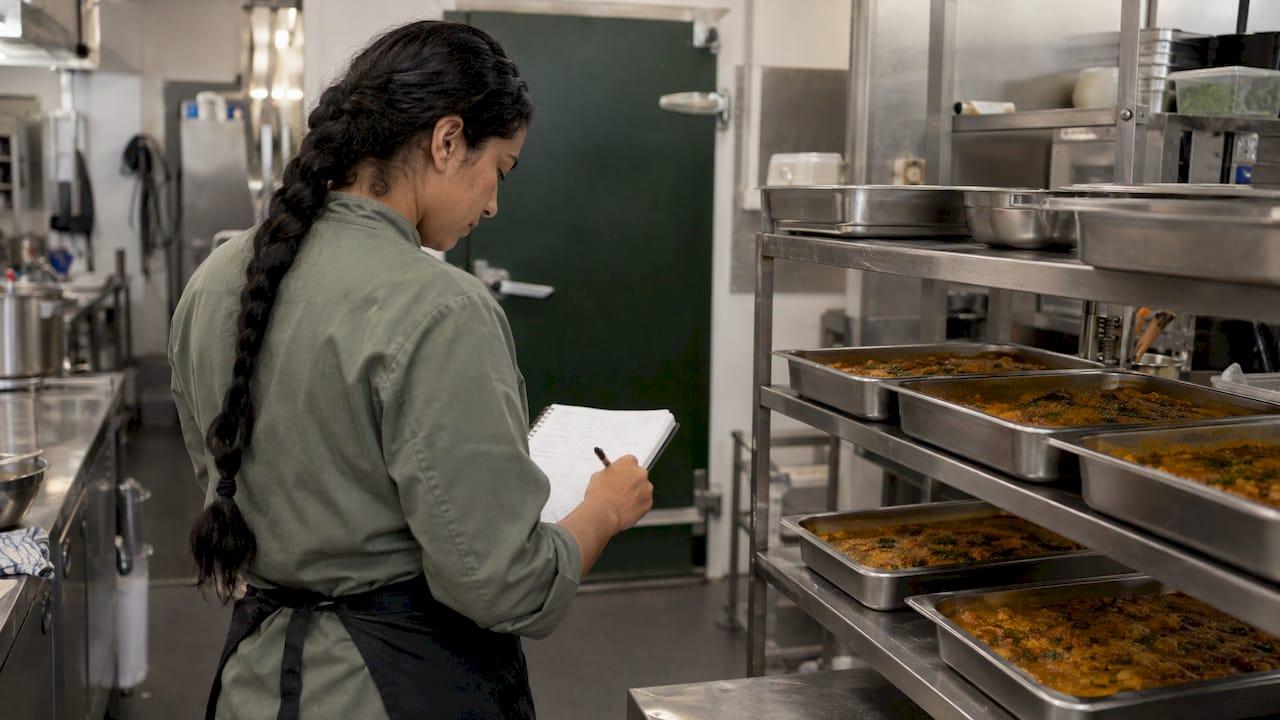
Batch production tracking means recording, for every prep run, what went in, how much came out, when it was made and where it went. In a restaurant, café, pub or club kitchen, the simplest way to do it is to tie each batch to a standard recipe and to live stock counts, so yield, waste and traceability come from the same numbers. That is the job PantryHub is built for: recipe standardisation, real-time stock tracking and waste and cost reporting in one platform, across one venue or several.
This guide is for owners, chefs and managers who prep in volume: stocks, sauces, batter, soups, marinades, cooked rice, cold-pressed or syrup bases. It covers what to put on a batch record, how to number batches, how to track yield against the recipe, and which Australian rules shape your records.
TL;DR
- A batch record answers four questions: what went in (with supplier and lot details), what was made, how much, and where it went or was discarded.
- A simple batch number built from date, product code and run letter is enough, as long as it is unique and used every time.
- Yield tracking compares projected output with actual output per batch. A repeated shortfall points to portioning or a recipe that needs recalibrating.
- Records must be made at the time, not from memory, and under Standard 3.2.2A Category One businesses generally keep them for at least three months.
- Recipes, stock counts and waste reports in one system make batch records faster to complete and easier to check across shifts and sites.
Table of Contents
- What batch production tracking means in a commercial kitchen
- What a batch record should include
- How to number and label batches
- Tracking batch yield: planned versus actual
- Linking batches to ingredients, allergens and storage
- What Australian rules expect from your records
- A routine that holds across shifts and sites
- Where the stock system fits
- Start with a free trial
- FAQ
- Sources
What batch production tracking means in a commercial kitchen
A batch is one production run of one product: 20 litres of bolognese, 8 kilos of battered fish, a tray of cooked rice. Tracking it means giving that run an identity and keeping a short record of its life.
The record is usually described as a detailed, contemporaneous document capturing every input, process step and output for a single run. Batchbase, an Australasian food-compliance reference, says that in practice this links raw material lot numbers, supplier details, quantities used, production date and time, equipment, temperatures and the operator's identity.
For a hospitality venue, that gets you three things:
- Food safety. You can show that cooking, cooling and holding were done as your food safety program says.
- Cost control. You see what a batch actually yielded against what the recipe promised, which is where margins quietly leak.
- Traceability. If a supplier problem surfaces, you can tell which batches used the affected ingredient.
A small café will not need the paperwork of a factory. But the same logic scales down: a clear label, a time, a quantity and a link back to the recipe.
What a batch record should include
Start with what a chef can fill in during service. A practical production checklist, such as the one in Otherfoods Kitchen's batch production guide, covers product, batch number, production date, recipe version, planned quantity, ingredient quantities and lot numbers, supplier information, who made it, key process measurements, actual yield, waste or rejected product, storage location, quality observations and corrective actions.
For most venues, trim that to a core set:
| Field | Why it matters |
|---|---|
| Product and batch number | Identifies the run |
| Date and time prepared | Sets use-by and the 2-hour/4-hour clock |
| Recipe version | Shows which spec the batch followed |
| Key ingredients with supplier and delivery or lot reference | Lets you trace back if a supplier has an issue |
| Planned and actual yield | Feeds cost and portion control |
| Critical temperatures (cooked, cooled) | Evidence the process worked |
| Prepared by | Accountability across shifts |
| Storage location and use-by | Stops old batches being served |
| Waste or discarded quantity, and why | Shows where food cost is lost |
The most common failure is a record that is too vague to help. Batchbase notes that a line such as "200g breadcrumbs" with no supplier delivery or lot is useless in a recall. Link the ingredient to the delivery it came from.
How to number and label batches
There is no official format. The Otherfoods guide suggests something like 260818-GR-A: the date, a product code and the run of the day. Its point is that consistency and uniqueness matter more than the format itself. We agree.
A workable scheme for a venue:
- Date: day, month, year in the order your team already writes it.
- Product code: two or three letters your team will remember (BOL for bolognese, BAT for batter).
- Run letter: A for the first batch of the day, B for the second.
Put the batch number, prep date and use-by on the container label. When the label, the record and the recipe all use the same code, anyone on any shift can find the history of what is in the walk-in.
The NSW Food Authority's 2-hour/4-hour rule guidance shows the same thinking for food on display: records must show the date and time food was prepared and put on display, the time on display, whether it was discarded or returned to the fridge, and the system used to identify the food, such as sticker colour or a labelled made-on date. The guidance also says to check the temperature of food for each batch received.
Tracking batch yield: planned versus actual
Yield is where batch tracking pays for itself. Every standard recipe has an expected output: so many portions, litres or kilos. Record what you actually got.
A production sheet should show projected and actual yield for each batch, according to LegalClarity's guide to production sheets. Its example: a soup batch that consistently produces 15% fewer portions than the recipe predicts signals a portioning problem or a recipe that needs recalibrating.
Here is a worked example for a pub kitchen:
- Recipe: beef and red wine pie filling, planned yield 40 portions of 180 g.
- Batch A on Monday: 40 portions. Batch A on Wednesday, different cook: 34 portions.
- Variance: 6 portions, or 15%.
One low batch is noise. Three in a row on the same shift is a pattern: oversized scoops, under-reduced sauce, trim that is too generous, or a recipe written for a different cut. Without a number on each batch, the only signal is a food cost percentage that drifts at month end.
Set batch sizes from real use as well. The same guide notes that if a kitchen has consistently thrown out 20% of a prep item, cutting the batch by that amount costs nothing in missed sales and directly reduces waste. The Hotel Blueprint's cost control guide makes a related point: start production planning from a cover forecast by meal period and day, and use it to decide what to prep and what batch sizes to run.
To see how yield connects to the rest of your numbers, read our guides on tracking ingredient usage from the recipe up, food waste reporting using actual versus theoretical and a two-week portion pilot.
Linking batches to ingredients, allergens and storage
A batch is only as traceable as its inputs. The Food Standards Australia New Zealand (FSANZ) traceability guidance says a strong system covers identifying suppliers, customers and products; supplier contact details and what they supply; dates of transactions and deliveries; batch numbers or lot identifiers; and quantities supplied or received.
For a kitchen, that translates to a few habits:
- At receiving: note the supplier, delivery date and any batch or lot code on the carton for the ingredients that go into batch prep.
- At prep: record which delivery went into which batch.
- For allergens: hold the allergen profile on the recipe, so every batch of that recipe carries it without anyone re-deciding.
- At storage: label location and use-by, and use first-in, first-out.
Standard recipes help here. When the recipe holds the ingredients and the allergens, the batch record only needs to capture what changed on the day.
What Australian rules expect from your records
Keep it simple and check the specifics with your local council or state food authority.
Records for prescribed activities. FSANZ's evidence tool states that under Standard 3.2.2A a food business doing a prescribed activity must make a record proving food safety risks were managed, keep it for at least three months, and make records each day the activity occurs, including the date and the food or activity it relates to. Restaurants and caterers that process unpackaged potentially hazardous food into ready-to-eat food are generally Category One businesses, and the standard took effect on 8 December 2023, as summarised by National Times Australia.
Cooling. Standard 3.2.2 requires cooked potentially hazardous food to cool from 60°C to 21°C within two hours and then from 21°C to 5°C within a further four hours, unless you can demonstrate your own process is safe. The compiled standard on legislation.gov.au sets this out. Large batches of stock, curry or rice are where this bites, so record the cooling times on the batch.

Traceability and recall. The FSANZ recall protocol says all food businesses must be able to trace one step backwards. It also notes that retail food-service businesses such as restaurants, cafés and takeaways are generally not required to have a food recall system, because food is usually eaten soon after it is made. That makes your supplier-side records, the link from batch to delivery, the part that matters most for a venue.
The same protocol notes that the size of the unit you trace, whether lot, batch or consignment, is a trade-off: larger units simplify tracing but mean more food may be affected if there is a safety problem. For a kitchen, that argues for one batch per run rather than a week's prep under one label.
Queensland councils publish ready-made templates too. Douglas Shire Council offers daily production record templates covering incoming goods, cooking, cooling and reheating, and says completed forms must be kept at the premises and available to an Environmental Health Officer at any time. FSANZ's Appendix 8 examples include a worked case of a rice batch boiled at 61°C that failed the 2-hour cooling limit and was discarded, a useful model for what a good batch entry looks like.
A routine that holds across shifts and sites
Records fail when they depend on one careful person. Batchbase lists the usual mistakes: writing it up afterwards from memory, no link to ingredient lots, and paper systems with no version control when recipes change. A routine that avoids them:
- Write the standard recipe once. One version, with yield, portion size, allergens and cost. Retire old copies.
- Record at the bench. Quantity, time and temperature go in as the batch is made, not at close.
- Label every container with batch number, prep date and use-by.
- Count yield before storing. Portions or kilos out, compared with planned.
- Log waste with a reason. Over-prep, spoilage, trim, spill, quality reject.
- Review weekly. Look at the batches with the biggest variance and the prep items with the most waste, then adjust recipes and batch sizes.
In a multi-site group, step 1 is the one that matters most. If two venues make the same sauce from different versions, their yields cannot be compared.
The things you buy in also need a stable code. A tidy supplies checklist organised into categories and SKUs is a good model for cafés setting up consistent item names before they start tracking, because a batch record is only as clean as the item list behind it.
Where the stock system fits
Batch tracking sits on top of stock control. Every batch consumes ingredients and creates a prepared item, so if the ingredient counts, the recipes and the waste log live in separate places, you reconcile them by hand. If they live in one platform, a variance on a batch shows up against the same ingredient data you use for ordering and stocktakes.

PantryHub is built around that idea: real-time stock tracking, recipe and pricing standardisation, waste and cost reporting, supplier ordering with Australian supplier integration, team access controls and multi-location inventory management. With recipes standardised and stock visible, your teams work from one version of each recipe and one set of numbers. The same data supports ingredient-level stock tracking, a regular stocktake process and the dashboard metrics that catch margin drift.
If your records are still spread across clipboards and spreadsheets, our list of seven signs your kitchen needs inventory software is a quick check, and our waste tracking steps show how to turn waste logs into food cost savings.
We built PantryHub by the chef for the chef, so we start from the pass, not the office. A batch is a recipe, a quantity and a result. When the recipe is standard, the stock is live and the waste is logged against the same items, yield stops being an end-of-month surprise and becomes something your cooks can see while they prep.
Our approach is local: AUD pricing, GST-ready reporting, local support and a mobile-first design, so the person doing the prep can use it on the phone in their pocket. For a single café or a multi-location group, the aim is the same: less food in the bin, tighter portions and one version of the truth across every kitchen.
the author
Start with a free trial
PantryHub plans are published at A$39 per month (Starter), A$69 per month (Regular) and A$99 per month (Pro), with pricing based on venue count and features. You can see the details on the pricing page. If you run a bar or pub, the bar inventory software page covers pour cost and stocktake, and the kitchen inventory app page covers iPhone and Android.
Ready to bin the spreadsheets? Start your free trial and put your first recipes in.
FAQ
What is a batch number?
A batch number is a unique code that identifies one production run. In a kitchen it can be as simple as the date, a product code and a run letter, such as 260818-GR-A. What matters is that each batch gets its own code and that the code appears on the label and the record.
How long do I keep batch and production records?
For Category One businesses doing prescribed activities, Standard 3.2.2A requires records that show food safety risks were managed, and FSANZ says they should be kept for at least three months. Keep them at the premises, as councils such as Douglas Shire note they must be available to an Environmental Health Officer on request. Check your own category with your local council.
Does a café or restaurant need a recall system?
FSANZ says retail food-service businesses such as restaurants, cafés and takeaways are generally not required to have a food recall system, because food is usually eaten soon after it is made. All food businesses must still be able to trace one step backwards, so keep supplier, delivery and batch details for your key ingredients.
How do I calculate batch yield variance?
Subtract actual yield from the recipe's planned yield and divide by the planned yield. If a 40-portion batch gives 34, the variance is 6 portions, or 15%. Track it per batch and per cook, and when the same shortfall repeats, review portioning or recalibrate the recipe.
Sources
- Batch Record, Australasian Food Compliance Definition (Batchbase)
- Batch Production (Otherfoods Kitchen)
- 2-hour/4-hour rule guidance (NSW Food Authority)
- Printable Food Production Sheet Template (LegalClarity)
- Hotel Food & Beverage Cost Control Reference Guide (The Hotel Blueprint)
- Food traceability (FSANZ)
- Evidence tool (FSANZ)
- Food Industry Food Recall Protocol, September 2024 (FSANZ)
- Food Safety Practices and General Requirements, Standard 3.2.2 (legislation.gov.au)
- Australian Food Policy 2026: Key Laws and Regulations (National Times Australia)
- Food Safety Template Records (Douglas Shire Council)
- Appendix 8: Template examples (FSANZ)
- Coffee shop supplies checklist