

Operational food waste reporting means measuring what your kitchen throws away, tying it to covers and cost, and using that data to fix the problem. Start with a short baseline audit this week, either by weight or visual estimate, and normalize the results by covers, so you can compare week to week. There are digital platforms that offer reporting built into inventory workflows.
TL;DR:
- Waste per cover and percentage of food wasted are key KPIs, with avoidable waste representing the largest cost leak and a priority to reduce.
- Weight-based audits offer the most accuracy but require planning and staff time, especially when separating liquids and spoilage.
- Regular, consistent reporting managed by a waste champion helps identify trends, prioritize actions, and track improvements over time.
- Focusing on the top wasted items by cost and addressing portion or prep issues often yields the quickest savings.
- Digital tools like PantryHub can streamline data collection, link waste with inventory, and support multi-site reporting, especially for larger operations.
Table of Contents
- Essential KPIs: what to measure and why it matters
- Practical measurement methods and trade-offs
- Building a reporting process you can actually repeat
- Turning reports into prioritized actions that cut cost
- Tools, templates and when to go digital
- Legal and regulatory requirements for food waste reporting
- Data privacy and security considerations when handling waste reporting data
- Connecting food waste data to sustainability and CSR reporting
- Communicating waste metrics to your team and stakeholders
- Measurement as an operational discipline
- PantryHub: a digital option for waste and inventory reporting
- Authoritative resources and toolkits
- Sources
- FAQ
Essential KPIs: what to measure and why it matters
Before you touch a bin, decide what numbers actually matter. Two figures do the heaviest lifting: kilograms of waste per cover and percentage of purchased food wasted. The first tells you how much you are throwing out relative to how busy you were; the second tells you how much of what you bought never made it to a plate.
Separate avoidable waste (edible food, over-prepped items, plate returns) from unavoidable waste (bones, peels, coffee grounds). Avoidable waste is where the money leaks, and it is the number you should chase down first.
The sharper diagnostic is Actual-versus-Theoretical (AvT) variance: the gap between what your recipes and sales say you should have used and what you actually used. When recorded waste does not fully explain an AvT gap, something else is happening, often portion drift, recipe inconsistency, or unrecorded loss.
- Kg per cover: total waste weight divided by covers served in the same period.
- Percentage wasted: waste cost divided by total food purchase cost, times 100.
- Avoidable share: weight of edible waste divided by total waste weight.
- AvT variance: theoretical usage (from recipes and sales) minus actual usage (from inventory draw-down).
Research shows restaurants generate highly variable waste per portion, with one cross-country hospitality study finding an average of roughly 20% of food served ends up wasted. That variance is exactly why you normalize by covers rather than relying on raw kilograms, which swing wildly between a slow Tuesday and a packed Saturday.
Practical measurement methods and trade-offs
You have three realistic options: visual estimation, weight-based audits, or an app-assisted version of either. Each has a place, and most kitchens move through them in order.
- Start with visual estimation. Walk the bins daily and log rough proportions of prep waste, plate waste, and spoilage; it is fast and gets your team waste-aware immediately.
- Move to weight-based audits once staff are on board. Weigh each waste stream separately, prep, plate, spoilage, using digital scales or a bin-weighing setup, and record date, time, item, weight, and a short cause note.
- Run the audit for 4 to 6 weeks, or use representative sampling across busy and quiet days, following the approach set out in NSW's hospitality waste toolkit, so seasonal and daily swings don't skew your numbers.
- Separate liquids and grease into their own container and weigh them independently; mixing them into general food waste inflates your kilogram figures and hides where the real solid waste is coming from.
Weight-based audits are the most accurate method available, but the same NSW guidance notes they are resource intensive, so plan for the extra staff time before you commit to running one full time.
Pro Tip: Assign one person to log the same waste stream every shift for the first two weeks. Consistency in who measures matters more than precision in the first few readings.
Building a reporting process you can actually repeat
A one-off audit tells you nothing useful. The value comes from repeating it on a schedule with the same rules every time, which means someone has to own it.
Name a waste champion, usually a sous chef or shift lead, who runs a five-minute briefing before each campaign and checks that logs are being filled in correctly. Define which bins and prep zones count before you start, so nobody is guessing mid-shift.
- Pick the zones: prep, plate returns, and spoilage/expiry, logged separately.
- Set sample days that include at least one slow and one peak service.
- Record covers served, waste weight by stream, and a one-line cause for each entry.
- Review the log weekly, not just at the end of the campaign.
A minimal weekly report needs only a handful of fields to be useful:
| Field | What it captures |
|---|---|
| Kg per cover | Waste weight divided by covers served |
| Percentage avoidable | Share of total waste that was edible |
| AvT variance | Theoretical usage minus actual usage |
| Top wasted item | Highest-cost or highest-volume item that week |
| Recommended action | One change to test next week |
Quality improves with repetition. Cross-check a sample of entries against physical bin weights every couple of weeks to catch drift in how staff are estimating, and tighten the process rather than the targets.
Turning reports into prioritized actions that cut cost
A report only pays for itself when it changes what you order, prep, or portion. Start with whatever item shows up most often as your top wasted item; that repetition is the signal, not the size of any single entry.
- Rank waste by cost, not weight. A small amount of wasted protein often costs more than a large volume of vegetable trim.
- Fix the top offender first: adjust portion sizes, change prep timing, or reduce order frequency on that ingredient.
- Use AvT variance to separate causes: a large gap with low recorded waste points to portion drift or unrecorded loss, while a gap that matches recorded waste points to genuine overproduction.
- Introduce a "use-up" special for surplus perishable stock before it turns into spoilage waste.
Storage discipline and FIFO rotation catch a surprising share of avoidable loss before it ever reaches the bin, and they cost nothing to implement.
Pro Tip: Run a five-minute staff briefing on the week's top wasted item before service. Naming the problem out loud changes behavior faster than any policy memo.

Tools, templates and when to go digital
A one-page audit sheet needs only a handful of columns: date, zone, item, weight, covers served, and cause. That's enough to calculate every KPI in this article by hand or in a basic spreadsheet.
The decision to go digital usually comes down to scale. If you're running one site with a stable menu, a spreadsheet works fine. If you're managing multiple locations, need AvT variance tied to real recipe and sales data, or want waste reporting linked to supplier ordering, manual tracking becomes the bottleneck.
- Bin Trim, referenced in NSW's hospitality waste toolkit, is a free, practical step for logging audits before moving to a full system.
- PantryHub connects waste and inventory data directly, so AvT variance calculates itself instead of requiring a separate spreadsheet.
- Multi-site groups benefit most from a system that aggregates reporting across locations automatically.
Legal and regulatory requirements for food waste reporting
Most hospitality businesses have no standalone legal obligation to publicly report food waste volumes. Where regulation exists, it typically governs how commercial food waste is stored, collected, and disposed of, not how you measure it internally. Commercial waste providers can clarify what counts as commercial waste in your area and what your collection contract requires.
Larger hospitality groups or venues supplying government or corporate clients may face reporting obligations tied to sustainability commitments or contract terms rather than general food waste law. If your business falls into that category, check the specific contract or program requirements rather than assuming a general rule applies. Internal operational reporting, the kind covered in this article, is a business choice rather than a compliance requirement for most independent venues, though that can change quickly if regulation in your jurisdiction shifts. When in doubt, a quick check with your local council or waste contractor on disposal rules is worth more than guessing.
Data privacy and security considerations when handling waste reporting data
Food waste logs seem harmless, but they often sit next to sales figures, recipe costs, and supplier pricing, information you don't want floating around in an unsecured spreadsheet shared over email. Treat waste and cost data with the same basic hygiene you'd apply to financial records.
Limit who can edit versus view reports, keep a single source of truth rather than multiple copies circulating among managers, and back up your data somewhere that survives a lost laptop or a staff turnover. If you're using a digital platform, check that access controls let you restrict sensitive cost data to owners and managers while still letting shift staff log waste entries. That separation matters more once you're comparing AvT variance across sites, since recipe costs and supplier pricing are commercially sensitive in a way that a single week's bin weight isn't.

Connecting food waste data to sustainability and CSR reporting
Once you're tracking kilograms per cover and avoidable waste share consistently, that data becomes useful beyond the kitchen. Many hospitality groups now fold food waste metrics into broader sustainability or corporate social responsibility reporting, whether that's an internal annual summary or a requirement from a landlord, franchisor, or corporate client.
The IFWC measurement methodology approach (aligning campaign-based food waste tracking with UNEP and SDG 12.3 targets) is a useful reference point if you need your numbers to sit alongside a recognized framework rather than a home-grown spreadsheet. Structuring your reporting around campaign IDs, site IDs, and consistent KPI fields from the start makes it far easier to plug your waste data into a larger CSR report later, rather than reformatting everything after the fact.
Communicating waste metrics to your team and stakeholders
Numbers on a spreadsheet change nothing until someone acts on them. How you share the results matters almost as much as the measurement itself.
For staff, keep it visual and specific: a short whiteboard note on last week's top wasted item does more than a monthly email nobody opens. For owners or investors, frame the numbers in dollars rather than kilograms, since a percentage-wasted figure tied to cost lands harder than a weight figure alone. For suppliers or landlords asking about sustainability performance, a simple trend line showing kilograms per cover dropping over several campaigns tells the story without needing a formal report.
Consistency in how often you share results, weekly for staff, monthly for management, builds trust in the numbers and makes the next campaign easier to run.
Measurement as an operational discipline
The kitchens that get the most out of waste reporting aren't the ones with the fanciest spreadsheet. They're the ones that measure something small every week without fail, then check it against AvT variance instead of trusting the bin alone. Start narrow, stay consistent, and let the data tell you where to look next.
— Admin
PantryHub: a digital option for waste and inventory reporting
Running audits by spreadsheet works, but it separates your waste data from the inventory numbers that actually explain it. PantryHub connects the two, so kg per cover, avoidable waste share, and AvT variance calculate from the same stock and sales data you're already tracking.
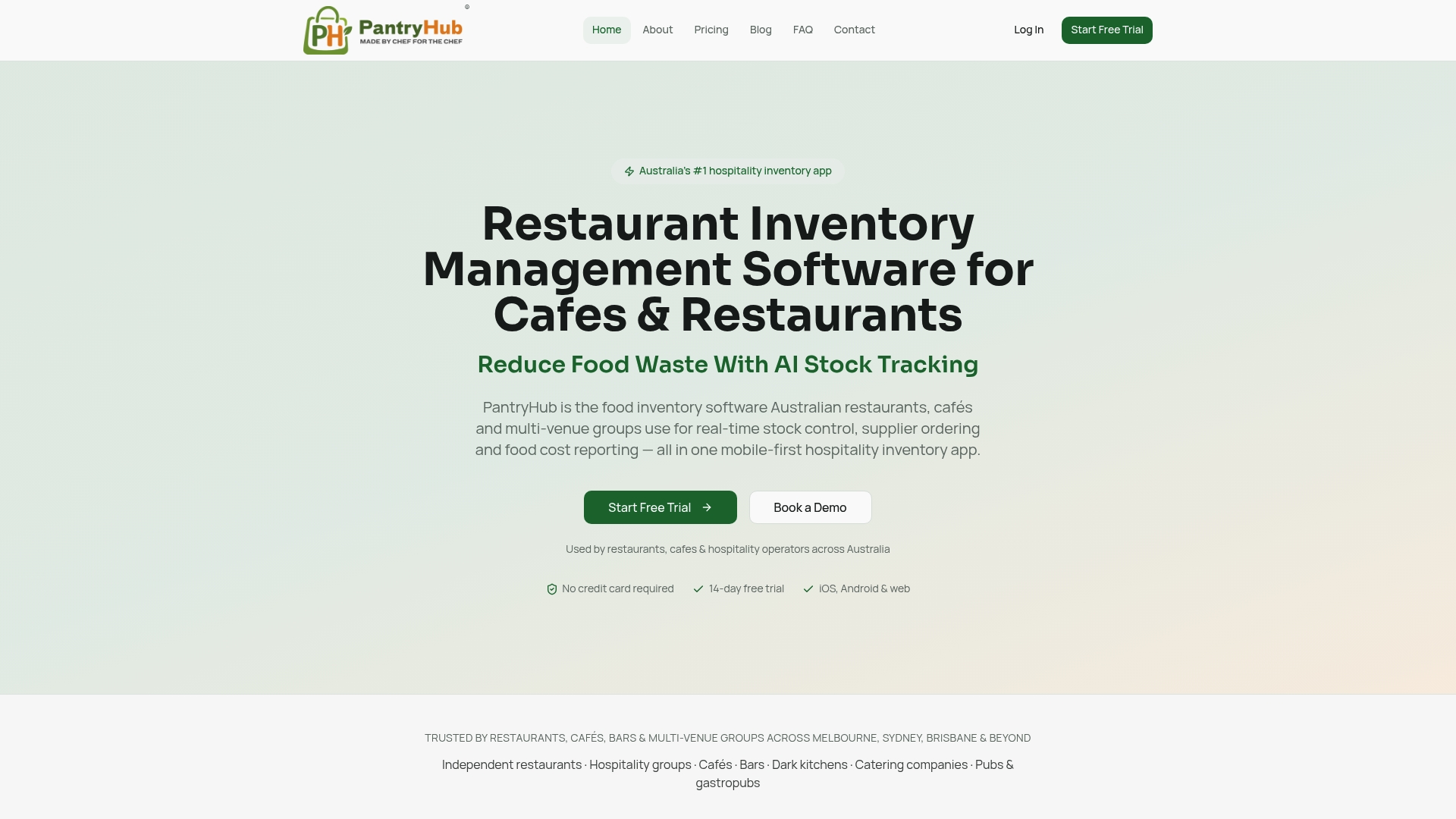
- Real-time inventory tracking with low-stock alerts across one or multiple venues.
- Waste and cost reporting built directly from your stock draw-down data.
- Multi-site visibility for groups comparing performance across locations.
- Supplier ordering tied to the same system, so ordering decisions reflect actual waste patterns.
Plans start at $39 AUD a month with Starter, with Regular at $69 AUD and Pro at $99 AUD, or you can start a free trial to see how it fits your kitchen before committing.
Authoritative resources and toolkits
For deeper methodology, see the NSW hospitality waste toolkit for audit templates and Bin Trim guidance, and the MDPI hospitality waste study for portion-level benchmarks. Served's restaurant resources offer additional operational tools worth reviewing.
Sources
- Waste Wise Hospitality in Healthcare Implementation Toolkit
- Towards a baseline for food-waste quantification in the hospitality sector
FAQ
What is operational food waste reporting?
Operational food waste reporting is the ongoing practice of measuring, recording, and analyzing on-site food waste in a kitchen, typically by weight or visual estimate, and normalizing it by covers served. It differs from national or industry-level food waste statistics, which look at broader trends rather than a single venue's performance.
How long should a food waste audit run?
Most hospitality guidance recommends a baseline campaign of 4 to 6 weeks, or representative sampling across busy and quiet days, so seasonal swings don't distort the results. Shorter audits can work as a quick check, but they're less reliable for setting a baseline you'll compare future campaigns against.
What is AvT variance and why does it matter?
AvT variance is the gap between theoretical food usage, calculated from recipes and sales, and actual usage drawn from inventory. A gap that isn't explained by recorded waste often points to portioning errors, recipe drift, or unrecorded loss that a simple waste log alone won't catch.
Do restaurants have a legal obligation to report food waste?
Most independent restaurants have no standalone legal requirement to report food waste volumes publicly, though disposal and storage rules for commercial waste do apply. Some businesses face reporting obligations through corporate contracts or sustainability commitments, which vary by agreement rather than general law.
Can PantryHub help with food waste reporting?
Yes, PantryHub calculates waste and cost reporting directly from the same inventory and sales data used for stock tracking, including AvT variance across one or multiple venues. Plans are available from $39 AUD a month, with a free trial available for operators who want to test it first.