
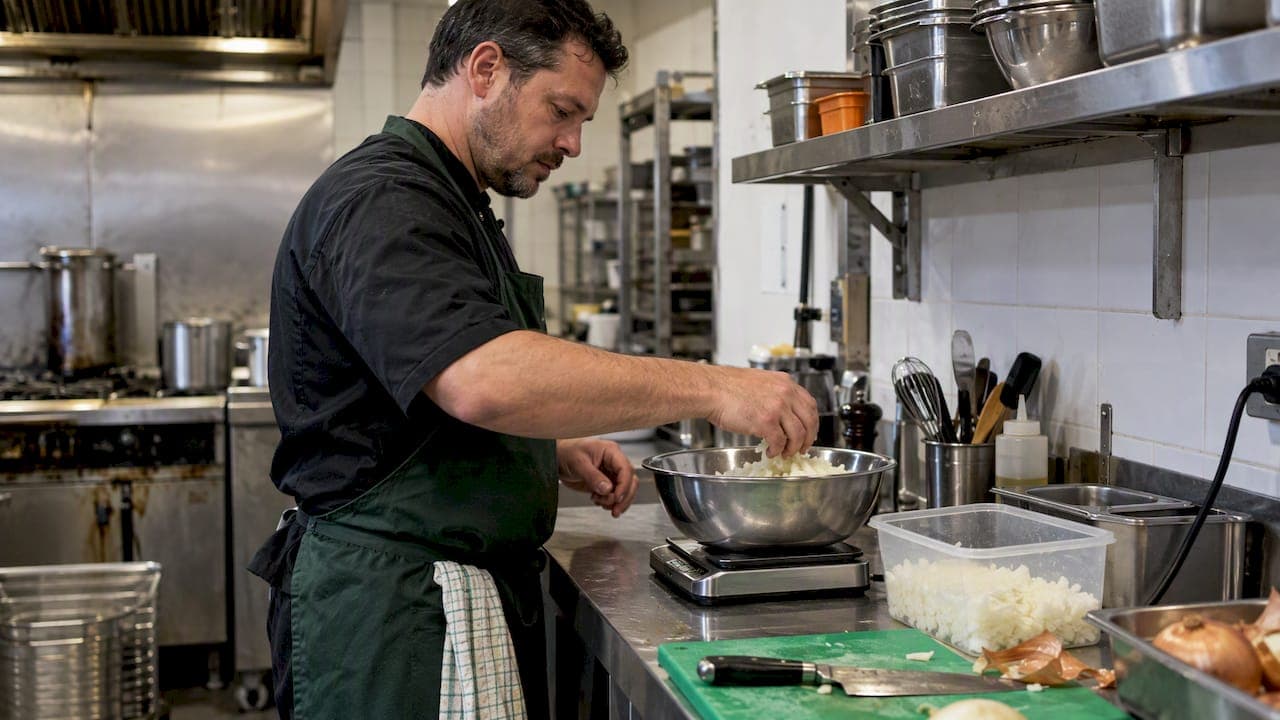
Unit of measure standardisation means every recipe, SKU, and purchase order in your kitchen speaks the same measurement language, grams, millilitres, each, or case, with no guessing between sites or shifts. The first move is simple: pick one base unit set and start converting your top recipe cards and highest-volume SKUs this week. That single change tightens costing, cuts ordering mistakes, and makes stock transfers between venues trustworthy.
TL;DR:
- Standardising units in solid, liquid, and countable items prevents costing inaccuracies and reduces ordering mistakes across all sites.
- Yield testing during recipe conversion and establishing fixed pack-to-each ratios are essential to maintaining accurate inventory and consistent portion sizes.
- A dedicated platform automates pack-to-stock-unit mapping, cost updates, and variance reports, supporting multi-location operations effectively.
- A pilot involving top SKUs and a one-week recipe review can establish a reliable standard within a few weeks, provided staff and inventory are routinely audited.
- Continuous ownership and clear documentation of recipes, SKUs, and conversions are vital to preventing drift and sustaining unit consistency over time.
Table of Contents
- Why mismatched units quietly cost you money
- How to convert recipes, map SKUs, and lock in standard units
- Conversion rules every kitchen can use today
- Rollout checklist and who owns what
- Tools and workflows that keep units consistent day to day
- A kitchen manager's view on making it stick
- Put these steps into PantryHub
- FAQ
- Sources
Why mismatched units quietly cost you money
When one recipe card lists "a bag of onions" and another lists "2kg," you cannot cost either dish reliably. Mixed units break recipe costing, distort inventory counts, and push teams toward guesswork when placing supplier orders. The gap shows up as over-ordering one week and emergency top-ups the next.
Formal training standards back this up directly. SITHCCC033A requires calibrated equipment for portion control, accurate use of standard recipe cards, and ordering to specification, all explicitly aimed at reducing wastage. SITXINV009 goes further, requiring stock control systems built on standard measures and purchase specifications, with reorder cycles tied to forecasted need rather than habit.
The accounting side matters too. Under AASB 102, inventory is measured at the lower of cost and net realizable value, and standard costing is only workable when the units feeding that calculation are consistent across your stock.
Three patterns show up again and again in kitchens without standard units:
- Recipe costing drifts because ingredient weights are estimated rather than measured.
- Stock counts disagree between the storeroom tally and the supplier invoice.
- Transfers between sites get rejected or re-counted because units do not match.
A kitchen with standardized portion control and recipe cards following SITHCCC033A guidance is positioned to cut recurring wastage caused by inconsistent measures as outlined in the helpful strategies to reduce food waste in restaurants.
How to convert recipes, map SKUs, and lock in standard units
Standardising units is a sequence, not a single afternoon project. Work through it in order and resist skipping the yield testing step, since that is where most of the real savings get found.
- Audit what you have. Pull every recipe card, supplier invoice, and current inventory sheet, and list the units each one uses right now.
- Choose your base units. Set weights in grams or kilograms, liquids in millilitres or litres, countable items as each, and ordering quantities as pack or case.
- Convert recipes and test yields. Rework each recipe card into the new base units, then run yield tests with calibrated scales and measures to confirm the numbers hold under real kitchen conditions.
- Map supplier packs to stock units. Record how many each-equivalents sit inside every pack or case so receiving staff never have to guess.
- Update inventory records and reorder rules. Set par levels and min-max thresholds in the new units, then test that automated reorder triggers fire correctly.
- Train staff and schedule audits. Roll out versioned recipe cards, brief every shift on the change, and set a recurring date to check for drift.
For the recipe conversion step specifically, our guide to converting recipes to ml/g walks through the exact process kitchen managers use to stop inventory drift within weeks rather than quarters. Mapping yields through to purchase orders is covered in more depth in our recipe yield conversion workflow.
Pro Tip: Run yield tests twice, once on a quiet shift and once during service, since cooking losses and portioning habits often differ under pressure.
Conversion rules every kitchen can use today
Most ambiguity disappears once you commit to a small set of base units and apply them without exception. Solids get weighed in grams or kilograms, liquids get measured in millilitres or litres, and anything countable gets logged as each. Packs and cases exist only as ordering units that map back to one of those three.
| Item type | Base unit | Example conversion |
|---|---|---|
| Flour, meat, cheese | Grams or kilograms | 1 case (10kg) = 10,000g |
| Oil, stock, dairy | Millilitres or litres | 1 case = 1 base unit set |
| Eggs, bread rolls, lemons | Each | 1 tray = 1 each-equivalent |
| Sauces, sealed cases | Pack or case | 1 case = 24 pack-units |
Bags, bunches, and tubs cause the most confusion because suppliers describe them inconsistently. Assign each one a fixed each-equivalent (a "bunch" of herbs always equals 1 each, a "tub" of feta always equals 1 each at a stated weight) and record that rule permanently in your product master.
- Weigh or measure once, then lock the conversion so staff never recalculate it.
- Record pack-to-each ratios at the SKU level, not the recipe level, so every recipe using that SKU inherits the correct conversion.
- Review conversions whenever a supplier changes pack size, not on a fixed schedule alone.
Rollout checklist and who owns what
A pilot beats a big-bang rollout. Pick one site, one week of recipes, and your 20 highest-volume SKUs, then set a clear success metric such as reduced stock-count variance or fewer emergency orders. Our free kitchen inventory checklist is a useful starting template for scoping that pilot.
Standardisation only holds if someone owns it. Assign a recipe owner, usually the head chef, who approves any change to a recipe card. Assign an inventory owner, typically purchasing or operations, who approves SKU and pack mapping changes. Assign a data steward, often an admin or ops manager, who maintains version history and change logs.
- Version every recipe card so staff always know which revision is current.
- Run yield tests on a fixed schedule, not only when something looks wrong.
- Audit for drift monthly, comparing recorded units against physical counts.
- Confirm pack sizes with suppliers in writing whenever an order changes.
Pro Tip: Keep a single shared change log for recipe and SKU updates, since scattered notes in group chats are where standardisation quietly falls apart.
Tools and workflows that keep units consistent day to day
Spreadsheets can hold a unit standard for a while, but they rarely survive busy services, staff turnover, or a second location. A hospitality-specific platform does the enforcing for you instead of relying on everyone remembering the rule.
The features that matter most are a product master with locked unit fields, automatic pack-to-SKU conversion, a recipe converter that recalculates costs when ingredient prices change, multi-location sync, and reporting that flags variance by unit rather than by guesswork.
- Receiving staff scan or select a SKU and the system applies the correct pack-to-each conversion automatically.
- Counting and stocktakes use the same unit fields as recipes, so variance reports compare like with like.
- Issuing stock to production deducts in the recipe's base unit, not the delivery unit.
- Reorder automation triggers from par levels set in standard units, not supplier pack descriptions.
We built PantryHub around exactly this workflow, with a product master, pack mapping, recipe costing, and multi-location reporting designed for Australian hospitality operators from day one. Our mobile inventory app extends the same unit fields to the floor for receiving and counting.
A kitchen manager's view on making it stick

A multi-site kitchen I spoke with during research for this guide had three venues using three different ways to describe the same cheese delivery. Stock counts never matched invoices, and nobody could say with confidence what a dish actually cost to plate.
Locking one recipe owner per dish and auditing monthly closed the gap within two pilot cycles. The lesson that stuck: visible, simple reporting won staff over faster than any policy memo did, because they could see their own counts finally matching the numbers on screen.
— Admin
Put these steps into PantryHub
Standardising units on paper is one thing. Keeping it standardized across every shift, every site, and every supplier delivery is where most kitchens need real support. We built PantryHub to hold your product master, enforce pack-to-each conversions automatically, and sync recipe costing across locations so the rules you set in week one still hold in month twelve.
- Product master with locked unit fields for every SKU.
- Automatic pack-to-stock-unit mapping at receiving.
- Recipe costing that updates in real time as supplier prices shift.
- Multi-location reporting to catch drift before it costs you.
Our Starter plan runs 39 AUD per month, Regular is 69 AUD per month, and Pro is 99 AUD per month, each built for Australian venues with AUD pricing and local support. Start a free trial and pilot unit standardisation on your busiest site this month.
FAQ
What is unit of measure standardisation in a kitchen?
It means every recipe, SKU, and purchase order uses the same measurement system, typically grams or kilograms for solids, millilitres or litres for liquids, and each for countable items. This removes the guesswork that causes costing errors and ordering mistakes.
How long does it take to standardize units across a kitchen?
A single-site pilot covering your top 20 SKUs and a week of recipes can be completed in a few weeks, including yield testing. Multi-location rollouts take longer because each venue needs its own audit and staff training before standards lock in.
Which units should a restaurant use for inventory?
Weigh solids in grams or kilograms, measure liquids in millilitres or litres, and count discrete items as each, with packs and cases used only as ordering units that map back to those base measures. SITXINV009 ties this directly to stock control systems and purchase specifications.
Does unit standardisation actually reduce food waste?
Consistent units make portion control and recipe following enforceable, which is the exact mechanism SITHCCC033A targets to reduce wastage. Clearer counts also mean fewer emergency orders and less spoilage from over-ordering.
Can PantryHub help standardize units across multiple venues?
PantryHub holds a shared product master and recipe converter so units stay consistent whether a venue is a single café or part of a multi-location group. Plans start with Starter at 39 AUD per month, scaling to Regular and Pro for larger operations, all listed on our pricing page.