
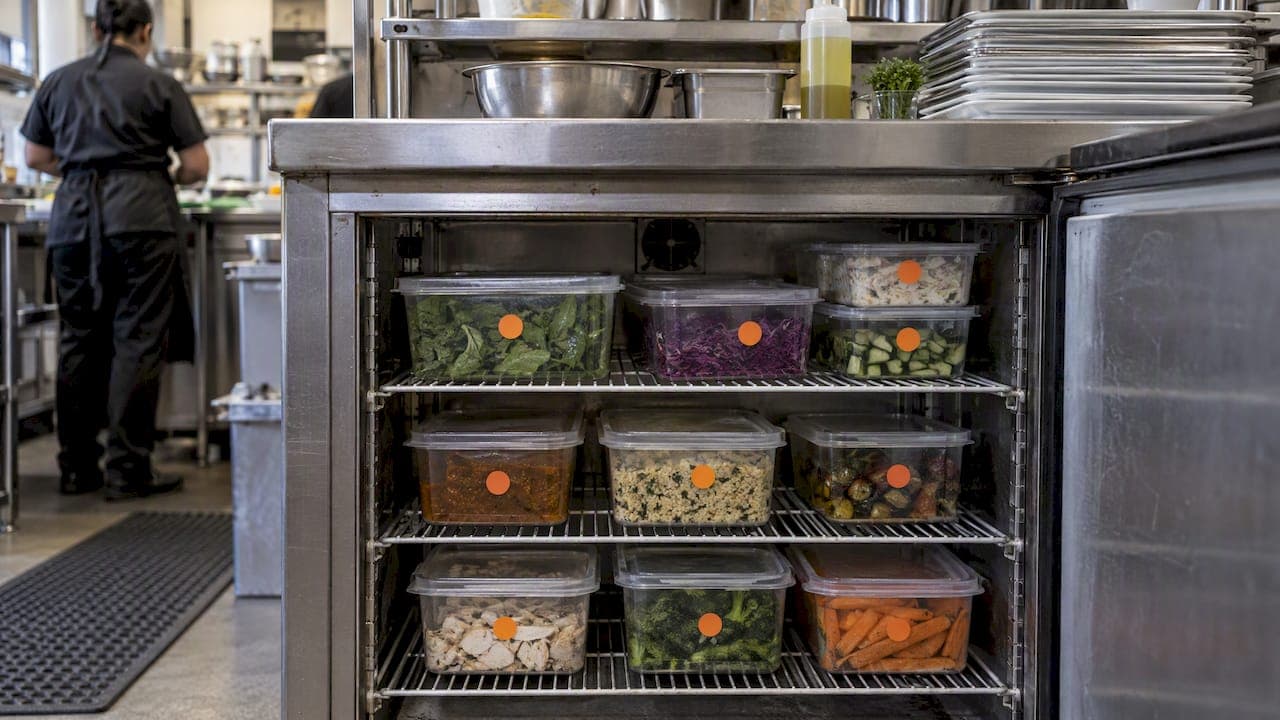
Shelf life management in a commercial kitchen means knowing how long every ingredient and prepared item stays safe and good to serve, labelling it, and using it in the right order before it turns into waste. Done well, it protects your customers, keeps you on the right side of your council inspector and stops money quietly leaving through the bin. This guide covers what the Australian rules say, how to set shelf lives for things you open or prepare yourself, and a routine your team can actually follow.
TL;DR
- Shelf life is how long food stays safe and good. A use-by date is a safety limit; a best-before date is a quality guide.
- You cannot legally sell food past its use-by date, so check dates on delivery and again on the shelf.
- Date-code anything you open, repack or prepare, and rotate older stock to the front (FEFO beats plain FIFO when dates differ).
- Potentially hazardous ready-to-eat food should generally not be kept more than 5 days; raw or low-cooked egg foods generally no more than 24 hours.
- Software that tracks batches and expiry turns this from a clipboard job into a daily alert. 📦
Table of Contents
- What shelf life management means in a kitchen
- Use-by, best-before and shelf life: what Australia says
- The storage rules that shape your shelf lives
- How to set shelf lives for opened and prepared food
- FIFO or FEFO: which rotation works
- Where shelf life programs usually fail
- A daily routine that holds up on a busy service
- Our view: shelf life is an ordering problem first
- Put it into practice with PantryHub
- FAQ
- Sources
What shelf life management means in a kitchen
In retail, shelf life management is about selling stock before it expires. In a kitchen the job is wider. You are managing three kinds of shelf life at once:
- Supplier shelf life: the date printed on the pack when it arrives.
- Opened or secondary shelf life: the shorter window that starts when you open a tub, decant a sauce or portion a protein.
- Prepared shelf life: how long your own prep (stocks, dressings, cooked rice, cut fruit, sandwiches) stays safe once it is made.
Most waste and most food safety risk sit in the second and third groups, because nobody prints a date on them for you. That is the part you have to build into your kitchen routines.
It also connects to ordering. If you buy more than you can use before the date, no labelling system will save the stock. Good shelf life management starts at the order sheet and ends at the pass.
Use-by, best-before and shelf life: what Australia says
Shelf life and date marks are related, but they are not the same thing. Shelf life is the period a product stays in good condition. The date mark is the label the manufacturer puts on it.
| Use-by | Best-before | |
|---|---|---|
| What it signals | Food must be eaten by this date for health or safety reasons | Quality guide, not a safety cut-off |
| Can you sell it after the date? | No | Yes, if it is still fit for human consumption |
| Kitchen action | Discard on the date | Inspect, then decide: use, downgrade or discard |
This is how Food Standards Australia New Zealand explains use-by and best-before dates. The legal footing is Standard 1.2.5 of the Food Standards Code, which prohibits selling food after its use-by date. The same standard says food with a best-before date two years or more away generally does not need date marking (infant formula is the exception), which is why you will not see dates on some long-life dry goods.
Two practical points follow:
- A use-by date is a hard stop. Treat it like a temperature limit, not a suggestion.
- A best-before date is a prompt to inspect. Smell, texture, packaging damage and storage history all matter. If you cannot say the food was stored properly, do not gamble on it.
Who sets the printed date? CSIRO notes that the primary responsibility for determining shelf life lies with the manufacturer or packer, often through storage trials. Once you open the pack or make something yourself, that responsibility moves to you.
The storage rules that shape your shelf lives
Under Standard 3.2.2, food businesses must store food so it stays safe and suitable. Businesses handling unpackaged, ready-to-eat, potentially hazardous food may also need to substantiate their storage controls under Standard 3.2.2A. FSANZ's guidance on storing food safely sets out both.
The same page gives two benchmarks worth printing on your prep-room wall:
- Potentially hazardous ready-to-eat food should generally not be stored for more than 5 days.
- Food containing raw or low-cooked eggs (think aioli, mayonnaise, mousse) should generally be kept no longer than 24 hours.
Temperature matters as much as time. Queensland's environmental health guidance explains that the danger zone sits between 5°C and 60°C, where bacteria multiply quickly, and that potentially hazardous food held above 5°C for more than four hours should be discarded. The same guide asks for food in coolrooms and fridges to be off the floor in clean, covered, food-grade containers, and for damaged-packaging or contaminated food to be discarded.
Rules differ slightly by state and council, so confirm the detail with your local environmental health officer and your own food safety program. The principle is the same everywhere: a shelf life you cannot justify is a risk.
How to set shelf lives for opened and prepared food
Here is a simple process for your own prep.
1. List what you open, repack or make
Walk the kitchen and write down every item that does not arrive with a date you can rely on: decanted sauces, portioned meat, cut produce, house-made dressings, cooked grains, stocks, batters, sandwiches and pastry fillings.
2. Assign a maximum life to each
Start from the supplier's guidance on the pack (for example, "refrigerate after opening" instructions), then apply the limits above. Be conservative with high-risk items: cooked rice, seafood, dairy, egg-based foods and anything ready to eat. Keep a single page that records each item, its storage method and its maximum days. Your food safety supervisor can sign it off.
Rule-of-thumb conventions such as "two days after opening" are common in kitchens, but they are habits, not law. Write down the reason behind every number so a new chef can follow it and an auditor can see it.
3. Label everything that leaves its original pack
The Victorian Department of Health's FoodSmart guidance recommends date-coding high-risk food, including opened or repacked dates, marking food prepared on site with its made date, rotating older stock first, checking use-by dates regularly and discarding food that has passed its use-by date. A usable label shows the item, the date made or opened, and the use-by date. Colour-coded day dots make a fridge readable at a glance.
4. Check, rotate, discard
Build a short check into opening and closing: scan the coolroom, pull anything expiring today or tomorrow, move it to the front and decide where it will be used. Record what you bin and why. That log is also your best waste data.
FIFO or FEFO: which rotation works
FIFO (first in, first out) rotates by delivery date. FEFO (first expired, first out) rotates by expiry date. When two deliveries of the same item carry different dates, FEFO is the safer rule, because the later delivery can have the earlier date. For items that are always used in the order received, FIFO is simple and enough.
If you want the step-by-step rollout, our guides on FIFO vs FEFO for kitchens, six-step expiry date tracking and stock rotation in the kitchen walk through shelving, labelling and training.
As a quick set-up, most kitchens do well with:
- Fixed shelf positions: oldest or earliest-expiry on the left or front, new stock behind.
- One "use first" tray in each fridge for items expiring within 48 hours.
- Receiving checks that reject short-dated or damaged deliveries before they hit your shelves.
- Dry goods on their own schedule. Our dry goods management checklist covers flour, oils, tins and spices.
The bar has its own shelf lives too. Citrus, syrups, juices and dairy mixers behave like kitchen prep, and spirits age differently once opened. If you stock a back bar, it is worth knowing how long gin keeps so you can set sensible par levels and rotation for it.
Where shelf life programs usually fail
Failures tend to be about systems rather than effort. NSF's overview of shelf-life management points to the building blocks: management policies, supplier checks, contingency plans, reliable equipment and adequate staff training. It also notes that weak shelf-life control can lead to prosecution, fines, reputational damage and extra waste from poor inventory control.
In day-to-day kitchens, the usual culprits are:
- Over-ordering. Stock bought "just in case" expires before it is used. Set par levels from actual usage, not gut feel.
- Unlabelled prep. If nobody knows when something was made, it gets binned or, worse, served.
- Rotation skipped on busy days. Delivery lands during service and gets shoved in the front.
- Paper logs nobody reads. A clipboard cannot warn you that 12 kg of cream expires on Thursday.
- One person holds it all in their head. The system leaves with them.
Our breakdown of common inventory mistakes restaurants make goes deeper on the ordering side.
The stakes are real. The Australian Government Department of Health and Aged Care says food poisoning affects more than 5 million cases a year and treats safe storage, handling and serving as a shared responsibility. Your date system is your part of that.
A daily routine that holds up on a busy service
Keep it short enough that the team does it every day.
Receiving (every delivery)
- Check use-by and best-before dates against what you ordered.
- Check temperature on chilled and frozen items, and packaging condition.
- Reject or flag short-dated product, then shelve by expiry.
Morning
- Walk the coolroom and pull the "use first" list.
- Plan specials, staff meals or prep around items nearing their date.
- Check prep labels and bin anything past its limit.
Close
- Date and cover everything opened that day.
- Update counts for fast-moving and high-cost items.
- Log waste with a reason: expired, spoiled, overproduced, dropped.
Weekly
- Review the waste log. Repeat offenders usually mean the par level is wrong.
- Do a full count of perishables and compare against usage.
- Check that your shelf life sheet matches the menu.
For the counting side, see how to track stock levels daily, and for the alerts side, inventory alerts in Australian kitchens.
Our view: shelf life is an ordering problem first
We built PantryHub with chefs, and the pattern we see is consistent: most expired stock was ordered in the wrong quantity, not stored badly. Labels and rotation matter, but they only manage the stock you already bought. The bigger lever is buying the right amount.

That is why we think shelf life management belongs in the same system as your stock counts, par levels and supplier orders. When on-hand quantities, usage and low-stock alerts sit in one place, you can see which items are slow movers before they near their date, and you can order to what you will actually sell. Recipes and standardised pricing help here too, because they link what you cook to what you need to buy. For a single café this saves the owner a lot of late-night spreadsheet time. For a group it gives head office the same view of every site.
We would also say this plainly: software does not replace your food safety program, your supervisor or your thermometer. It makes the routine easier to follow and harder to forget. If you are comparing options, our food inventory software guide for Australia lists what to look for.
— Admin
Put it into practice with PantryHub
PantryHub is an inventory and ordering platform for restaurants, cafés, bars, pubs, clubs and commercial kitchens, with real-time stock tracking, AI-powered low-stock alerts, supplier ordering, multi-location views, team access controls and waste and cost reporting. Plans are priced in Australian dollars: Starter is $39 per month, Regular is $69 per month and Pro is $99 per month, and you can see what each includes on the pricing page. Not sure yet? Start your free trial and bin the spreadsheets. 🔔
Running a hotel or multi-outlet venue? Our guide to hotel F&B inventory management in Australia covers the extra complexity, and the PantryHub blog collects more kitchen tips.
FAQ
Does shelf life mean expiry date?
Not exactly. Shelf life is the period food stays in good condition, while the date mark is the label that states a limit. A use-by date is a safety limit and food cannot be sold after it. A best-before date is about quality, and food may still be sold after it if it is fit for human consumption.
How do you calculate shelf life for food you make in your kitchen?
Start with the highest-risk ingredient in the recipe, then apply the storage limits for your food type. For example, potentially hazardous ready-to-eat food should generally not be kept more than 5 days, and raw egg foods generally no more than 24 hours. Record the number, the storage temperature and the reason on your shelf life sheet, and have your food safety supervisor approve it.
What is the difference between FIFO and FEFO?
FIFO uses the oldest delivery first. FEFO uses the item that expires first, whatever its delivery date. FEFO is the better choice for perishables where dates vary between batches.
Who is responsible for shelf life once I open a product?
The manufacturer or packer sets the date on the unopened pack, as CSIRO explains. Once you open, repack or prepare food, you need to set and label a safe life yourself and be able to justify it.
Can software help with shelf life management?
Yes. It will not make food safe on its own, but it tracks quantities, flags low stock and helps you order to demand so less stock ages out on the shelf. That is where most kitchen waste starts.
Sources
- Use-by and best-before dates, Food Standards Australia New Zealand
- Standard 1.2.5 Information requirements, date marking
- Storing food safely, Food Standards Australia New Zealand
- Develop a Food Safety Program in Your Commercial Food Business
- FoodSmart, Victorian Department of Health
- Shelf life, CSIRO
- The Recipe to Shelf-Life Management Success, NSF
- Food standards and safety, Australian Government Department of Health and Aged Care