

Stock rotation in the kitchen is defined as the practice of using the oldest inventory first, so every item moves through your operation before it expires or loses quality. The role of stock rotation in the kitchen extends well beyond organization. It is the foundation of food safety compliance, waste reduction, and healthy cash flow for any restaurant or café. The FDA Food Code and ServSafe both mandate the FIFO (First In, First Out) method as the legal standard for US foodservice operations. Managers who treat rotation as a daily discipline rather than a periodic task consistently see lower spoilage rates, fewer regulatory violations, and tighter control over their kitchen inventory management.
What are the main stock rotation methods used in kitchens?
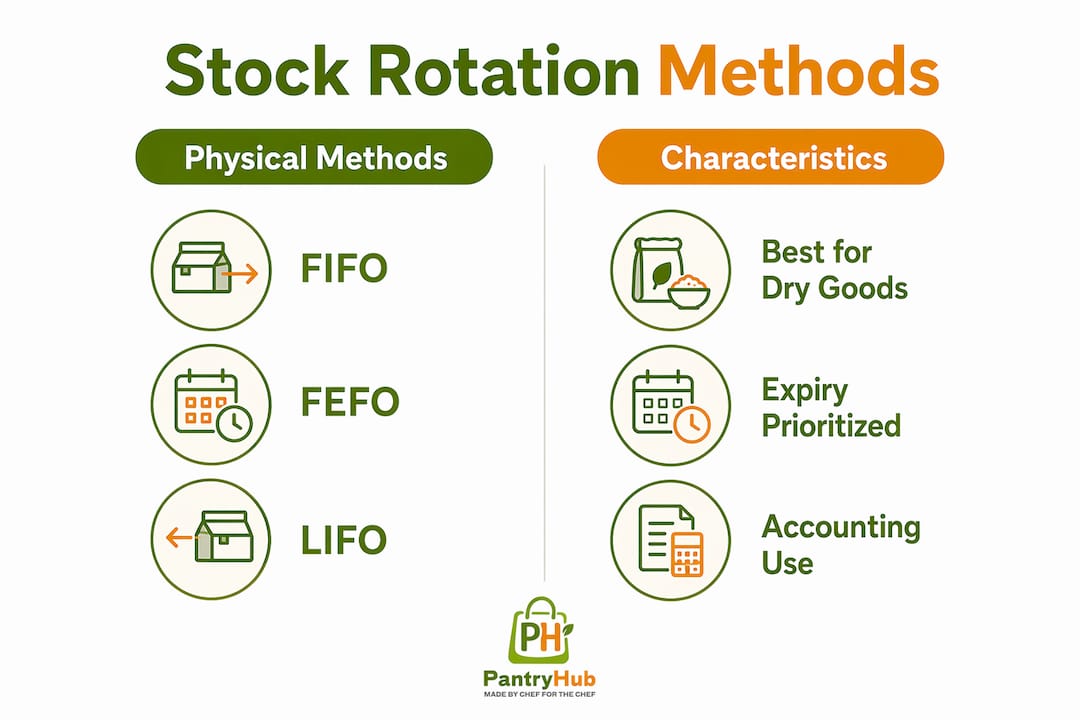
Three methods define how kitchens physically manage stock order. Each carries different risk profiles and operational demands.
FIFO (First In, First Out) is the dominant method for US foodservice. FIFO is a regulatory requirement mandated by the FDA Food Code and ServSafe, making it the legal baseline for most commercial kitchens. Older stock sits at the front or top of storage; newer deliveries go behind or below. Staff pull from the front, so the oldest product always moves first.

FEFO (First Expired, First Out) is a refinement of FIFO that prioritizes expiry date over arrival date. It applies most directly to perishable items where two deliveries might carry different use-by dates despite arriving in sequence. A batch of dairy delivered on Monday may expire before a batch delivered the previous Friday if cold chain conditions varied. FEFO catches that gap where FIFO alone would miss it.
LIFO (Last In, First Out) is primarily an accounting concept. LIFO is banned under most health codes for physical food handling because it leaves older stock buried at the back, accelerating spoilage and creating serious food safety risks.
Matching the rotation method to each SKU's shelf life and risk profile is what separates effective stock rotation from a policy that exists only on paper.
| Method | Best for | Spoilage risk | Tech requirement |
|---|---|---|---|
| FIFO | Dry goods, packaged items, most perishables | Low when enforced | Basic labeling |
| FEFO | High-turnover perishables, dairy, produce | Very low | Expiry-tracking software |
| LIFO | Accounting only. Not for physical food use | Very high | Not applicable |
Pro Tip: Apply FEFO to any product category where two deliveries within the same week could carry different expiry dates. Dairy, fresh produce, and prepared sauces are the most common examples.
How does stock rotation affect food safety and financial performance?
Poor rotation is one of the most expensive operational failures a kitchen can make. Financial losses from expired products run 3–8% of total inventory value, and US food waste from inefficient rotation costs $163.1 billion annually. That figure represents real money leaving real kitchens every day.
Regulatory exposure compounds the financial hit. Fines for rotation violations range from €500 to €5,000 per incident, and repeat offenses can trigger venue closures. The FDA Food Code requires that older products are positioned first to minimize spoilage, and health inspectors check storage areas specifically for FIFO compliance. A failed inspection is not just a fine. It is a public record that affects your reputation.
Inventory that sits too long stops being an asset. It becomes a liability. Every day an item ages past its optimal use window, it erodes your margin and ties up cash that could fund your next order.
Stock rotation also functions as a cash flow tool. Rotating inventory faster converts stock to sales more quickly, preventing capital from becoming frozen in aging product. A kitchen that rotates correctly holds less dead stock, orders more accurately, and maintains better liquidity. Managers who track rotation as a financial metric, not just a food safety task, consistently make better purchasing decisions.
The link between food safety in kitchens and financial performance is direct. Spoiled product costs you twice: once when you discard it, and again when you reorder to replace it.
What are practical strategies for implementing stock rotation?
Consistent rotation requires three things working together: clear labeling, a layout that enforces the method, and staff who understand why it matters.
Labeling at the point of receipt
Label all deliveries at receipt with large, visible expiry or arrival dates before the product enters storage. Once items are stacked on a shelf, lot codes printed on the back of packaging become invisible. A label applied at delivery takes seconds and prevents hours of guesswork later. Use a consistent format across your team: date received, expiry date, and product name on every item.
Storage layout that makes FIFO automatic
A well-planned kitchen layout with one-direction flow and gravity racks removes the temptation to grab whatever is closest. Gravity flow racks load from the back and dispense from the front, so the oldest stock physically arrives at the pick point first. For standard shelving, organize storage so that new deliveries always go behind existing stock. Older items should never require staff to reach around or move newer product to access them.
Key layout principles for rotation compliance:
- Load new deliveries from the back or top of each shelf section
- Position high-turnover perishables at eye level for fastest access
- Use clear bin labels with product name and date range visible from the aisle
- Keep aisles wide enough for staff to restock without disturbing existing order
- Separate dry goods, refrigerated, and frozen zones with consistent FIFO rules in each
Staff training and incentive alignment
Automation and technology that captures expiry data improve compliance, but technology cannot replace a team that understands the purpose behind rotation. Train staff on the direct connection between rotation accuracy and food safety outcomes. Use real examples: a missed expiry date on a sauce that caused a customer complaint, or a spoiled produce delivery that cost the kitchen $200 in a single shift.
Performance metrics tied to rotation accuracy rather than speed create lasting culture change. When speed is the only metric, staff take shortcuts. When accuracy is measured and recognized, rotation becomes a habit rather than an afterthought. Onboarding new team members to follow inventory protocols from day one sets the standard before bad habits form.
What common challenges do kitchens face with stock rotation?
The most persistent rotation failures share a common thread: the system was designed for compliance on paper, not for how a busy kitchen actually operates.
Hidden expiry dates and poor layout are the two most frequent blind spots. Manufacturers print lot codes in small fonts on the back or bottom of packaging. Once a case is stacked, that information disappears. Staff cannot rotate what they cannot read. The fix is labeling at receipt, before the product ever reaches the shelf.
Layout failures are subtler but equally damaging. A walk-in cooler where newer deliveries get stacked in front of older stock because the delivery happened during a rush is a rotation failure waiting to happen. It is not a staff failure. It is a system failure. The layout did not make FIFO the path of least resistance.
Staff being rewarded for speed rather than accuracy is the cultural failure that underpins most protocol violations. A line cook pulling the nearest container instead of the oldest one during a Friday dinner rush is not being careless. They are responding rationally to the incentives they have been given. Managers who want better rotation outcomes need to change what they measure and reward.
Common challenges and their fixes:
- Hidden lot codes: Apply date labels at delivery, before stocking
- Blocked older stock: Redesign shelving so new product loads from behind
- Speed over accuracy: Add rotation accuracy to performance reviews
- Inconsistent labeling: Standardize label format across all staff and shifts
- High staff turnover: Build rotation into onboarding, not just annual training
Pro Tip: Walk your storage areas at the start of each week and pull any item where the label is missing or unreadable. Treat unlabeled stock as a rotation failure, not just a minor oversight. It changes how seriously your team treats labeling.
Reviewing your common inventory mistakes regularly gives you a structured way to catch these issues before they become costly patterns.
Key Takeaways
Effective stock rotation in the kitchen requires FIFO enforcement, accurate labeling at receipt, a layout that makes older stock physically accessible, and performance metrics that reward accuracy over speed.
| Point | Details |
|---|---|
| FIFO is the legal standard | FDA Food Code and ServSafe mandate FIFO for all US commercial kitchens. |
| Label at receipt, not after stocking | Apply visible date labels before product reaches the shelf to prevent hidden expiry information. |
| Layout enforces or undermines rotation | Gravity racks and one-direction flow make FIFO automatic rather than dependent on staff memory. |
| Poor rotation costs 3–8% of inventory value | Financial losses from expired product compound with regulatory fines and reorder costs. |
| Incentives drive behavior | Measuring rotation accuracy rather than speed reduces protocol violations and builds lasting compliance. |
Why rotation discipline separates good kitchens from great ones
Most kitchen managers understand FIFO in theory. The gap between knowing it and running it consistently is where real operational performance is won or lost.
I have seen well-funded kitchens with expensive shelving and printed rotation charts fail inspection because nobody enforced the system during a busy Saturday delivery. The chart was there. The training had happened. But when a delivery arrived mid-service and the easiest move was to stack it in front, that is exactly what happened. The system failed because it required staff to make the right choice under pressure, instead of making the wrong choice structurally impossible.
The kitchens I have seen get this right share one trait: the manager treats rotation as a non-negotiable operational standard, not a food safety formality. They walk the cooler. They check labels. They ask about rotation during shift briefings, not just during inspections. That consistency signals to the team that rotation accuracy is part of the job, every shift.
Technology helps. Expiry-aware software and barcode scanning reduce human error in high-volume operations. But the mindset has to come first. A digital tool installed in a kitchen where rotation is not taken seriously becomes another system that staff work around. Get the culture right, then use technology to reinforce it.
The financial case is straightforward. Kitchens that rotate correctly waste less, order more accurately, and hold less dead stock. That translates directly to margin. For a café or restaurant operating on thin margins, the difference between 3% inventory loss and 1% is often the difference between a profitable month and a break-even one.
— Admin
Pantryhub makes kitchen stock rotation easier to enforce
Running consistent FIFO and FEFO across a busy kitchen requires more than good intentions. Pantryhub's hospitality inventory software gives restaurant and café managers real-time visibility into stock levels, expiry dates, and low-stock alerts from any device.
Pantryhub tracks stock movement, flags items approaching expiry, and supports accurate ordering so you stop rebuying product you already have. The platform is built specifically for commercial kitchens, which means the workflow matches how your team actually operates during service. Whether you manage a single café or multiple locations, Pantryhub gives you the data to enforce rotation protocols, reduce spoilage, and protect your margins every week.
FAQ
What is the role of stock rotation in a kitchen?
Stock rotation in the kitchen means using the oldest inventory first to prevent spoilage, maintain food safety, and reduce waste. It is the operational practice that connects daily storage habits to regulatory compliance and financial performance.
What does FIFO mean in kitchen inventory management?
FIFO stands for First In, First Out. It requires that the oldest stock is used before newer deliveries, and it is mandated by the FDA Food Code and ServSafe as the legal standard for US commercial kitchens.
How does poor stock rotation affect a restaurant financially?
Poor rotation causes financial losses of 3–8% of inventory value through expired product, plus regulatory fines and reorder costs. US food waste from inefficient rotation totals $163.1 billion annually across the industry.
What is the difference between FIFO and FEFO?
FIFO rotates stock by arrival date, while FEFO (First Expired, First Out) rotates by expiry date. FEFO is more precise for perishables where two deliveries may carry different use-by dates regardless of when they arrived.
How can kitchen managers improve stock rotation compliance?
Label all deliveries at receipt with visible dates, design storage so older stock is always at the front, and measure staff performance on rotation accuracy rather than speed alone. Digital tools that track expiry dates and enforce pick order reduce human error in high-volume kitchens.