

FIFO (first in, first out) rotates stock by receipt date; FEFO (first expired, first out) rotates it by expiry date. Use FEFO for anything with a use-by or best-before date and FIFO for undated, long-life goods. The two aren't rivals, either. You can run FIFO accounting for your books while your team physically picks by FEFO on the floor.
TL;DR:
- FEFO significantly reduces expired product write-offs and regulatory risks but requires accurate expiry data capture at receiving and ongoing compliance checks.
- Using FEFO and FIFO concurrently for different SKUs based on perishability optimizes stock rotation while minimizing manual data entry and process complexity.
- Proper implementation of FEFO involves enforcing expiry date enforcement, physical shelf organization, staff training, and weekly tracking of expiry rates and pick accuracy.
- FIFO maintains its role in accounting and for undated items, while FEFO is strictly a physical picking rule for items with expiry or use-by dates.
- Automatic FEFO systems that integrate expiry data collection and alerting can greatly improve rotation accuracy and reduce manual errors across multiple sites.
Table of Contents
- FIFO vs FEFO: What Each Term Actually Means
- FIFO vs FEFO Comparison: Sorting Rules, Data, and Failure Points
- Which Method Fits Which Product Type?
- How Do You Roll Out FEFO on the Floor?
- Does FIFO or FEFO Change Your Accounting?
- Where FIFO and FEFO Rotation Usually Breaks Down
- The Real Reason Most Kitchens Get This Wrong
- Make FEFO Automatic Instead of Manual
FIFO vs FEFO: What Each Term Actually Means
FIFO does double duty, and that's where most confusion starts. On the accounting side, FIFO is a cost-flow assumption: the oldest purchase cost gets assigned to cost of goods sold first, regardless of which physical unit actually leaves the shelf. On the warehouse floor, FIFO also describes a picking convention: oldest stock in, oldest stock out.
FEFO only lives on the floor. It's a picking and policy rule, not an accounting method, and it sorts stock by expiry or use-by date instead of receipt date. Many operators run both at once without realizing it, and that's actually the smart setup, not a contradiction, according to LineNow's breakdown of the three rotation methods.
Picture a restaurant walk-in cooler. The bookkeeper values dairy inventory using FIFO costing for the profit and loss statement. Meanwhile, the kitchen team pulls the carton with the nearest use-by date first, even if it arrived after a later-dated carton from a different delivery. Both rules are correct, at the same time, for the same product.
- FIFO (accounting): oldest cost hits COGS first
- FIFO (picking): oldest received unit ships first
- FEFO (picking): nearest-expiry unit ships first, receipt date ignored
FIFO vs FEFO Comparison: Sorting Rules, Data, and Failure Points
The core operational difference between FIFO and FEFO comes down to one question: what field are you sorting on? FIFO sorts on receipt date or lot sequence. FEFO sorts on expiry date, and FEFO is standard for perishables, pharmaceuticals, and cosmetics precisely because receipt order and expiry order frequently don't match.
That mismatch is the failure mode FIFO can't catch. Say a supplier delivers a fresh batch of yogurt with a shorter shelf life than the batch already sitting in the cooler, maybe due to a different production run or a slower cold chain upstream. Pure FIFO picking sends out the older-received, longer-dated batch first and leaves the short-dated new arrival sitting in the back. It expires on the shelf while "fresher" stock in receiving-date terms gets sold.
FEFO prevents that, but it costs you something. It demands lot and expiry capture at receiving, expiry fields in your inventory system, and a picking process that checks dates instead of just grabbing the nearest box. FEFO implementation cuts expired-product write-offs and supports regulatory compliance, but it adds real data and process complexity that undated FIFO simply doesn't need.
- FIFO: low data overhead, prevents aging stock, blind to expiry mismatches
- FEFO: higher data overhead, prevents expiry loss, requires accurate date capture at every receiving event
Which Method Fits Which Product Type?
Not every SKU needs the same rule, and forcing one method across an entire assortment wastes effort on one end and risks spoilage on the other. Match the method to what actually goes bad.
- Perishables, pharmaceuticals, and cosmetics get FEFO. Anything with a use-by or best-before date belongs to expiry-based picking. Warehouses that separate FEFO for dated items from FIFO for everything else tend to run leaner on both waste and labor.
- Spare parts, dry hardware, and non-dated goods stay on FIFO. Running FEFO on stock with no expiry date just adds paperwork with no waste benefit.
- Mixed assortments get a per-SKU policy, not a warehouse-wide rule. Tag each item as FEFO or FIFO individually rather than picking one method for the whole facility.
- When two lots share the same expiry date, fall back to FIFO. Pick the older receipt first so staff aren't left guessing between identical dates.
Supplier agreements matter here too. If a vendor delivers stock that's already used up a third of its shelf life, your FEFO system inherits that shrinking window. Building a minimum remaining shelf life into supplier service agreements protects the whole rotation strategy before goods even hit your dock.
How Do You Roll Out FEFO on the Floor?
Switching from FIFO to FEFO, or tightening a FIFO process you already run, comes down to four connected changes: what you capture at the dock, how your system allocates picks, how the physical space is arranged, and what you measure afterward.
- Fix receiving first. Capture lot number, production date, and expiry date on every delivery, and calculate remaining shelf life against your minimum threshold. Reject or quarantine anything that arrives undated.
- Configure your system to enforce dates. Set FEFO as an attribute at the SKU or product-group level, apply FIFO as a tiebreaker, and quarantine any lot missing an expiry entry so it can't accidentally ship.
- Rework the physical layout. Add shelf labels showing expiry, front-face short-dated stock, and organize pick faces so the nearest-expiry item is the easiest one to reach, not the hardest.
- Train staff and log exceptions. Require a pick-validation scan against the lot's expiry field, log every manual override, and revisit supplier shelf-life terms when short-dated deliveries keep recurring.
- Track four numbers weekly. Expiry-rate (stock lost to date), write-off dollars, pick accuracy against the FEFO rule, and time-to-pick, since date-checking will slow pickers down at first.
For a deeper walkthrough on organizing pick faces and shelf labeling in a working kitchen, our guide to stock rotation in the kitchen covers the physical side in more detail.
Pro Tip: Run your SKU reclassification and staff retraining as a single event, not two separate rollouts. Teams that add expiry-horizon reports and daily short-dated alerts right after reclassifying tend to see write-offs drop fast, because the new habit and the new data land together instead of staff relearning the process twice.
Does FIFO or FEFO Change Your Accounting?
FEFO doesn't touch your books at all. It's purely a picking rule. FIFO is different because it's also a costing method, and that distinction matters for anyone reconciling inventory value with what's physically leaving the warehouse.
Under FIFO accounting, the cost of your oldest inventory hits cost of goods sold first, which is permitted under both IFRS and GAAP. During inflationary periods, that tends to push reported profit and taxable income higher, since older, cheaper stock is what's being expensed while replacement costs climb.
LIFO works the opposite way. It assigns your newest, usually more expensive, costs to COGS first, which lowers reported income when prices are rising. LIFO is disallowed under IFRS, so international operators generally don't have the option anyway. Talk to your accountant about which costing method fits your tax position, but keep that conversation separate from how you physically rotate stock on the shelf.
- FIFO costing: oldest cost to COGS, higher taxable income in inflation, IFRS and GAAP compliant
- LIFO costing: newest cost to COGS, lower taxable income in inflation, blocked under IFRS
- Picking method choice: entirely operational, unaffected by which costing method your books use
Where FIFO and FEFO Rotation Usually Breaks Down
Most FEFO failures trace back to the receiving dock, not the picking floor. A delivery arrives without a printed expiry date, someone logs it anyway, and the system treats it as though it never expires. That one gap undoes every downstream control.
Manual overrides are the second big culprit. A picker grabs the closest box instead of scanning the lot, especially under time pressure, and the exception never gets logged. Over weeks, those quiet overrides are what actually drive your write-off number, not any flaw in the FEFO logic itself.
- Undated lots: quarantine on arrival, don't guess an expiry date
- Silent manual overrides: require a scan at every pick, log exceptions automatically
- No visibility into what's aging: run a weekly expiry-horizon report and reconcile pick-to-lot data
- Recurring short-dated deliveries: renegotiate minimum remaining shelf life with that supplier
The Real Reason Most Kitchens Get This Wrong
The mistake I see constantly isn't picking the wrong method. It's treating FIFO and FEFO as a single either/or decision when they're answering two different questions. Kitchens that fail at rotation usually failed at receiving discipline months earlier, not at the picking step everyone blames.
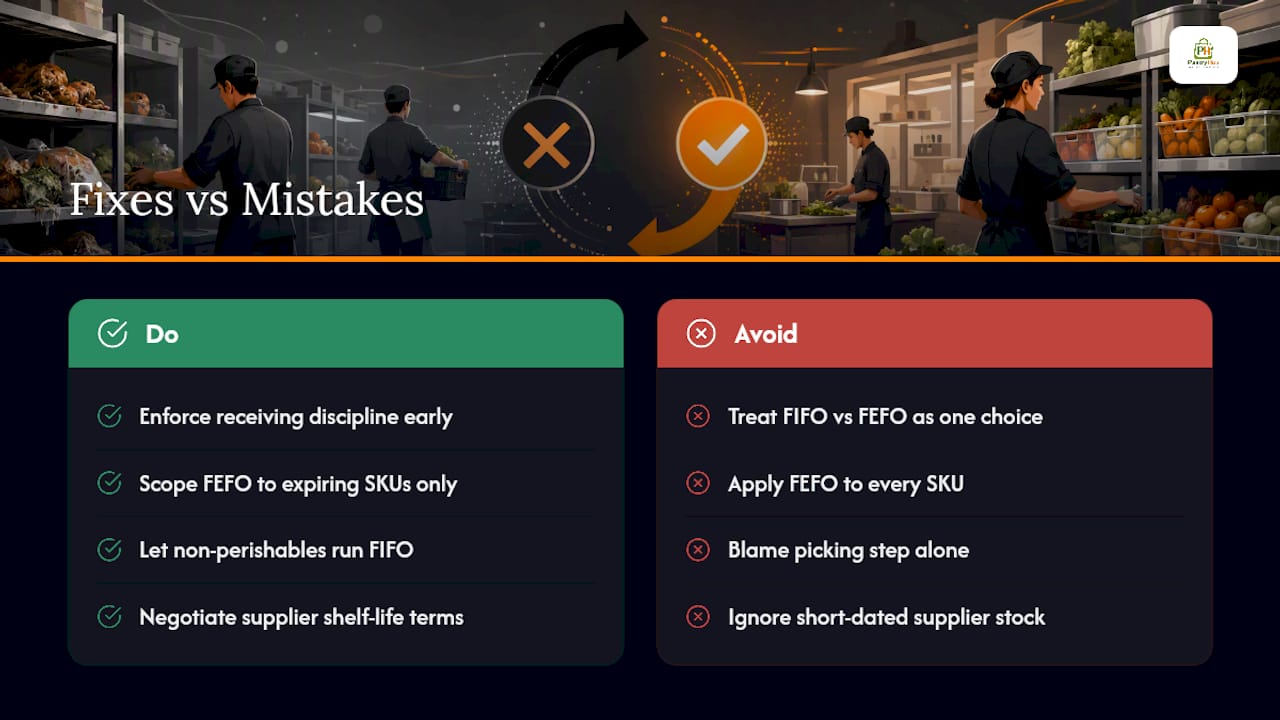
Here's the uncomfortable part: FEFO looks like the "better" method on paper, and for dated stock it is. But bolting expiry tracking onto every SKU, including the dry goods and hardware that never expire, just buries staff in fields to fill out for zero waste benefit. The operators who get this right are ruthless about scoping FEFO to only the items that need it, and letting everything else run on simple FIFO. That discipline, not the sophistication of the system, is what actually keeps write-offs down. Reducing spoilage this way also has a compounding effect worth naming: less waste going to landfill is a real, measurable piece of an operator's sustainability performance, not just a cost-control talking point.
The other underestimated factor is supplier behavior. Kitchens obsess over internal picking rules while ignoring that a chunk of their expiry losses arrive already baked in from a supplier shipping short-dated stock. Fixing your floor process without fixing your incoming shelf-life terms is solving half the problem.
— Admin
Make FEFO Automatic Instead of Manual
Running FEFO on paper or in a spreadsheet means someone has to remember to check dates every single time, and eventually someone won't. There are hospitality inventory platforms designed to capture lot and expiry data at receiving, flag nearest-expiry stock automatically, and send low-stock and expiry alerts before anything gets buried behind newer deliveries.
For multi-site operators, some platforms extend that visibility across every location from one dashboard, helping head office avoid chasing spreadsheets from multiple kitchens to find out what's about to expire. Such platforms may also connect supplier ordering to real stock positions, reducing emergency orders and short-dated deliveries slipping through unnoticed.
If you're still running rotation manually, start a free trial through the Pantryhub pricing page and see how much of this checklist your software could be handling for you already.