
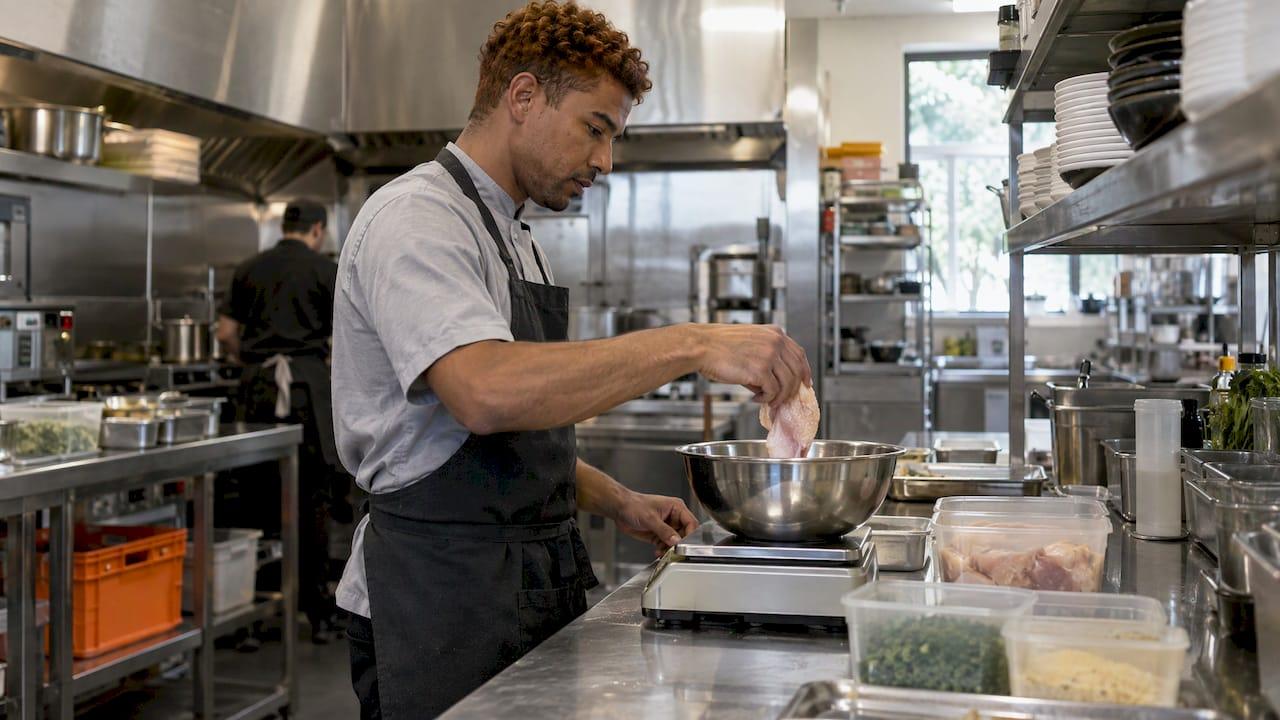
In a restaurant, a bill of materials (BOM) is the recipe broken down into every ingredient, quantity, unit and cost needed to produce one dish or one batch. Manufacturers use the term for the parts list of a product. Kitchens usually call it a standardized recipe or recipe card, and "recipe BOM" is the same thing with costing and stock attached. Build one for every menu item and you can price dishes properly, order the right amounts and see where food is going missing. Keep it in a system that links to your stock counts and suppliers, and it updates itself as prices move.
TL;DR
- A recipe BOM lists every ingredient in a dish with quantity, unit, yield, portion size and cost, so one dish costs the same to make whoever is on the pass.
- Cost per portion is total ingredient cost divided by portions, but only after you adjust for trim, peel and cooking loss (yield).
- The same BOM drives menu pricing, ordering, par levels and waste tracking, so build it once and reuse it everywhere.
- Supplier prices move, so review costs fortnightly or monthly, or let software recalculate them when invoices change.
- If you run a café, pub, club or restaurant in Australia, Pantryhub plans start at $39 per month, with a free trial.
Table of Contents
- What a bill of materials means in a restaurant
- What goes into a recipe BOM
- How to build a recipe BOM, step by step
- Using the BOM beyond costing
- Keeping your recipe BOMs current
- Spreadsheet, or software that does it for you
- Our view: the recipe is the control point of the kitchen
- Try it on your own menu
- FAQ
- Sources
What a bill of materials means in a restaurant
The phrase comes from manufacturing, where a BOM is the full list of parts and quantities needed to build one product. Translate that to a kitchen and the "product" is a plated dish, a sauce, a dough or a cocktail. The "materials" are your ingredients and packaging.
You will hear it called a recipe BOM, a standardized recipe, a recipe card or a costed recipe. The names differ, but the job is the same: write down exactly what goes into one serve so that the cost and the result are predictable.
Without one, the recipe lives in the head of whoever cooks that shift. The fish and chips come out with 180 g of fish on Friday and 220 g on Saturday. A new cook free-pours the oil. Nobody can say what a burger actually costs, so the menu price is a guess. Those gaps quietly eat into margins, and they are hard to find in a month-end profit and loss because they are spread across hundreds of plates.
What goes into a recipe BOM
A useful BOM is short enough to use on a busy line and detailed enough to cost. Nisbets Australia's costing guide recommends a sheet with these fields: meal name, a recipe identifier or code, yield, portion sizes, an area for chef's notes, a breakdown of every ingredient (including seasonings, oil and additives) and revision fields. A 2024 profitability workshop booklet hosted by Health Promotion Australia describes costing sheets the same way: ingredients or packaging, quantities, units, cost per unit and total recipe cost.
Put together, each recipe BOM should carry:
| Field | What to record | Why it matters |
|---|---|---|
| Dish name and code | One name, one code per dish or batch | Links the recipe to your menu, POS and stock |
| Yield | How many serves or how much finished product the batch makes | Lets you scale up and divide cost |
| Portion size | Grams, millilitres or pieces per serve | Stops portion creep |
| Ingredients | Every item, including oil, salt, garnish and sauces | Small items add up across hundreds of serves |
| Quantity and unit | The amount in the unit you count and order (g, kg, L, each) | Keeps recipes and stock counts in the same language |
| Usable yield % | How much of the purchased item ends up on the plate | Turns purchase cost into true cost |
| Unit cost | Latest price per purchase unit from your supplier | Drives the cost per portion |
| Packaging | Takeaway boxes, cups, paper, lids | Essential for cafés and fish and chip shops |
| Method and chef's notes | Short steps and plating notes | Consistency between cooks and shifts |
| Revision date | When it was last costed | Shows which recipes are out of date |
Sub-recipes count too. A house burger sauce, a pizza dough, a stock or a batter should each have their own BOM, then appear as a single line in the dishes that use them. That way, when the mayo cost changes, every dish that uses it changes with it.
How to build a recipe BOM, step by step
1. Start with your best sellers and highest-cost dishes
Don't try to document the whole menu in a weekend. Start with the dishes that sell most and the ones with expensive proteins, seafood or cheese. A café might begin with its top five breakfast plates and the coffee and milk lines. A pub starts with the parmas, steaks and schnitzels. A fish and chip shop begins with fish, chips, calamari and the seafood basket.
2. Weigh and record what actually goes on the plate
Cook the dish the way your best cook makes it, and weigh each component as it goes in. Do not copy amounts from an old recipe or a cookbook. Record grams, millilitres or each-pieces, and include the oil, seasoning, garnish and sauce. Then fix the portion size: the finished weight or count per serve.
3. Convert purchase units into recipe units
You buy chicken thighs by the 10 kg carton, but the recipe uses 150 g. List both, so the system or sheet knows a carton holds 10,000 g. This is where manual sheets often go wrong: a supplier changes a pack size from 2 L to 2.5 L and the cost per millilitre quietly stops being right.
4. Apply yield to get the true cost
Yield is the usable part of what you buy. The Institute of Child Nutrition's costing lesson defines yield percentage as the edible product weight divided by the as-purchased weight, multiplied by 100. It also gives the planning formula: quantity needed equals number of portions times portion size, divided by yield percentage.
Here is an example with round numbers. You want 20 serves of 150 g trimmed pork belly. Your butcher's belly has a tested yield of 75% after skin, bone and cooking loss.
- Usable weight needed: 20 × 150 g = 3,000 g
- Weight to buy: 3,000 g ÷ 0.75 = 4,000 g (4 kg)
If you cost only 3 kg, you understate the ingredient by a quarter. The lesson makes the same point: paying for trim, peel, brine or cooking loss reduces what is usable, so costing only the purchase weight understates the cost of the edible product. Run a yield test on any ingredient with real loss: whole fish, fillets, prawns, ribs, brisket, vegetables you peel, and anything you roast or brine.
The oven also adds a cost that a plain ingredient list misses. If you want to put a figure on long cooks, a guide to commercial oven running costs shows one way to work out what each hour of oven time costs.
5. Calculate cost per portion
Add up the cost of every line, then divide by the number of serves the batch yields.
The Victorian Healthy Eating Advisory Service publishes a recipe costing template with a worked example: 24 chicken burger serves with a total ingredient and packaging cost of $63.90, which comes to $2.66 per serve. The Nisbets guide shows a chicken curry costing $47.22 for eight 400 g meals, or $5.90 per meal. Both follow the same arithmetic: total cost divided by serves.

To turn cost into a menu price, divide the cost per portion by your target food cost percentage. A $5.90 dish at a 30% target is $5.90 ÷ 0.30, about $19.67 before GST considerations, so you might round to $19.90 or $20. For benchmarks and the different costing methods, see our guide to recipe costing methods and keeping food cost between 28 and 35%.
6. Lock it in and train the team
A BOM only works if the kitchen uses it. Put the card where the cook can see it, use scales and portion tools, and make the recipe the standard for the dish. When a chef changes something, update the BOM first, then the menu. Give each version a date.
Using the BOM beyond costing
The costed recipe is the starting point. Once every dish has a BOM, the same data does several jobs.
Menu pricing. You can see which dishes earn their place and which ones look popular but make little. Dishes with a high cost per serve and a low price are the first to fix, by adjusting portion, ingredient or price.
Ordering and par levels. If you know a burger uses 140 g of mince and you sell about 400 a week, you know how much mince to order. A par level is the amount of an item you want on the shelf at the start of a service or week, and BOMs let you set them from real usage instead of habit. Our guide to ingredient-level stock tracking shows how that works in practice.
Stock counts and variance. The Health Promotion Australia booklet describes a stocktake as physical verification of the quantities and condition of items held, with fields for product, purchase unit, amount in stock, unit cost and stock value. Compare what the BOM says you should have used against what the count says you did use. The gap is your variance: waste, over-portioning, spillage, theft or unrecorded comps. Start with our stock count sheet guide and the kitchen inventory checklist to set the routine.
Waste reduction. When you know the intended use of each ingredient, over-ordering and spoilage show up quickly. Prep lists built from the BOM mean cooks prepare what is needed, not what feels safe. For the wider picture, read our restaurant cost control strategies.

Keeping your recipe BOMs current
A costed recipe goes stale as soon as a supplier's price changes. Nisbets recommends reviewing recipe costs fortnightly or monthly because food prices change. In practice, the items to watch first are the volatile ones: seafood, cheese, oils, dairy, produce in off-season and imported goods. Pantry staples such as flour or rice also move over time; if you bake in-house, a flour or specialty ingredient like organic white rice flour is a good example of a line to recheck whenever your supplier's price list changes.
A simple routine that works for a small venue:
- When a supplier invoice arrives, check the lines for any price change over about 5%.
- Update the unit cost for those ingredients.
- Recalculate the dishes that use them, starting with the top sellers.
- Note the date in the revision field.
- Once a quarter, re-weigh portions and re-test yields on the high-cost items.
Done by hand in a spreadsheet, this takes hours, and it is the step most venues skip. That is why costed recipes so often sit untouched for a year while the margin slips.
Spreadsheet, or software that does it for you
A spreadsheet is a reasonable way to prove the idea. It breaks down when you have more than a few dozen recipes, more than one person editing, more than one site, or suppliers who change prices every week. Every change must be copied across by hand, units get mixed up, and the stock count lives in another file entirely.
What operators in Australia need is a recipe BOM that is connected to the rest of the kitchen: recipes, ingredient costs, stock levels, supplier orders and reporting in one place. That is what we built Pantryhub to do. It is an inventory and ordering platform designed for Australian restaurants, cafés, bars, pubs, clubs and commercial kitchens, with recipe and pricing standardization, real-time stock tracking, low-stock alerts, supplier ordering, waste and cost reporting, team access controls and multi-location management. It works in Australian dollars and has GST-ready reporting, and it is mobile-first, so a chef can count stock on a phone in the coolroom.
Our view: the recipe is the control point of the kitchen
We built Pantryhub by chefs, for chefs, so we start where the kitchen starts: with the recipe.
Most venues we talk about in this industry have the same problem. The costs are known in general terms, but not dish by dish. Stock is counted, but not matched to what should have been used. Orders are placed from memory and habit. A standardized recipe with real ingredient costs is what joins those three things together.
That is why our platform keeps recipes, pricing, stock and supplier ordering in one place. When the recipe is the source of truth, a price change from a supplier flows through to the cost of the dish, a low-stock alert has a meaning, and a weekly report can show where the margin went. Operators can bin the spreadsheets and spend their time on the pass instead of on formulas.
We price for Australian venues in Australian dollars, support them locally, and offer plans that suit a single café as well as a multi-site group.
the author
Try it on your own menu
The quickest way to see the value of a recipe BOM is to cost your top ten dishes against real supplier prices. Pantryhub plans are Starter at $39 per month, Regular at $69 per month and Pro at $99 per month, with plans based on venue count and the features you need. You can start a free trial and put your first recipes in today. If you are in Melbourne or Adelaide, see our local pages for restaurant inventory software in Melbourne and in Adelaide.
If you also want a simple starting point for counts, our guide to food inventory templates for restaurants explains what to include, and our step-by-step guide to tracking ingredient usage shows how to start from the recipe.
FAQ
What is a recipe BOM?
A recipe BOM is a costed, standardized recipe that lists every ingredient and packaging item in a dish with its quantity, unit, yield and cost. It tells you what one serve should contain and what it should cost. Kitchens also call it a recipe card or costed recipe.
How is a bill of materials different from a normal recipe?
A normal recipe tells a cook how to make a dish. A BOM adds the numbers behind it: exact quantities, purchase units, usable yield, unit costs and cost per portion. That extra detail is what lets you price the menu, set par levels and compare expected usage with your stock counts.
How often should I update recipe costs?
Review them at least fortnightly or monthly, as the Nisbets guide recommends, since food prices change. Check high-volatility items like seafood, dairy and oils more often. Software that recalculates costs whenever a supplier price changes removes most of that manual work.
Do I need a BOM for every item on the menu?
Begin with your best sellers and your most expensive dishes, then work through the rest. Sub-recipes such as sauces, batters and doughs deserve their own BOM because they feed many dishes. Beverages and packaging for takeaway belong in the system too.
Sources
- A Guide to Menu & Food Costing, Nisbets Australia
- Profitability workshop participant summary booklet, Health Promotion Australia (2024)
- Lesson 2.4: Recipe and Menu Costing, Institute of Child Nutrition
- Schools Recipe Costing Template, Healthy Eating Advisory Service (Victoria)
- Calculate Commercial Oven Running Costs
- Organic White Rice Flour