
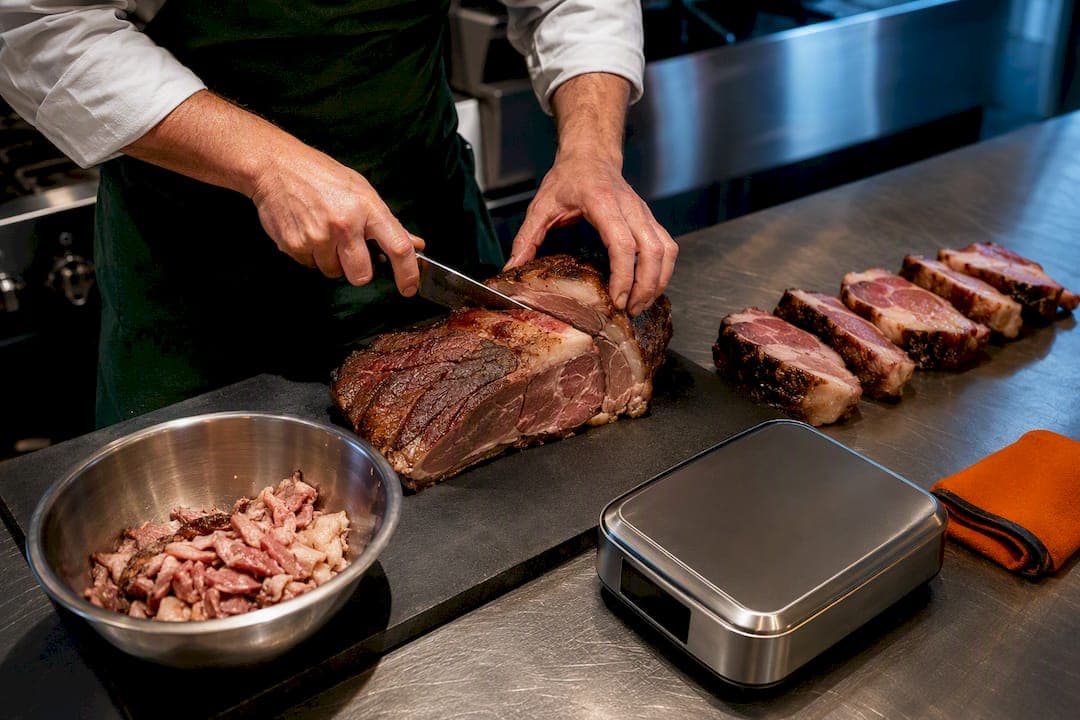
The single method that works for most restaurants and cafés is yield‑adjusted ingredient costing, built on a standard recipe detail sheet with prices linked to live inventory. You cost every ingredient at its edible portion rate, total it into a cost per portion, then check that number against a target food cost of 28% to 35% for a typical restaurant. Start with your top selling items this week. Software platforms can automate the price updates once the template is built.
TL;DR:
- Yield-adjusted ingredient costing is essential for accurately pricing proteins, seafood, and produce with heavy waste, as it accounts for trim and cooking loss.
- Using consistent recipe detail sheets with proper unit conversions and regular yield tests ensures precise cost per portion and prevents under-costing.
- Updating recipe costs monthly for top sellers and immediately after supplier price changes avoids discrepancies between theoretical and actual food costs.
- Inventory-linked software can automate price updates, saving hours and reducing errors, especially for multiple locations with frequent price fluctuations.
- Focusing on accurate yield testing and process standardization is more impactful than software alone, as manual tests are required for reliable cost calculations.
Table of Contents
- What Are the Main Recipe Costing Methods?
- How Do You Build an Accurate Recipe Cost, Step by Step?
- What Belongs on a Recipe Detail Sheet?
- How Often Should You Update Recipe Costs?
- Putting the System Into Practice
- Automate the Recipe Costing Workflow With Pantryhub
- Sources
- FAQ
What Are the Main Recipe Costing Methods?
Four approaches cover almost every kitchen, and picking the right one depends on how fast your prices move and how much time your team has.
Cost-plus costing takes a rough ingredient total and adds a markup. It's fast, and it works for a food truck with a six-item menu. It falls apart the moment you're running proteins with real trim loss, because a rough guess on a $32/kg beef cut can be off by several dollars per portion.
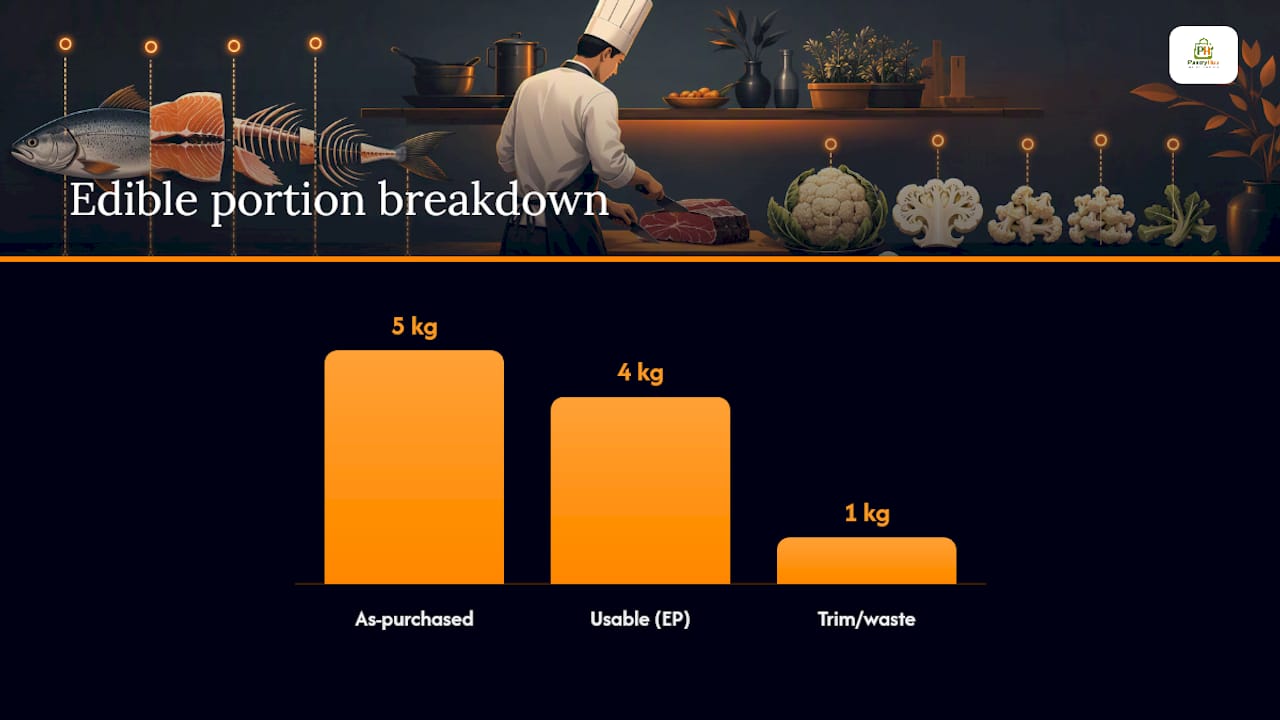
Yield-adjusted edible portion (EP) costing starts with the as-purchased quantity (APQ), then applies a yield percentage from an actual trim or cooking test to get the true cost per usable kilogram. This is the method that matters most for meat, seafood, and produce with heavy waste. A 5 kg roast bought at $8/kg that yields 4 kg of usable meat after trimming actually costs $10/kg once you account for the loss/02%3A_Menus_and_Recipes/2.04%3A_Recipe_and_Menu_Costing), not $8. Skip this step and every dish built on that protein is under-costed.
Batch-to-portion costing fits soups, stocks, sauces, and bakery items where you cost the whole pot or tray, then divide by yield count. A 20-liter stock pot costed at $84 and yielding 80 portions gives you $1.05 per portion, and that math holds whether you're pricing a soup special or a house vinaigrette.
Software-assisted costing links your recipe sheets to live supplier prices and inventory SKUs, so a cost update happens automatically instead of during a Sunday-night spreadsheet session.
Here's how the tradeoffs actually shake out:
- Cost-plus: fastest to set up, least accurate, fine only for low-waste, low-price-volatility items.
- Yield-adjusted EP costing: the accuracy standard for anything with trim, bone, or cooking loss.
- Batch-to-portion: the natural fit for kitchens running large-format prep.
- Inventory-linked software: worth it once price changes hit weekly or you're managing more than one venue.
Once you have an accurate cost per portion from any of these, you're ready to set price using cost-plus, market-based, or value-based pricing — but that decision only works if the cost underneath it is right.
How Do You Build an Accurate Recipe Cost, Step by Step?
Accuracy comes from following the same sequence every time, not from a smarter spreadsheet formula.
-
Build one standard recipe detail sheet and use it for every dish. Fields should include ingredient name, purchase unit, SKU, purchase price, yield percentage, EP cost, batch size, portion count, cost per portion, and resulting food cost percentage. A fixed template keeps every dish comparable, which matters once you're scanning a whole menu for margin problems.
-
Convert purchase units into recipe units. If you buy olive oil by the 4-liter tin but use it by the tablespoon, work out the per-tablespoon cost once and store it. Get this wrong and every recipe using that ingredient inherits the error.
-
Run yield tests on proteins and produce with real trim or cooking loss. Weigh the item as purchased, trim or cook it the way your kitchen actually does, then weigh the usable result. Divide usable weight by original weight for your yield percentage, then apply that to the purchase cost to get true EP cost.
-
Calculate extended cost, batch cost, and cost per portion. Extended cost is the EP unit cost multiplied by the quantity used in the recipe. Add every ingredient's extended cost for the batch cost, then divide by portion count. A pasta dish with $4.20 in ingredients selling at $18 runs a 23% food cost, which sits comfortably inside target range.
-
Don't skip the small stuff. Garnish, finishing oils, and sauce components can each add $0.10 to $0.30 per plate, and across 100 covers a day that gap adds up fast.
-
Prioritize by impact. Cost your top selling items and highest-cost proteins first, since those items cause the biggest swing in gross margin if the numbers are wrong.
Pro Tip: Use a quick approximate yield (based on industry averages) for low-volume specials, but run a full weigh-in test on anything you sell more than 20 times a week. The time investment pays for itself the first time a supplier changes their cut spec.
What Belongs on a Recipe Detail Sheet?
A recipe detail sheet only works if it captures the full picture, including how sub-recipes feed into finished dishes.
Every sheet needs: ingredient name, purchase unit and price, SKU reference, yield percentage, EP cost per unit, quantity used, extended cost, batch yield, cost per portion, and target food cost percentage. If a dish uses a house-made sauce or stock, that sub-recipe needs its own costed sheet feeding into the parent dish, not a rough guess bolted on top.
Unit conversion mistakes are one of the most common ways costing goes wrong. Volume-to-weight conversions (a cup of flour is not the same weight as a cup of honey) trip up even experienced cooks, and reference tables like the Book of Yields exist specifically to standardize these numbers across a kitchen.
Linking that sheet to your actual inventory SKUs is where the real payoff shows up:
- Prices update automatically when a new invoice comes in, instead of sitting stale for months.
- Reporting shows which recipes are drifting out of target food cost range without a manual audit.
- Multi-location operators get one source of truth instead of five spreadsheets drifting apart.
Spreadsheets are genuinely fine for a single café with stable suppliers and a small menu. Once you're juggling multiple locations, weekly price movement, or more than 40 active recipes, an ingredient-level inventory link saves more hours than it costs.
How Often Should You Update Recipe Costs?
Costing isn't a once-a-year project. Prices move, suppliers change specs, and portion sizes drift without anyone noticing.
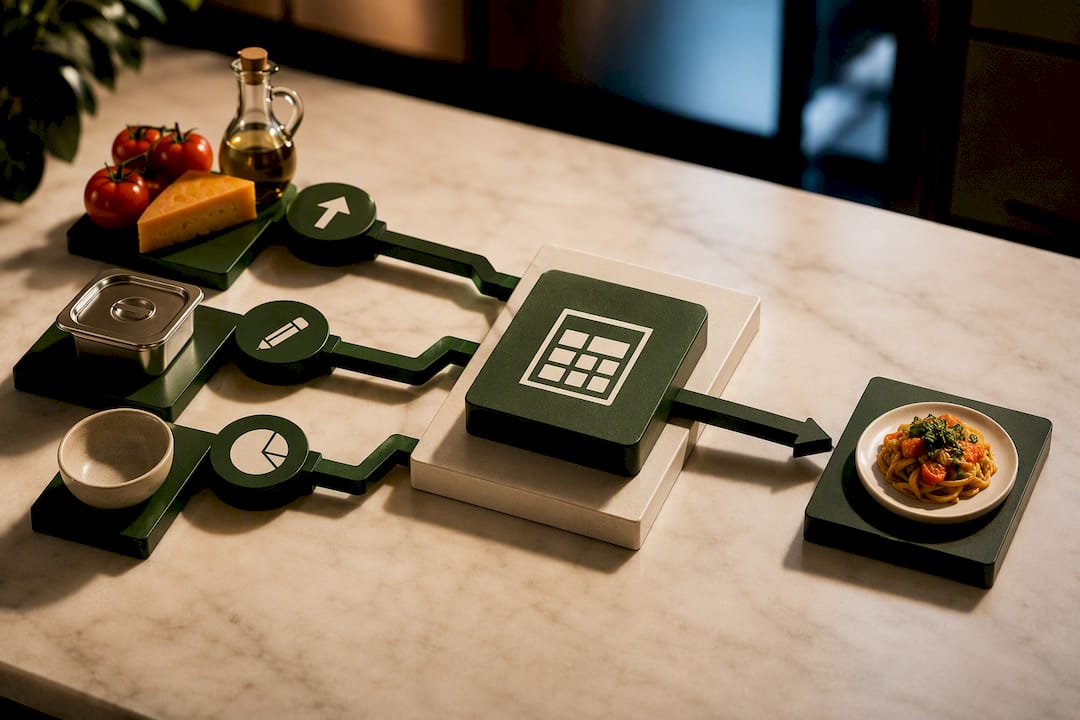
A workable cadence: recost your top sellers and highest-cost proteins regularly, and run the rest of the menu on a regular basis. Update immediately whenever a new invoice shows a major price move on a key ingredient.
Weekly, run three quick checks:
- Compare theoretical food cost against actual food cost from your P&L.
- Spot-check portion weights on two or three high-volume dishes.
- Scan for price jumps on your top 10 ingredients by spend.
A gap between theoretical and actual food cost of more than a couple of percentage points is worth investigating immediately — it usually points to portion drift, waste, or a stale ingredient price rather than a costing error. When that happens, investigate the top five variances first, tighten portion control tools, and reformulate or reprice before the gap becomes a pattern.
Putting the System Into Practice
Start with 10 to 30 dishes, not the whole menu. Standardize portions with scales and scoops before you touch a spreadsheet, and document real yields rather than industry averages wherever a dish drives real volume.
The traps are predictable: inconsistent portioning between shifts, prices that go stale the moment a supplier changes their list, and garnish or sub-recipe costs that quietly disappear from the math. Fix the process first. Software accelerates accuracy, but it can't correct a yield test you never ran.
— Admin
Automate the Recipe Costing Workflow With Pantryhub
Some hospitality inventory software alternatives to spreadsheet-based costing link invoices straight to ingredient SKUs, so when a price moves, every recipe using that ingredient recalculates automatically instead of waiting for manual updates.
Beyond automatic recalculation, such platforms can track low-stock alerts, consolidate food cost reporting across venues, and keep recipe detail sheets tied to current purchase prices rather than outdated figures. To judge the return, weigh it against the hours your team currently spends re-costing manually and the margin lost to prices that slipped through unnoticed. Plans start at A$39 a month, and you can see the full feature set on the hospitality inventory platform page before you commit.
Sources
FAQ
What Is the Best Recipe Costing Method for a Small Café?
Yield-adjusted ingredient costing on a standard recipe sheet is the most reliable starting point, even for a small menu, because it catches trim and cooking loss that flat cost-plus estimates miss.
What Food Cost Percentage Should Restaurants Target?
Most restaurants target 28% to 35%, while catering operations typically run a bit higher, around 30% to 40%.
How Do You Calculate Edible Portion Cost?
Divide the as-purchased cost by the yield percentage from a trim or cooking test; a $40 roast yielding 4 kg of usable meat from a 5 kg cut works out to $10 per kilogram edible.
How Often Should Recipe Costs Be Updated?
Recost top sellers and high-cost proteins monthly, run the rest of the menu quarterly, and update immediately after any major supplier price change.
Can Software Replace Manual Yield Testing?
No. Some software platforms automate price updates and recalculation once accurate yields are entered, but the yield test itself still has to be conducted manually in the kitchen.