
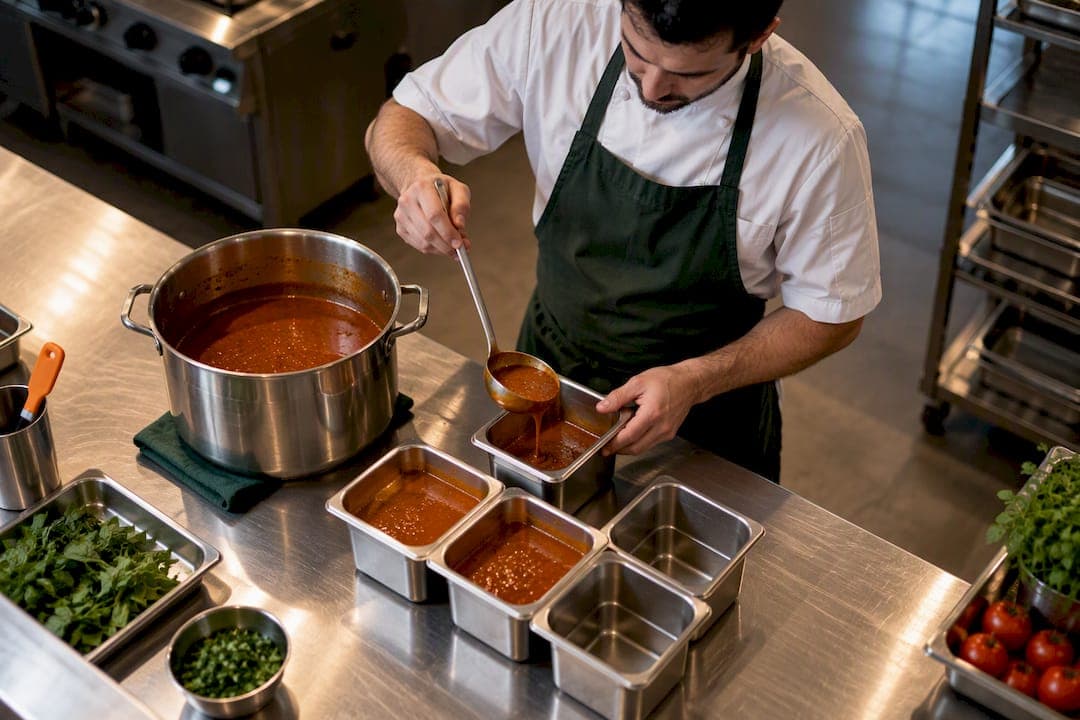
Batch recipe management turns culinary recipes into verified, costed production plans so kitchens hit target food cost, consistent quality, and traceable safety records. It replaces guesswork with documented yields, standard units, and prep cards that any team member can follow. Done well, it lowers waste and protects margins across one venue or many. Platforms like PantryHub build this discipline directly into daily kitchen operations.
TL;DR:
- Accurate recipe linking to inventory SKUs is crucial to prevent costing errors caused by unit conversions and supplier packaging differences.
- Verifying actual yields through live tests helps update master recipes, ensuring food costs and menu prices reflect real production outcomes.
- Implementing version control, approval workflows, and role-based permissions ensures consistency and accountability across multiple kitchen locations.
- Connecting recipes to demand signals allows for better stock reservation, reducing overproduction, spoilage, and purchasing costs by up to 31.6%.
- Recording critical food safety controls within recipes, such as temperature logs and cooling times, is essential for compliance and traceability in high-risk environments.
Table of Contents
- The building blocks of a reliable batch recipe system
- How to cost and verify batch recipes
- Scaling and standardizing recipes across locations
- Connecting recipes to inventory and demand forecasting
- Food safety and compliance controls to build into recipes
- Implementation checklist and pitfalls to avoid
- Why recipes deserve to be treated as production plans
- Putting batch recipe management to work with PantryHub
- Primary standards and studies worth reading next
- Sources
- FAQ
The building blocks of a reliable batch recipe system
Before you can cost or scale anything, your master recipes need a consistent structure. Every recipe should function as a production document, not a scribbled card taped above the pass.
A solid master recipe includes:
- Ingredient SKU and unit: each ingredient tied to a specific purchase unit so costing stays accurate.
- Yield and portion count: the total batch output and how many portions it produces.
- Method steps: written instructions detailed enough for any trained team member to follow.
- Critical control points: cooking and cooling temperatures flagged directly in the method.
- Version and date: so kitchens know which recipe is current and what changed.
Mapping ingredients to inventory SKUs matters more than it sounds. When a recipe calls for "1 kg diced tomato" but your supplier invoices in cases of 6 kg, someone has to do that conversion every single time, and errors creep in. Locking units at the recipe level removes that friction.
Prep cards translate the master recipe into something usable on the line: fewer numbers, clearer steps, and space to record actual output. Paired with SOPs, they create an audit trail that shows what was made, by whom, and to what standard.
How to cost and verify batch recipes
Theoretical cost on paper rarely matches what happens in production. Verifying that gap is what separates accurate food cost reporting from a spreadsheet that quietly drifts out of date.
- Cost every ingredient at SKU level, then total the batch cost and divide by portion count for a per-portion figure.
- Run a live yield test: produce a full batch under normal conditions and weigh or count the usable output.
- Compare actual yield to theoretical yield and note the variance, trim loss and cooking loss are the usual culprits.
- Update the master recipe with the verified yield and recalculate gross profit percentage and menu price implications.
- Set a re-testing cadence, ideally whenever a supplier, portion size, or preparation method changes.
Training resources for hospitality, including Training, outline this same sequence: convert yields to costs, calculate portion yields, and price to protect profitability.
Pro Tip: Log yield tests in the same place you store the recipe, not in a separate file, so the two numbers never drift apart.
Scaling and standardizing recipes across locations
A recipe that works in one kitchen can fall apart in another if it depends on one chef's memory. Standardizing across venues means building recipes that travel without losing accuracy or safety.
- Use templated master recipes with required fields locked in, including allergen flags and critical temperature limits.
- Apply version control and approval workflows so a head chef signs off before a change goes live in every location.
- Set role-based permissions so line cooks can view and log, while only senior staff can edit the master recipe.
- Run short, visual training sessions on prep cards rather than relying on verbal handovers between shifts.
- Assign a recipe owner per dish to keep accountability clear and maintain an audit trail across sites.
This governance layer is what makes multi-site consistency achievable. Without it, small substitutions and shortcuts accumulate until the "same" dish tastes and costs differently depending on which venue made it.
Connecting recipes to inventory and demand forecasting
Once a recipe is costed and standardized, the next gain comes from linking it directly to stock. Every batch you plan should translate into a specific SKU demand, reserving stock before prep even starts.
- Convert recipe usage into SKU-level demand so purchasing reflects what's actually being cooked.
- Feed short-term signals, bookings, local events, weather, into planned batch volumes to avoid overproduction.
- Trigger low-stock alerts automatically when recipe-linked usage pulls inventory below par.
- Reserve stock for scheduled batches so a big prep run doesn't get undercut by another section's order.
AI-enabled, demand-informed replenishment cut spoilage costs by an average of 19.4%, and up to 31.6% in stable branches, while reducing purchasing costs by about 4%, according to a 2026 Springer Nature study on sustainable inventory planning. The same research found forecasting accuracy improved substantially when demand data was tied directly to replenishment decisions rather than static averages.
Separate research into predictive analytics frameworks for restaurant operations found similar patterns: waste and cost fell when forecasts were translated into actual purchasing and prep decisions, not just reported as numbers on a dashboard.

Food safety and compliance controls to build into recipes
Recipes are also your compliance record. Kitchens handling unpackaged, ready-to-eat, potentially hazardous food need to prove critical controls were followed, not just claim they were.
Build these into every relevant prep card:
- Cooking temperatures logged against each protein or high-risk item.
- Cooling windows recorded as they happen: 60°C to 21°C within 2 hours, then to 5°C within the next 4 hours.
- Holding temperatures for hot and cold service, checked and timestamped.
- No mixing of batches made on different days, with leftovers clearly labeled and dated.
Standard 3.2.2A requires category-one food businesses to substantiate these critical controls, appoint a food safety supervisor, and keep records an authorized officer can review. Cooling and reheating specifics are detailed further in Standard 3.2.3's guidance on food premises and equipment. For kitchens managing this across multiple sites, ISO 22000 offers a system-level framework for food safety management that scales alongside your recipe governance.
Implementation checklist and pitfalls to avoid
Start small, then expand once the process holds up.
- Week 1 to 2: map three recipes to inventory SKUs, run yield tests, and build prep cards.
- Week 3 to 4: document SOPs and attach temperature logs to each batch.
- Week 5 to 8: integrate demand forecasting, assign permissions, and train staff on the updated workflow.
Watch for inconsistent units between recipes, forgetting to update costs after a supplier substitution, and thin training that leaves prep cards unused. Track food cost variance, spoilage rate, and adherence to prep schedules as your core success metrics.
Pro Tip: Pick your highest-volume recipe for the pilot. The data you gather there will justify the rollout faster than any low-volume dish would.
Why recipes deserve to be treated as production plans
Recipes that stay static on paper stop protecting your margin the moment a supplier substitutes an ingredient or a new hire skips a step. Treating them as living production plans, with yield checks, SOP discipline, and version history, keeps cost and quality honest over time. That discipline is what PantryHub's Admin team builds into its blog content and product guidance for hospitality operators managing this shift.
— Admin
Putting batch recipe management to work with PantryHub
Everything covered here, SKU-level costing, yield verification, demand-informed prep, compliance records, is what PantryHub was built to run day to day. It maps recipes to ingredient-level stock, syncs standardized recipes across multiple locations, and triggers low-stock alerts when batch usage pulls inventory below par. Reporting flags cost variance and waste as it happens, not at month end.
A practical pilot: pick two or three recipes, turn on yield logging and low-stock alerts, and review the cost variance after two weeks. PantryHub's plans start with Starter at 39 AUD per month, with Regular and Pro tiers available as your venue count grows. You can also start with a free trial to see how it fits your kitchen before committing to a plan.
Primary standards and studies worth reading next
For the legal and technical detail behind this guide, review Standard 3.2.2A directly, the Springer Nature 2026 study on demand-driven inventory, and training.gov.au's costing unit. Wild Foodz also offers a practical look at Standard 3.2.2A in daily operations.
Sources
- AI-enabled decision support framework for sustainable inventory planning (Springer Nature, 2026)
- Standard 3.2.2A – Food Safety Management Tools (FSANZ PDF)
- Training
- AI-based predictive analytics frameworks for restaurant operations (2025 conference paper)
FAQ
What is batch recipe management in a commercial kitchen?
Batch recipe management is the process of standardizing, costing, and scaling recipes so batch production stays consistent across shifts and locations. It ties each recipe to inventory SKUs, verified yields, and safety records rather than relying on memory or informal notes.
How do I verify actual yield against theoretical yield?
Run a live production batch under normal conditions, then weigh or count the usable output and compare it to the recipe's stated yield. Update the master recipe with the actual figure so food cost and menu pricing reflect what really happens on the line, not just what the recipe card assumes.
What records does Standard 3.2.2A require for batch recipes?
Standard 3.2.2A requires category-one food businesses to substantiate critical food safety controls, appoint a food safety supervisor, and keep records that an authorized officer can review, including temperature logs for cooking, cooling, and holding. These records should be attached to the specific batch they cover, not stored separately from the recipe.
Can demand forecasting really reduce food waste in batch cooking?
Yes. Research on demand-informed replenishment found spoilage costs dropped significantly when forecasts were tied directly to purchasing and prep decisions, according to a 2026 study on sustainable inventory planning. Feeding short-term signals like bookings or events into batch volumes helps kitchens avoid overproduction.
Does PantryHub support batch recipe costing and yield tracking?
Yes. PantryHub maps recipes to ingredient-level SKUs, supports yield logging, and reports on cost variance and waste across single or multiple venues. Plans start with Starter at 39 AUD per month, and a free trial is available for kitchens that want to test the workflow first.