
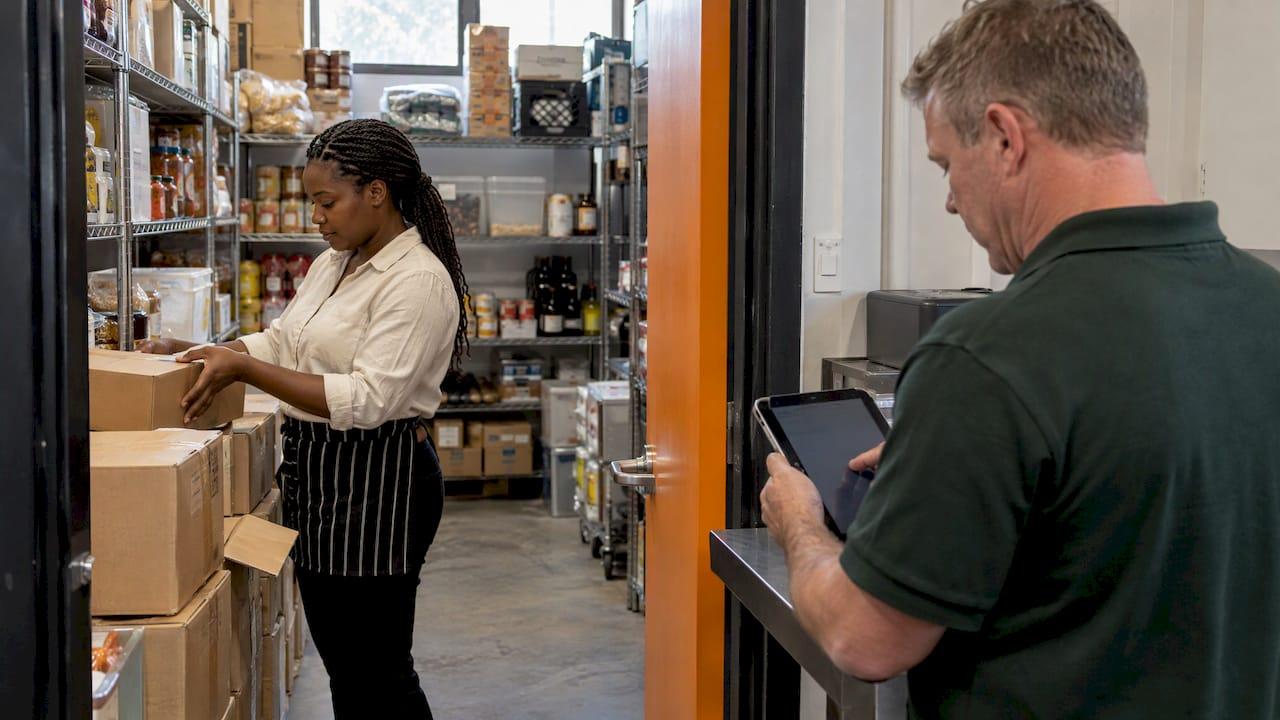
Separation of duties (also called segregation of duties) means no single person controls a whole stock transaction from start to finish. One person orders, another receives, another records and counts, and someone else approves payment or write-offs. In a café, pub, club or restaurant, that split turns a quiet theft or costly mistake into something that needs two people to hide. This guide shows which stock tasks to separate, how to do it in a small team, and how to keep the records honest day to day.
TL;DR
- Keep four jobs apart where you can: ordering, receiving, recording and counting, and approving payment or write-offs.
- Receiving is the weak point. The person who checks the delivery should not be the person who placed the order.
- If you have too few staff, rotate duties, add spot checks and review reports you did not prepare yourself.
- Count on a fixed schedule, and count liquor more often than dry goods.
- Software with team access controls and shared records makes the split easier to run and easier to see.
Table of Contents
- What separation of duties means for stock
- Why it matters in a restaurant, café, pub or club
- The four jobs to keep apart
- A worked example: a Tuesday delivery at a 60-seat café
- Receiving: the three-way match
- Counting: who, when and how
- Variances, adjustments and write-offs
- When you do not have enough staff
- Lock it up and limit who can get in
- Where Pantryhub fits
- Our view on separation of duties
- FAQ
- Sources
What separation of duties means for stock
The idea is old and simple. CPA Australia's guide for small business defines it as keeping certain functions separate, for example the person taking cash receipts should not also do the banking. Its aim is to remove both the opportunity and the motivation for fraud and theft, and to catch errors and odd patterns quickly.
For inventory, the Wiley hospitality management accounting text puts it plainly: the person who controls the stock, such as a storekeeper who receives and issues it, should be separate from the person who keeps the inventory records.
That is the whole principle. The person with their hands on the stock is not the person who writes down what the stock should be. If the two disagree, you have a variance to look at.
Why it matters in a restaurant, café, pub or club
Stock is cash in a different shape. Steak, spirits, kegs and seafood all walk out the back door as easily as cash walks out of a till, and they are harder to notice because nobody counts them every night.
The Wiley text explains why splitting duties works: when record keeping and asset control are held by different people, hiding a theft needs collusion between two people instead of one. It also warns that a dishonest employee who keeps shifting figures around to cover earlier gaps can snowball the problem until it is found, by which point the money is often gone.
Time is the other cost. Accounting firm Ahlbeck & Cook reports a median of 18 months to discover occupational fraud, and says that when staff can both carry out and conceal transactions, theft becomes nearly impossible to detect.
Most of what goes wrong with stock is not theft. It is a wrong order, a short delivery nobody checked, a keg booked in twice or a case that was never entered. Separation of duties catches these too, because a second pair of eyes sees what the first person stopped noticing.
Small venues carry the most exposure. CPA Australia notes that small businesses are vulnerable because they often lack effective internal controls and have fewer people to check procedures. It adds that the owner has to stay active and vigilant, and that businesses can combine controls where they cannot fully split roles.

The four jobs to keep apart
Procurement advisers commonly name the same set of functions to separate: requisitioning, purchasing, receiving and payment approval, with the rule that whoever starts a purchase should never approve its payment. For a venue, it helps to think of four jobs.
| Job | What it covers | Who should not also do it |
|---|---|---|
| Ordering | Deciding what to buy, placing the order with the supplier | Receiving the delivery, approving the invoice |
| Receiving | Checking quantity, quality, temperature and paperwork on arrival | Placing the order |
| Recording and counting | Entering stock in, running stocktakes, keeping the records | The person who stores or issues the stock, where possible |
| Approving | Paying invoices, signing off write-offs and adjustments | The person who ordered or counted |
Plante Moran's restaurant checklist says the same person should not order goods, receive them and authorise payment. It also says the person who operates the register should not be the one reconciling cash and card takings to the POS at the end of the night. Even where most sales are by card, it points out that unauthorised free or discounted meals are still a risk.
You do not need a different human for every row. You need to make sure that no one person holds all four, and that the two riskiest pairs, ordering with receiving and counting with approving, are split first.
A worked example: a Tuesday delivery at a 60-seat café
Take a café with an owner, a head chef, a second cook and a front-of-house manager.
- Ordering. The head chef checks stock against par levels (the minimum quantity you want on the shelf) and places the order with the supplier on Monday afternoon.
- Receiving. On Tuesday, the second cook receives the delivery. They compare the delivery docket against the order, count the boxes, check use-by dates and probe the temperature of chilled goods. Victoria's food safety guide for food businesses says cold food should arrive at 5°C or below.
- Recording. The second cook signs the docket and records the delivery. Any shortfall or rejected item is noted on the spot and raised with the supplier straight away.
- Approving. The front-of-house manager or owner matches the signed docket to the supplier's invoice before it is paid. The chef who ordered never approves the payment.
- Counting. At the end of the week, the manager and the head chef count the pantry together, and the owner looks at the variance report they did not prepare.
No one person can order extra product, accept it, record it and pay for it alone. That is all the control you need to start with, and it takes no more staff than most cafés already have.
Receiving: the three-way match
Receiving is where most venues are loose, because deliveries arrive in the middle of prep and whoever is nearest signs. A three-way match fixes that.
Ahlbeck & Cook describe it as confirming what was authorised to order, comparing the supplier's invoice, and checking what actually arrived. They say it should always be handled by someone other than the person placing orders. Plante Moran adds a practical detail: the signature on the receiving document is compared with the invoice and any supplier portal record, and discrepancies are followed up with the vendor immediately.
In practice:
- Keep a printed or digital copy of the order so the receiver checks against the order, not against the docket alone.
- Receive before you store. Nothing goes into the coolroom until it has been checked.
- Photograph shortfalls and damaged goods when they arrive.
- Do not let drivers or reps wander into storage areas unsupervised.
If you are building a stock-control routine from scratch, our practical guide to hospitality inventory management covers the wider process around receiving.
Counting: who, when and how
The training package behind Australian hospitality qualifications treats this as a core skill. SITXINV002A Control and order stock covers keeping stock levels and records, processing orders, minimising stock losses and organising stocktakes, including allocating stocktaking responsibilities and producing accurate reports within set timelines. It also expects supervisors to tell colleagues what they are individually responsible for when reordering.
The key word is allocating. A stocktake works when responsibilities are written down and the person who counts is not the person whose purchasing or storage is being checked.
A few habits make counts reliable:
- Count on a schedule. A food safety training guide recommends counting on the same day and time each week or month, before opening or after closing, and the day before scheduled deliveries.
- Count in pairs. 360training's guide suggests each person counts separately, then the two compare numbers and recount anything that does not match.
- Make it a rostered duty. The same guide recommends treating inventory as a recurring shift task so one person owns it week after week. Rotate who does it every few months so no one becomes the only person who knows the shelves.
- Count high-value items more often. Plante Moran recommends physical counts at least monthly, with liquor ideally counted nightly. Bennett Thrasher likewise suggests standard count sheets, assigned responsibilities and more frequent counts for items like liquor.
For pubs and clubs, bar stock deserves its own routine. Our bar stocktake guide for Australian pubs and bars and the piece on club bar stocktakes that actually work walk through it.
Variances, adjustments and write-offs
A count is only useful if you act on the gap between what the records say and what is on the shelf.
Ahlbeck & Cook report that busy bars often need weekly or even daily liquor counts, that shrinkage of 15 to 20 per cent is common when controls are weak, and that a variance outside a tolerance of typically 5 per cent or less deserves investigation. Those are United States figures from an accounting firm, so treat them as a starting yardstick and set your own tolerance after a few months of your own counts.
Who handles a variance matters as much as the number:
- The person who counted reports the gap. They do not fix it quietly.
- A manager who did not do the count decides whether it is a recording error, waste, spillage, comps or something else.
- Every write-off has a reason: damage, spoilage, staff meal, comp, breakage.
- The owner or senior manager reviews write-offs as a total, not just one at a time. A steady drip of small write-offs is exactly what hides a problem.
Our article on common inventory mistakes restaurants make lists several that come from skipping this step.
When you do not have enough staff
Most Australian cafés, fish and chip shops and small pubs cannot staff four separate roles. The research is consistent that you do not need perfect separation, you need deliberate overlap.
CPA Australia's guide suggests combining controls: rotate duties, require annual leave so another person reviews the work, re-check totals, set purchasing approval levels, and keep management supervision and review in place. Here is how that looks in a small venue.
| Your situation | A workable split |
|---|---|
| Owner-operator plus two staff | Staff member orders and receives separately. Owner approves invoices and reviews the variance report. |
| Chef runs ordering and the kitchen | Chef orders. A trusted team member or the front-of-house manager receives. Owner does random spot checks. |
| One manager does everything | Rotate who receives each week. Owner counts one high-value category, such as spirits, without warning each month. |
| Two or more sites | Each site manager counts. Head office or the owner reviews reports across sites. |
Plante Moran's advice for small teams is to bring in a trusted employee, whether server, cook or host, to take one task in the chain, to alternate responsibilities, and to have owners or district managers randomly audit records. Scale CPA makes a useful point about a ten-person restaurant: the person scheduling staff is not the one approving payroll, the manager entering bills is not the only one reviewing bank activity, and owners glance at reports they did not prepare, on a weekly rhythm.
As one open-access hospitality textbook notes, in a small operation inventory may fall to one or two key people, but you still need to track purchases against sales. Arrivals and usage can be reconciled with a regular count.
Lock it up and limit who can get in
Separation on paper means little if everyone has a key. Ahlbeck & Cook advise keeping walk-ins, dry storage and liquor rooms locked when not in use, limiting keys or codes to specific managers, and letting no stock leave storage without documentation.
The same logic applies to your digital records. Not everyone needs to edit stock levels or change prices. A cook might need to record a delivery, while only a manager should be able to change par levels or sign off a write-off.
Where Pantryhub fits
Paper count sheets and shared spreadsheets work against separation of duties. Anyone can edit them, nothing shows who changed what, and the owner rarely sees the numbers in time.
Pantryhub is a hospitality inventory and ordering platform built for Australian restaurants, cafés, bars and commercial kitchens. It gives you real-time stock tracking, AI-powered low-stock alerts, supplier ordering, team access controls, and waste and cost reporting, across one venue or several. That means the person ordering, the person receiving and the person reviewing can each work from the same live picture of stock, and the owner can see reports from anywhere.
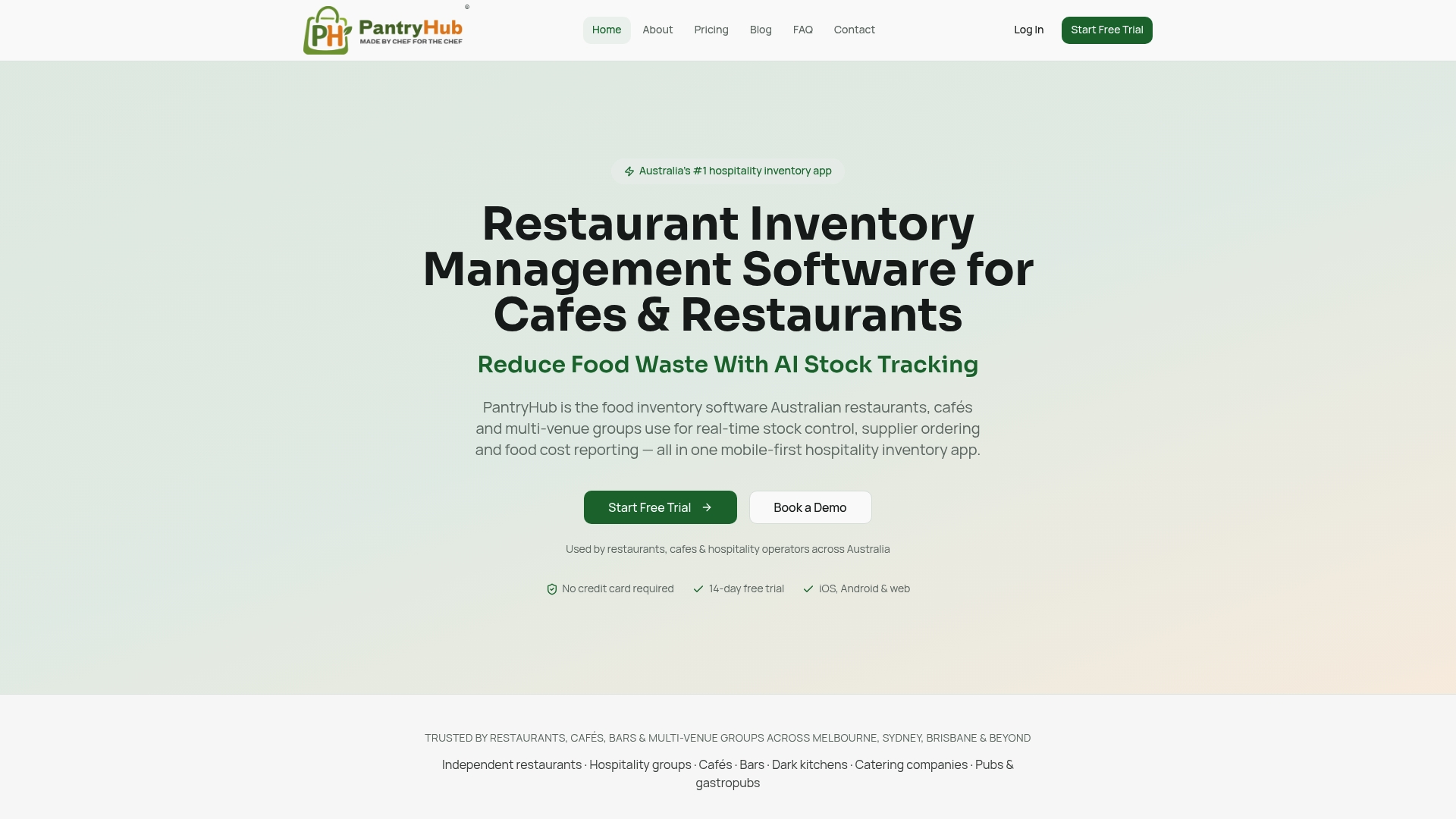
Plans start at $39 a month for Starter, with Regular at $69 a month and Pro at $99 a month, all in Australian dollars, and you can start with a free trial. You can compare the tiers on the pricing page, or see how it works for pubs and clubs on our bar inventory software page. For a broader view, take a look at our hospitality inventory software.
Our view on separation of duties
Most venue owners we talk about this with think of separation of duties as something for big companies with accounts departments. We think it is the opposite. The smaller the team, the more a single person tends to hold the whole chain, and the more a clear split matters.
Pantryhub was built by a chef for chefs, so we start from the kitchen, not the accounting textbook. A chef who orders, receives and counts is not dishonest, they are busy. The system should make the right split the easy one: orders placed by the person who knows the menu, deliveries checked by someone else, counts compared against live records, and reports that reach the owner without anyone having to build them.
That is why we put team access controls, real-time stock tracking and waste and cost reporting in one place, with Australian supplier integration and GST-ready reporting. Each person in your team sees and does what their role needs, and you see the numbers that matter across every venue. Bin the spreadsheets, set clear roles, and let the records do the watching.
the author
FAQ
Is separation of duties the same as segregation of duties?
Yes. Both terms describe the same control: dividing the key steps of a transaction, such as authorising, recording and holding assets, between different people. Australian accounting bodies usually say segregation, but in a kitchen or bar the practical meaning is identical.
Which inventory tasks matter most to separate?
Start with ordering and receiving, because the person who places an order should not be the one who checks the delivery. Next, separate counting from approving write-offs and payments. Those two splits cover most of the risk with the fewest extra people.
What can I do if I only have two or three staff?
Combine controls instead of aiming for a perfect split. Rotate who receives deliveries, have the owner approve invoices, run unannounced spot counts on spirits or proteins, and review variance reports you did not prepare. CPA Australia and Plante Moran both recommend this kind of overlap for small teams.
How often should we count stock?
Set a fixed schedule and keep to it. Monthly is a minimum for general stock, and high-value items such as liquor are counted more often, weekly or even nightly in busy bars. Count before opening or after closing, and the day before a delivery.
Does software replace separation of duties?
No, it supports it. Software gives each person a defined role, keeps one shared record and puts variances in front of the owner sooner. The decision of who orders, who receives and who approves is still yours, and it should be written down.
Sources
- Internal controls for small business, CPA Australia
- Internal Control, Hospitality Management Accounting (Wiley)
- 5 Non-Negotiable Internal Controls for Restaurants, Ahlbeck & Cook
- How to Prevent Procurement Fraud in Hospitality
- Internal controls checklist: 7 strategies for restaurants, Plante Moran
- Food safety guide for food businesses Class 3
- SITXINV002A Control and order stock, training.gov.au
- 4 Steps to Master Restaurant Inventory Management
- Inventory Management Tips for Bars & Restaurants, 360training
- What financial controls should a restaurant group have in place, Bennett Thrasher
- How to Structure Internal Controls for Independent Restaurants, Scale CPA
- Basic Inventory Procedures, Basic Kitchen and Food Service Management