
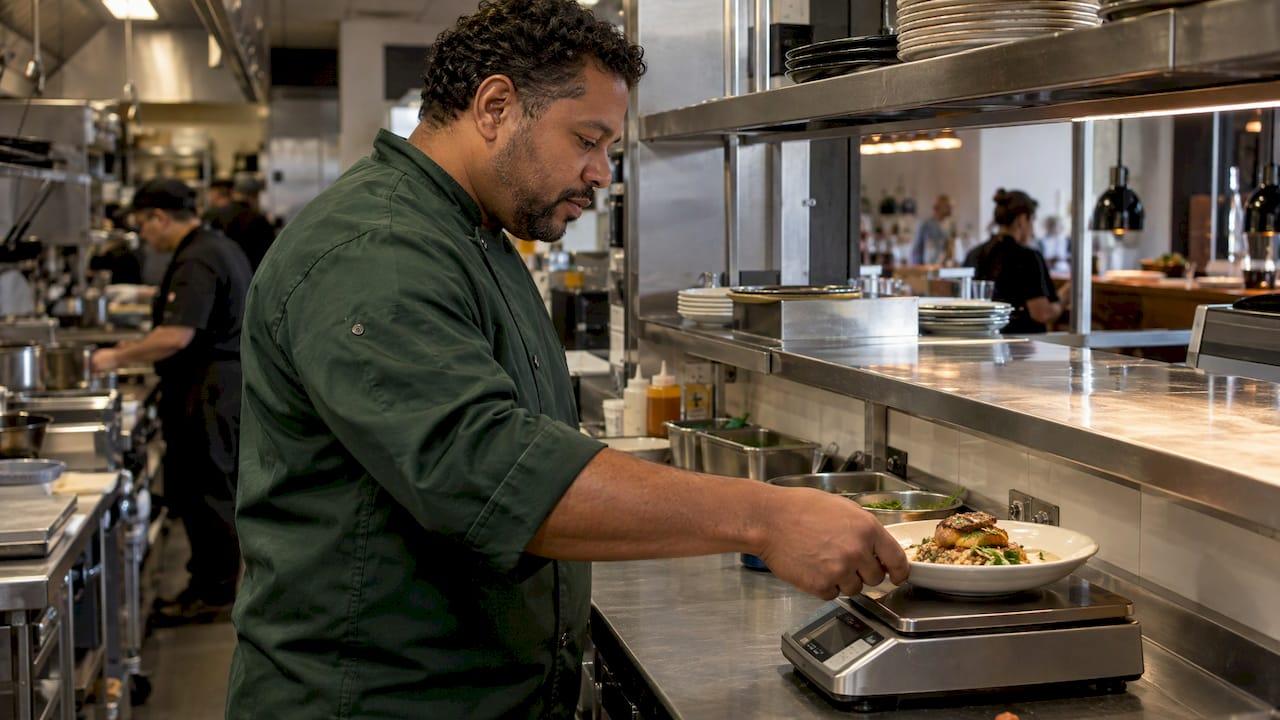
You lower restaurant COGS by finding where ingredients leak out of your kitchen and closing each gap. The usual leaks are over-ordering, inconsistent portions, unrecorded waste, supplier invoice errors and stocktakes that happen too rarely. Fix those in order, measure weekly, and your food cost percentage moves without touching quality.
This guide walks through how to calculate your COGS, what a sensible target looks like in Australia, and eight steps that work for cafés, restaurants, pubs and clubs.
TL;DR
- COGS is your opening stock plus purchases minus closing stock. Divide it by sales excluding GST to get your percentage.
- Australian benchmarks sit roughly between 20% and 35% depending on venue type, and over-ordering, spoilage and loose portioning are what push venues above 32%.
- Excess COGS is usually an operational problem, not just a purchasing problem. Costed recipes, portion control, waste tracking and regular counts fix most of it.
- Consolidating purchasing and checking supplier invoices can trim unit prices on key categories.
- 📦 Real-time stock tracking makes every one of these steps faster. Start your free trial to see it on your own pantry.
Table of Contents
- What COGS includes (and what it doesn't)
- How to calculate your COGS and COGS percentage
- What a reasonable COGS looks like in Australia
- Step 1: Find out where the money is actually going
- Step 2: Cost every recipe and standardise it
- Step 3: Control portions
- Step 4: Track waste so you can reduce it
- Step 5: Order to par levels, not to gut feel
- Step 6: Manage suppliers and check every invoice
- Step 7: Engineer your menu
- Step 8: Count stock on a schedule
- Our perspective
- Put it all in one place with PantryHub
- FAQ
- Sources
What COGS includes (and what it doesn't)
Cost of goods sold is the direct cost of what you sell. For a restaurant that means ingredients, beverages and packaging. Rent, utilities, marketing, insurance and non-kitchen salaries are operating expenses, which sit below the gross profit line. COGS affects gross profit, while operating expenses affect net profit.
In accounting terms, revenue minus COGS equals gross profit, and that is the margin you have left to pay for everything else. In hospitality, food cost is about how much you spend on ingredients relative to what you earn from food sales. Treat it as its own controllable line, not something buried in overheads.
Two practical notes:
- Keep beverage COGS separate from food COGS. A bar, a pub and a kitchen have very different targets.
- Where your accountant treats direct kitchen labour as part of COGS, agree on one definition and stick to it, so month-to-month comparisons stay honest.
How to calculate your COGS and COGS percentage
The formula is simple:
COGS = opening stock + purchases − closing stock
COGS % = COGS ÷ sales, using amounts excluding GST so the percentage is not distorted.
A worked example for a café over one week:
| Line | Amount (ex GST) |
|---|---|
| Opening stock | $4,200 |
| Purchases during the week | $6,300 |
| Closing stock | $3,900 |
| COGS | $6,600 |
| Food and drink sales | $22,000 |
| COGS % | 30% |
The numbers are only as good as your counts. If closing stock is a guess, your COGS is a guess. That is why the first fix is almost always counting more often and more accurately.
What a reasonable COGS looks like in Australia
One Australian benchmark puts typical food costs at 25–28% for takeaway cafés, 28–32% for casual dining, 28–33% for full-service restaurants, 20–26% for bars or venues with food, and 30–35% for fine dining. The same source notes that over-ordering, spoilage and poor portion control can push food costs above 32%.

Use these as a guide, not a verdict. Your menu mix, location, and how much you cook from scratch all change the right number for your venue. The useful comparison is your own COGS this month against last month and against your menu's theoretical cost.
Step 1: Find out where the money is actually going
Before changing anything, locate the leak. Industry advisers note that excessive COGS is rarely just a purchasing problem. It is often operational: inconsistent portioning, no waste accountability, or no regular inventory counts to expose the problem.
Start with three questions:
- Which 10 ingredients make up most of your spend? Proteins, dairy, produce and spirits usually top the list.
- Which menu items have the widest gap between theoretical cost and actual usage?
- Who orders, who receives, and who counts? Gaps between those roles are where stock disappears.
A recipe-first approach helps here. Our guide on tracking ingredient usage in seven steps shows how to tie usage back to dishes so you can see variance by item instead of one blurry total.
Step 2: Cost every recipe and standardise it
If a dish has no written recipe, it has no reliable cost. Two cooks plating the same burger will use different amounts of cheese, and the difference compounds over hundreds of covers.
Maintaining accurate recipe costs and portion specifications is one of the core ways to improve F&B COGS. In practice:
- Write each recipe with weights and yields, not "a handful".
- Cost it from your current supplier prices, ex GST.
- Recost whenever a key ingredient price moves.
- Keep one master version so every shift and every site cooks the same plate.
Our article on standardising recipes for busy kitchens covers how to roll this out without slowing service. With PantryHub, 🧾 recipe and pricing standardisation sits alongside your stock, so a price change on an ingredient flows through to your dish costs.
Step 3: Control portions
Portion control is one of the fastest wins because it costs almost nothing to start. Standardised recipes, scales and measured tools, and staff training help every plate hit its target cost consistently.
Try a two-week pilot:
- Pick your five highest-volume dishes.
- Weigh the protein and the most expensive garnish at the pass.
- Compare actual usage to what the recipe says should have been used.
- Share the results with the team, without blame.
We lay out the method in our two-week portion control pilot. Most teams find one or two dishes where "generous" has quietly become the standard.
Step 4: Track waste so you can reduce it
Waste is the leak operators most often underestimate, because nobody records it. Good waste tracking means tracking waste at outlet level and managing trim, preparation waste, spoilage and over-production.
Separate your waste into types:
- Prep waste: trim, peelings, yield loss.
- Spoilage: product that expired or was stored badly.
- Plate waste: food returned or left uneaten.
- Over-production: batches that outlast demand.
Each type has a different fix. Prep waste is a recipe and training issue, spoilage is an ordering and rotation issue, and plate waste is often a portion or menu issue. Our guides on measuring prep versus plate waste in two weeks, restaurant waste tracking and reducing food waste in restaurants give you a simple routine to follow.
Stock rotation matters too. First in, first out means newer deliveries go behind existing stock and you always draw from the front. It cuts spoilage and keeps you on the right side of use-by dates.
Step 5: Order to par levels, not to gut feel
Over-ordering is the quiet way COGS climbs. Stock that sits in the coolroom is cash you have already spent, and some of it will end up in the bin.
Set a par level for each ingredient: the amount you need on hand to get through to the next delivery, plus a small buffer. Then order only the gap between what you count and par. A few habits make this stick:
- Count before you order, every time.
- Review par levels each season, since demand shifts.
- Use sales history and upcoming bookings to adjust for big weekends and events.
Forecasting helps. See how to predict restaurant food waste with three essentials for better orders. 🔔 PantryHub's AI-powered low-stock alerts flag items that fall below par, so you reorder when you need to and not before.
Step 6: Manage suppliers and check every invoice
Purchasing is where many operators think COGS begins and ends. It is only one part, but it is a real one. Reducing COGS through purchasing involves consolidating procurement volume for better negotiated rates, regularly reviewing supplier invoices for price and quantity errors, and governing supplier performance. For groups, that source says consolidating purchasing across outlets can secure 3–8% unit-price reductions on key commodity categories.
You do not need to be a group to apply the discipline:
- Match every delivery to the order and the invoice. Short-delivered cases and substituted products are common.
- Check invoice prices against agreed prices. Small creeping increases add up.
- Ask two or three suppliers to quote your top 10 lines twice a year.
- Pick fewer suppliers for more of your volume, where quality allows.
For more ideas on cutting food costs while holding quality when prices rise, look at how other operators approach supplier relationships and menu pricing. 🛒 With supplier ordering and integration with Australian suppliers inside PantryHub, orders and received stock sit in one place, which makes invoice checks quicker.
Step 7: Engineer your menu
Menu engineering sorts dishes by popularity and profitability. It identifies popular and profitable dishes; plowhorses can be repriced or portioned, while dogs can be removed or reformulated. Done well, it shifts sales toward profitable dishes without customers feeling put upon.
Simple moves that work:
- Reposition high-margin dishes where the eye lands first.
- Rewrite descriptions of profitable dishes so they sell themselves.
- Use one ingredient across several dishes, so you buy in bulk and waste less.
- Remove the slow dish that needs three unique ingredients.
Our menu engineering guide has the step-by-step method, and the restaurant cost control strategies article shows how it fits with the other levers.
Step 8: Count stock on a schedule
You cannot manage what you do not measure. Xero's hospitality guidance recommends weekly stocktakes for high-value items like proteins and alcohol, monthly full inventory counts, and comparing actual usage with POS data.
A workable rhythm:
| Frequency | What to count | Why |
|---|---|---|
| Weekly | Proteins, seafood, spirits, high-value items | Catches theft, over-portioning and spoilage early |
| Monthly | Full inventory, all categories | Gives you a reliable closing stock for COGS |
| Every service | Waste log entries | Keeps waste visible while it is fresh |
Paper counts are slow and error-prone, which is why they get skipped. Counting on a phone, by storage area, takes a fraction of the time. For ingredient-level detail, read our guide to ingredient-level stock tracking for restaurants. If you run a bar, bar inventory software with pour cost and stocktake tools gives you the same control over spirits, beer and wine.
Our perspective
Most operators we speak to do not have a COGS problem so much as a visibility problem. They know the number at month end, but by then the money has gone.
PantryHub was built by a chef, for chefs, because we saw the same pattern again and again: spreadsheets that fall behind, counts done on the quiet Monday if at all, and orders placed from memory. Costs creep in silently and eat into margins.
Our view is that the fix is a habit, not a heroic one-off clean-up. Count often, cost every recipe, record waste, order to par and check invoices. Software makes the habit easy enough that your team actually keeps it.
That is why we designed PantryHub for Australian venues, with AUD pricing, GST-ready reporting, local support and a mobile-first layout. You can run it in a single café or across a group, and see real-time stock and cost reporting wherever you are.
the author
Put it all in one place with PantryHub
Every step above gets easier when stock, recipes, suppliers and waste live in the same system. PantryHub gives you real-time stock tracking, low-stock alerts, supplier ordering, team access controls and waste and cost reporting for restaurants, cafés, bars, pubs and clubs.
Plans are published at PantryHub pricing: Starter is $39 per month, Regular is $69 per month and Pro is $99 per month, all in AUD. You can start a free trial first. If you operate in Victoria, see our restaurant inventory software for Melbourne venues. Prefer to see it first? Book a demo and we will walk you through it.
FAQ
How often should I review my COGS?
Review it weekly for high-value items such as proteins and alcohol, and run a full count and COGS calculation monthly. Weekly checks catch problems while you can still trace them to a shift or a delivery. The monthly figure gives you a clean number for your accountant and for comparing against your target.
Should I calculate COGS with or without GST?
Without. Use purchases and sales excluding GST so the percentage is not distorted. GST-ready reporting helps here, since it separates the tax from your real costs. Your accountant or the ATO can confirm how GST applies to your specific business.
What is the quickest way to lower COGS?
Start with portion control on your top-selling dishes and begin recording waste. Both cost very little, and both show results within a couple of weeks. Then move on to par levels, invoice checks and menu engineering.
Is a high COGS always a purchasing problem?
No. Advisers point out that high COGS is often operational, caused by inconsistent portions, unrecorded waste or too few inventory counts. That is good news, because those factors are under your control. Improving them often does more than renegotiating prices.
Does the same COGS target apply to a pub or bar?
Not quite. Benchmarks for bars and venues with food sit lower than full-service restaurants, and beverage cost is tracked separately from food. Set a target for each category and measure each against its own sales.
Sources
- COGS vs Expenses: What Every Restaurant Owner Needs to Know
- COGS explained: what it is and how to calculate it (Xero AU)
- Hospitality accounting: Financial management for hospitality (Xero AU)
- Food Cost and COGS Calculator for Cafes
- Average Restaurant Profit Margins in Australia 2026
- How to Reduce Food and Beverage COGS in Hospitality
- How to Lower Restaurant Food Costs
- Australian Restaurant Cost Breakdown 2026
- FIFO Stock Rotation for Food Businesses (Australia)
- Cutting food costs while boosting quality