
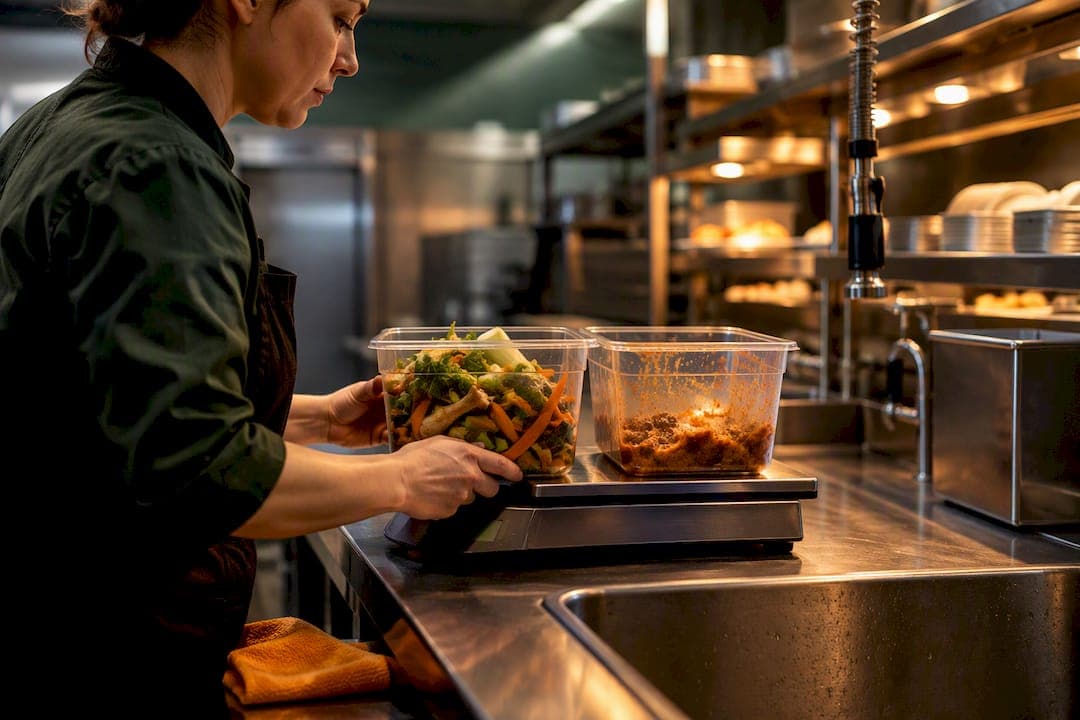
Prep waste is everything you trim, spoil, or overproduce before food ever reaches a guest. Plate waste is what comes back on the tray after service, uneaten. Both cost money, but they need different fixes: measure both for two weeks, then put your energy into whichever one is bleeding the most dollars.
TL;DR:
- Reducing prep waste involves standardizing trimming, portioning, and ordering practices to minimize spoilage and overproduction, with a focus on avoidable waste.
- Tracking waste with simple tools like scales and logs over two weeks helps identify key problem areas, especially in high-cost ingredients and peak service days.
- Menu and portion adjustments, such as offering smaller or optional servings, can significantly cut plate waste, which can account for up to a third of overall food waste.
- Implementing connected systems that link waste data to inventory and reporting helps identify trends and prevent overordering, maximizing waste reduction efforts.
- Prioritizing waste stream separation, proper disposal methods, and composting can enhance sustainability, with prep waste being easier to reuse or compost than complex plate waste.
Table of Contents
- 1. Definitions and Where Each Waste Type Shows Up
- 2. How to Measure Prep and Plate Waste Without Heavy Investment
- 3. Prep Waste Reduction Tactics for Kitchens
- 4. Plate Waste Reduction Tactics for Service and Menu Teams
- 5. Connecting Waste Data to Inventory and Reporting Systems
- 6. Costs and ROI: Turning Waste Savings Into Dollars
- 7. Environmental Impact and Sustainability Considerations
- 8. Differences in Disposal Methods for Prep and Plate Waste
- 9. An Operator's 30/60/90-Day Waste Checklist
- PantryHub: One System to Track Waste and Inventory Together
- Sources
- FAQ
1. Definitions and Where Each Waste Type Shows Up
Prep waste happens in the back of house, before a dish is ever plated. Plate waste happens after service, when food comes back uneaten. Knowing the difference matters because the fixes are completely different: one is a kitchen skills and procurement problem, the other is a menu and portioning problem.
Prep waste includes:
- Vegetable peelings, trim, and bones from butchery and prep work
- Spoiled deliveries or stock that passed its use-by date before it could be used
- Overproduced mise en place that gets tossed at close
Plate waste includes:
- Leftover mains sent back half-eaten
- Sides guests never touch, like a scoop of rice nobody asked for
- Returned trays from banquet or buffet service
Mapping both onto your workflow helps assign ownership. Procurement and storage sit with your kitchen manager or head chef. Prep waste sits with line cooks and section leads. Service and plate waste sit with front-of-house staff and the menu itself. Post-service waste, like uneaten buffet trays, often falls between the cracks because nobody owns it.
It's worth separating avoidable from unavoidable waste early. Bones for stock and pea shells aren't the target. A guest sending back an entire dish because the portion was wrong, or a prep cook trimming too aggressively, is. KPIs should track the avoidable share, not raw weight, or you'll chase numbers that were never going to move.
2. How to Measure Prep and Plate Waste Without Heavy Investment
You can't fix what you don't track, and tracking waste doesn't require expensive equipment. A set of digital scales, a clipboard, and a consistent routine will get you real numbers within two weeks.
The metrics that matter most:
- Grams of waste per cover, so numbers scale with volume
- Percentage of prepared weight lost to trim or spoilage
- Cost per cover attributed to waste
- Waste as a percentage of total food sales
For prep waste, weigh trim at the end of each prep session and log it against the item being prepped. For plate waste, run "weighbacks" at the end of service, scraping plates into a labeled bin before washing and weighing the total. Tray audits work well for buffet or banquet settings where individual plates aren't practical. Sample at least a full week of services, including your busiest and slowest days, before drawing conclusions.
Reported waste levels differ sharply by service type: a systematic review of plate waste found hospital food services often show the highest leftover proportions, while popular restaurants tend to show the lowest. That gap means a benchmark from a hospital cafeteria tells you almost nothing about a bistro, so build your own baseline rather than borrowing someone else's number.
Record five fields for every entry: date, station, item, weight, and reason. Reason codes (spoilage, over-portioning, guest preference, kitchen error) are what let you fix root causes later instead of just watching a number move. The most common measurement error is inconsistent timing, weighing some nights but not others skews your baseline before you've even started.
3. Prep Waste Reduction Tactics for Kitchens
Most prep waste comes down to inconsistent yields and habits, not bad ingredients. Fixing it starts with standardizing how food is cut, portioned, and stored.
- Build trim-to-yield tables for your highest-volume proteins and vegetables so every cook trims the same way
- Use portion scoops and standard cuts to remove guesswork from prep stations
- Turn trims into stocks, pickles, or garnishes instead of the bin, with clear rules on what's safe to reuse and for how long
- Order closer to actual usage and negotiate smaller pack sizes with suppliers to cut spoilage from oversized deliveries
- Run short training sprints on knife skills and prep station layout, since a badly organized station creates waste through rework and dropped product
Pro Tip: Run a two-week prep-trim log on your three highest-cost ingredients before touching anything else. It tells you exactly where to focus without guessing.
Procurement changes pay off fastest. If a supplier's standard case size forces you to over-order a perishable item, ask about smaller packs or more frequent deliveries, even if the unit price ticks up slightly. The spoilage you avoid usually outweighs it. A two-week portion pilot is a low-risk way to test recipe changes before rolling them out kitchen-wide, since you get real trim data without committing to a permanent recipe rewrite.
Staff habits matter as much as recipes. A cook using the wrong knife or cutting board for a job wastes product through inconsistent cuts and rework. Fifteen-minute training sprints at the start of a shift, focused on one technique at a time, tend to stick better than a single long session that gets forgotten by Friday.
4. Plate Waste Reduction Tactics for Service and Menu Teams
Plate waste is a portioning and menu problem more than a kitchen skills one. The fastest wins come from giving guests control over portion size rather than guessing what they want.
- Offer optional sides or smaller base portions with a paid top-up, so guests aren't served food they never intended to eat
- Rework or remove high-waste menu items, especially anything sold on the strength of a decorative garnish nobody eats
- Adjust plate size and staff scripting so servers can offer a smaller portion without it feeling like a downgrade
- Run quick feedback forms or A/B tests on suspect dishes to confirm whether the issue is portion size, flavor, or presentation
Plate waste commonly makes up close to a third of hospitality food waste, though the exact share depends heavily on the type of outlet and service style. That's a meaningful chunk of your food cost sitting in the bin after guests have already paid for it, which makes menu and portion adjustments some of the highest-leverage changes available.
Share plates and family-style formats tend to reduce individual plate waste because guests self-select how much they eat rather than being served a fixed amount. If you run a set menu or banquet service, tray audits after each event will quickly show which dishes are consistently coming back untouched, information that's far more useful than a generic industry number.
Small experiments beat big menu overhauls. Swap the side on one dish for two weeks, track the weighback difference, and only roll the change out wider if the numbers hold up. A dish nobody finishes is telling you something about portion size, seasoning, or expectation, not just food cost.
5. Connecting Waste Data to Inventory and Reporting Systems
Spreadsheets work for a week. They fall apart once you're tracking multiple stations, shifts, and locations, which is where a connected system starts paying for itself.
- Convert weighback totals into inventory adjustments so your stock counts and cost-of-goods figures reflect what actually left the kitchen, not just what was ordered
- Track waste by category, station, and reason code so trend reports show you where the problem is concentrated
- Use centralized reporting across shifts or locations to catch overordering patterns before they become spoilage
- Set low-stock alerts that reflect real usage rather than guesswork, reducing the emergency orders that often lead to oversized deliveries and waste
Waste reduction works best as a shared responsibility rather than one manager's side project, since the data that explains a spike in waste often lives across ordering, inventory, and prep logs rather than in one place. A restaurant waste tracking system that pulls these threads together makes root-cause analysis possible instead of guesswork.
Assign an owner for the program, even if it's a rotating role between shift leads. Set two or three KPIs, like grams per cover and cost per cover, and review them weekly rather than monthly. Momentum dies fast when reporting loops stretch out too long between checks.
6. Costs and ROI: Turning Waste Savings Into Dollars
A gram figure means nothing to an owner until it's converted into a dollar figure. Take your grams-per-cover waste reduction, multiply by your ingredient cost per gram, then multiply by covers served per week to get a weekly saving.
Pilot programs focused on prep and portion changes have reported modest to substantial waste reductions, depending on what the intervention targeted. A kitchen serving 500 covers a week with a modest food cost per cover could see a meaningful weekly saving just from tightening prep yields, without touching the menu at all.
Structure your own pilot to run four to eight weeks: two weeks of baseline measurement, followed by the intervention, followed by a final measurement period to confirm the change held. Shorter pilots tend to catch noise rather than a real trend.
7. Environmental Impact and Sustainability Considerations
Prep waste and plate waste carry different environmental footprints, even when the weight looks similar on a scale. Prep waste, being largely vegetable trim, bones, and unavoidable byproducts, has clearer reuse and composting pathways. Stock made from bones and trim replaces a purchased product, and composted peelings avoid landfill entirely.
Plate waste is messier from a sustainability standpoint because it's mixed: cooked proteins, sauces, and starches that are harder to compost cleanly and almost impossible to repurpose into another dish. It also represents wasted water, energy, and transport emissions that went into growing, cooking, and delivering food nobody ate, none of which can be recovered once it hits the bin.
Reducing either type cuts landfill volume and the methane that comes with it, but the sustainability upside is highest when you tackle plate waste, since that's food that used the full weight of the supply chain's resources for zero return. Composting and food donation programs offer meaningful diversion pathways for both waste streams, though donation applies mainly to unused, safely stored prep surplus rather than plate returns. Guidance from food donation compliance resources can help operators think through what's safe and practical to redirect before it becomes waste at all.
8. Differences in Disposal Methods for Prep and Plate Waste
Prep waste and plate waste often need separate bins, separate handling, and separate staff habits, even in kitchens that treat all food scraps the same today. Prep waste, largely raw trim and unused ingredients, is well suited to composting or, where volume justifies it, small on-site processing equipment like pulpers that reduce wet waste to a manageable volume before collection.

Plate waste is typically mixed with sauces, oils, and cooked starches, which limits composting options in many municipal or commercial programs and often means it goes straight to general waste unless your disposal provider has a food-specific stream. Contamination is the biggest risk here: a compost bin mixed with plastic wrap or non-food scraps can void an entire collection.
Bin logistics matter more than most kitchens plan for. Clear labeling, separate collection schedules, and staff training on what goes where prevent contamination that turns a good composting program into general landfill waste by accident. Implementation guidance for hospitality operators recommends pairing upstream prevention (procurement, storage, prep discipline) with downstream diversion (composting, donation) rather than treating disposal as the only lever, since a bin change alone won't fix a portioning problem.
9. An Operator's 30/60/90-Day Waste Checklist
Start today: calibrate your scales, run one full day of weighbacks, and audit your three highest-cost recipes for yield consistency.
In the first 30 days, run a prep-trim pilot on your top ingredients. By 60 days, test a portion change on one low-risk dish and measure the difference. By 90 days, decide whether a connected system makes sense to keep the data flowing without manual logging.
Brief your team early and keep it simple: explain why you're measuring, not just that you are. Momentum holds when staff see the numbers move.
— Admin
PantryHub: One System to Track Waste and Inventory Together
Running prep-trim logs and weighbacks on paper works for a two-week pilot, but keeping it going long-term needs a system that doesn't add extra work for your team. PantryHub connects real-time stock tracking, low-stock alerts, and reporting in one place, so waste data feeds straight into your inventory counts and cost reporting instead of living in a separate spreadsheet nobody updates.
If you're ready to test this properly, the Starter plan at $39 AUD per month gives a single venue enough reporting depth to run a two-week waste pilot without a big commitment. Multi-location groups needing more visibility can step up to Regular or Pro. You can also start with a free trial to see how the reporting fits your kitchen before committing to a plan.
FAQ
What are the 7 types of food waste?
Food waste frameworks vary, but common categories include spoilage, trim and preparation waste, overproduction, plate waste, expired stock, packaging loss, and storage or handling damage. Definitions differ across industry toolkits, so check the specific framework your business or region uses before applying it to reporting.
What is the most thrown away grocery item?
Fresh produce, particularly leafy greens and salad items, is widely cited as among the most frequently discarded grocery items due to short shelf life and spoilage. Exact rankings vary by source and region, so treat this as a general pattern rather than a fixed figure.
What is the difference between waste and wastage?
"Waste" typically refers to the material itself, the food or product that's discarded, while "wastage" often describes the process or rate of loss over time. In kitchen operations, the terms are frequently used interchangeably, though wastage sometimes implies a percentage or ongoing measurement rather than a single instance.
What is the difference between prep waste and plate waste?
Prep waste happens during food preparation, like trim, peelings, and spoiled stock, while plate waste is food left uneaten by guests after service. They require different fixes: prep waste responds to recipe standardization and procurement changes, while plate waste responds to portioning and menu adjustments.
How can software help reduce both prep and plate waste?
Connecting waste weighbacks to inventory and reporting systems, like PantryHub, turns raw waste weights into cost data and trend reports automatically. This makes it easier to spot which stations, dishes, or shifts are driving waste without relying on manual spreadsheet tracking.