
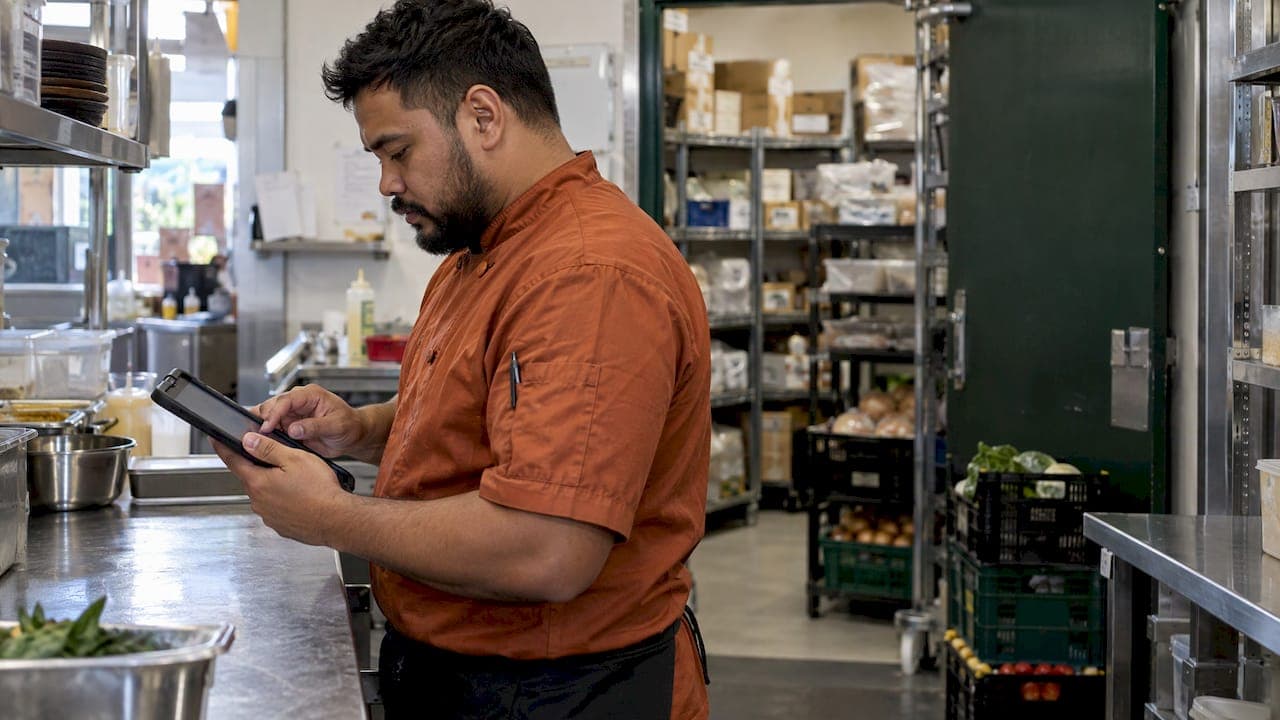
EDI ordering means your purchase order travels from your system straight into your supplier's system in a standard format, with nobody retyping it. For most Australian restaurants, cafés, pubs and clubs, the practical way to get that result is an ordering platform that connects to your suppliers for you, rather than building a formal EDI link yourself. This guide explains what EDI is, how the process runs, which standards matter in Australia, and how to get the same benefits at venue scale.
TL;DR
- EDI (Electronic Data Interchange) is a set of agreed message formats that move purchase orders, confirmations, delivery notices and invoices between two businesses' systems without re-keying.
- In Australia, GS1 maintains the EDI standards (EANCOM and XML), and location numbers (GLNs) identify the trading partners.
- Formal EDI is built around large suppliers and supermarkets. Foodservice orders still arrive by phone, text, email and portals, so a venue usually gets the benefit through its inventory and ordering software.
- Our platform is built so you can track stock, set par levels and send supplier orders from one place, with plans from A$39 per month and a free trial.
Table of Contents
- What EDI means for a restaurant
- How the EDI ordering process works
- The documents and standards used in Australia
- Where EDI sits in Australian hospitality
- What you need to start ordering electronically
- What it costs
- What happens when an order goes wrong
- Getting the benefits at venue scale
- A quick checklist before you choose a system
- Our perspective
- Try structured ordering in your own kitchen
- FAQ
- Sources
What EDI means for a restaurant
EDI is a way for two computers at different companies to share trading information, such as purchase orders and invoices, without paper-based processes. Jiwa, an Australian software company, describes it as automatic, electronic exchange between two systems. Another Australian explainer puts it simply: agreed message formats let one business's system send a purchase order, confirmation, delivery notice or invoice straight into another's.
In the food and drink supply chain, the same idea replaces paper, email and fax with standard formats that computers process automatically.
For a kitchen, the picture is easy to grasp. Instead of a chef counting the walk-in, writing a list, texting a produce rep and later checking the invoice by eye, the order is built from your stock data, sent in a structured form, confirmed by the supplier, and matched against the delivery and invoice.

What an "EDI order" is, in plain terms
An EDI order is a purchase order sent as structured data rather than as a message a person has to read. Every line carries a product code, a quantity and a unit of measure. The receiving system can read it without interpretation. That is the whole difference, and it is why errors drop: nobody mishears "two cases" as "twelve".
How the EDI ordering process works
The flow is the same whether the buyer is a national retailer or a single venue. Here it is in the order it happens.
- You decide what to order. Stock counts and par levels show what has fallen below the level you need to trade comfortably.
- A purchase order is created. Product, quantity, delivery date and delivery location are captured as data.
- The order is transmitted. TradeNet Solutions explains that EDI sends documents such as purchase orders, invoices, shipping notices and statements directly between your system and the recipient's system. That removes re-keying and cuts data entry errors.
- The supplier validates and confirms. On receipt, the partner's EDI layer validates and translates the message into its own internal format and posts it into its system.
- Goods are dispatched with a shipping notice. The supplier signals what is on the truck.
- You receive and check. What arrives is compared with what was ordered.
- The invoice is matched. Where the order, delivery notice and invoice agree, payment can proceed without chasing.
The three layers behind it
An Australian integration provider, DigitalHub, describes an EDI programme as three layers: a transport layer that moves documents between you and each trading partner, a mapping layer that translates their format into your system's structure, and an operational layer of validation, exception handling and monitoring. Most of the effort sits in mapping and exceptions, not in the transport itself. That is worth remembering when you hear that a supplier "does EDI": the connection is the easy part, and the product codes and units behind it are where the work lives.

The documents and standards used in Australia
Supermarket-style EDI revolves around four documents: purchase orders, purchase order acknowledgements, advance shipping notices and electronic invoices. When an invoice is tied to the PO and the shipping notice, matching can be automatic.
| Document | Who sends it | What it does |
|---|---|---|
| Purchase order (PO) | Buyer | States what is wanted, how many, where and when |
| PO acknowledgement | Supplier | Confirms, changes or declines the order lines |
| Advance shipping notice (ASN) | Supplier | Tells the buyer what is on its way |
| Electronic invoice | Supplier | Bills against the PO and the delivery |
GS1 standards and location numbers
In Australia, GS1 maintains two EDI standards: GS1 EANCOM and GS1 XML. Trading partners and locations are identified by a Global Location Number. GS1 Australia explains that GLNs identify trading partners and locations in EDI messages and allow accurate, automatic processing.
For foodservice specifically, GS1 Australia notes that GTINs, GLNs and SSCCs enable consistent tracking, and that GS1 standards and EDI technology support efficient data exchange. If you run several sites, that is why each location benefits from being identified distinctly: an order for the Fitzroy kitchen should not land at the Richmond dock.
Where EDI sits in Australian hospitality
Here is the honest picture of the market. Retail orders arrive electronically in a standard format, while foodservice orders reach suppliers through varied channels. Walk into any pub kitchen or café and you will see it: a text to the butcher, an email to the dry goods rep, a portal login for the produce wholesaler, a phone call to the fish supplier.
That variety is exactly why venues feel the pain EDI was designed to solve: re-keying, missed lines, "I thought you ordered it" and invoices that do not match the delivery. The goal for a venue is not the acronym. The goal is an order that is built from your real stock numbers, reaches the supplier in a clean form, and can be checked when the delivery lands.
If you want a deeper look at how connected systems fit together on the venue side, our guide to Australian restaurant software integrations covers the common links between POS, accounting and inventory. And how inventory platforms integrate with suppliers walks through the supplier side in more detail.
What you need to start ordering electronically
Being ready is mostly about clean data, not about technology.
1. A clear product list
Every item you buy needs a consistent name, pack size and unit. "Tomatoes" is not enough. "Roma tomatoes, 5 kg tray" is. Mismatched units of measure and unknown item numbers are the classic reasons electronic orders get routed to exception handling.
2. Par levels
A par level is the stock you want on hand after a delivery. Without it, an automated order has nothing to aim at. Set pars by item, by venue, and adjust them for your busy and quiet seasons.
3. Your supplier list and how each one takes orders
Sort suppliers into those with an online ordering channel, those who take email, and those who take a call or text. Each needs a different route, and a good platform handles all three so your team follows one routine.
4. Location identifiers if you run more than one site
Each venue should have its own delivery address and, where a supplier uses them, its own location number.
5. Someone who owns the process
Pick one person per venue who approves orders. Team access controls help here: the sous chef builds the order, the manager approves it.
How the formal route works for larger suppliers
Larger suppliers can connect an ERP to an EDI network provider. Setup may require GTINs and a GLN, and certification tests PO responses, shipping notices and invoices until the retailer signs off. The same source estimates two to four weeks to go live including certification. Managed EDI providers handle translation and the maintenance of technical specifications, generally the lowest-effort path for businesses with limited in-house development capacity.
What it costs
Cost is where many operators pause. On the supplier side, an Australian integration firm says managed providers charge monthly and per-document fees, while self-managed EDI involves software, setup and ongoing maintenance. The same page cites bespoke supermarket integrations at $10,000 to implement plus $1,000 per month to maintain, multiplied for each supermarket supplied.
Those figures describe supplier-to-supermarket projects. They are not what a café or a pub group should expect to pay to order from its wholesalers. As a venue, you are better placed to look at a subscription platform priced for your size. Our plans, as published at the time of writing, are:
| Plan | Price |
|---|---|
| Starter | A$39 per month |
| Regular | A$69 per month |
| Pro | A$99 per month |
Current inclusions are on the pricing page.
What happens when an order goes wrong
An electronic order does not remove mistakes. It makes them visible and traceable.
- Unknown item or unit mismatch. The receiving system flags it and routes it to exception handling with a log, and it can be reprocessed once fixed, according to Flowmondo.
- Price or quantity differences. Some integrations use a tolerance engine that flags genuine price or quantity exceptions for a person to review, rather than stopping every small variance.
- Order, delivery and invoice disagree. Expect a query or a claim rather than payment until it is resolved.
For a venue the lesson is simple: check deliveries against the order on the day, and record shortfalls and substitutions straight away. That one habit protects your food cost percentage more than any other.
Getting the benefits at venue scale
Most of the value of EDI comes down to five things, and each one is something a kitchen can have today.
- 📦 Orders built from real stock. Counts drive the order, not memory.
- 🔔 Early warning. Low-stock alerts tell you before you run out of the item that sells your best dish.
- 🛒 One routine for every supplier. Orders go out the same way each time, whichever channel a supplier prefers.
- ✅ Cleaner receiving. The order sits next to the delivery, so short-shipped lines get caught.
- 📊 Cost visibility. Waste and cost reporting show where margin is leaking.
Working through the maths on this? Our piece on calculating payback from supplier integration shows how managers can think about it. If you are in Queensland, see why Queensland restaurants automate ordering. Sydney cafés can start with simplifying supplier orders.
The wider shift is also visible on the customer side. Many operators are weighing up online food ordering for restaurants at the front of house; the same logic of structured, trackable orders applies at the back door with your suppliers.
A quick checklist before you choose a system
- List every supplier and how they accept orders today.
- Count your active products and check each has a clear pack size and unit.
- Decide who builds orders and who approves them.
- Confirm the system handles every venue you run, each with its own stock and delivery details.
- Confirm it reports in Australian dollars and supports GST-ready reporting.
- Ask how support works and where the team is based.
Our own food inventory software guide for Australia goes further on selection, and our hospitality inventory software page shows what the platform covers.
Our perspective
We built PantryHub by chefs, for chefs, and the lesson we keep coming back to is that venues do not need an acronym. They need an order that is right the first time.
Formal EDI was designed for big supply chains with dedicated integration teams. A café owner at 5 am with a clipboard has a different problem: stock counts that do not match the order, three suppliers who each want to be contacted differently, and an invoice that arrives two days later.
That is why we focus on real-time stock tracking, AI-powered low-stock alerts, supplier ordering and integration with Australian suppliers in one place. Par levels drive what you order. Team access controls decide who can send it. Recipe and pricing standardisation and cost reporting show you what each decision does to your margin.
We also built it for the way Australian venues actually trade: AUD pricing, GST-ready reporting, local support and a mobile-first design, so a manager can order from the cool room as easily as from the office. Whether you run one café or a group of pubs and clubs, the goal is the same: bin the spreadsheets and stop silent costs eating into margins.
the author
Try structured ordering in your own kitchen
If you are ready to replace texts, emails and handwritten lists with one ordering routine, start with the free trial. Set up your suppliers and par levels, count your stock, and see your first order built from real numbers.
Start your free trial or compare Starter, Regular and Pro plans. Based in Adelaide? See our restaurant inventory software for Adelaide. You can also browse more Aussie kitchen tips on our blog.
FAQ
What is an EDI order?
An EDI order is a purchase order sent between two businesses' systems as structured data in an agreed format. The supplier's system reads it directly, so nobody has to retype it. It is usually followed by a confirmation, a shipping notice and an invoice in the same electronic form.
Do restaurants need EDI to order from suppliers?
Not as a standalone project. EDI is most common between large suppliers and retailers, while foodservice orders arrive through varied channels. A venue gets the same benefits, such as fewer re-keyed orders and clearer receiving, from an inventory and ordering platform that connects to its suppliers.
Which standards are used in Australia?
GS1 Australia maintains GS1 EANCOM and GS1 XML. Global Location Numbers identify trading partners and locations in the messages.
How long does it take to set up?
For a supplier connecting to a retailer, one Australian source estimates two to four weeks to go live, including certification. For a venue, setup time depends mostly on how quickly you can list products, pack sizes and par levels, which is why we recommend starting with your top suppliers first.
How much does PantryHub cost?
Plans are published at A$39 per month for Starter, A$69 for Regular and A$99 for Pro, and there is a free trial. See the pricing page for what each plan includes.
Sources
- All you need to know about EDI, Jiwa
- EDI for Food Suppliers: Supermarket Orders Explained
- How EDI Is Used in the Food and Drink Supply Chain
- EDI and eCommerce, TradeNet Solutions
- EDI (Electronic Data Interchange), flowmondo
- Trade with your partners without a person in the middle, DigitalHub
- Global Location Number GLN, GS1 Australia
- Foodservice, GS1 Australia
- Why retail ordering got solved, Orderstream
- EDI Integration Australia: Woolworths and Coles
- Custom ERP Integrations for Australian Retail and FMCG
- The Role of Online Food Ordering for Restaurants and Customers