

Restaurant software integrations are the connected systems that allow Australian restaurants to automate operations across point of sale, delivery, inventory, accounting, and customer management from a single technology stack. The types of Australian restaurant software integrations available in 2026 span everything from Xero and MYOB accounting connections to Uber Eats and Menulog delivery aggregators, Deliverect middleware hubs, and AI-driven kitchen platforms. Choosing the right mix directly determines how much time your team spends on manual tasks versus serving guests. This guide breaks down every major integration category, compares the top platforms, and gives you a clear framework for building the best restaurant systems for your operation.
1. Types of Australian restaurant software integrations: POS as the hub
The point of sale system is the center of every restaurant's technology stack. Every other integration either feeds data into your POS or pulls data out of it, which means the POS you choose sets the ceiling for what your entire tech setup can do.
Lightspeed, Square, OneBookPlus, POSApt, and OrderMate are the most recommended POS platforms for Australian restaurants in 2026, each with different strengths in native integrations, pricing, and scalability. Square suits small cafes that want a low-cost entry point with built-in online ordering. Lightspeed targets mid-to-large venues that need deep reporting and multi-location support. POSApt and OneBookPlus are strong local options built specifically for the Australian market with local support teams.

The critical decision is not which POS has the longest feature list. It is which POS has the most stable native integrations with the other tools you already use or plan to use.
2. Online ordering and delivery platform integrations
Online ordering is now a baseline expectation for Australian diners, not a premium add-on. Popular ordering systems in Australia include POSApt, Square Online Ordering, HungryHungry, me&u, Bopple, and Deliverect, each supporting different order types such as QR table ordering, pickup, delivery, and direct website ordering.
The key distinction here is between first-party and third-party ordering. First-party platforms like Square Online or HungryHungry send orders directly to your POS with zero commission. Third-party aggregators like Uber Eats, Menulog, and DoorDash charge commissions of 15 to 30 percent per order but deliver customer acquisition you cannot replicate independently. Most operators run both, which creates the menu-sync and order-routing problem that middleware solves.
Pro Tip: Set up your first-party ordering channel before scaling on aggregators. Every customer you convert to direct ordering saves you commission on every future transaction.
3. Accounting software integrations: Xero and MYOB
Integrations with Xero and MYOB eliminate manual double-entry and automate BAS reporting, which is one of the highest-value integrations any Australian restaurant can activate. The time savings alone justify the setup cost within the first quarter.
When your POS connects directly to Xero or MYOB, daily sales data, payment types, and tax summaries push automatically to your accounting file. Your accountant or bookkeeper works from live data instead of spreadsheets you export and email. For multi-location groups, this becomes even more critical because consolidating financials across sites manually is a full-time job.
The practical setup requires mapping your POS revenue categories to the correct chart of accounts in Xero or MYOB. This takes one to two hours with your accountant upfront and saves dozens of hours per year in reconciliation.
4. Middleware platforms and multi-delivery management
Middleware platforms sit between your POS and multiple delivery services, acting as a single control point for menus, orders, and reporting. Deliverect provides over 1,000 global integrations, consolidating online orders and synchronizing menus from different platforms in one interface. That scale matters for any operator running on more than two delivery channels.
Without middleware, updating your menu across Uber Eats, Menulog, DoorDash, and your own website means logging into four separate portals and making the same change four times. One missed update creates customer complaints and refund requests. Middleware makes that a single action.
Middleware platforms managing multi-location operations avoid discrepancies in stock and menu availability for large franchises running 100 or more locations. For virtual and ghost kitchen operators, middleware is not optional. It is the operational backbone.
Pro Tip: Before signing with any middleware provider, test their offline mode. Australian connectivity is inconsistent in regional areas and even in some metro venues. A middleware platform that fails when your internet drops takes your entire delivery operation down with it.
5. Inventory management software integrations
Inventory management integrated with your POS is the single fastest way to improve your food cost percentage. Integrated inventory solutions like PantryHub and FigPepper improve purchasing decisions and margin control for Australian hospitality businesses by connecting real-time sales data to stock depletion.
Here is how the connection works in practice. When your POS records a sale, the integrated inventory system automatically deducts the ingredients used based on your recipes. You see your actual stock levels in real time without doing a physical count. Low-stock alerts trigger before you run out, and reorder suggestions go directly to your supplier portal.
The financial impact is direct. Restaurants that track inventory against theoretical usage consistently identify variance, which is the gap between what you should have used and what you actually used. That variance represents theft, waste, or portioning errors. Knowing the number gives you the power to act on it.
| Feature | Without inventory integration | With inventory integration |
|---|---|---|
| Stock visibility | Manual counts, often weekly | Real-time, updated per sale |
| Food cost tracking | Estimated, end-of-period | Live variance reporting |
| Supplier ordering | Manual, based on memory | Automated low-stock alerts |
| Waste identification | Difficult to isolate | Tracked against theoretical usage |
6. Reservation and table management integrations
Reservation platforms like OpenTable and ResDiary integrate with POS systems to connect booking data with spend data. This means you can see which tables generate the most revenue per cover, which booking sources convert to the highest check averages, and which time slots consistently underperform.
The practical benefit beyond analytics is floor management. When your reservation system talks to your POS, your front-of-house team sees table status, covers, and timing in one view. Servers know when a table has been seated for two hours and a reservation is incoming. Managers can make real-time decisions about pacing without walking the floor constantly.
For venues running private dining or events, reservation integrations also connect to deposit and payment processing, reducing the administrative load on your events coordinator significantly.
7. Loyalty and gift card program integrations
Loyalty programs integrated directly with your POS capture customer spend data automatically. The customer earns points or rewards at the point of payment without requiring staff to manually log anything. This removes the friction that kills most paper-based loyalty programs.
The data value is substantial. A loyalty integration tells you your visit frequency per customer, average spend per visit, and which menu items your best customers order most. That information shapes your marketing, your menu development, and your promotional calendar in ways that gut instinct cannot.
Gift card integrations matter for cash flow. When a customer buys a gift card, you receive the cash before delivering any product. Integrated gift card systems track redemptions automatically and prevent double-use, which is a real problem with manual systems.
8. AI and emerging technology integrations
AI integrations are moving from pilot programs to production deployments in Australian restaurants faster than most operators realize. Guzman y Gomez began deploying AI-driven kitchen management hardware across 225 restaurants in May 2026 over six weeks, using agentic systems to optimize kitchen workload and inventory based on real-time demand forecasts. This is not a future trend. It is happening now at scale.
For independent operators, the more accessible AI integration is the conversational interface. Ai-Menu's AI Mate offers automated management actions via simple chat, reducing reliance on complex dashboards and cutting staff training time. Instead of navigating menus to update a price or pull a sales report, a manager types a plain-language request and gets an immediate result.
"The restaurants that will win the next five years are not the ones with the most integrations. They are the ones with the right integrations, configured correctly, and actually used by their teams." This distinction between having technology and using it effectively is where most operators lose the advantage they paid for.
Pro Tip: When evaluating AI integrations, ask the vendor specifically how their system handles Australian tax codes, GST calculations, and BAS reporting. Generic AI tools built for US or UK markets often require manual workarounds for Australian compliance requirements.
9. Comparing top Australian restaurant software integration options
Choosing between platforms requires matching your operational model to the strengths of each system. The table below summarizes the key criteria for the most widely used platforms in Australia.
| Platform | Best for | Native integrations | Offline mode | Scalability |
|---|---|---|---|---|
| Square | Small cafes, pop-ups | Strong (Xero, online ordering) | Yes | Limited for multi-site |
| Lightspeed | Mid-large venues | Extensive | Yes | High |
| POSApt | Australian SMEs | Local-focused | Yes | Moderate |
| OneBookPlus | Full-service restaurants | Accounting-focused | Yes | Moderate |
| Deliverect | Delivery-heavy, ghost kitchens | 1,000+ delivery integrations | Varies | Very high |
Native integrations built by POS developers are more stable and cost-effective than third-party plugin connectors, reducing failure points and additional fees. This is the single most important criteria to apply when comparing platforms. A third-party connector between your POS and your accounting software adds a monthly fee, a potential failure point, and a support gap where neither vendor takes responsibility when something breaks.
Australian operators also prioritize offline capabilities to maintain payments and order processing during internet outages, which occur frequently enough in both regional and metro venues to be a genuine operational risk. Check the offline mode documentation before you commit to any platform.
For hospitality technology trends that apply across markets, the direction is clear: fewer, deeper integrations outperform sprawling tech stacks with many shallow connections.
Key takeaways
The most effective Australian restaurant software integration strategy connects POS, inventory, accounting, and delivery through native integrations first, then adds middleware for multi-channel delivery management.
| Point | Details |
|---|---|
| POS is the foundation | Every integration connects to your POS, so choose it based on native integration depth, not feature count. |
| Native beats third-party | Native integrations are more stable, cheaper to run, and easier to support than third-party connectors. |
| Middleware for delivery scale | Operators running two or more delivery channels need middleware like Deliverect to manage menu sync and order routing. |
| Inventory integration pays fast | Real-time inventory connected to POS identifies food cost variance and reduces waste within the first month. |
| Offline mode is non-negotiable | Australian connectivity issues make offline mode a critical requirement for any POS or middleware platform. |
What I've learned about integration decisions in Australian restaurants
After working closely with restaurant operators across Australia, the pattern I see most often is not a lack of technology. It is too much technology that does not talk to each other properly. Operators buy a POS, then add a separate loyalty app, a separate inventory tool, a separate reservation system, and a separate accounting connector, and end up with five monthly fees and a tech stack that requires a part-time IT coordinator to maintain.
My honest recommendation is to start with your POS and activate every native integration it offers before looking at third-party tools. Square's native Xero connection, for example, is genuinely excellent and costs nothing beyond your existing subscriptions. Lightspeed's native inventory module covers the needs of most single-site operators without requiring a separate platform.
Where I see operators genuinely benefit from third-party tools is in inventory management at the ingredient level. Native POS inventory modules track product sales well but rarely handle recipe costing, supplier invoicing, and waste logging with the depth that a dedicated platform like PantryHub provides. That is a gap worth filling with a specialist tool, because the margin impact is real and measurable.
The other thing I would push back on is the instinct to wait for AI integrations to mature before adopting them. The operators I have seen get ahead are the ones who started experimenting with conversational AI tools 12 months ago. They have trained their teams, worked out the compliance quirks, and are now running faster than competitors who are still evaluating.
— Admin
Take control of your kitchen with Pantryhub
If inventory costs are eating your margins and supplier ordering still runs on spreadsheets and phone calls, Pantryhub is built specifically for Australian restaurants, cafes, and commercial kitchens that need real control over their stock.
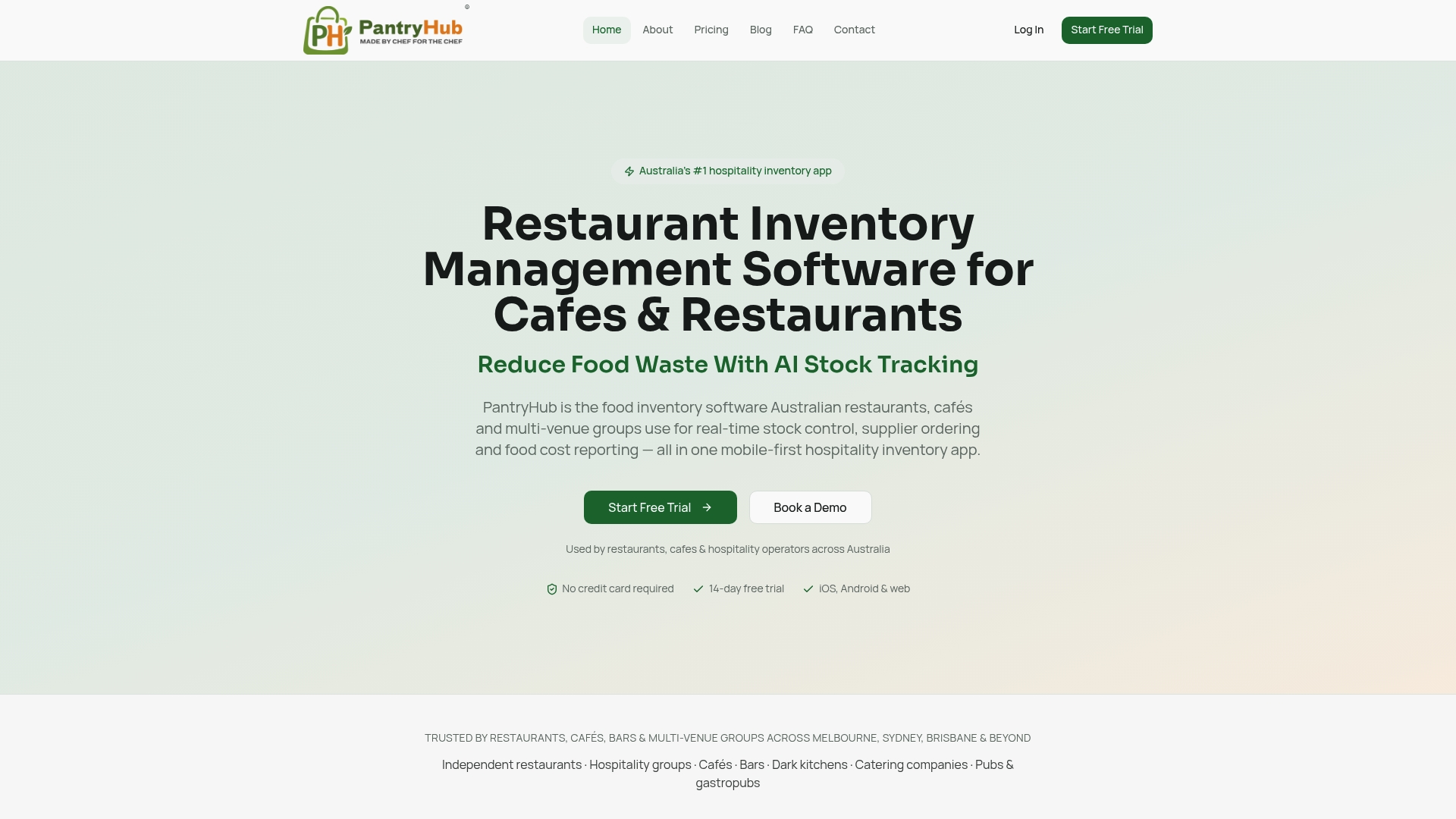
Pantryhub connects directly with your POS and accounting systems to give you real-time stock visibility, automated low-stock alerts, and supplier ordering from a single platform. Whether you run one location or ten, you get the same live data and reporting tools that large chains use, at a price that works for independent operators. Explore hospitality inventory software built for Australian kitchens, or check the pricing plans to find the right fit for your operation.
FAQ
What are the main types of restaurant software integrations in Australia?
The main types are POS integrations, online ordering and delivery platform connections, accounting software links (Xero and MYOB), inventory management systems, reservation platforms, loyalty programs, and middleware hubs like Deliverect that centralize multi-channel order management.
What is middleware and why do Australian restaurants need it?
Middleware is a platform that sits between your POS and multiple delivery services, syncing menus and routing orders from one interface. Deliverect, for example, manages 1,000+ integrations and is critical for operators running on Uber Eats, Menulog, and DoorDash simultaneously.
How do I choose between native and third-party integrations?
Native integrations are more stable and cost-effective than third-party connectors because they are built and supported by the same vendor. Always activate native integrations first and only add third-party tools when a native option does not exist for your specific need.
Does my restaurant POS need an offline mode in Australia?
Yes. Australian operators prioritize offline capabilities because internet outages affect both regional and metro venues regularly. A POS without offline mode stops taking payments the moment your connection drops, which is an unacceptable operational risk.
How does inventory software integration improve restaurant profitability?
Inventory management connected to your POS tracks stock depletion in real time against actual sales, identifying variance between theoretical and actual food costs. Integrated inventory solutions improve purchasing decisions and margin control by giving operators the data to act on waste, theft, and portioning errors before they compound.