
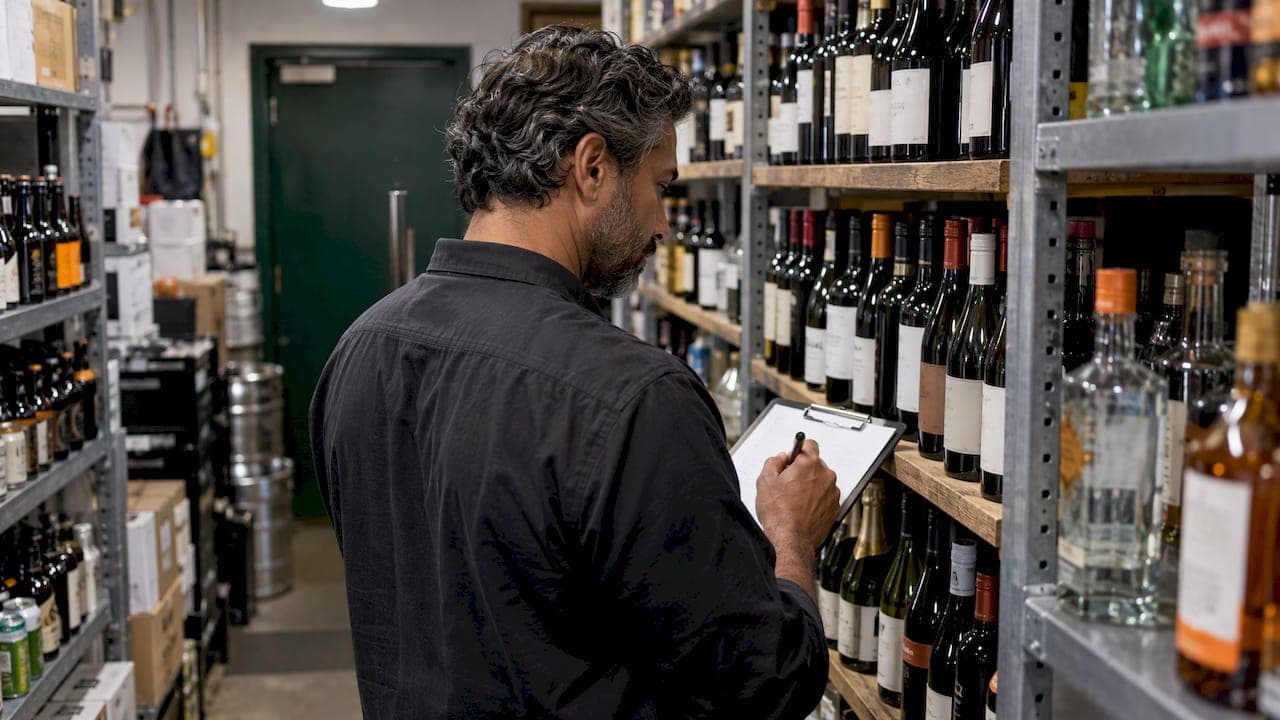
A blind inventory count is a stocktake where the counter does not see the expected quantity. They count what is physically on the shelf and write it down, and only then does a manager compare it to the system. For a restaurant, café or pub, it is one of the simplest ways to find out whether your stock records are true. Below you will find how to run one, which items to count blind, how often, and what to do with the gaps.
TL;DR
- A blind count hides the expected figure, so the counter records what is really there instead of ticking off a number.
- Count blind for high-value lines (spirits, proteins, seafood) and for any count that feeds a report. Use quick open checks for low-value items.
- Count by zone, finish each area before moving on, and handle open cartons and part-used bottles with care.
- Compare the results against usage from your POS, set a tolerance, recount outliers, then adjust stock.
- Cycle counts let you do blind counting weekly without closing the kitchen.
Table of Contents
- What a blind count is, and how it differs from an open count
- Why blind counting suits hospitality
- How to run a blind stocktake, step by step
- Which sampling method should you use?
- How often should you count?
- Reading the results: what the variance is telling you
- Making blind counts work across a team or several venues
- Our perspective
- Put your count routine on one platform
- A simple first month
- FAQ
- Sources
What a blind count is, and how it differs from an open count
In a blind count, the counting sheet or screen lists the item and its location but not the quantity on hand. Oracle's inventory documentation describes the difference plainly: a blind count hides the expected quantity, so the counter has to enter the physical quantity found, while an open count displays the expected quantity and only discrepancies need to be entered.
That one design choice changes human behavior. If the sheet says 12 bottles of gin and you see 11, it is tempting to assume one is hiding behind the others and write 12. If the sheet says nothing, you write 11. The same thing happens at the end of a long shift on a Sunday night: a pre-filled number is an invitation to agree.
Other names for the same idea are blind stocktaking and blind stock counts. In Australia, "stocktake" is the word most operators use, so you will see both terms used for the same process.

Why blind counting suits hospitality
Hospitality stock moves fast and leaks quietly. Over-pouring, unrecorded waste, staff meals, missed deliveries and miscounted partial packs all chip away at margin, and a stocktake that only confirms the book figure hides all of it.
Blind counting helps because it removes the counter's expectation. In practice that stops three habits:
- Stopping the count when the number gets close to what the system says.
- Skipping the recount because the first count happened to match.
- Settling any doubt in favor of the book figure.
It also gives you a cleaner reading. When a blind count comes back matching the system, that is real evidence your records are right, not an echo of them.
When an open count is the better tool
Blind counting is not the answer to everything. It takes longer and can generate more exceptions, and a visible figure can help a counter hunt for stock that has been put in the wrong place. Use an open check when you are verifying a delivery against the delivery docket, or doing a quick five-item spot check mid-service where speed matters more than rigor. For anything that ends up in a report, or any line where money goes missing, count blind.
How to run a blind stocktake, step by step
This process works for a single café or a multi-venue group. The steps are the same; only the number of counters changes.
1. Set the scope and the cut-off
Decide what you are counting: the whole venue, one zone, or a chosen group of items. Then fix the cut-off time. Record the last delivery received and the last sale before counting starts, so the system figure you compare against is for the same moment as the physical count. Counting while a delivery is half unpacked is the fastest way to create a fake variance.
2. Build the count sheet by zone
List items in the order you walk the venue: dry store, walk-in cool room, freezer, bar back, bottle shop fridge, under-bar. Do not list items alphabetically, because that sends the counter all over the building and leads to double counts and missed lines. Our guide to stock count sheets for restaurants covers layout in detail.
3. Hide the quantities and brief the counter
Give counters the item, the unit and the location, nothing more. Tell them the count is not a test of the person; it is a test of the records. Staff who think they are being checked up on tend to round numbers up or avoid reporting damage.
Be clear on units. Is a spirit counted in bottles, or bottles plus a tenth of a bottle for the open one? Is cheese counted in blocks or kilos? Unit-of-measure confusion is one of the more common causes of blind count errors, so write the unit on the sheet.
4. Count what you can see, and handle partials carefully
Count on the shelf, not from memory and not from last week's sheet. Finish one location completely before moving to the next. Open cartons, split packs and part-used bottles cause more mistakes than sealed cases, so agree one way to record them. Many venues count part-used bottles in tenths, and weigh or estimate consistently, whichever method you choose.
If a pack is damaged or you cannot identify it, flag it on the spot with a note. Do not guess a quantity and move on.
5. Use a second counter on the lines that matter
For the expensive, easy-to-lose lines such as premium spirits, scotch fillet, prawns and wine, have a second person count independently. Neither should see the other's number. If the two counts disagree, a third count settles it.
If you run a team, our article on the kitchen stocktake process shows how to split the zones between people so nobody counts their own area alone every time.
6. Reveal the system figure and measure the variance
Only now does a manager compare the count against the system. A stock variance is simply the counted quantity minus the system quantity. A positive number means you found stock the records did not show; a negative number is a shortfall.
Convert each variance into dollars as well as units. Two missing bottles of vodka and two missing lemons are both a variance of two, and they are very different problems.
7. Recount the outliers, then adjust
Set a tolerance before you look at the results, for example a percentage and a dollar value per line. Anything outside it gets recounted by someone else. Oracle's inventory guidance describes this same pattern: percent and value tolerances on the reconciliation report, with a separate step that updates stock quantities to match the counts. Keep approval separate from counting, so the person who counted is not the person who signs off the adjustment.
Which sampling method should you use?
A full blind count of every item is slow, and no venue wants to do one every week. You have a few options for choosing what to count.
| Method | What you count | Best for | Trade-off |
|---|---|---|---|
| Full count | Everything in the venue | Month end, end of financial year | Takes the most time and labor |
| Cycle count | A scheduled subset of items or locations | Weekly or daily routine | Needs a rotation plan |
| ABC (value-based) count | A-items (top value) often, C-items rarely | Venues with a big spirits or protein spend | Needs sorting of items by value |
| Random spot check | A few lines chosen at random | Keeping staff honest between counts | Less thorough |
| Targeted count | Lines with a known problem | Chasing a specific variance | Reactive rather than routine |
The difference between a cycle count and a full count is simple. Oracle notes that cycle counts can target selected locations, items or item families, while a physical count covers the whole business unit. That is what makes them practical for a busy kitchen: count the cool room on Monday, the bar on Tuesday, dry store on Wednesday. Our cycle counting guide for restaurants shows how to set up the rotation.
A sensible mix for most venues:
- Count A-items (spirits, proteins, seafood, anything you would lock up) blind every week.
- Cycle through B-items on a rolling schedule.
- Do a full blind count monthly or at financial year end.
- Use open spot checks for low-value consumables.
How often should you count?
Xero's Australian hospitality guide advises weekly stocktakes for high-value items such as proteins and alcohol, and a monthly full inventory count. It also suggests comparing actual usage with what your POS says should have been used, because the gap can point to waste, over-portioning or theft.
The same guide gives a benchmark for context: a healthy food cost percentage sits between 28% and 35% for restaurants and 25% to 30% for cafés. If your food cost is running above your range, a blind count on your highest-cost lines is the quickest way to find where it is going.
For pubs, bars and clubs, bottle counts are usually the weekly priority. We cover that routine in our bar stocktake guide for Australian pubs and bars, and club operators with multiple bars will find more in managing club bar stocktakes. If you are in South Australia, the Adelaide bar stock management checklist is a good companion.

Reading the results: what the variance is telling you
A variance is a clue, not a verdict. Before anyone is blamed, work through the common causes in this order:
- Counting errors. Wrong unit, missed location, double count. Recount first.
- Timing. A delivery or a transfer between venues was not entered before the cut-off.
- Recipe and portion drift. The recipe says 30 ml, the pour is 40 ml. The usage gap shows up on every sale.
- Unrecorded waste. Spoilage, spills, comps, staff meals and returns that never made it into the system.
- Supplier shortfalls. Short-delivered cartons that were signed for without checking.
- Theft. Last on the list, because it is the least common and the most damaging to assume.
Compare theoretical usage (what your sales and recipes say you should have used) against actual usage (opening stock plus purchases minus closing stock). One-off spikes often have a simple explanation, such as a function or a large booking. Planning for these is easier when you understand an event hosting workflow for restaurants, because big events change usage in ways your normal week will not show.
When the same line is short two weeks in a row, that is a pattern, and patterns are where margin is recovered. Our list of common inventory mistakes restaurants make is a handy checklist for the causes above, and types of hospitality inventory reports explains which reports show each one.
Making blind counts work across a team or several venues
A few habits keep blind counts accurate when more than one person is involved.
- Split the count into groups. Different people count different locations or item groups within one counting event, so the count finishes faster and nobody is tired by the last shelf. Oracle's mobile counting documentation describes splitting counts into groups so multiple users count different locations or items.
- Rotate counters. The person who closes the bar every night should not be the only one who counts it.
- Scan or tap, don't write. Fewer manual keystrokes means fewer transcription errors, and a phone replaces the clipboard and the end-of-night data entry.
- Use the same unit and item names everywhere. If one venue calls it "Coke 375" and another "Coca-Cola can", group reporting is a mess.
- Keep a standard count day. A fixed routine, for example Monday before open, makes the numbers comparable week to week.
Our perspective
We built PantryHub by the chef for the chef, and the lesson we keep hearing from operators is the same: the stocktake is rarely the problem. The problem is what happens around it. The sheet is out of date, the count takes half a day, the numbers go into a spreadsheet on Tuesday, and by Friday nobody trusts them.
That is why we think a count process should be fast enough to repeat. Blind counting is only valuable if your team actually does it every week, and they will only do it every week if it takes minutes per zone rather than hours. A phone in the hand, items listed in the order you walk the venue, and stock levels you can see in real time make that realistic for a café and for a multi-venue group alike.
Our platform is designed to give you real-time stock control, low-stock alerts, team access controls and food cost reporting in one place, with AUD pricing and GST-ready reporting for Australian venues. The idea is that your count results, your supplier ordering and your reports all draw from the same stock figures, so a variance you find on Monday shapes the order you place on Tuesday.
If you are still counting on paper, our advice is to start small: pick your ten most expensive lines, count them blind every week, and see what the numbers say. Bin the spreadsheets once you trust the routine.
the author
Put your count routine on one platform
If you want blind-style counts, usage reports and supplier ordering in one place, PantryHub is built for Australian restaurants, cafés, pubs and clubs. Plans are priced in Australian dollars: Starter is $39 per month, Regular is $69 per month and Pro is $99 per month, and you can see what each includes on the pricing page. Prefer to see it first? Start your free trial and set up your first zone this week.
You can also read how hospitality inventory software fits into your day-to-day, or compare digital stocktake tools in Australia by type before you decide.
A simple first month
You do not need to overhaul everything at once. Here is a four-week start:
- Week 1: Pick the top ten lines by dollar value. Write the unit for each. Do one blind count and one open count so you see the difference.
- Week 2: Count the same lines blind, with a different person. Compare against POS usage and note the biggest gaps.
- Week 3: Add a second zone, such as the cool room or the bar back. Recount any line outside your tolerance.
- Week 4: Run a full blind count. Review variances in dollars, fix the top two causes (often a portion size and an unrecorded waste habit), and set your routine for the next quarter.
By the end of the month you will know which lines drift, which zones are messy, and whether your records can be trusted.
FAQ
What is a blind inventory count?
It is a stock count where the counter cannot see the expected quantity. They record what they physically find, and a manager compares it with the system afterwards. This removes the temptation to confirm a number instead of counting.
Is a blind count slower than a normal stocktake?
Usually a little, because the counter must enter every quantity rather than only the exceptions. You can offset that by counting by zone, using a phone instead of paper, and using cycle counts so each session covers fewer items.
Which items should I count blind first?
Start with high-value and high-shrink lines: spirits, wine, proteins, seafood and anything expensive that is easy to take or over-portion. Low-value items such as napkins and cleaning supplies can be checked openly and less often.
What should I do when the count doesn't match the system?
Recount the line with a second person first, then check delivery timing, transfers and unrecorded waste. Only after that should you adjust the stock record, and keep a note of the cause so you can spot repeat patterns.
How often should a café or pub run blind counts?
A common approach is weekly counts of high-value items and a full count monthly, as Xero's hospitality guide suggests for Australian venues. Adjust it to how fast your stock turns and how large your variances are.
Sources
- Understanding Inventory Stock Counts Using Mobile Devices (Oracle PeopleSoft 9.2.057)
- Setting Up Inventory Counts (Oracle PeopleSoft 9.2.056)
- Hospitality accounting: Financial management for Australian hospitality (Xero)