

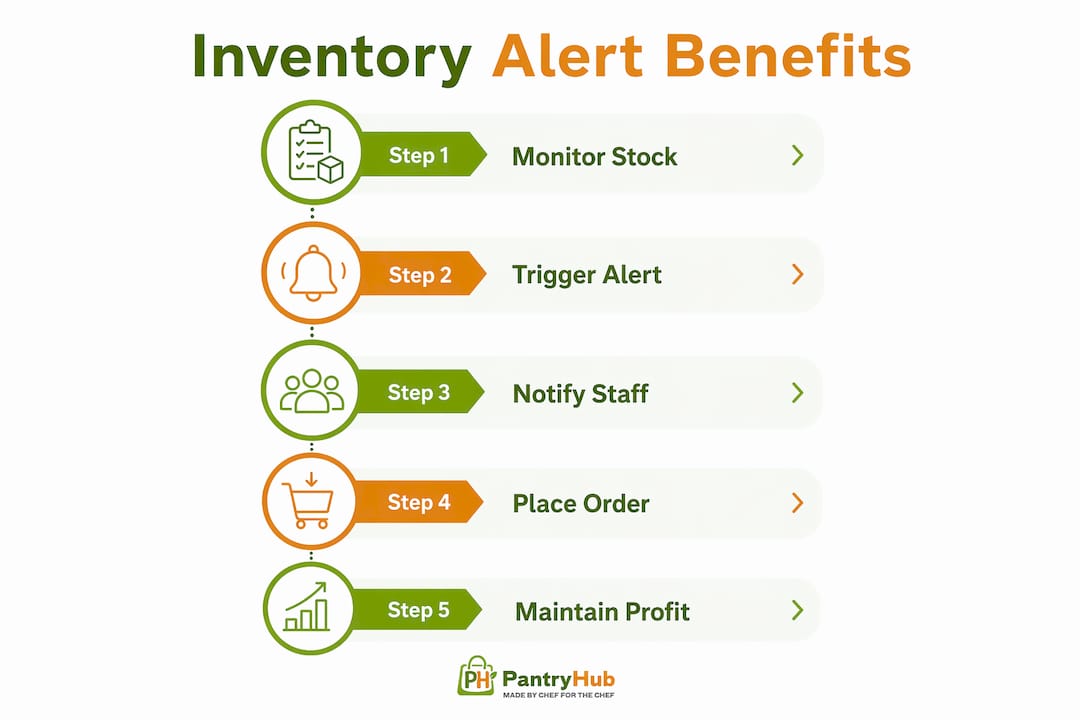
Inventory alerts are automated notifications that trigger when stock levels drop below a predefined threshold, giving hospitality managers time to reorder before a shortage hits. The reason why hospitality businesses need inventory alerts comes down to one hard fact: the global retail and hospitality sectors lose $1.73 trillion annually due to inventory distortion from out-of-stocks and overstocks. That number reflects real revenue walking out the door every day. Pantryhub was built specifically to solve this problem for restaurants, cafés, bars, and commercial kitchens by turning reactive stock management into a proactive system.
Why hospitality businesses need inventory alerts to stay profitable
Inventory alerts function as an early warning system, not a convenience feature. Without them, stock depletion happens in real time while your team is focused on service, not spreadsheets. Manual, interval-based checks create blind spots that allow stock to fall below reorder thresholds completely undetected. By the time someone notices the shortage, the damage is already done.
The types of alerts matter as much as having them at all. Automated alert systems cover low-stock, slow-moving, bulk order, and goods-received notifications, each serving a different operational purpose. A low-stock alert on your most-ordered wine protects revenue. A slow-moving alert on a seasonal ingredient prevents spoilage. Together, these alert categories give you a complete picture of what your stock is doing between physical counts.

Hospitality profit margins are notoriously thin. Alerts protect those margins by eliminating the two most expensive inventory mistakes: running out of something guests expect, and buying too much of something that spoils. Both outcomes cost money you cannot afford to lose.
How do inventory alerts improve operational efficiency and reduce waste?
Real-time inventory monitoring replaces the reactive cycle of manual checks with a system that works continuously in the background. Automated reorder points reduce stockouts by 50–80% and cut excess inventory by 20–30%. That is not a marginal improvement. It is the difference between a kitchen that runs smoothly and one that constantly scrambles.
The efficiency gains show up in specific, measurable ways:
- Fewer emergency orders. When alerts fire early enough, you reorder through normal channels at standard prices.
- Less staff time on manual counts. Automated tracking frees your team to focus on service and preparation.
- Reduced spoilage. Slow-moving alerts flag ingredients before they expire, giving you time to use or return them.
- Better supplier relationships. Consistent, predictable orders build trust and often unlock better pricing.
- Improved guest satisfaction. A kitchen that never runs out of key items delivers a more consistent experience.
The connection between stock visibility and guest experience is direct. A hotel that runs out of toiletries or a restaurant that cannot serve a signature dish loses more than one sale. It loses the repeat visit.
Pro Tip: Set your alert thresholds based on actual sales velocity, not gut feeling. Pull your average daily usage for each item, multiply by your supplier's lead time, then add a safety buffer of two to three days. Review these numbers every quarter as your menu and demand patterns shift.
What are the financial impacts of lacking inventory alerts?
The financial cost of poor stock control in hospitality is concrete and well-documented. A 100-room hotel can lose up to $20,000 per month from supply-related room closures alone. That figure does not include the cost of guest complaints, negative reviews, or lost repeat bookings.
Overstocking carries its own financial penalty. Carrying costs for excess inventory consume 20–30% of inventory value annually. For a restaurant holding $50,000 in stock, that is up to $15,000 per year tied up in storage, spoilage, and capital that could be working elsewhere.
The emergency restocking scenario is where costs spike fastest. Emergency freight runs 3–5 times the cost of standard shipping when a stockout forces an urgent order. A single emergency delivery can erase the profit margin on an entire week of service.
| Cost scenario | Without inventory alerts | With inventory alerts |
|---|---|---|
| Stockout frequency | High, discovered reactively | Low, prevented proactively |
| Emergency freight costs | 3–5x standard shipping rate | Rare, near-standard rates |
| Carrying costs | 20–30% of inventory value annually | Reduced through tighter ordering |
| Monthly loss (100-room hotel) | Up to $20,000 from room closures | Significantly reduced |
| Spoilage rate | Elevated, slow movers undetected | Lower, flagged before expiry |
The pattern is consistent across property types. Whether you run a single café or a multi-location group, the absence of alerts means you are always reacting to problems rather than preventing them.
How to set effective inventory alert thresholds for hospitality
The reorder point formula is the foundation of every effective alert system. Reorder Point = (Average Daily Sales × Supplier Lead Time) + Safety Stock. Each variable requires honest data, not estimates.
Follow these steps to configure alerts that actually reflect your operation:
- Calculate average daily usage. Pull sales data for each item over the past 30–90 days. Divide total units sold by the number of days. This is your baseline consumption rate.
- Confirm supplier lead times. Contact each supplier and record their actual delivery window, not the best-case scenario. Use the longest realistic lead time for your calculation.
- Add a safety stock buffer. Multiply your average daily usage by two to three extra days. This buffer absorbs unexpected demand spikes or supplier delays.
- Segment fast and slow movers. High-velocity items like cooking oil or coffee need tighter thresholds and more frequent review. Slow movers need different logic to avoid overstocking.
- Adjust for seasonality. A beach resort's linen usage in summer differs sharply from its winter baseline. Build seasonal multipliers into your thresholds before the season starts.
- Connect alerts to purchase orders. Properly configured alert workflows linked directly to purchase orders remove human delay from the reorder process entirely.
Dynamic stock alert levels improve both operational stability and cash flow management compared to static thresholds that never change. Static thresholds are the most common mistake hospitality managers make when first setting up an alert system.
Pro Tip: Schedule a monthly threshold review on your calendar. Treat it like a financial review, not an optional task. Menus change, suppliers change, and demand shifts. Alerts calibrated six months ago may be triggering too early or too late right now.
What technologies make inventory alerts more effective in hospitality?
The effectiveness of any alert system depends on the quality of data feeding it. Disconnected spreadsheets and manual entry produce unreliable alerts. Integrated platforms produce alerts you can act on with confidence.
The most impactful technology integrations for hospitality inventory tracking include:
- Property Management System (PMS) integration. Real-time integration between inventory software and PMS improves reorder alerts by connecting occupancy data directly to stock consumption forecasts. A fully booked weekend triggers different supply needs than a slow midweek period.
- Point of Sale (POS) connection. Every sale recorded at the POS automatically deducts from inventory. This eliminates the lag between consumption and stock count updates.
- Mobile apps and barcode scanning. Staff can update stock counts from the floor in real time. Mobile tools reduce room turnover time by 10–15 minutes per room and decrease guest complaints by 30–40%.
- AI-powered forecasting. AI-powered inventory systems reduce forecasting errors by up to 50%, which means alerts fire at the right time rather than too early or too late.
- Cloud-based centralized platforms. Multi-location operators need a single view of stock across all sites. Cloud platforms deliver that visibility and allow managers to set location-specific alert thresholds from one dashboard.
The benefits of inventory management technology compound over time. Better data produces better alerts, which produce better ordering decisions, which reduce both stockouts and overstock simultaneously. Pantryhub delivers all of these integrations in a single platform built specifically for hospitality operations.
Real-time inventory data also gives managers the ability to spot trends before they become problems. A gradual increase in daily coffee usage might signal a menu change is working. An alert firing earlier than expected might signal a supplier is delivering short. Both insights are only visible when your data is current.
Key Takeaways
Inventory alerts are the single most effective tool hospitality businesses have to protect margins, prevent stockouts, and reduce waste simultaneously.
| Point | Details |
|---|---|
| Alerts prevent costly stockouts | Automated reorder points reduce stockouts by 50–80% compared to manual monitoring. |
| Overstocking has a real price | Carrying costs consume 20–30% of inventory value annually without tight alert controls. |
| Emergency orders destroy margins | Expedited restocking costs 3–5 times standard shipping rates when alerts are absent. |
| Thresholds need regular calibration | Static alert levels become inaccurate as demand, menus, and suppliers change over time. |
| Integration multiplies alert value | Connecting alerts to PMS, POS, and supplier systems removes human delay from reordering. |
The case for treating alerts as a management discipline
I have seen hospitality operators set up inventory alerts once and then forget them for two years. The alerts keep firing, orders keep going out, and no one questions whether the thresholds still make sense. That is not inventory management. That is automated guesswork with a false sense of security.
The operators who get the most out of alert systems treat them as a living part of their operation. They review thresholds when the menu changes. They adjust safety stock before a public holiday. They investigate when an alert fires earlier than expected, because that usually means something has changed upstream. This discipline is what separates a kitchen that runs well from one that just runs.
The shift from manual to automated alerts is not difficult, but it does require commitment. The first month of setup is the hardest. After that, the system does the heavy lifting. I have watched managers reclaim hours each week that used to go toward manual stock counts and emergency supplier calls. That time goes back into the operation, into training, into guest experience.
If you are still relying on weekly physical counts and gut instinct to manage stock, you are not managing inventory. You are reacting to it. The signs your kitchen needs inventory software are usually obvious in hindsight. The cost of waiting is not.
— Admin
Pantryhub gives hospitality managers real control over stock alerts
Pantryhub is built for exactly this problem. It gives restaurants, cafés, bars, and commercial kitchens a centralized platform for hospitality inventory management with automated low-stock alerts, supplier integration, and real-time visibility across single or multiple locations.
Every alert in Pantryhub connects directly to your supplier ordering workflow, so a low-stock notification does not just inform you. It triggers the next step. Managers can set location-specific thresholds, track stock movements from any device, and generate reports that show exactly where waste and shortages are occurring. Whether you run one venue or ten, Pantryhub puts your stock data where you need it, when you need it.
FAQ
What are inventory alerts in hospitality?
Inventory alerts are automated notifications that fire when a stock item drops below a set threshold. They give hospitality managers time to reorder before a shortage affects service or revenue.
How do inventory alerts reduce waste in restaurants?
Slow-moving alerts flag ingredients that are not being used at the expected rate, allowing managers to adjust orders or use stock before it spoils. This directly reduces food waste and the cost of disposing of expired goods.
Why do hotels need stock alerts specifically?
Poor inventory control in hotels can cause up to $20,000 in monthly losses from supply-related room closures. Stock alerts prevent these closures by triggering reorders before critical supplies run out.
How often should hospitality businesses review alert thresholds?
Alert thresholds should be reviewed at least monthly and always before seasonal shifts, menu changes, or supplier changes. Static thresholds become inaccurate quickly in a dynamic hospitality environment.
Can inventory alerts integrate with existing hotel or restaurant software?
Yes. Modern inventory platforms integrate with PMS and POS systems to connect stock data directly to occupancy and sales. This integration means alerts reflect actual consumption rather than estimated usage.