
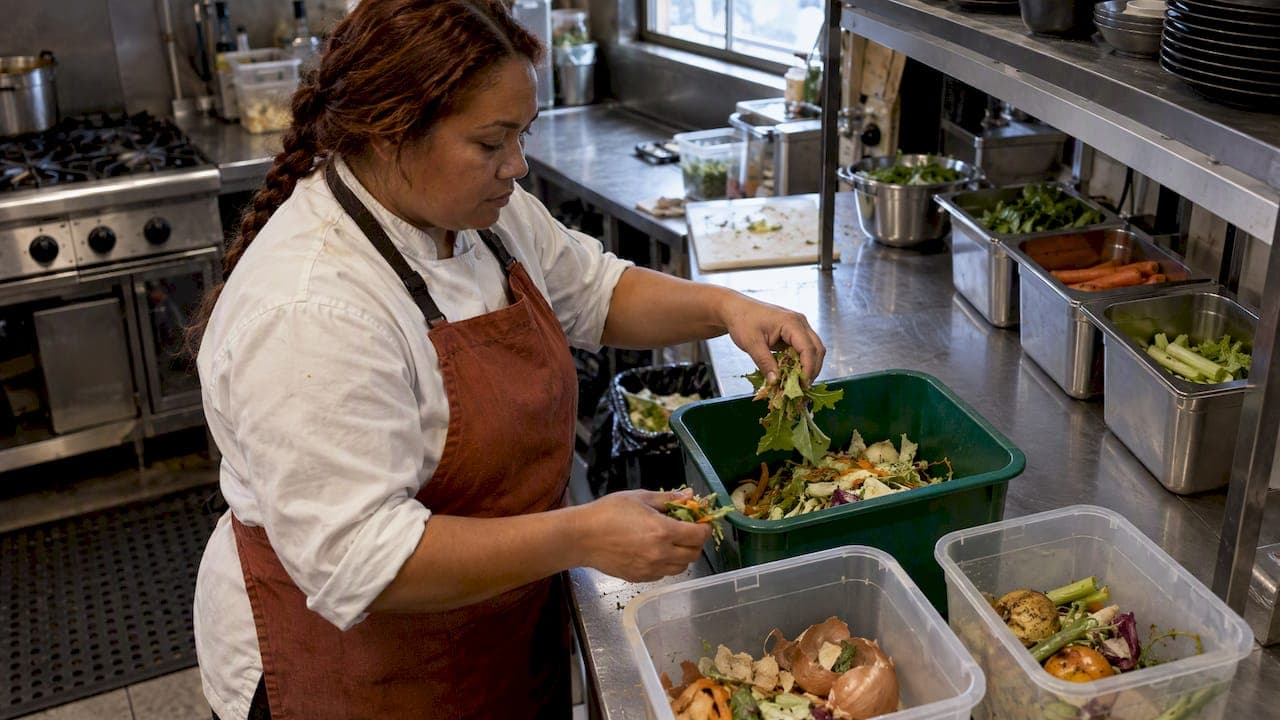
A restaurant waste audit is a structured count of what your kitchen and floor throw away: what it is, how much it weighs, which shift produced it and why. Run properly, it gives you a baseline you can cost in dollars and fix one cause at a time. This guide shows you how to do it in a restaurant, café, fish and chip shop, pub or club, with the equipment, timing and recording method that Australian guidance recommends.
TL;DR
- Audit for 4 to 6 weeks, not one day, and include busy and quiet trading days plus events.
- Separate prep waste, spoilage and plate waste before you weigh. One combined number can't tell you what to fix.
- Weigh net, not gross: tare the empty container, then record date, shift, food type and likely cause.
- Turn kilograms into dollars using your average purchase cost per kilo, then change one thing and measure again.
- Record covers or turnover next to every weight so weeks can be compared fairly.
Table of Contents
- Why audit before you change anything
- What a waste audit actually measures
- How long to audit for
- Equipment: keep it simple
- The audit, step by step
- Turning kilograms into dollars
- Look at contamination, not just weight
- Connecting the audit to your stock numbers
- Where PantryHub fits
- Our view: the audit is the start, not the project
- A simple four-week plan
- FAQ
- Sources
Why audit before you change anything
Most venues already suspect they bin too much. Few know how much. The 2024 Australian Café Sector Action Plan reports that hospitality generates 16% of Australia's food waste, and that only 22% of foodservice businesses in the research it cites had carried out a food-waste audit or assessment. It also cites research that almost 50% of small-to-medium cafés said waste was not monitored. Those figures come from a 2024 sector report and its cited studies, so treat them as a snapshot, not a current national rate.
The practical point is simple. Waste that isn't measured quietly eats into margins. business.gov.au describes a waste audit as the way to set a baseline: how much goes to landfill, what is in it, what is recycled, which part of the business produces it and where staff communication or education gaps sit.
It also changes the order of decisions. Measure first, then buy new bins, change your collection service or promise anyone a diversion result. The baseline tells you which waste streams are real and which department owns them. The NSW hospitality toolkit makes the same case from an operational angle: reliable measurements help you size food-waste bins, spot contamination, plan collection frequency and cut overflow and unnecessary service costs.
So think of the audit as a purchasing and costing tool first, and a sustainability exercise second.
What a waste audit actually measures
A full audit can cover general waste, recycling, food organics and cooking oil. For most kitchens the money is in food, so start there. The US EPA's assessment guide notes that for restaurants, separating pre-consumer from post-consumer waste helps distinguish over-purchasing, preparation losses, cooking errors and uneaten food.
In practice that gives you three food buckets:
| Stream | What goes in it | What it usually points to |
|---|---|---|
| Prep waste | Trim, peels, off-cuts, coffee grounds, bread ends | Cutting method, specs, supplier pack sizes |
| Spoilage | Out-of-date, spoiled or over-ordered stock | Ordering, par levels, stock rotation, storage |
| Plate waste | Food returned or scraped from plates | Portion size, menu mix, side dishes |
Add two more records if they apply to you. Cooking oil should be logged separately in sealed containers, by weight or volume. And note special events, holiday periods and catering jobs, because the NSW toolkit says they can materially change your waste profile and are best noted or audited separately.
A NSW fact sheet citing a 2015 NSW EPA study says that on average 66% of hospitality food waste is pre-consumer and 34% is left on plates. Your own split will differ, and finding out yours is the point of the exercise.

How long to audit for
A one-day bin sort is a snapshot. The EPA guide itself calls a waste audit a snapshot in time. It says a one-week sample can give accurate data, and that a single day can be extrapolated to a week when you have to.
For an Australian hospitality venue, we'd aim higher. The NSW hospitality toolkit recommends daily measurement for 4 to 6 weeks, covering busy and quiet days. If daily isn't realistic, it suggests a representative mix of weekdays, weekends and events. A one-off audit can understate your normal waste because staff change behaviour when they know they are being watched, or because the period was unusually quiet.
A few timing rules:
- Don't start the week your head chef is on leave or the week of a public holiday, unless you also want to measure that.
- Include your Friday and Saturday peaks. For a pub or club, include trivia nights, bistro specials and function days.
- If you can't weigh every bin, audit the regularly used ones or sample your highest-waste areas and extrapolate.
Equipment: keep it simple
You don't need specialist gear. The toolkit's minimum list is tabletop or floor scales, labelled containers or bins, audit sheets or a digital form, gloves and cleaning supplies.
Buy or borrow:
- One floor scale for bulk bins and one benchtop scale for smaller tubs.
- Three or four identical, clearly labelled containers: Prep, Spoilage, Plate, plus Oil if relevant.
- A clipboard sheet at each station, or a shared tablet.
- Gloves, sanitiser and a wipe-down routine, so the audit never compromises food safety.
Keep audit containers away from clean prep surfaces and follow your venue's food safety program.
The audit, step by step
The sequence below follows the structure used in the NSW toolkits, adapted for a working kitchen.
1. Define scope and name a waste champion
Decide what you're measuring: kitchen only, or kitchen plus bar and floor. Then name one person who owns the sheets. This is usually a sous chef, kitchen manager or café owner. Without an owner, week three always goes missing.
2. Label separate containers
Set up separate containers for prep, spoilage and plate waste at the points where waste is created, not at the back door. If staff have to walk across the kitchen, they'll toss things in the nearest bin and your data is gone.
3. Weigh net, not gross
Tare the empty container first and record net weight. Gross weights include the tub and any liquid, and they'll flatter or punish a shift for no reason.
4. Record the right fields
For every entry, capture:
- Date and shift
- Location or station
- Food type (for example cooked rice, lettuce trim, coffee grounds, bread, fries)
- Net weight
- Likely cause (over-prepped, dropped, out of date, returned, trim)
- Covers served or sales for that shift
The toolkit advises noting composition, not weight alone: cooked food, coffee grounds, vegetable peels, bread and prep waste each tell a different story.
5. Normalise against covers or turnover
Kilograms alone make a busy Saturday look worse than a quiet Tuesday. The NSW toolkit's advice is to relate results to covers or turnover, so that week-to-week and venue-to-venue comparisons mean something. Track grams of waste per cover as your headline number.
6. Ask the team why
Weighing doesn't explain itself. NSW guidance stresses combining measurement with staff knowledge: chefs can explain prep and spoilage, while front-of-house can spot recurring plate waste and portion issues. A ten-minute huddle at the end of week two often surfaces more than the scales do.
7. Analyse, change one thing, measure again
Rank your top five wasted items by weight and by dollar value. Pick the one or two with the clearest cause. Change something operational, such as a par level, a portion, a trim spec or a delivery day, and keep measuring so you can see whether it worked.
Turning kilograms into dollars
The cost calculation is straightforward. Multiply the measured waste weight by your average procurement cost per kilogram, and analyse disposal costs separately.

The NSW toolkit illustrates the method with 45 L of food waste a day at $10 per kg, which works out to roughly $450 a week and nearly $24,000 a year in preventable loss. That is an illustration of the method, not a benchmark for every venue.
Here is a smaller hypothetical to show how it works for a café. These numbers are made up for demonstration:
| Item | Measured per week | Average cost per kg | Weekly cost |
|---|---|---|---|
| Spoiled produce | 6 kg | $7 | $42 |
| Bread and pastry ends | 9 kg | $6 | $54 |
| Plate waste (sides) | 5 kg | $5 | $25 |
| Total | 20 kg | $121 |
Over 52 weeks that is $6,292 before disposal costs. Your own numbers will differ, and the value lies in knowing which line is biggest. In this example, bread and pastry are the biggest line, so you'd look at bake quantities before you touch anything else.
Look at contamination, not just weight
If you use a food-organics collection, the audit should include what ends up in the wrong bin. A 2025 field audit by the Waste and Recycling Association's C&I survey inspected 448 sites in Sydney and found contamination at 40% of food-organics sites, with soft plastic and wrongly marketed compostable bags among recurring problems. Clubs and hospitality sites recorded contamination above 40%.
So a food-organics service can exist and food can still leak into general waste. Add two lines to your sheet: what's in the wrong bin and which shift put it there. Then fix it with bin placement, clear signage and a quick training session, not a lecture.
Connecting the audit to your stock numbers
A waste audit tells you what you threw out. Your inventory tells you what you bought, used and sold. Put the two together and you can see which ingredient, supplier, recipe or process is behind the loss.
That is where most manual audits stall: the sheets sit in a folder and nobody reconciles them with purchasing. We cover the next steps in these guides:
- Restaurant waste tracking: practical steps to cut food cost for turning a one-off audit into a daily habit.
- Prep waste vs plate waste for a two-week measurement plan aimed at kitchen managers.
- Actual vs theoretical food waste reporting for spotting the gap between what recipes say you should use and what you actually use.
- Waste allowance policies for naming an officer and logging waste daily.
- Predicting food waste for better orders once you have a baseline to forecast from.
For a wider view of the fixes that usually follow an audit, see how to reduce food waste in restaurants.
Where PantryHub fits
If you'd rather not run the audit on paper, this is what PantryHub is built for. It's an inventory and ordering platform for Australian restaurants, cafés, bars, pubs, clubs and commercial kitchens, with real-time stock tracking, low-stock alerts, supplier ordering, recipe and pricing standardisation, and waste and cost reporting across one or many venues.
- 📦 Track stock movement so waste lines up with what was bought and used.
- 🔔 Get low-stock alerts that help you order closer to need.
- 🛒 Order from suppliers inside the same platform.
- 📊 See food cost and waste reporting in AUD.
Plans are published at Starter $39 per month, Regular $69 per month and Pro $99 per month, and you can start a free trial to see how your own stock and waste data look in one place. If you're in a capital city, we have pages for Melbourne, Sydney, Adelaide and Perth venues.
Our view: the audit is the start, not the project
We built PantryHub from a chef's point of view, and what we see across hospitality kitchens is consistent. The audit itself is rarely the problem. Venues run one with real enthusiasm, find something uncomfortable, and then the sheets go in a drawer.
Three things separate the venues that benefit from those that don't.
They tie waste to a dollar value quickly. Kilograms don't move an owner. A line that says bread ends cost $54 this week does. Once waste has a price, it gets onto the agenda of the Monday meeting.
They look upstream. Plate waste gets the attention because it's visible, but spoilage and over-ordering are usually where money leaks. If an item is always spoiled, the fix is usually a par level or a delivery schedule, not a stricter bin policy. Our common inventory mistakes and kitchen inefficiency guides cover the patterns we see most.
They keep measuring. A baseline is useful because you can compare against it. If you change nothing and measure nothing, you'll never know if the change worked. A shorter, lighter routine kept up every week beats a perfect audit done once.
For single-site cafés, we'd suggest the paper method above for the first two weeks, then move the recording into the same tool that handles your ordering and stock, so the data lives with the decisions it informs. Bin the spreadsheets when they stop saving you time.
— Admin
A simple four-week plan
- Week 0, set up. Name the champion, buy the scales, label the containers, print the sheets, brief the team on why you're doing it (to find savings, not to catch people out).
- Weeks 1 to 2, measure. Record every shift. Note events and unusual days.
- Week 3, review. Rank items by weight and cost, and hold the team huddle. Pick one or two changes.
- Weeks 4 to 6, change and re-measure. Keep recording. Compare grams per cover with your first two weeks.
If you can, carry on to the full 4 to 6 weeks of baseline data recommended by the NSW toolkit before you judge results.
FAQ
How long should a restaurant waste audit run?
Aim for 4 to 6 weeks of daily measurement, as the NSW hospitality toolkit recommends. If that isn't possible, a representative mix of weekdays, weekends and events will do. A single day is the weakest option, though the EPA guide says it can be extrapolated to a week when necessary.
Do I need a professional auditor?
Not to get started. Scales, labelled containers and a recording sheet cover the basics, and your own team knows why the waste happens. Professional assessments can help if you're dealing with contamination or collection contracts across several sites.
Should I weigh waste or estimate it visually?
Weighing is more accurate but takes more labour. Visual audits are faster and less precise. If time is tight, weigh your highest-waste areas and estimate the rest, and record which method you used.
How do I know what my waste costs me?
Multiply the net weight of each food item by what you pay per kilogram, then add disposal costs separately. Repeat weekly and track the cost per cover so busy and quiet weeks compare fairly.
Is a waste audit the same as a stocktake?
No. A stocktake counts what you hold on the shelf. A waste audit records what you discard and why. The two work best together, because stock movement shows where an ingredient went and the audit shows what became waste.
Sources
- Manage business waste, business.gov.au
- Waste Wise Hospitality Implementation Toolkit, NSW Love Food Hate Waste
- Winding Down Wineries Food Waste toolkit, NSW Love Food Hate Waste
- A Guide to Conducting and Analyzing a Food Waste Assessment, US EPA
- Café Sector Action Plan Report 2024, AusFAB
- WCRA C&I Survey 2025
- How to Conduct a Food Waste Audit fact sheet, NSW Love Food Hate Waste