

The fastest way to prevent kitchen theft is to combine tight inventory controls, locked-down POS permissions, and clear staff policies all at once. Start today with blind cash counts, locking up high-value stock like meat and alcohol, and running weekly spot checks. Tools like PantryHub and practices like exception-based reporting turn these fixes into a repeatable system instead of a one-time cleanup.
TL;DR:
- Tracking high-value items like meat, seafood, and alcohol upfront helps prioritize spot checks and prevents more expensive thefts from going unnoticed.
- Implementing weekly rotating spot checks and blind counts on top SKUs can identify discrepancies within days, reducing the lag that allows theft to hide.
- Enforcing POS permission restrictions, manager-only refunds, and exception-based reporting significantly cuts fraud by enabling quick detection of suspicious transactions.
- Requiring thorough three-way matching for deliveries and maintaining detailed waste logs facilitate early detection of receiving and spoilage issues that may mask theft.
- Using real-time inventory software that flags variances immediately provides faster responses, prevents long-term loss, and streamlines investigations when discrepancies arise.
Table of Contents
- Recognize Theft: The Types That Look Like Ordinary Shrinkage
- Where To Start: A Prioritized Prevention Checklist
- Inventory Controls That Make Theft Visible
- POS And Cash Controls: Locking Down The Register
- Receiving And Vendor Controls Stop Losses Before They Start
- Physical Security: Cameras, Access Control, And Device Hardening
- People And Policy: Rules Staff Actually Understand
- Technology Workflows That Catch Theft Faster
- The Investigation Playbook: What To Do When Stock Goes Missing
- How A Platform Like PantryHub Supports These Controls
- Rolling Out Controls Without Breaking Team Trust
- Put These Controls On Autopilot With PantryHub
- Sources
- FAQ
Recognize Theft: The Types That Look Like Ordinary Shrinkage
Most kitchen losses don't look like theft. They look like paperwork, spoilage, or "just a busy night." That's exactly why so many operators miss it for months.
Shrinkage is the umbrella term for any gap between what your inventory system says you should have and what you actually have. Theft is one cause. So are receiving errors, over-portioning, and spoilage from bad storage rotation. The National Retail Federation's shrink data puts retail shrink around 1.6% of sales, and foodservice operators typically see comparable or higher losses because perishable inventory adds a layer of legitimate waste that can mask deliberate theft.
You need to know which flavor of loss you're actually dealing with before you pick a fix. The main categories:
- Product theft — staff taking food, liquor, or supplies home, either in bulk or a little at a time.
- Sweethearting — a cashier or server giving free items, oversized portions, or discounts to friends and family.
- Unauthorized comps — voiding or discounting checks without manager approval to cover mistakes or reward regulars off the books.
- Refund fraud — processing fake refunds and pocketing the cash difference.
- Cash skimming — pocketing cash sales before they hit the register, common in high-volume counter service.
- Vendor collusion — a receiver and a supplier working together to short deliveries or inflate invoices.
Meat, seafood, and alcohol carry the highest dollar value per unit, which makes them the first place a thief looks and the first place you should look back. Focus your early spot checks there before you build out a full program.
Where To Start: A Prioritized Prevention Checklist
Not every fix costs the same or pays off at the same speed. Sequencing matters. Trying to install a full access-control system before you've fixed your till procedures is backward.
- Quick wins (this week, near zero cost): Start blind cash counts, where the person counting doesn't see the expected total first. Lock high-value stock like alcohol and premium proteins in a separate, access-logged space. Give every staff member a unique POS login and restrict voids, refunds, and price overrides to managers only.
- Near-term operational changes (this month): Introduce weekly rotating cycle counts on your highest-risk items. Start a waste log that records who logged the waste, the quantity, and the reason. Write a staff meal policy into your handbook. Require three-way matching between purchase orders, delivery notes, and invoices.
- Longer-term investments (this quarter): Move to an integrated inventory platform that logs scans in real time. Link your POS exceptions to time-stamped video footage. Add keycard or code-based access control to your storage and walk-in areas.
Pro Tip: Don't announce which week you're doing spot checks. A predictable count schedule is almost as useless as no count at all, because staff learn to game the pattern.
The order matters because the quick wins cost nothing and start paying off within days, while the investments need budget approval and a rollout plan. Build momentum first, then scale.
Inventory Controls That Make Theft Visible
A monthly stocktake tells you that something went missing sometime in the last thirty days. It rarely tells you what, when, or who. That lag is where most theft hides, because by the time a manager notices the pattern, weeks of loss have already compounded.
Perpetual inventory, where every receipt, transfer, and sale updates your stock count in real time, closes that gap. Instead of waiting for a monthly reconciliation, you see variance the same day it happens. A scan-logged workflow also removes the guesswork of manual tally sheets, which are themselves an easy target for manipulation.
Between full counts, run these three checks consistently:
- Weekly spot checks on your five to ten highest-value SKUs, rather than waiting for the full monthly count.
- Rotating cycle counts, where you vary which items get checked and who does the checking, since predictable audit schedules let staff neutralize them before you ever look.
- Blind counts compared directly against system-recorded usage, so the counter has no prior number to anchor against.
Three-way matching, where you cross-check the purchase order, the delivery note, and the supplier invoice against one another, catches the receiving-side losses that a stock count alone will miss. If the quantities don't align across all three documents, flag it before you sign off on payment.
Waste logs deserve more attention than most kitchens give them. A proper waste log records who logged the waste, how much, and why, every single time. Reconcile those entries against your standardized recipes on a weekly basis. If your logged waste for a proportion of prime cuts spikes without a matching sales dip, that's not spoilage. That's a pattern worth pulling camera footage for. A structured stocktake process gives your team a repeatable script for all of this instead of reinventing the count every week.
POS And Cash Controls: Locking Down The Register
Your point-of-sale system is either your best fraud detector or your biggest blind spot, depending entirely on how you configure it. Most restaurants leave the default settings in place for years, which means any staff member can void a transaction or issue a refund with zero oversight.
Fix the permissions first. Every staff member gets a unique login, never a shared PIN, and voids, refunds, and price overrides route through manager approval only. This single change closes the door on the most common form of register fraud: a cashier voiding a paid transaction and pocketing the cash.
Layer these controls on top:
- Blind till counts at shift change, where the outgoing staff member counts without seeing the expected drawer total first.
- Random cash drawer audits, done at unpredictable intervals rather than the same time every shift.
- Exception-based reporting that flags clustered voids, an unusually high void-to-sales ratio, or one server issuing far more comps than their peers.
Exception-based reporting is the highest-leverage change most mid-sized operators can make to their POS setup, because it removes the need for a manager to manually scan every transaction log. Instead, the system surfaces only the outliers.
Retailers that pair blind counts with manager-only overrides and exception-based reporting see investigation time drop from hours to seconds, because the flagged transaction arrives pre-narrowed rather than buried in a full day's log. Linking that flagged transaction directly to time-stamped video closes the loop: instead of scrubbing hours of footage, you jump straight to the sixty seconds that matter.
Receiving And Vendor Controls Stop Losses Before They Start
Loss prevention often starts at the loading dock, not the register. If a delivery arrives short and nobody checks it against the invoice before signing, that loss is baked in before the food even reaches your kitchen.
Assign one responsible receiver per shift and require them to physically count deliveries against the delivery note before signing anything. A signature on an unchecked delivery is worse than useless. It's a paper trail that says everything arrived correctly when nobody actually verified it.
Build these habits into every delivery:
- Three-way match the purchase order, delivery note, and invoice before approving payment.
- Annotate discrepancies on the delivery note itself, on the spot, rather than trying to reconstruct the count from memory later.
- Rotate who receives and who approves invoices to reduce the risk of a receiver and a vendor colluding over time.
- Spot-check unit prices against your last three orders and investigate any split invoice or sudden price jump.
A clear ordering and receiving workflow keeps this consistent across every shift, not just when your most careful manager happens to be on the floor.
Physical Security: Cameras, Access Control, And Device Hardening
Cameras deter theft, but only when staff know they're being watched fairly, not singled out. Position cameras at entry points, storage areas, and the register, and skip the break room and staff areas entirely. That balance matters: over-surveillance breeds resentment, while under-surveillance leaves your highest-value stock unwatched.
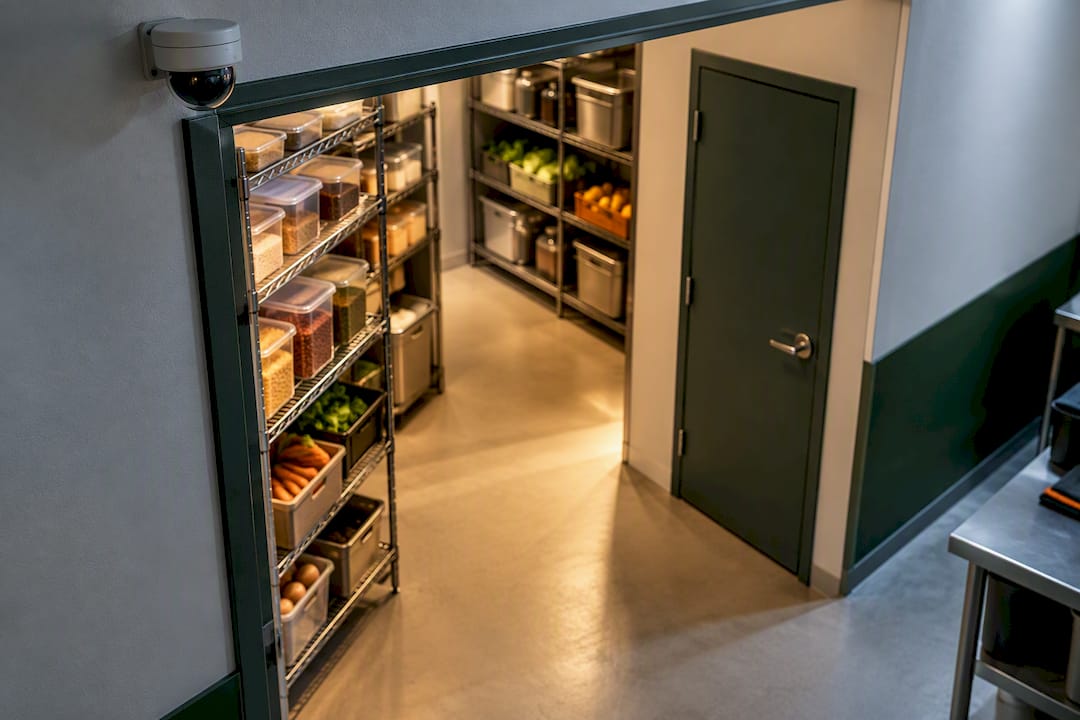
Access control matters just as much as cameras. Walk-ins, dry storage, and liquor cages should require a keycard or rotating code, with a log of who entered and when. If you're still using a single shared key that's been passed around for years, you have no way to narrow down who accessed a space before stock went missing.
Don't overlook your hardware:
- Change default passwords on POS terminals, cameras, and any networked kitchen device the day you install them.
- Separate your POS network from guest Wi-Fi and other connected devices, since unsegmented networks are a known entry point for tampering.
- Rotate access codes whenever a staff member with storage access leaves the business.
- Log every storage access, even for trusted long-term staff, so the record is consistent rather than selective.
People And Policy: Rules Staff Actually Understand
Most theft doesn't start with a bad person. It starts with a vague policy, an unclear expectation, and a staff member who genuinely wasn't sure if that end-of-shift meal was allowed. Write it down before you enforce it.
Your employee handbook should spell out exactly what counts as theft, what your staff meal policy covers, and who can approve a comp. If a server doesn't know the rule exists, disciplining them for breaking it damages trust without actually preventing the next incident.
Build the policy side of your program on these pillars:
- Document clear definitions of theft, comps, and staff meals directly in the handbook, not just in a verbal onboarding chat.
- Train every new hire on why the controls exist, not just what they are, so the rules read as protection rather than suspicion.
- Explain consequences and the appeals process up front, so enforcement never feels arbitrary.
- Keep pay and scheduling transparent, since operational research consistently links financial strain to opportunistic theft.
Pro Tip: When you investigate a discrepancy, gather the facts first and keep the conversation confidential until you have them. A public accusation that turns out wrong costs you more in team trust than the original loss ever did.
Technology Workflows That Catch Theft Faster
A monthly count catches theft after the fact. A continuous audit trail catches it while it's happening. That's the entire argument for moving beyond spreadsheets and clipboards.
Scan-logged inventory turns every stock movement into a timestamped record, which means a pattern that would take weeks to notice manually surfaces within days. Continuous tracking is what separates a periodic check from an actual audit trail.
Two technology moves matter more than the rest:
- Exception-based alerts flag only the transactions or stock movements outside your normal range, so a manager reviews five anomalies instead of five hundred routine transactions.
- Automated linking between POS exceptions and video means a flagged void or refund pulls up the matching footage automatically, cutting investigation time from a manual footage search to a direct review.
The ROI case for these systems is strongest for exactly the mid-sized operations that can't afford a dedicated loss-prevention manager. If you're rolling this out for the first time, don't try to instrument every location at once. Pilot it on your highest-theft SKUs at a single location first, then track time-to-resolution and shrink improvement for four to six weeks before deciding whether to scale it across your other sites.
The Investigation Playbook: What To Do When Stock Goes Missing
Finding a discrepancy is only step one. What you do in the next hour determines whether you can actually prove what happened or just end up guessing.
- Isolate the issue immediately. Preserve the relevant footage, POS logs, and timestamps before anyone else touches the affected area or shift records.
- Document the evidence chain. Note who had access, when the discrepancy first appeared, and what the system-recorded quantity should have been.
- Run a neutral interview. Ask fact-based questions rather than leading with an accusation, and keep the conversation confined to those directly involved.
- Set escalation thresholds in advance. Decide beforehand what dollar amount or pattern of repeat incidents triggers HR involvement, legal counsel, or a police report.
- Preserve evidence properly for any external review, meaning original logs and unedited footage, not summaries or secondhand notes.
A clear process for handling stock discrepancies keeps every manager on your team following the same steps, so an investigation doesn't depend on who happens to be working that night.
How A Platform Like PantryHub Supports These Controls
Every control in this playbook works better when the data behind it updates in real time instead of once a month. That's the practical link between the operational fixes above and the software layer underneath them.
Scan logs become your continuous audit trail. Role-based permissions enforce the same manager-only override rule you just set up at your POS. Automated reporting turns your exception-based monitoring from a manual spreadsheet chore into a standing alert.
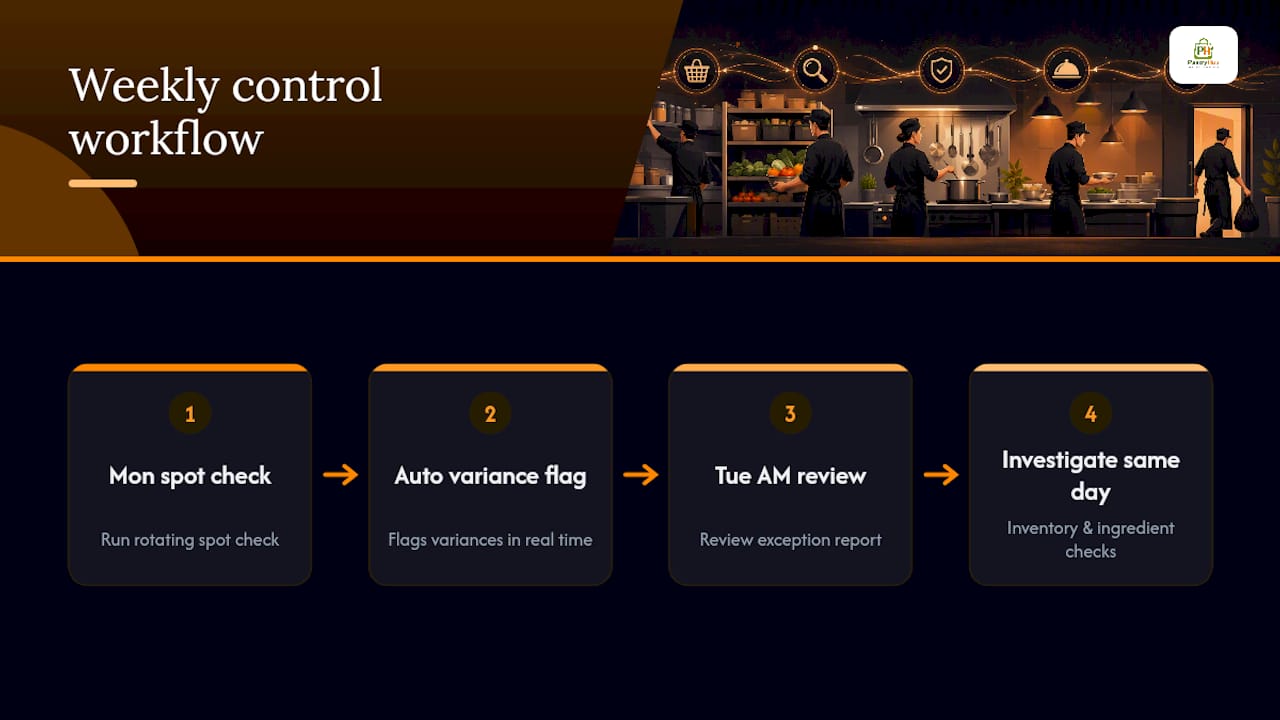
A workable weekly routine looks like this: run your rotating spot check on Monday, let the system flag any variance against expected usage automatically, and review the exception report Tuesday morning before it becomes a pattern instead of an incident. Pair that with a kitchen inventory audit structure and an ingredient-level tracking setup, and you've replaced a once-a-month guess with a system that tells you the same day something's off.
Rolling Out Controls Without Breaking Team Trust
Every control on this list works better, and lasts longer, when your team understands why it exists. Talk to staff before you change anything. Explain the actual dollar impact of shrink on wages and scheduling stability, and invite their feedback on how the changes will play out on the floor.
Frame this as protecting fair pay, not policing your team. Share the results once you have them: less shrink funds more stable staffing and better bonuses. Controls introduced as an accusation breed resentment. Controls introduced as a shared goal tend to stick.
— Admin
Put These Controls On Autopilot With PantryHub
PantryHub is the practical alternative to running loss prevention off spreadsheets and gut instinct, built specifically for Australian kitchens with AUD pricing and local support instead of a US-built platform retrofitted for your market.
Real-time stock tracking replaces your monthly count with a continuous audit trail. Low-stock alerts catch variance before it becomes a pattern. Role-based access enforces the same manager-only permissions you just read about, and built-in reporting turns exception-based monitoring into something your team actually checks every week instead of ignoring.
Grab the free kitchen inventory checklist to start your first rotating count this week, then compare current plans and pricing on the pricing page. If you're weighing PantryHub against other inventory software, the MarketMan comparison breaks down the differences. Start a free trial at Pantryhub and see your first variance report within a week.
Sources
- Appriss Retail expands global presence by adding Australian retailer Officeworks to its customer portfolio
- Inventory shrinkage: What it is, what causes it, and how to prevent it in 2026
- Types of Restaurant Theft & How to Prevent Them
- The Ultimate Food Service Fraud Prevention Checklist for Commercial Kitchens
FAQ
What Are Five Ways To Prevent Theft In A Kitchen?
Run blind cash counts, restrict voids and refunds to managers, lock up high-value stock like alcohol and meat, use weekly rotating spot checks instead of predictable monthly counts, and require three-way matching on every delivery. Combining inventory, POS, and receiving controls closes far more gaps than any single fix on its own.
What Are Five Ways To Stay Safe In A Commercial Kitchen?
Beyond theft prevention, kitchen safety generally covers clear walkways, proper knife and equipment training, non-slip flooring, secured chemical storage, and functioning fire suppression systems. These are separate from theft controls but often get reviewed together during operational audits.
What Should I Do If A Cleaner Or Staff Member Is Stealing?
Isolate the affected area, preserve any footage and POS logs immediately, and document the evidence chain before confronting anyone. Run a neutral, fact-based conversation rather than an accusation, and set a clear threshold in advance for when the issue escalates to HR, legal counsel, or police.
How Can I Stop Staff From Taking Food Home?
Lock high-value ingredients in access-logged storage, write a specific staff meal policy into your handbook so expectations are clear, and reconcile your waste logs against recipes weekly to catch quantities that don't add up. A platform like PantryHub can flag those variances automatically instead of waiting for your next full count.
Does PantryHub Help With Theft Prevention Specifically?
PantryHub supports theft prevention through real-time stock tracking, role-based permissions, and automated variance reporting, the same continuous audit trail this article recommends building. Plans and pricing are detailed on the pricing page, with a free trial available at Pantryhub.