

Stock discrepancies happen when your recorded inventory doesn't match what's physically on the shelf. The gap costs you money, distorts your ordering decisions, and quietly erodes your margins every week you let it sit. The good news: most discrepancies follow predictable patterns, and fixing them doesn't require a complete operational overhaul.
What are stock discrepancies and how do you handle them?
A stock discrepancy is the difference between what your system says you have and what you actually have. It shows up as a variance between your physical count, your purchase invoices, and your point-of-sale (POS) sales data. When those three numbers don't reconcile, you have a discrepancy.
Handling restaurant inventory issues starts with a few immediate steps:
- Recount the item using a consistent unit of measure before assuming a problem exists
- Check all storage locations including walk-ins, dry storage, and the line
- Verify units to confirm you're comparing the same measure across your count sheet and invoice
- Match SKUs to confirm the item recorded is the item counted
- Reconcile against invoices and POS sales to identify where the gap originates
The impact goes beyond a number on a spreadsheet. Inaccurate inventory data leads to over-ordering, under-ordering, inflated food cost percentages, and purchasing decisions based on fiction rather than fact. Addressing discrepancies through regular audits, inventory reconciliation, and the right technology turns a reactive problem into a manageable routine.
Common causes of stock discrepancies in restaurants
Understanding why variances occur is the first step toward stopping them. Most restaurant supply chain errors don't come from one big failure. They come from small process gaps compounding over time at receiving, counting, invoicing, and ordering.
-
Counting errors. Different staff members counting the same item using different units or methods produce incomparable results. A count done in "each" one week and "case" the next creates variance that looks like a real loss.
-
Receiving mistakes. Deliveries often arrive during peak periods when attention is split. A quick visual check replaces a thorough one, and quantity shortfalls or damaged items go unlogged. Those errors ripple through your cost tracking for weeks.
-
Invoice mismatches. Manual invoice entry, delayed processing, or reconciling invoices well after delivery means pricing errors go undetected for an entire billing cycle. By the time you catch it, the window to correct it has closed.
-
POS drift. Your POS depletes inventory theoretically, assuming every plate matches the recipe exactly. Real kitchens don't work that way. Portioning inconsistencies and untracked waste cause POS inventory to drift from physical reality, plate by plate.
-
Waste and spoilage not logged. A dropped tray, a spoiled case, a comped entrée — none of these are sales, so the POS never deducts them. That shrinkage disappears from the theoretical count and shows up as unexplained variance.
-
Theft. It's less common than process errors, but high-value proteins and premium spirits are the most vulnerable. Free pours and untracked bar comps are a behavior problem, not a system failure.
-
Stale par levels. Par levels set months ago and never revisited don't reflect current menu changes, staffing shifts, or seasonal demand. Ordering against outdated targets creates chronic over-ordering and waste.
-
Recipe changes not updated in the system. The moment a recipe changes and the POS isn't updated, every depletion for that item is wrong until someone fixes it. Prep yield and trim loss rarely map cleanly to POS recipes either.
-
Inconsistent count timing. Counting before a delivery one week and after it the next produces numbers that aren't comparable. Timing variation alone can manufacture a discrepancy that doesn't exist.
-
Transfer and inter-location errors. In multi-site operations, stock moved between locations without proper documentation creates phantom shortages at one site and unexplained surpluses at another.
How discrepancies hurt your restaurant's finances and operations
The financial damage from inventory discrepancies is direct. Food costs have risen for the vast majority of restaurant operators, and at those margins, inventory inefficiency isn't a back-of-house nuisance. It's a threat to profitability.
Here's where the damage shows up:
- Margin erosion. Every untracked loss, whether from waste, theft, or portioning, inflates your actual food cost without showing up as a sale. You're spending more than your P&L reflects.
- Distorted ordering decisions. When your on-hand numbers are wrong, your orders are wrong. You over-order items you already have and under-order items you're about to run out of.
- Stockouts and service failures. Running out of a key ingredient mid-service damages the guest experience and forces costly last-minute purchasing from retail suppliers at full price.
- Wasted labor. Staff spend time chasing phantom shortages, re-counting items, and correcting orders that shouldn't have been placed. That time has a real cost.
- Delayed financial reporting. When inventory and accounting systems operate independently, the financial impact of inventory decisions may not surface until the monthly close. That lag makes cost management reactive rather than proactive.
- Compounding errors. A small variance left uninvestigated doesn't stay small. It compounds across weeks and becomes a distorted picture of your true consumption and loss.
The gap between what you order, what you receive, what you use, and what ends up as waste is rarely visible in real time. By the time discrepancies appear in your financial reporting, the damage is already done.
12 practical strategies to fix and prevent inventory variances
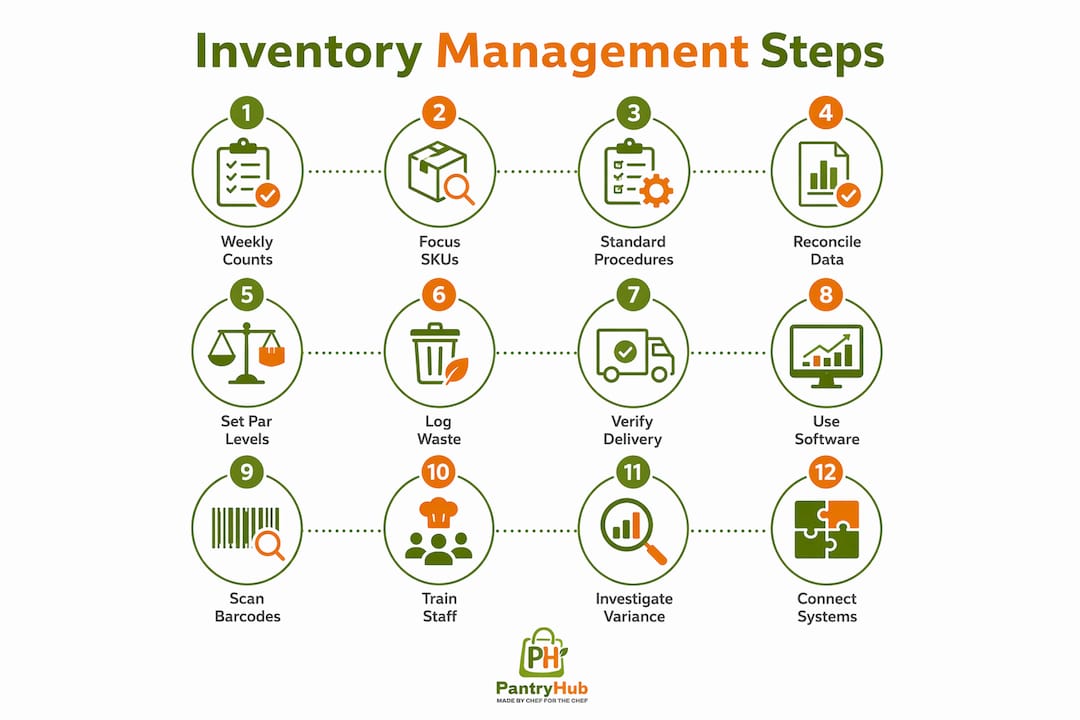
1. Move to weekly counts on a fixed schedule
Monthly counts tell you what happened four weeks ago, after the over-ordering and waste are long gone and impossible to trace. Moving to weekly counts is the single biggest accuracy lever most restaurants have. Same day, same time, same person leading it, every week.
2. Focus on your highest-cost SKUs, not everything
Counting every item every week is impractical. Most restaurants have well over 100 SKUs, but a small subset of those, typically proteins, premium produce, and premium spirits, account for the bulk of food cost. Audit those high-cost items weekly. The rest can get a full count quarterly. A 90-minute focused weekly audit targeting your top high-cost SKUs catches more variance than an exhaustive monthly count that exhausts your senior staff.
3. Standardize your count procedures
Walk the kitchen in the same direction every time. Count each item in one consistent unit. Assign the same person, ideally a sous chef or senior cook, to own the count rather than delegating to a new hire. Two counts are only comparable if they were done the same way.
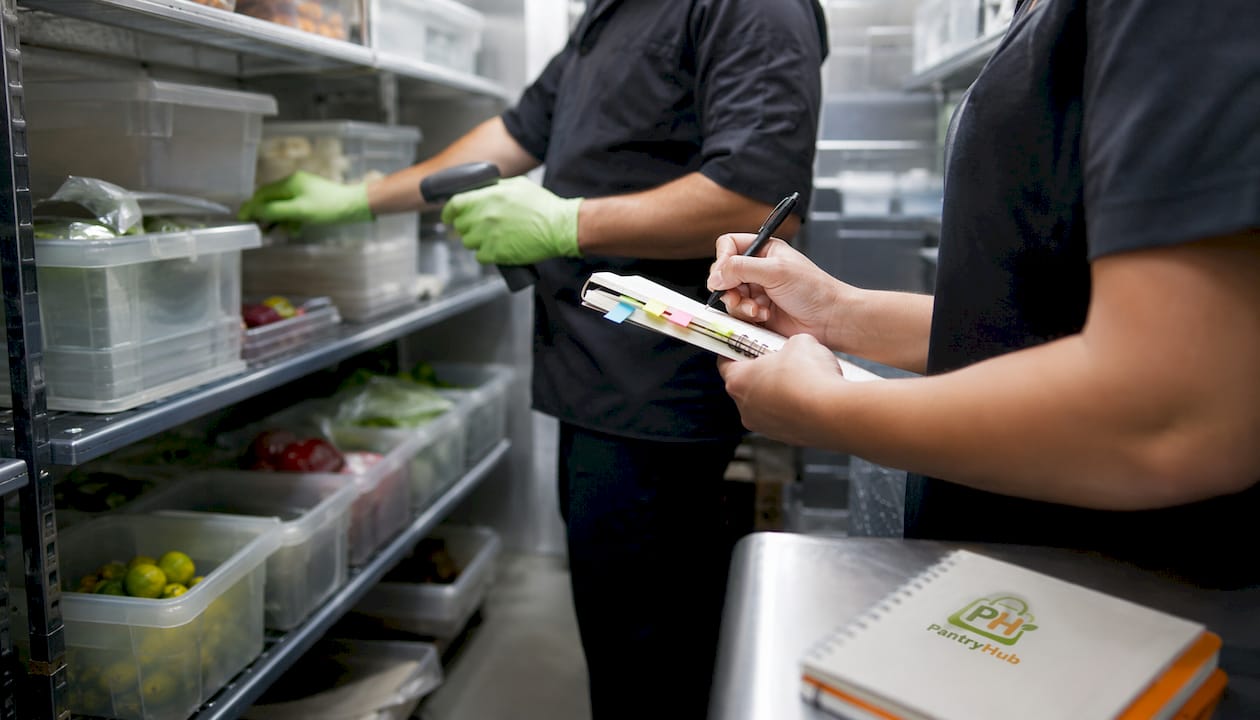
4. Reconcile counts against invoices and POS sales
Matching your physical count to what you bought and what you sold is how you calculate real food cost, not a guess. This reconciliation exposes where variance originates: receiving errors, portioning drift, waste, or theft. Without it, you're navigating without a map.
Pro Tip: Set a 30-minute investigation budget immediately after each count. Variance numbers sitting in a spreadsheet without follow-up are useless. A focused investigation session turns audit data into corrective action.
5. Write down par levels for every item
A par level turns ordering from a feeling into a calculation. Without written pars, ordering runs on instinct, and the safest-feeling order is always a little too much. The extra rots in the walk-in. Review par levels monthly against actual usage data, because menu changes, staffing shifts, and seasonal demand all affect how much of any ingredient you actually need. Monthly par level reviews aligned with sales trends meaningfully reduce over-ordering and the waste that follows.
6. Log waste and comps as they happen
Unlogged spoilage and comps don't disappear. They show up as variance nobody can explain. A clipboard on the line for spoilage, drops, and comps closes the biggest gap between theoretical and actual usage. Training staff to log waste in real time is one of the highest-return habits you can build.
7. Verify every delivery at the door
Don't let a rushed receiving process create weeks of inaccurate data. Check quantities against the purchase order, inspect for damage, and log any discrepancies before the driver leaves. Receiving is one of the most overlooked stages in inventory accuracy, and errors at the door ripple through your cost tracking long after the delivery is forgotten.

8. Implement inventory management software after your manual routine is solid
Software amplifies discipline. It doesn't create it. Inventory software becomes most effective once solid manual routines exist. Once your weekly counts, written pars, and invoice reconciliation are consistent, the right platform automates invoice capture, POS comparison, recipe costing, and variance flagging. Buying software to fix discipline you don't have yet just digitizes the chaos. Pantryhub's real-time stock tracking and low-stock alerts are built to amplify the routines you've already established.
9. Use barcode or RFID scanning to reduce manual entry errors
Manual data entry is where formulas break and units get swapped. Barcode scanning at receiving and during counts removes a full class of human error from your process. RFID technology takes this further, enabling item-level tracking without manual scanning. For high-volume kitchens, the time savings alone justify the investment.
10. Train staff on consistent counting and accurate data entry
Training focused on consistent counting, waste logging, and accurate data entry lowers variance across the board. Staff accountability matters as much as the system. When your team understands why accurate counts affect ordering, food cost, and ultimately their working environment, compliance improves. Build counting procedures into onboarding and reinforce them regularly, not just when a discrepancy surfaces.
11. Investigate variances beyond your threshold immediately
Don't let variance data sit unused. At the per-SKU level over a single week, a 5% variance on a major protein is your investigation threshold. Ask the right questions: Are cooks plating heavier than spec? Did a vendor short the delivery? Has the recipe yield changed? Early investigation means earlier correction and smaller losses.
Pro Tip: When a discrepancy surfaces, contain the impact before you investigate the cause. Prioritize your most profitable orders, reallocate available stock, and pause auto-replenishment on affected items. Reactive ordering without stabilizing your data first worsens shortages and financial losses.
12. Connect inventory, purchasing, and financial data in one system
When inventory and accounting systems operate independently, cost variance only surfaces at the monthly close. Connecting these data streams tightens the feedback loop considerably. You can monitor cost variance on a rolling basis, respond to ingredient price spikes while there's still time to adjust, and identify outlier locations in a multi-site operation before small problems become expensive ones. For multi-location operators, unified inventory management makes it possible to spot a location running consistently higher usage on a core ingredient and investigate whether it's a training gap, a recipe deviation, or a receiving issue.
Industry benchmarks and expert insights on managing inventory discrepancies
Knowing what "normal" looks like gives you a threshold for action. Industry-wide inventory variance benchmarks sit at 1–2% of total sales for top-level figures, with anything sustained above 10% triggering an immediate audit. At the per-SKU level over a single week, a 5% variance on a major protein is the standard investigation threshold. That range is high enough to filter out legitimate recipe-yield noise, but low enough to catch real theft, vendor shorts, and recipe drift.
Benchmark to know: A per-SKU variance threshold over a single week on a major protein warrants investigation; sustained high variance requires immediate audit.
The most common expert mistake isn't failing to count. It's counting and then doing nothing with the data. A 30-minute investigation budget after each weekly audit is what turns variance numbers into corrective action. Without that follow-up, the audit is just paperwork.
Reactive ordering is the other trap. When a shortage surfaces, the instinct is to order immediately. The better move is to contain first: prioritize your most profitable orders, reallocate existing stock across the kitchen or across locations, and stabilize your data before placing new orders. Ordering against inaccurate numbers compounds the problem.
For operators running multiple locations, the inventory challenge extends beyond accuracy at a single site. Without shared systems and standardized procedures, each restaurant develops its own counting and recording habits. That variation makes it nearly impossible to diagnose performance differences across your portfolio. When leadership can see inventory data and usage patterns across all locations simultaneously, outliers become visible early. A location running higher usage on a core ingredient despite comparable sales volume is signaling something worth investigating, and early visibility means earlier correction.
Applying standard work principles to your counting and receiving procedures, the same steps, the same sequence, the same person, every time, is what separates operations that catch discrepancies early from those that discover them at month-end.
Pantryhub gives you the tools to stay ahead of stock discrepancies
Pantryhub is built specifically for restaurant operators who are done guessing. With real-time stock visibility, automated low-stock alerts, supplier ordering integration, and food cost reporting across one or multiple locations, Pantryhub gives you the control you need to catch discrepancies before they become losses.
Whether you're running a single café or a multi-site group, Pantryhub connects your inventory, purchasing, and reporting in one place so the feedback loop stays tight and your decisions stay grounded in accurate data.
Start managing your inventory with Pantryhub and stop letting stock discrepancies eat into your margins.
Key Takeaways
Accurate inventory management requires consistent counting routines, reconciliation against invoices and sales, and a clear investigation protocol for variances that exceed your threshold.
| Point | Details |
|---|---|
| Count weekly, not monthly | Weekly counts surface problems while you can still act; monthly counts only reveal symptoms after the damage is done. |
| Focus audits on high-cost SKUs | Audit your top high-cost items weekly in a 90-minute session; count the rest quarterly to balance accuracy and workload. |
| Investigate at the 5% threshold | A 5% per-SKU weekly variance on a major protein is your trigger for investigation, not just observation. |
| Reconcile counts, invoices, and POS | Matching all three data sources is the only way to calculate real food cost and identify where variance originates. |
| Connect inventory and financial data | Linking inventory, purchasing, and reporting in one system shifts cost management from reactive to proactive. |