

Most restaurant owners discover their inventory problem the same way: a dish goes 86'd mid-service, or the end-of-month food cost number looks wrong and nobody can explain why. Understanding what is an inventory audit kitchen means recognizing that a physical count is only the surface layer. The real work is reconciling what you think you have against what you actually have, then using that gap to fix the systems underneath. This guide covers the definition, types, step-by-step process, technology tools, and how to handle the discrepancies that every kitchen eventually finds.
Table of Contents
- Key takeaways
- What is an inventory audit in a kitchen context
- Types of kitchen inventory audits and how often to run them
- How to conduct a kitchen inventory audit step by step
- Using technology to improve audit accuracy
- Common challenges and how to address discrepancies
- My honest take on kitchen audits after years in hospitality
- How Pantryhub makes kitchen audits faster and more accurate
- FAQ
Key takeaways
| Point | Details |
|---|---|
| Audits go beyond counting | A kitchen inventory audit reconciles physical stock against records to expose waste, theft, and ordering errors. |
| Choose the right audit type | Full stock takes suit quarterly reviews; cycle counts work better for weekly, high-value item checks. |
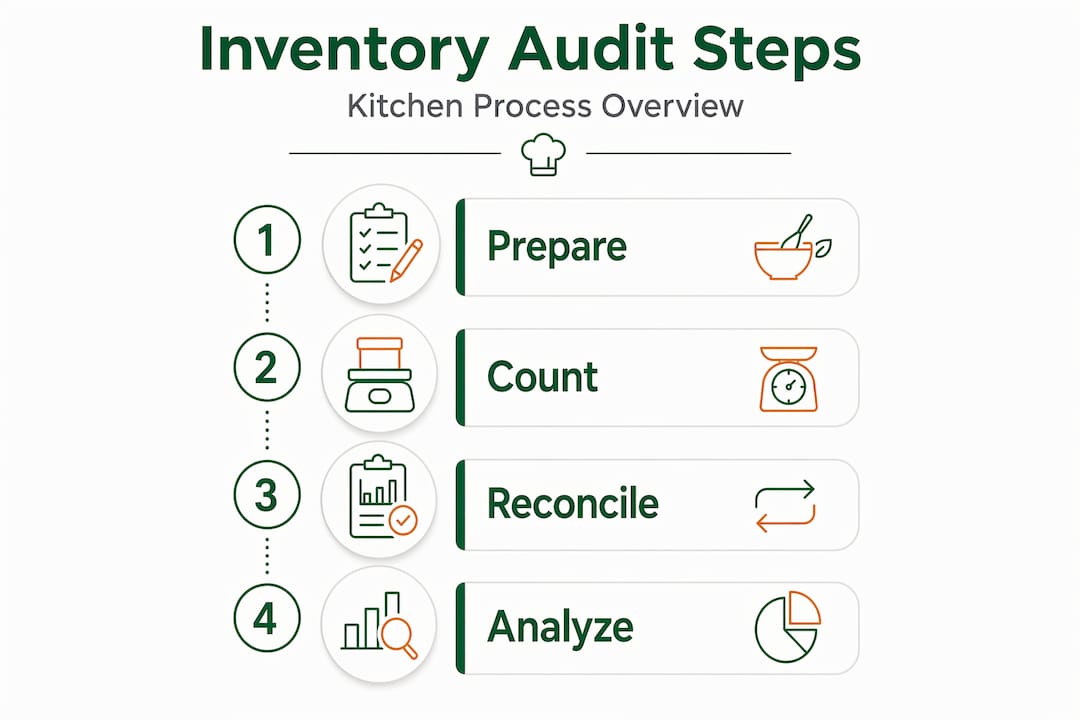
| Follow a four-step framework | Preparation, physical count, reconciliation, and variance analysis form the backbone of every effective audit. |
| Technology cuts errors significantly | POS integration and digital checklists catch discrepancies that manual counting misses. |
| Treat gaps as revenue signals | Unexplained variances are operational warnings, not just paperwork problems. |
What is an inventory audit in a kitchen context
An inventory audit in a commercial kitchen is the formal process of physically counting every ingredient, supply, and consumable on hand, then comparing that count against what your purchasing records and inventory software say you should have. The gap between those two numbers tells you where your money is going.
This is distinct from a general business audit. In a kitchen, food is lost before it reaches customers at rates that compound quickly across a busy week of service. Perishability makes the stakes higher and the window for correction shorter than in almost any other industry.
The purposes of a kitchen inventory audit break down into four specific categories:
- Loss prevention: Identifying theft, pilferage, or unauthorized consumption by comparing theoretical usage against actual usage.
- Waste reduction: Spotting spoilage patterns that point to over-ordering, poor rotation, or incorrect storage temperatures.
- Financial accuracy: Reconciling physical stock with accounting records so your food cost percentage reflects reality, not assumptions.
- Operational insight: Understanding which items are moving faster than expected, which suppliers are shorting deliveries, and where your kitchen's blind spots are.
The importance of kitchen inventory shows up differently depending on your operation size. A single café running tight margins needs audits to control food costs and prevent financial leakage. A multi-location restaurant group needs them to maintain consistency and catch location-specific problems before they become systemic.
One thing both operations share: inaccurate inventory audits cause waste, stockouts, theft exposure, and lost profits. The audit is not a bureaucratic exercise. It is the mechanism that keeps your kitchen's financial reality visible.
Types of kitchen inventory audits and how often to run them
Not every kitchen audit looks the same, and choosing the wrong format for your operation wastes time without improving accuracy. The two primary methods are full stock takes and cycle counts, and most well-run kitchens use both.
| Audit Type | Frequency | Disruption Level | Best For |
|---|---|---|---|
| Full stock take | Monthly or quarterly | High (2 to 4 hours) | Complete reconciliation, financial reporting |
| Cycle count | Daily or weekly | Low | High-value items, ongoing monitoring |
| Spot check | As needed | Minimal | Investigating specific discrepancies |
| Surprise audit | Unscheduled | Moderate | Theft deterrence, staff accountability |
Full stock takes can suspend operations for up to four hours and require multiple staff members working simultaneously. That disruption is worth it for a complete picture, but it is not practical every week.

Cycle counts solve this by auditing a rotating subset of your inventory on a regular schedule. You might count proteins on Monday, dairy on Tuesday, and dry goods on Wednesday, completing a full rotation every two weeks without ever shutting down the kitchen.
The most effective approach uses a tiered system. High-value items like proteins require daily spot-checks because their cost impact is immediate. Bulk dry goods and low-cost consumables can be audited monthly without meaningful risk. This tiered strategy is where most operators leave efficiency on the table by treating a $40-per-kilo tenderloin the same as a $2 bag of rice.
Frequency also depends on your kitchen's turnover rate and staff size. A high-volume restaurant doing 300 covers a night needs more frequent counts than a small café doing 80. The right cadence is the one you can actually sustain without burning out your team.
How to conduct a kitchen inventory audit step by step
A well-organized audit can be completed in 30 to 60 minutes when the preparation is solid. Here is the framework that works in real kitchens.
-
Prepare your workspace and tools. Print or pull up your kitchen inventory checklist before you touch a single item. Confirm that all units of measurement are consistent across your system. If your software tracks chicken in kilograms but your team counts in portions, every number will be wrong before you start.
-
Organize the physical space. Group items by category and location before counting. Freezer items together, dry goods together, refrigerated produce together. This prevents double-counting and missed items.
-
Count in teams of two. One person counts and calls out quantities; the other records. This single change catches the majority of counting errors. Never let the same person who places orders also conduct the count alone.
-
Record counts in real time. Do not hold numbers in your head and write them down later. Use a mobile app or printed sheet and record each item as you go.
-
Reconcile against your records. Compare your physical counts against your inventory system's expected quantities. Calculate the variance for each item. A 2% variance on a low-cost item is noise. A 10% variance on your most expensive protein is a problem that needs an explanation.
-
Analyze variances and act. Categorize each significant variance as waste, theft, supplier shortage, or counting error. Adjust your purchasing quantities, update your par levels, and document your findings for the next audit cycle.
Pro Tip: Schedule your full stock takes at the end of a business day or before a delivery, when stock levels are at their lowest. Counting 10 kilos of chicken is faster and more accurate than counting 40.
The kitchen stock assessment process only creates value if the variance analysis leads to a decision. Numbers without action are just paperwork.
Using technology to improve audit accuracy
Manual counting with paper sheets works, but it introduces errors at every step. Transposition mistakes, illegible handwriting, and miscommunications between the counter and the recorder compound across a full stock take. Technology addresses each of these failure points directly.
- Inventory management software eliminates manual entry errors by storing par levels, unit costs, and historical usage data in one place. When your physical count is entered, the system calculates variances automatically.
- Barcode scanners and mobile apps allow staff to scan items directly, reducing the chance of recording the wrong product or quantity. Digital checklists and scanning tools cut counting time significantly in high-SKU kitchens.
- POS integration is where the real insight comes from. When your point-of-sale system feeds sales data directly into your inventory platform, automatic usage calculations flag unexpected differences immediately. If your POS says you sold 50 portions of salmon but your inventory shows 65 portions consumed, that 15-portion gap needs an explanation.
- Low-stock alerts catch problems between scheduled audits. If a high-turnover item drops below par level unexpectedly, an alert prompts a spot-check before you run out mid-service.
Pro Tip: When evaluating inventory software for restaurants, prioritize POS integration above almost every other feature. Without it, your audit data and your sales data live in separate silos and the most valuable discrepancy signals never surface.
The best inventory management for restaurants treats the audit not as a standalone event but as a continuous data feed. The technology that makes this possible has become far more accessible for independent operators in the past few years.
Common challenges and how to address discrepancies
Finding a variance is the beginning, not the end. The harder work is diagnosing its cause accurately, because the wrong diagnosis leads to the wrong fix.
The three main causes of kitchen inventory discrepancies are:
- Theft and pilferage: Staff taking food home, unauthorized snacking during shifts, or deliberate stock manipulation. Surprise audits are the most effective deterrent because they remove the predictability that enables planned theft.
- Spoilage and waste: Produce that expires before use, over-portioning, and prep waste that is not recorded. This is often a training problem rather than a dishonesty problem.
- Administrative errors: Wrong units entered at receiving, invoices not matched to deliveries, or quantities recorded incorrectly during a previous audit. These errors are invisible until a physical count exposes them.
Spoilage, theft, and administrative errors require different responses. Theft calls for tighter access controls and unannounced counts. Spoilage calls for ordering adjustments and better rotation practices. Administrative errors call for process changes at the receiving stage.
Treating all discrepancies as a theft problem is one of the most common management mistakes. It damages staff trust without fixing the real issue. Start with the most statistically likely cause, which in most kitchens is waste and administrative error, before assuming the worst.
Tracking menu outages and emergency purchases is also part of the discrepancy picture. When you are constantly buying small quantities at retail prices to cover gaps, that cost rarely shows up clearly in your food cost report. Regular cycle counts catch these patterns early and give you the data to fix them before they become expensive habits. You can also reduce the downstream impact by building smarter ordering habits, which connects directly to how you reduce food waste across your operation.
My honest take on kitchen audits after years in hospitality
I have worked with enough restaurant operators to know that most of them treat inventory audits as a compliance task. They do it because they feel they should, not because they understand what the numbers are telling them.
What I have learned is that the audit itself is not the valuable part. The variance analysis is. The number that does not match your records is a signal from your kitchen, and learning to read those signals is what separates operators who control their food cost from those who are perpetually surprised by it.
The kitchens I have seen succeed with audits share one habit: they treat every significant variance as a question that demands an answer before the next service. Not next week. Not at the next management meeting. Before the next service. That urgency is what turns an audit from a paperwork exercise into an operational tool.
The other thing I would push back on is the idea that technology replaces the need for discipline. Software makes audits faster and more accurate, but it does not make them happen. The restaurants that get the most out of inventory platforms are the ones that already had a culture of accountability before they installed the software. The tool amplifies the habit. It does not create it.
— Admin
How Pantryhub makes kitchen audits faster and more accurate
Running a kitchen inventory audit manually is time-consuming and error-prone. Pantryhub was built specifically for commercial kitchens that need a faster, more reliable way to manage stock and conduct audits without pulling their team off the floor for hours.
With Pantryhub's hospitality inventory software, you get real-time stock tracking, POS integration, and automated variance alerts that flag discrepancies the moment they appear. Digital checklists replace paper sheets, and the mobile app means your team can count from anywhere in the kitchen without returning to a workstation. Whether you run one location or ten, every audit feeds into a centralized dashboard that gives you a clear picture of your stock position across the whole operation. If you want to start with a practical foundation, Pantryhub's kitchen inventory app puts everything you need in your pocket.
FAQ
What is a kitchen inventory audit?
A kitchen inventory audit is the process of physically counting all stock in a commercial kitchen and comparing those counts against purchasing records and inventory system data to identify discrepancies, control costs, and reduce waste.
How often should a restaurant conduct an inventory audit?
Most restaurants benefit from weekly cycle counts on high-value items and a full stock take monthly or quarterly. The right frequency depends on your operation's volume and the cost sensitivity of your key ingredients.
What are the main steps for a kitchen inventory audit?
The four core steps are preparation, physical counting, reconciliation against system records, and variance analysis. Strategic audits can be completed in 30 to 60 minutes when these steps are followed consistently.
What causes discrepancies in a kitchen inventory audit?
The most common causes are spoilage, administrative recording errors, supplier shortages, and theft. Each cause requires a different corrective response, so accurate diagnosis matters as much as finding the variance itself.
Does inventory management software really improve audit accuracy?
Yes. Barcode scanners and digital tools reduce human counting errors and speed up reconciliation. POS integration adds another layer by automatically flagging gaps between theoretical and actual usage in real time.