

Poor stock rotation causes expired and dead stock, lost sales from stockouts, higher disposal and freight costs, slower warehouse operations, and serious compliance or reputation risk. These aren't edge cases. They're the predictable result of skipping FIFO and FEFO disciplines, recording inaccurate receipt dates, or letting layout block access to older product. The consequences of bad inventory rotation compound quickly, and most operations don't catch them until the P&L already shows the damage.
Here's what you're up against when rotation breaks down:
- Dead stock and spoilage: Older product sits behind newer receipts until it expires or becomes unsellable.
- Markdowns and write-offs: Expired or near-expiry goods get discounted or binned, eroding margin.
- Disposal and compliance costs: Regulated categories (food, pharma, cosmetics) carry disposal fees and potential fines.
- Stockouts and lost sales: Mismanaged stock creates phantom inventory, hiding real shortages until a customer order can't be filled.
- Expedited freight: Reactive replenishment after a stockout costs far more than planned ordering.
- Recall and safety exposure: Misrotated product reaching customers triggers recalls, returns, and potential legal liability.
- Customer churn: Repeated quality failures or out-of-stocks push buyers to alternative suppliers.
The sections below unpack each of these with concrete examples by industry, measurable financial impacts, detection KPIs, and a prioritized prevention plan you can act on this week.
Key Takeaways
Poor stock rotation is an operational discipline problem with measurable financial consequences, and fixing it starts with capturing expiry data at receiving and measuring FEFO compliance every week.
| Point | Details |
|---|---|
| Scale of the problem | The US discards $163.1 billion in expired or unsellable goods annually; rotation failures drive a significant share. |
| Operational loss rate | Rotation and operational breakdowns cost an estimated 4.5% of gross sales annually, more than theft. |
| First fix to make | Capture lot number and expiry date per pallet at receiving; this single step gives your system the data to enforce FEFO. |
| Detection KPI to monitor | Track FEFO compliance rate weekly; a rate below 90% signals a systemic rotation failure requiring immediate process review. |
| Culture beats SOPs alone | Incentive programs tied to rotation accuracy change daily behavior more reliably than procedures posted without accountability. |
Table of Contents
- What poor stock rotation actually looks like across industries
- How rotation failures translate into measurable financial losses
- Day-to-day operational damage you'll see on the warehouse floor
- Compliance, recall risk, and what a single misrotation can cost your reputation
- What's actually causing rotation to fail in your operation
- How to spot rotation problems before they become expensive
- Practical steps to fix poor rotation, starting this week
- The scale of the problem, backed by research
- Why culture determines whether your rotation SOPs actually work
- Sources
What poor stock rotation actually looks like across industries
The negative effects of inadequate stock rotation show up differently depending on your category, but the failure patterns repeat. Here are the most common scenarios, mapped to their root cause and consequence.
Grocery and fresh food: A produce distributor receives two pallets of leafy greens on the same day. One pallet is three days older than the other. The receiver logs a single receipt date for both and stacks the newer pallet in front. Pickers pull from the front. By the time the older pallet is touched, half of it is unsellable. The quick win here is capturing lot dates at receiving for every pallet separately, not one date per delivery.
Restaurant and commercial kitchen: A kitchen stores dairy on a rolling basis, but new stock gets placed in front of existing product. Chefs pull from the front. A container of cream that should have been used four days ago gets discovered during a weekly count, already past its use-by date. The fix is a simple FEFO zone label on each shelf, so staff always pull from the designated side first. A kitchen stock rotation guide walks through exactly how to set this up.
Pharmacy and OTC retail: A pharmacy receives a mixed lot of over-the-counter supplements. The lot with the shorter expiry gets placed at the back of the shelf because it arrived in a later shipment. Customers pull from the front, taking the longer-dated stock. The shorter-dated lot approaches expiry unnoticed. Lot-level scanning at receiving, tied to a FEFO pick rule in the dispensing system, catches this before it becomes a disposal problem.
Electronics and seasonal retail: A retailer carries last season's smart home devices alongside the current model. Without a clear obsolescence flag, both sit in the same bin location. Pickers fill orders with whichever unit is easiest to reach, sometimes shipping the older model after the manufacturer has ended support. The consequence is a spike in returns and warranty disputes.
B2B parts and MRO: An industrial supplier holds fasteners across multiple bin locations. A new shipment gets placed in an open bin that already holds older stock from a previous order. No lot segregation, no date capture. When a quality issue surfaces with a specific production batch, the supplier can't isolate which units shipped to which customers.
| Category | Rotation rule | Common failure mode | Likely consequence |
|---|---|---|---|
| Grocery / fresh food | FEFO | Mixed-date pallets, single receipt date | Spoilage, write-offs, food safety risk |
| Restaurant / kitchen | FEFO | Front-facing restock, no shelf labels | Expired ingredients, margin loss |
| Pharmacy / OTC | FEFO | Back-of-shelf placement for short-dated lots | Expired product reaching customers, recall risk |
| Electronics / seasonal | FIFO + obsolescence flag | No model-year segregation | Returns, warranty disputes, brand damage |
| B2B parts / MRO | FIFO | Mixed-lot bin storage, no lot capture | Traceability failure, quality disputes |
Pro Tip: For any expiry-sensitive SKU, FIFO applies to non-perishables and FEFO applies wherever a use-by or expiry date exists. Applying a single rule across all SKUs creates losses in one category or the other. Segment your SKUs and configure your system rules accordingly.
How rotation failures translate into measurable financial losses
The financial impact of poor stock management is larger than most operators expect, and it exceeds what most attribute to theft.
$163.1 billion worth of expired or unsellable goods are discarded annually in the US. Rotation failures at the warehouse and retail level drive a significant share of that figure.
Operational breakdowns, including rotation failures, account for an estimated 4.5% gross sales loss annually, compared to roughly 3% from theft. That gap surprises most operators, who spend more energy on loss prevention than on rotation discipline.
That figure breaks down across several cost buckets:
- Disposal and write-off costs: Expired or spoiled product that must be binned, including any regulated disposal fees.
- Markdown losses: Near-expiry product sold at a discount to clear it before the date passes.
- Carrying costs: Capital tied up in slow-moving or dead stock that could be deployed elsewhere.
- Expedited freight: Emergency replenishment orders placed after a stockout, typically at a 20–40% freight premium over planned orders.
- Labor waste: Staff time spent sorting, relocating, or disposing of misrotated product instead of productive picking.
Inventory distortion globally, covering overstocks, stockouts, and returns, costs retailers an estimated $1.75 trillion annually, with overstocks alone accounting for roughly $800 billion of that total. Overstocks are a direct consequence of rotation failure: product that should have moved doesn't, newer stock arrives, and the older product becomes dead weight.
Day-to-day operational damage you'll see on the warehouse floor
Rotation failures don't just show up in the financials. They degrade daily operations in ways that compound over time.
The most visible effects include:
- Longer pick times: Pickers spend extra time locating the correct lot or date-coded unit when storage is disorganized.
- Higher cycle-count exceptions: Misrotated stock creates discrepancies between system records and physical counts, triggering repeated investigation cycles.
- Congested aisles and bin locations: Mixed-date stock in the same location makes it physically harder to access older product without moving newer units.
- Increased shrinkage: Product that expires undetected becomes shrinkage, inflating your shrink rate without any theft involved.
- More returns: Customers receiving near-expiry or obsolete product generate returns that cost two to three times the original order value to process.
- Inefficient replenishment: Without accurate aging data, replenishment triggers fire too early or too late, creating both overstock and stockout conditions simultaneously.
Top-performing operations achieve inventory accuracy near 95%, while struggling businesses often operate at around 65%. That 30-point gap represents phantom inventory, locked capital, and fulfillment failures that show up as customer complaints before they show up in a report. Manual stocktaking processes are a major contributor to that accuracy gap, particularly in hospitality environments where counts happen weekly or less.
Pro Tip: Gravity-flow racking is one of the highest-impact, lowest-tech fixes for FEFO compliance. Product loads from the back and picks from the front automatically, removing the human decision about which unit to grab. For high-velocity perishable SKUs, the ROI on racking typically pays back within a single quarter of reduced spoilage.

Compliance, recall risk, and what a single misrotation can cost your reputation
Rotation failures in regulated categories carry consequences that go well beyond a write-off. In food, pharmaceuticals, and cosmetics, expired or misrotated product reaching a customer is a safety event, not just a quality complaint.
A food safety recall triggered by expired product reaching consumers involves FDA notification, product retrieval logistics, customer notification, and potential regulatory fines. The direct cost of a mid-scale food recall in the US regularly runs into six figures before legal fees. Beyond the direct cost, the reputational damage from a single public recall can reduce customer retention for years.
Environmental disposal costs add another layer. Expired perishables, pharmaceutical waste, and certain cosmetic formulations require regulated disposal, not standard waste removal. Those fees accumulate quickly when rotation failures produce large volumes of expired product at once.
A 2004 New Jersey appellate case, CDS v. Zurich Insurance Co., shows how misrotation can escalate into a contract and insurance dispute. The operator was held liable after misrotated product forced a client to sell goods at a severe discount, and the resulting insurance claim became contested. A single receiving error created a chain of financial and legal consequences that took years to resolve.
Contract risk is equally serious for B2B operators. Distributors and suppliers who repeatedly ship near-expiry or misrotated product to retail or foodservice customers face contract termination, chargeback penalties, and loss of preferred vendor status. Rebuilding that trust takes far longer than fixing the rotation process that caused the problem.
Pro Tip: *For any SKU subject to regulatory expiry requirements, document your FEFO compliance rate as a standing KPI. If a recall or dispute ever occurs, a documented compliance record is your first line of defense.
What's actually causing rotation to fail in your operation
Rotation programs fail most often because teams can't see which pallet or carton is oldest, lot codes are buried, expiry dates aren't scanned at receiving, and metrics reward speed over rotation accuracy. The technical fixes are well understood. The harder problem is that most operations have structural and cultural conditions that defeat those fixes before they take hold.
The most common root causes:
Mixed-date pallet receipts recorded as a single date. A receiver logs one receipt date for a pallet that contains product from two different production runs. The system now has no visibility into the older lot's remaining shelf life. This is the most common silent failure in warehouse receiving, and it creates compounding near-expiry backlogs that only surface during a physical count.
Layout that blocks older stock. Newer product placed in front of older product is the default behavior when no physical or procedural control forces the opposite. Without gravity-flow racking or a strict put-away rule, pickers will always take the path of least resistance.
Pick-speed KPIs that ignore rotation accuracy. When pickers are measured on units per hour and nothing else, they optimize for speed. Rotation accuracy requires extra steps: checking lot dates, moving units to reach older stock, scanning the correct carton. Those steps slow throughput, so pickers skip them when no one is measuring the outcome.
Systems that don't capture expiry or lot at receiving. A WMS or inventory system that records only quantity and SKU, not lot number and expiry date, cannot enforce FEFO. The data simply isn't there to drive a compliant pick sequence.
Training gaps at the receiving dock. Receiving is where rotation either starts correctly or fails permanently. Staff who don't understand why lot segregation matters, or who are under pressure to process receipts quickly, take shortcuts that the rest of the operation can't recover from.
Pro Tip: Add a two-field check to your receiving SOP: lot number and expiry date, captured per pallet, not per delivery. Mobile scanning at receiving makes this fast enough that it doesn't slow throughput, and it gives your system the data it needs to enforce FEFO automatically.
How to spot rotation problems before they become expensive
Catching rotation failures early requires monitoring a small set of KPIs consistently, not a complex audit program. The signals are usually visible weeks before the financial damage shows up.
Key metrics to watch:
- Inventory turnover ratio: A declining turnover rate for a specific SKU or category often signals aging stock accumulating faster than it's being sold.
- Days inventory outstanding (DIO): Rising DIO in perishable or short-lifecycle categories is a direct warning sign.
- Aging report exceptions: Any SKU with stock older than its standard rotation cycle deserves immediate investigation.
- FEFO/FIFO compliance rate: Measured as the percentage of picks that correctly pulled the oldest eligible unit. A rate below 90% indicates a systemic problem.
- Cycle-count exception rate: Frequent discrepancies between system records and physical counts in specific locations point to rotation and put-away failures.
- Spoilage rate: Track spoilage as a percentage of receipts by SKU. A rising rate in a specific category identifies where rotation is breaking down.
A FEFO compliance rate above 95% is the operational target for expiry-sensitive categories. Operations running below 90% face compounding spoilage and recall risk that grows with each rotation cycle.
Quick audit checklist (15–60 minutes):
- Pull three random pallets or shelf locations and check the physical lot dates against what your system shows as the receipt date.
- Compare the system's oldest lot date for five high-risk SKUs against the physical carton dates in storage.
- Watch two or three picks in a perishable zone and confirm the picker is selecting the correct (oldest) unit.
- Check whether front-facing restocking is happening in any refrigerated or ambient zone.
- Review the last cycle count exception report for recurring location discrepancies.
Pro Tip: Run this audit unannounced, mid-shift. Announced audits show you what the team can do when they're trying. Unannounced audits show you what actually happens every day. The gap between those two results is your real rotation compliance rate. For a structured approach to resolving stock discrepancies, the investigation process matters as much as the count itself.
Practical steps to fix poor rotation, starting this week
The highest-impact fixes don't require a full system overhaul. Start with process controls, then layer in technology as your operation scales.
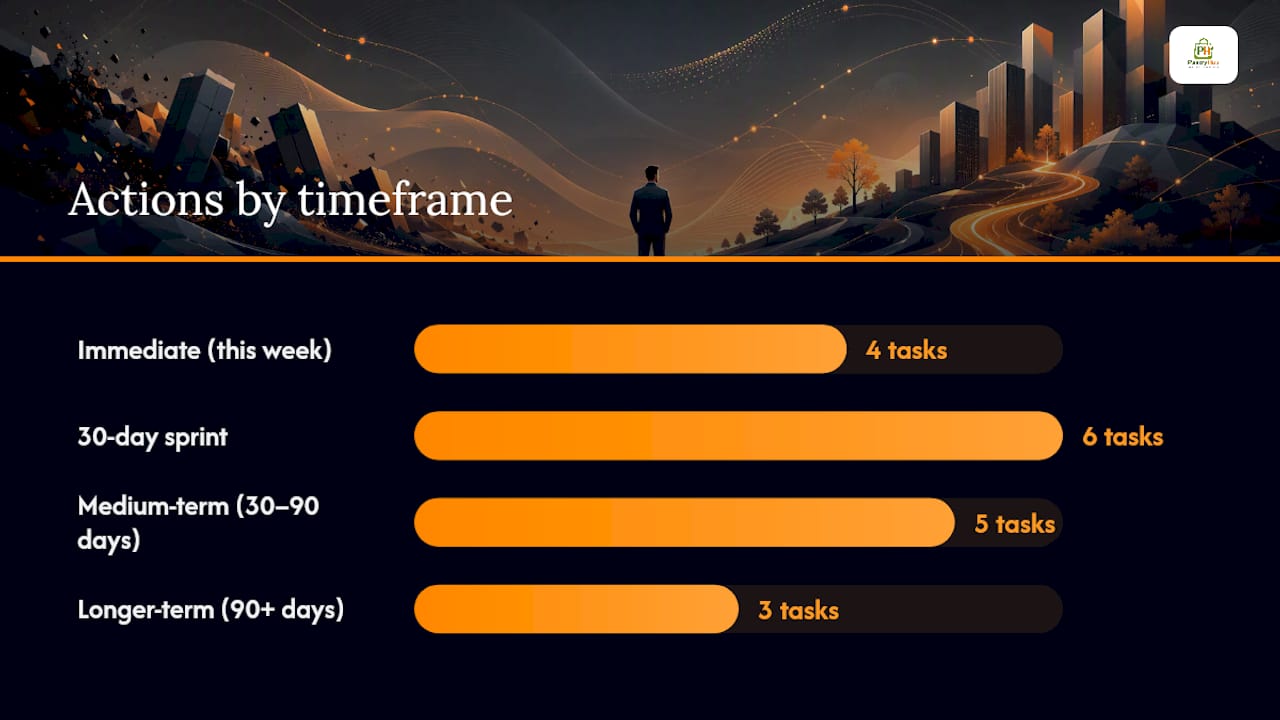
Immediate actions (this week):
- Add lot number and expiry date fields to your receiving SOP and make them mandatory for every pallet receipt.
- Label shelf zones with FEFO or FIFO indicators so staff know which side to pick from without having to think about it.
- Pull an aging report for your top 20 highest-risk SKUs and flag anything past its standard rotation cycle for immediate action.
- Brief your receiving team on why lot segregation matters, not just what to do, but what goes wrong when they don't.
Medium-term process changes (30–90 days):
- Configure your WMS or inventory system to enforce FEFO pick sequences for expiry-sensitive SKUs and FIFO for all others.
- Add rotation accuracy to your picker KPIs alongside throughput. Measure it weekly and share the results with the team.
- Implement cycle counting for your highest-risk SKUs on a weekly cadence rather than waiting for a full physical count.
- Redesign put-away rules so new receipts always go behind existing stock in the same location, not in front.
Longer-term tech integrations (90+ days):
- Implement lot-level scanning at receiving using GS1 AI-17 barcode standards, which encode expiry dates directly in the barcode for automatic capture.
- Configure expiry alerts in your inventory system to flag SKUs approaching their rotation deadline with enough lead time to act.
- For multi-location operations, centralize rotation reporting so a manager can see aging stock across all venues in a single view. Managing stock across multiple locations adds complexity that manual processes can't reliably handle.
30-day rotation sprint checklist:
- Receiving SOP updated with lot and expiry capture
- Aging report reviewed weekly for top 20 SKUs
- FEFO/FIFO zone labels installed in all storage areas
- Rotation accuracy added to picker performance scorecard
- Cycle count schedule set for highest-risk SKUs
- One unannounced rotation audit completed per week
Pro Tip: Digital stock management removes the manual steps that cause rotation to fail. When expiry dates are captured at receiving and the system enforces pick sequences automatically, rotation compliance stops depending on individual behavior and becomes a system output.
The scale of the problem, backed by research
The consequences of poor stock rotation aren't theoretical. The numbers at the US level make the case for treating rotation as a strategic priority, not a warehouse housekeeping task.
$163.1 billion in expired or unsellable goods are discarded annually in the US. A significant share of that figure is attributable to avoidable rotation failures at the warehouse and retail level.
Operational breakdowns drive an estimated 4.5% gross sales loss annually, a figure that exceeds typical shrinkage losses from theft. For a hospitality operator, that loss is concentrated in food cost, labor waste, and emergency procurement.
An investigation reveals that dairy and fresh produce are being restocked front-to-back in walk-in coolers, with no FEFO labels and no expiry capture at receiving. Older product is consistently missed until it's past its use-by date. The fix: FEFO shelf labels installed in all three walk-ins, expiry dates added to the receiving checklist, and a weekly aging report configured in their inventory system. Within 60 days, spoilage as a percentage of food purchases dropped, and emergency supplier orders, which had been running at a premium, fell significantly.
| KPI | Before rotation fix | After 60-day sprint | Direction |
|---|---|---|---|
| Spoilage rate (% of food purchases) | Elevated, untracked | Actively monitored, declining | Improving |
| Emergency supplier orders per month | Frequent | Reduced | Improving |
| FEFO compliance rate | Not measured | Tracked weekly | Baseline established |
| Walk-in aging exceptions | Discovered at count | Caught within rotation cycle | Improving |
The before/after figures above are illustrative of the pattern this type of intervention produces. The directional outcomes are consistent with what operators report when receiving controls and FEFO labeling are implemented together.
Why culture determines whether your rotation SOPs actually work
The technical fixes for poor stock rotation are well documented. The harder truth is that SOPs don't rotate stock. People do. And people follow the incentives they're given, not the procedures posted on the wall.
Rotation programs fail most reliably when pickers are measured on speed and nothing else. When throughput is the only KPI that matters, every extra step required for correct rotation becomes a tax on performance. Staff skip it, not out of negligence, but because the system rewards them for doing so. Incentive structures that reward rotation accuracy, such as a "Rotation Champion" recognition or bonus tied to FEFO compliance rates, change day-to-day behavior more reliably than enforcement alone. The cost of a small incentive program is a fraction of one month's spoilage write-offs.
The operators who sustain rotation improvements long-term do two things differently: they measure rotation accuracy as a standing KPI, and they make the correct behavior the easiest behavior through layout and system design. Pantryhub supports both with real-time stock tracking, expiry alerts, and aging reports that give your team the visibility to act before product becomes a write-off.
Sources
- How overstock, stockouts and returns cost retail $1.75tn
- Bad Inventory Costs Retailers $1.77 Trillion 2026 Data