

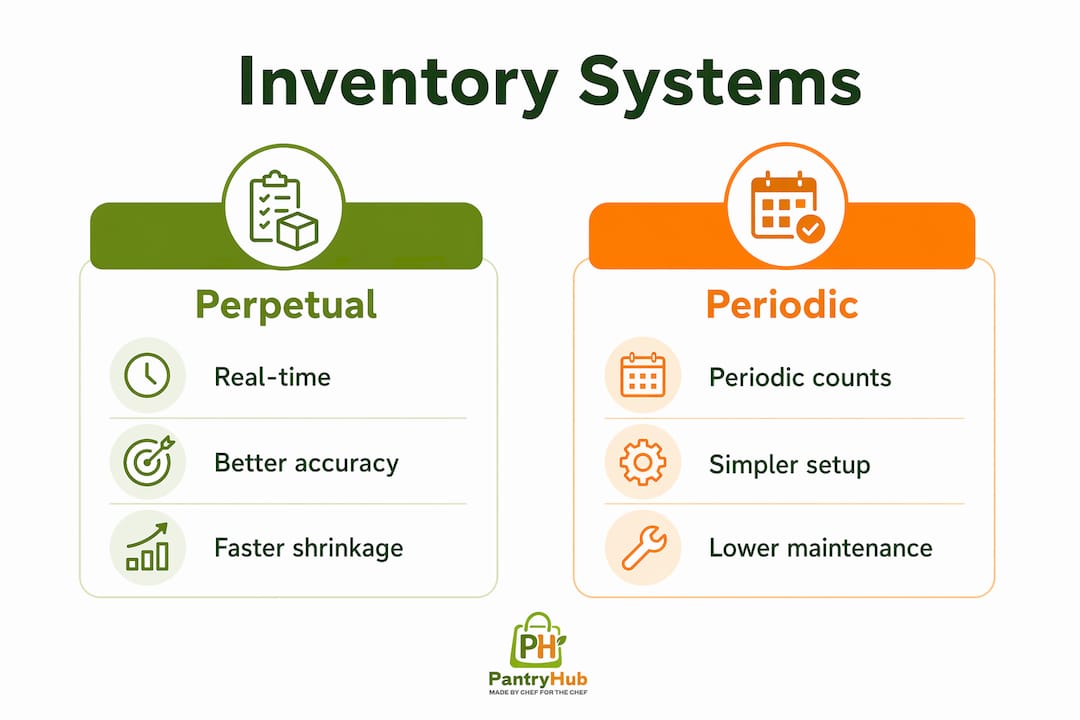
A perpetual inventory system is a real-time inventory tracking method that records every stock movement the moment it happens, giving you an accurate, up-to-the-minute picture of what you have on hand. For hospitality operators managing kitchens, bars, and storerooms across busy service periods, this is the difference between guessing and knowing. Unlike a periodic system that only updates stock counts at set intervals, the perpetual inventory method updates your records continuously with every purchase, sale, return, or transfer. The result is tighter cost control, faster shrinkage detection, and fewer operational surprises.
What is a perpetual inventory system and how does it work?
A perpetual inventory system records every stock movement continuously in real time, eliminating the need for disruptive periodic stocktakes. The system relies on three core technologies working together: point-of-sale (POS) systems, barcode scanners, and RFID tags. Each time a transaction occurs, the system updates both your inventory ledger and your cost of goods sold (COGS) automatically.
The operational flow in a hospitality business looks like this:
- A delivery arrives. Your receiving staff scan incoming stock with a barcode scanner. The system adds those units to your inventory count immediately.
- A sale is made. Your POS system records the transaction. The system deducts the ingredients or products used and logs the corresponding COGS entry.
- A return or transfer occurs. Whether a bottle moves from the bar to the kitchen or a supplier takes back damaged goods, the system records the movement and adjusts stock levels accordingly.
- Reports update in real time. Managers at any location can view current stock levels, low-stock alerts, and cost data without waiting for a manual count.
Every sale generates two journal entries: one for revenue and one for COGS and inventory adjustment. This means your financial records stay accurate alongside your physical stock counts, which is critical when you are managing food and beverage costs on tight margins.
Automated integration with POS systems and barcode or RFID technology is not optional. Without automation, maintaining continuous updates becomes too labor-intensive to sustain accurately in a busy kitchen or bar environment.
Pro Tip: Set up your POS system to map directly to ingredient-level recipes. When a dish sells, the system deducts each component automatically. This gives you granular cost visibility without any extra manual work from your team.
What are the benefits of perpetual inventory over a periodic system?
Perpetual inventory systems vastly outperform periodic ones in catching inventory errors and shrinkage early. For hospitality businesses with significant daily stock movement, that early detection translates directly into saved revenue.
The core advantages for hospitality operators include:
- Real-time stock accuracy. You know exactly what is in your walk-in cooler, dry store, and bar at any moment. No more ordering stock you already have or running out mid-service.
- Faster shrinkage detection. Real-time tracking enables managers to identify theft or errors quickly, rather than discovering losses weeks later during a physical count.
- Fewer disruptive full stocktakes. Your team does not need to shut down operations for a full physical count. Smaller, rolling cycle counts replace the annual disruption.
- Accurate COGS reporting. Because every transaction updates your cost records instantly, your profit and loss statements reflect actual performance rather than estimates.
- Better purchasing decisions. Real-time data supports demand forecasting. You can see which items move fast and which sit idle, and adjust your orders accordingly.
- Multi-location visibility. If you run more than one venue, a perpetual system lets you view stock across all sites from a single dashboard.
The financial accuracy benefit deserves emphasis. In a periodic system, you only know your true COGS after a physical count. In a perpetual system, that number updates with every transaction. For a restaurant or bar reviewing weekly P&L reports, that difference is significant.
Pro Tip: A periodic system may still suit a very small café with minimal SKUs and low transaction volume. High maintenance costs and the complexity of a perpetual system can outweigh its benefits at that scale. Assess your operation size honestly before committing.
What are the biggest challenges of perpetual inventory management?
The most common failure point in perpetual inventory is phantom inventory. Phantom inventory occurs when the system shows stock that does not physically exist, caused by theft, spoilage, or recording errors. Hospitality operators frequently underestimate how often this happens and how quickly it corrupts the data they rely on.
The second major challenge is staff discipline. Effective perpetual systems depend heavily on disciplined, well-trained staff recording every item movement accurately. When a chef grabs a bottle of wine for a sauce and does not log it, or a bartender voids a transaction incorrectly, the system drifts from reality. Over time, those small errors compound into large discrepancies.
| Challenge | Perpetual system risk | Mitigation strategy |
|---|---|---|
| Phantom inventory | System shows stock that does not exist | Run regular cycle counts to reconcile records |
| Staff recording errors | Unlogged movements corrupt data | Train all staff on scanning and logging procedures |
| Technology dependency | System failure halts real-time updates | Maintain backup processes and redundant hardware |
| Initial setup cost | Higher upfront investment than periodic | Calculate ROI based on shrinkage reduction and labor savings |
| Data overload | Too many reports without clear action | Set up alerts for key thresholds only |
The solution to most of these challenges is the same: training and process. Ongoing physical cycle counts remain mandatory to verify accuracy and meet compliance requirements, but they can be smaller and more frequent rather than a single disruptive annual event. Counting one section of your storeroom each week is far less painful than shutting down for a full stocktake.
Pro Tip: When onboarding kitchen staff to a new inventory system, run a two-week parallel period where staff log movements manually alongside the digital system. Discrepancies reveal exactly where your training gaps are before they become costly data errors.
How do hospitality businesses apply perpetual inventory in practice?
Perpetual inventory becomes most powerful in hospitality when it connects directly to kitchen and bar operations. Integrating perpetual inventory with kitchen and bar software enables granular ingredient-level tracking, which sharpens cost control and cuts waste. A bar manager who can see that gin usage is running 15% above what sales justify knows to investigate immediately, not at month end.

For multi-location groups, the advantage compounds. A restaurant group running three venues can view consolidated stock across all sites, identify which location is over-ordering, and redistribute stock before it spoils. That kind of visibility is impossible with a periodic system.
Practical steps to get the most from a perpetual inventory setup in hospitality:
- Map every recipe to its ingredients. Link each menu item in your POS to the exact quantities of each ingredient it uses. Every sale then automatically deducts the right amounts.
- Assign scanning responsibility clearly. Designate who scans deliveries, who logs transfers, and who handles returns. Ambiguity leads to gaps.
- Set low-stock alerts for critical items. Identify your top 20 highest-cost or highest-usage items and configure alerts before you hit zero.
- Schedule weekly cycle counts by section. Rotate through your dry store, cool room, and bar weekly. This keeps your inventory audit process manageable and your data clean.
- Review variance reports weekly. Compare what the system says you used against what you actually sold. Consistent variances in specific items point to waste, theft, or recipe inconsistency.
Real-time data also changes how you buy. When you can see that your avocado stock typically drops to reorder level by thursday each week, you can automate a standing order rather than reacting in a panic on friday morning. That shift from reactive to planned purchasing reduces both waste and emergency premium pricing from suppliers.
Key Takeaways
A perpetual inventory system gives hospitality operators real-time stock accuracy, faster shrinkage detection, and better cost control than any periodic method can deliver.
| Point | Details |
|---|---|
| Real-time stock accuracy | Every transaction updates your inventory instantly, so you always know what you have on hand. |
| Shrinkage detection | Perpetual systems catch theft and errors immediately, not weeks later during a physical count. |
| Staff training is critical | Undisciplined recording creates phantom inventory that makes your data worse than useless. |
| Cycle counts still matter | Small, frequent physical checks complement the digital ledger and keep records compliant. |
| Technology integration is required | POS systems, barcode scanners, and inventory software must connect for the system to work reliably. |
Why real-time inventory changed how I think about hospitality operations
The most common mistake I see hospitality managers make is treating perpetual inventory as a technology project rather than an operations project. They buy the software, connect the POS, and expect the numbers to fix themselves. They do not. The technology is only as good as the habits of the people using it.
What actually transforms operations is the combination of real-time data and a team that trusts it. When your head chef can pull up current stock on a tablet before writing the specials board, and your bar manager gets an alert before the house pour runs dry, the whole operation runs with less friction. That is not a software outcome. That is a culture outcome that software enables.
The other thing I have learned is that the transition period is where most operators give up. The first four weeks of a perpetual system often look worse than the periodic system it replaced, because suddenly every discrepancy is visible. That visibility is not a failure. It is the system working exactly as it should. Push through that period, fix the process gaps it reveals, and the data becomes genuinely reliable.
For multi-location operators, the ROI case is straightforward. Centralized real-time inventory visibility across venues eliminates the guesswork that leads to over-ordering at one site while another runs short. That alone typically justifies the investment within the first quarter.
— Admin
Pantryhub: built for perpetual inventory in hospitality
Pantryhub is an inventory and ordering platform built specifically for restaurants, cafés, bars, and commercial kitchens. It connects directly with your POS system and supports mobile barcode scanning, so every stock movement updates your records in real time without adding work to your team's day.
Pantryhub includes low-stock alerts, supplier ordering, multi-location dashboards, and reporting tools designed for food and beverage operations. The platform is built by people who have worked in hospitality, which means the workflows match how kitchens and bars actually operate. If you are ready to move beyond spreadsheets and periodic counts, explore Pantryhub's hospitality inventory software to see how real-time tracking works in practice.
FAQ
What is the perpetual inventory method in simple terms?
The perpetual inventory method updates your stock records automatically every time a purchase, sale, return, or transfer occurs. You always have a current count without needing to stop operations for a manual stocktake.
How does perpetual inventory differ from periodic inventory?
A periodic system only updates stock counts at set intervals, such as monthly or quarterly. A perpetual system updates continuously with every transaction, giving you real-time accuracy and faster error detection.
What technology does a perpetual inventory system require?
A perpetual system requires a POS system, barcode scanners or RFID tags, and inventory management software that connects them. Without automation, maintaining continuous updates accurately is not practical in a busy hospitality environment.
What is phantom inventory and how do you prevent it?
Phantom inventory is stock the system records as available but that does not physically exist, caused by theft, spoilage, or unlogged movements. Regular cycle counts and thorough staff training are the primary defenses against it.
Is a perpetual inventory system worth it for a small café?
For very small operations with minimal stock variety, a periodic system may be more practical due to lower technology and training costs. As your menu complexity and transaction volume grow, the case for a perpetual system strengthens significantly.