

Supplier performance metrics are the numbers you track to judge whether a vendor delivers what they promised, on time, at the quality and cost you agreed to. Five metrics carry most of the weight for almost any category: on-time-in-full (OTIF) delivery, defect rate, order accuracy, lead time, and total cost of ownership. Build a weighted scorecard around those, publish the exact formulas to your suppliers before you score them, and you'll cut most of the disputes that make performance reviews painful.
TL;DR:
- Suppliers should be evaluated using clear, precisely defined formulas for metrics like OTIF, defect rate, order accuracy, lead time, and total ownership cost to prevent disputes.
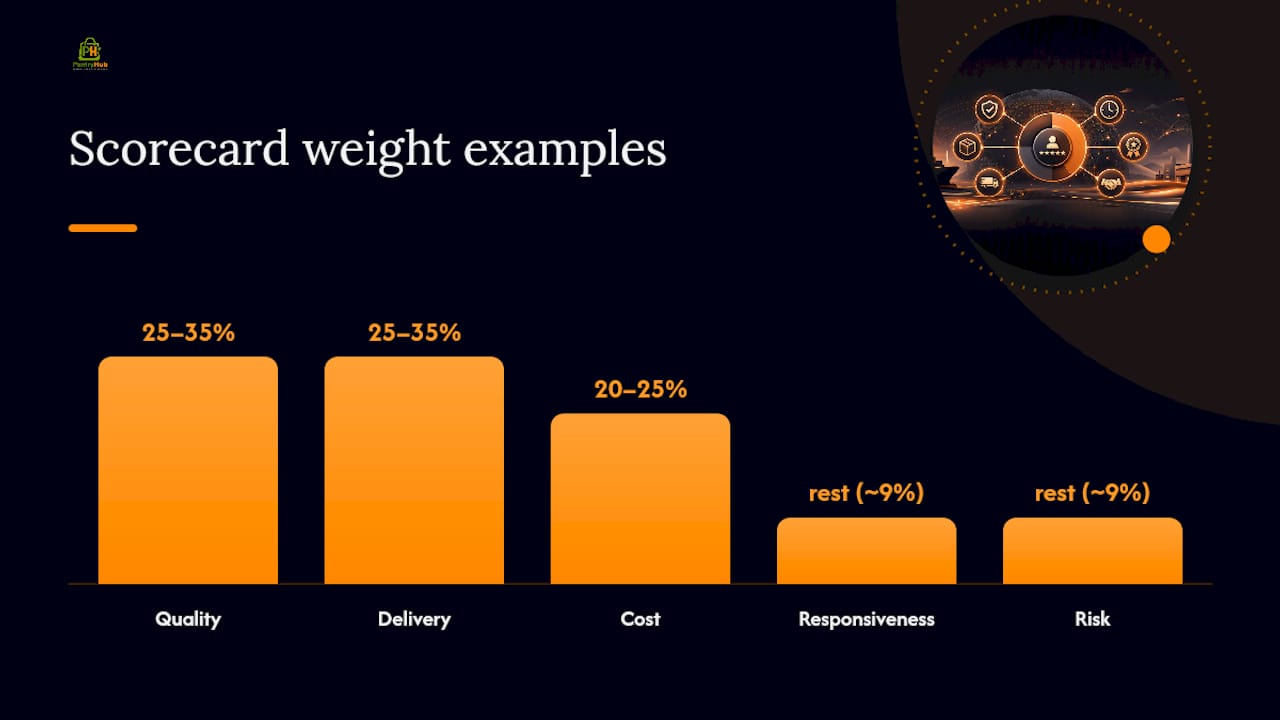
- For critical suppliers, weighting quality and delivery at 25 to 35 percent each, with others like cost, risk, and responsiveness making up the rest, aligns scores with business priorities.
- Running scheduled review meetings and establishing specific, time-bound corrective actions ensures measurable improvement rather than relying on static scorecard data.
- Automating data collection through inventory platforms reduces manual errors, keeps scorecards current, and minimizes disputes over timestamps and delivery claims.
- Tracking only a few core metrics with automation and frequent reviews provides more actionable insights and improves overall supplier performance management.
Table of Contents
- Supplier Performance Metrics: Formulas, Traps, and What They Actually Tell You
- How to Build a Weighted Supplier Scorecard That Doesn't Trigger Disputes
- Turning Scores Into Action: Reviews, Remediation, and When to Walk Away
- How Inventory Platforms Keep Supplier Scorecards Current
- Practitioner Perspective: What Most Scorecards Get Wrong
- Try Automated Scorecards Before You Build Another Spreadsheet
- Downloadable Templates and Where to Verify the Details
- Sources
- FAQ
Supplier Performance Metrics: Formulas, Traps, and What They Actually Tell You
Getting the definitions right matters more than picking the metrics themselves. A vague formula produces a number nobody trusts, and a supplier who disagrees with your math will fight the score instead of fixing the problem.
On-time-in-full (OTIF) measures the percentage of orders delivered complete and on the agreed date, capped at the ordered quantity so a supplier can't inflate their score by over-shipping. The real value comes from decomposing misses into late, short, or both. A supplier who's chronically late but always full needs a different conversation than one who ships on time but consistently short.

Defect rate, often expressed in parts per million (PPM) or as a simple percentage of rejected units, tells you about quality consistency. Pair it with first-pass yield, the share of goods accepted without rework or return, and track how incoming shipments actually get verified: full inspection, sampling, or a certificate of analysis on file. CIPS recommends treating evaluation as a continuous process rather than a once-a-year audit, and the verification method you choose should match how much risk that supplier's category carries.
Order accuracy and fill rate sound similar but measure different things. Order accuracy compares what was ordered to what was shipped; fill rate compares what was ordered to what's currently available to ship. Decide upfront whether you're measuring accuracy at receipt, at shipment confirmation, or at both, because suppliers will quote whichever number flatters them.
Lead time and its variability matter as much as the average. A supplier who's usually two days late is more manageable than one who swings between one day early and five days late, even if their average lead time looks identical.
Total cost of ownership (TCO) goes beyond the invoice price to include landed cost, invoice accuracy, freight, and the cost of rework or returns. Watch for unit-conversion errors, unannounced substitutions, and case-pack changes. All three quietly distort every metric above if nobody catches them at receiving.
How to Build a Weighted Supplier Scorecard That Doesn't Trigger Disputes
A supplier performance scorecard works only when the weights reflect what actually matters for that supplier category, and when every score is backed by evidence a supplier can check themselves.
- Pick six to eight criteria tied to your business priorities: quality, delivery, cost, responsiveness, risk, and capacity cover most categories without overloading the sheet.
- Assign weight ranges that match risk. Procurement Toolkit's scoring examples suggest quality and delivery often carry 25 to 35 percent each for critical suppliers, cost around 20 to 25 percent, with risk and responsiveness splitting the remainder.
- Define 1 to 5 scoring bands with hard evidence. A "5" for quality might require zero defects and a valid certification on file; a "2" might mean a defect rate above a stated PPM threshold with no corrective action submitted.
- Set minimum thresholds that override the composite. A supplier who scores a 5 everywhere but fails a food safety check should never land in "preferred" status just because the math averages out.
- Calibrate across reviewers. Have two people score the same supplier independently once a quarter and compare. Disagreement usually means your band definitions are too vague, not that your reviewers disagree on facts.
Pro Tip: Write the formula for every metric directly on the scorecard template, not in a separate policy document. Suppliers who can see the math argue less about the outcome.
A copy-ready example: if OTIF is weighted at 30 percent and a supplier hits 92 percent OTIF against a target band where 95 to 100 percent scores a 5 and 85 to 94 percent scores a 4, that line contributes 4 out of 5, or 1.2 weighted points toward the total.
Turning Scores Into Action: Reviews, Remediation, and When to Walk Away
A scorecard that never leaves the spreadsheet doesn't improve anything. The value shows up in the meeting where you use it to change behavior.
- Run scheduled review meetings using the scorecard as the agenda, and tie every remediation item to a specific target and a deadline, not a general "please improve."
- Decompose the root cause before assigning blame. A short shipment might be the supplier's fault, or it might be a receiving error on your end. Kitchen inefficiency often traces back to inventory management gaps as much as supplier failures, so check your own process first.
- Use corrective action plans (CAPAs) for the first miss, preferred-supplier tiers or rebate structures for sustained strong performance, and treat both as part of the same governance system rather than separate programs.
- Escalate to re-sourcing only after remediation windows pass without measurable improvement, and document every step so the contract conversation is grounded in numbers, not frustration.
How Inventory Platforms Keep Supplier Scorecards Current
Manual scorecards decay fast because someone has to remember to update them. An inventory and ordering platform captures the raw data automatically. Purchase orders, receiving timestamps, invoice matching, and low-stock alerts all flow through the same system, which means OTIF and order accuracy calculate themselves instead of waiting for a monthly spreadsheet push.
Standardizing timestamps across every receiving event also removes a common source of disputes. When a supplier claims their truck arrived on time and your team logged it two hours later, accurate inventory tracking settles the argument with a timestamped record instead of two conflicting stories. That's the gap between a metric you can defend and one you're guessing at.
Practitioner Perspective: What Most Scorecards Get Wrong
Most procurement teams track too many metrics and update too few of them. Twenty fields on a scorecard sound thorough but usually mean four get filled in accurately and sixteen get guessed. Publish your formulas before you score anyone, decompose misses instead of reporting a single blended number, and let automation handle the data entry while you spot-check a sample by hand. That combination beats a bigger spreadsheet every time.
— Admin
Try Automated Scorecards Before You Build Another Spreadsheet
A hospitality inventory platform can help operators stop rebuilding supplier scorecards by hand every month by linking purchase orders and receiving events automatically, calculating OTIF as deliveries come in, triggering low-stock alerts before a shortage becomes a service failure, and keeping supplier ordering centralized instead of scattered across emails and paper invoices.
A practical way to test it: run Pantryhub on your two or three highest-spend suppliers for 30 to 60 days and compare the automated score outputs against whatever you're tracking manually now. Most teams find the gap between the two numbers is where the disputes were hiding. If you're weighing options against tools like MarketMan, the MarketMan alternative comparison walks through where an integrated platform fits. Start with the hospitality inventory software page to see what a 30 to 60 day pilot looks like for your kitchen.
Downloadable Templates and Where to Verify the Details
The Victorian government's KPI and supplier performance scorecard tool gives you a ready-made XLSX to adapt. CIPS's supplier evaluation guidance and Procurement Toolkit's scoring rubric examples cover the criteria and weighting logic in more depth than any single article can.
Sources
Your scorecard is only as good as the data feeding it, and most of that data already exists somewhere in your operation. Receiving logs, inspection reports, purchase order and ERP records, invoices, and point-of-sale or inventory feeds all carry pieces of the picture.
- Key performance indicators and supplier performance scorecard: Goods and services
- Supplier evaluation — CIPS
- Supplier Evaluation Criteria Examples — Procurement Toolkit
FAQ
What are supplier performance metrics?
They're quantified measures of how well a vendor meets agreed terms for delivery, quality, cost, and service, usually rolled up into a weighted scorecard for regular review.
What are five examples of metrics to measure performance?
On-time-in-full delivery, defect rate (or PPM), order accuracy, lead time variability, and total cost of ownership cover most supplier categories effectively.
What are the five key supplier evaluation criteria?
Quality, delivery, cost, responsiveness, and risk form the core of most scorecards, with capacity and innovation sometimes added for strategic suppliers.
What are some examples of supplier KPIs?
OTIF percentage, first-pass yield, fill rate, invoice accuracy, and average lead time are common KPIs, each defined with a clear numerator, denominator, and measurement window.
How often should supplier performance be reviewed?
Critical, high-spend suppliers benefit from continuous or monthly tracking, while quarterly reviews are usually sufficient for lower-risk, commodity suppliers.