

Supplier integration software cuts ordering time, sharpens visibility into stock and lead times, and strengthens the supplier relationships that drive innovation and better margins. A meta-analysis of 184 studies and 41,498 observations found that relational integration, not raw efficiency, is the strongest predictor of firm performance. Platforms like PantryHub put that research into practice for hospitality operators, while Gartner reports that most procurement leaders now rank supplier relationship strength as a top priority, ahead of cost-cutting alone.
Onboarding automation can eliminate up to 75% of manual setup steps, and integrated procurement workflows have driven 20% increases in digital revenue for suppliers working with integrated buyers. Those aren't marginal gains. They're the difference between a kitchen that runs on guesswork and one that runs on data.
Here's what supplier integration software delivers, in short form:
- Faster, more accurate ordering with fewer manual entry errors
- Real-time visibility into stock, pricing, and supplier lead times
- Priority access to scarce inventory during supply squeezes
- Measurable gains in product innovation and customer experience, not just cost
Key Takeaways
Supplier integration software delivers its largest and most durable gains through relational collaboration and supplier-driven innovation, not through efficiency automation alone.
| Point | Details |
|---|---|
| Efficiency is the starting point, not the goal | Automate orders and invoices first, but treat it as the foundation for deeper collaboration. |
| Relational integration drives performance | Meta-analytic research ties the largest firm performance gains to trust and joint planning, not just automation. |
| Pilot before you scale | Test integration with one or two cooperative, technically ready suppliers for 4 to 8 weeks before expanding. |
| Track innovation, not just cost | Add a supplier-innovation KPI alongside cycle time and cost metrics to capture the full value. |
| PantryHub applies this directly to hospitality | Its supplier ordering, alerts, and reporting tools automate the operational side while supporting stronger supplier collaboration. |
Table of Contents
- What Are the Benefits of Supplier Integration Software?
- The Three Dimensions of Supplier Integration
- Concrete Benefits You Can Measure
- How Supplier Integration Software Actually Delivers These Outcomes
- What the Research Actually Says About Supplier Integration
- Where Supplier Integration Programs Go Wrong
- How to Measure Whether Supplier Integration Is Working
- A Six-Step Plan to Start Your First Pilot
- A Procurement Leader's View on Where This Is Headed
- How PantryHub Supports Supplier Integration for Hospitality Operators
- Sources
What Are the Benefits of Supplier Integration Software?
Supplier integration means connecting your procurement, inventory, and financial systems directly with your suppliers' systems, so data, orders, and communication flow automatically instead of through phone calls, emails, and spreadsheets. Supplier integration software is the tool that makes that connection work: it links your point-of-sale or inventory platform to supplier catalogs, pricing, and order systems through APIs, EDI, or dedicated supplier portals.
This is a different animal from basic supplier management. A basic supplier record system stores contact details and a price list. An integrated approach synchronizes live data, automates the order-to-delivery cycle, and gives both sides a shared view of stock levels, order status, and performance history.
The businesses that get the most value from integration aren't the ones with the fanciest tech. They're the ones that treat their suppliers as partners in solving problems, not just vendors to squeeze on price.
The distinction matters because a standalone ERP supplier module often just digitizes paperwork. True integration changes behavior on both sides of the relationship:
- Orders trigger automatically at par levels instead of waiting for a manual check
- Suppliers see your demand patterns and can plan production or delivery accordingly
- Pricing and invoice discrepancies get flagged before they become disputes
- Both parties build a shared performance record over time
That sets up three distinct dimensions of integration worth understanding before you build a program.
The Three Dimensions of Supplier Integration
Information integration means sharing data, like stock levels, forecasts, and order status, through connected systems rather than phone calls or spreadsheets. Process integration means automating the actual transactions, like purchase orders, invoices, and delivery confirmations, so they move without manual intervention. Relational integration means building strategic collaboration, like joint planning, shared forecasting, and preferential capacity agreements, that turns a transactional supplier into a genuine partner.
A simple example makes each concrete:
- Information integration: An EDI feed or API connection that lets your inventory platform pull live pricing and stock availability from a supplier's system
- Process integration: Automated purchase order generation and invoice matching, so a low-stock alert becomes a confirmed order without anyone touching a keyboard
- Relational integration: Quarterly business reviews with a key produce supplier, where you jointly forecast seasonal demand and lock in capacity ahead of a busy period
Most operators start with information and process integration because they're faster to implement and produce visible wins within weeks. Relational integration takes longer to build and depends on trust, but the research is clear that it produces the larger payoff over time.
Pro Tip: Don't wait until your information and process integration are "perfect" before starting relational work. Book your first supplier business review as soon as you've automated even one order cycle. Momentum matters more than sequencing purity.
Concrete Benefits You Can Measure
Ranked by the strength of the evidence behind them, here's what integrated supplier software actually changes on the ground.
-
Operational efficiency and cost reduction. Automating purchase orders and invoice matching removes the manual data entry that eats hours every week. Practitioner ROI data shows integration can cut purchase order management time by 80% and integration setup time by 60%, with payback periods as short as 3.3 months in some studies. The metric to watch: order cycle time, from stock alert to confirmed delivery.
-
Improved visibility and risk reduction. Real-time stock and pricing data means you spot a supply gap before it becomes an empty walk-in fridge. TechTarget's analysis of supplier relationship management finds that these tools increase resilience and risk visibility specifically because they surface problems earlier. The metric to watch: days of stock cover and supplier lead-time variance.
-
Faster time-to-market and innovation. This is the benefit most procurement teams underweight. When suppliers see your demand data and get folded into planning conversations, they bring you new products, better pricing structures, and early access to limited stock. The meta-analysis referenced earlier found innovation and customer experience are the actual channels through which integration boosts firm performance, not cost savings directly.
-
Quality and compliance improvements. Automated tracking of batch numbers, delivery temperatures, and supplier certifications reduces the manual compliance burden and catches issues before they reach a plate. The metric to watch: defect or rejection rate on incoming stock.
-
Stronger collaboration and supplier performance. Shared scorecards and performance data give both sides a factual basis for renegotiating terms or resolving disputes, rather than relying on memory or gut feel. Gartner's research ties this collaboration directly to priority access during supply constraints, a real advantage when a category-wide shortage hits.
| Benefit | Typical KPI Affected | Reported Impact |
|---|---|---|
| Operational efficiency | Order cycle time, PO management hours | Up to 80% reduction in PO management time |
| Onboarding speed | Supplier onboarding cycle time | Up to 75% of steps automated |
| Revenue and retention | Digital revenue from existing buyers | 20% increase reported in integrated workflows |
| Innovation and experience | Product innovation, customer satisfaction | Identified as the primary performance driver in meta-analysis |
How Supplier Integration Software Actually Delivers These Outcomes
Every benefit above traces back to a specific software feature. Supplier portals give suppliers direct access to update pricing and availability, which removes the back-and-forth email chain. APIs and EDI connections handle the technical plumbing that keeps your inventory numbers and a supplier's catalog in sync without manual updates. Automation engines turn a low-stock alert into a purchase order without a person in the loop. Scorecards and risk monitoring turn supplier performance from an anecdote into actionable data.

The friction points differ by feature. Supplier portals stall when suppliers are slow to adopt a new login or workflow. API and EDI connections require upfront technical mapping, which can take weeks if a supplier's systems are outdated. Automation only works if your par levels and product data are accurate, garbage in means garbage out. Scorecards need consistent data feeding them or they become one more unused dashboard.
There's also a structural choice to make early: point-to-point connections versus a middleware or API platform approach. Point-to-point integrations are faster to stand up with one supplier but multiply in complexity as you add more. A middleware layer takes longer to configure initially but scales far better once you're managing a dozen or more supplier connections, which matters if you run multiple venues. Guides on how inventory platforms integrate with suppliers walk through these patterns in more technical detail.
What the Research Actually Says About Supplier Integration
The strongest evidence available comes from a meta-analytic structural equation modeling study covering 184 primary studies and 41,498 observations. Its core finding cuts against a lot of procurement conventional wisdom: relational integration produces the largest effect on firm performance, larger than information sharing or process automation alone. Efficiency gains matter, but the study frames them as a starting point, not the destination.
Why? Because efficiency gains plateau. Once you've automated your purchase orders, the next unit of value doesn't come from automating them harder. It comes from the innovation and customer experience improvements that flow from a supplier who trusts you enough to bring you first access to new products or better terms.
Gartner's own research on procurement priorities backs this from the industry side. A majority of procurement leaders now name strengthening supplier relationships as a top priority, and Gartner's guidance recommends pairing digital tools like portals and scorecards with actual relationship practices, like supplier summits and structured reviews, rather than treating software as a substitute for the relationship work.
- Relational integration shows the largest effect size on firm performance across the meta-analysis's pooled data
- Supplier collaboration gives priority access to scarce capacity and materials during shortages
- Digital tools alone don't build trust. They make the relational work more consistent and easier to sustain
Where Supplier Integration Programs Go Wrong
The risks are predictable enough to plan around, which is exactly why so many procurement teams skip the planning.
- Supplier technical readiness: A smaller supplier may lack the systems to support an API connection. Mitigation: start with portal-based access for less mature suppliers and reserve deeper integration for those who can support it.
- Data quality: Automation amplifies bad data instead of fixing it. Mitigation: audit your product codes, units, and par levels before automating anything.
- Governance gaps: Without clear ownership, integration projects stall between IT and procurement. Mitigation: assign one accountable owner per supplier connection from day one.
- Contract terms: Integration can quietly shift risk or cost onto whichever party built the connection. Mitigation: clarify who owns maintenance and support costs in writing before go-live.
- Supplier concentration risk: Research on supply chain concentration shows some integration benefits only materialize at higher levels of supplier concentration, which also raises dependency risk if that supplier fails. Mitigation: segment suppliers by criticality and avoid over-integrating with a single source for anything mission-critical.
Pro Tip: Balance your integration roadmap so it isn't all efficiency projects. For every purchase order automation initiative, pair it with one relational initiative, a quarterly review, a joint forecast, a shared scorecard conversation. The efficiency wins fund the trust-building work.
Before selecting a vendor, run through a short checklist: Can this supplier support the integration technically? Is our product data clean enough to automate on? Who owns this connection internally? What happens if the supplier relationship ends?
How to Measure Whether Supplier Integration Is Working
The KPIs worth tracking align closely with the benefits already covered. Track onboarding cycle time to see how fast new suppliers get connected. Track purchase order and invoice matching rate to catch discrepancies automatically instead of at month-end reconciliation. Track days sales outstanding and order cycle time to see the cash flow and speed impact. Track supplier lead-time variance to catch reliability problems early. Track the percentage of orders placed automatically versus manually, since that number tends to climb steadily once a pilot proves out.
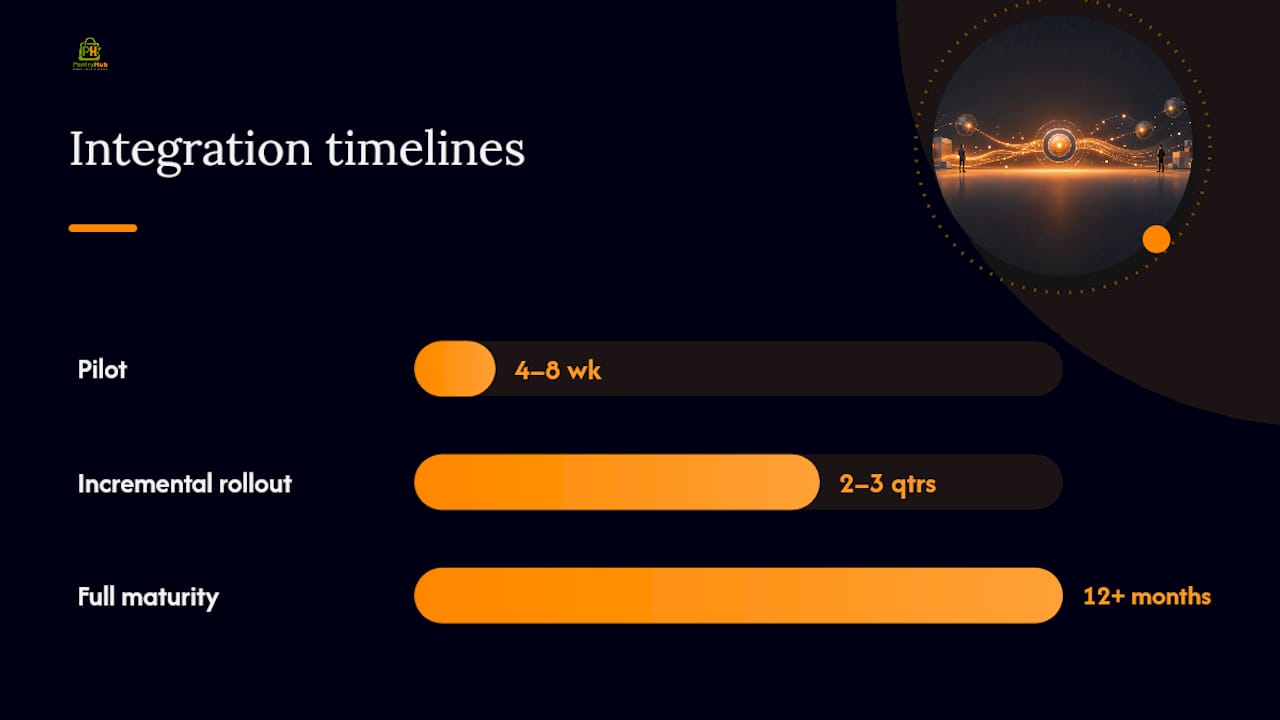
Timelines follow a predictable arc. A pilot with one or two suppliers typically runs 4 to 8 weeks, focused on proving the integration pattern works and the data is clean. Incremental rollout to your broader supplier base then follows over the next two to three quarters, adding suppliers in batches rather than all at once. Full relational maturity, the joint planning and forecasting work, tends to build over 12 months or longer, since it depends on trust rather than technical setup.
| Cost Line Item | What It Covers |
|---|---|
| Integration engineering | Technical setup of API, EDI, or portal connections per supplier |
| Middleware or platform fees | Ongoing subscription cost for the integration or inventory platform |
| Supplier enablement | Time and support helping suppliers adopt new workflows |
| Change management | Internal training and process redesign for your own team |
A guide to automating supplier ordering walks through a fuller ROI breakdown if you're building the business case for your own operation.
A Six-Step Plan to Start Your First Pilot
- Define your goals and KPIs. Pick two or three metrics, like order cycle time or onboarding speed, before you touch any software.
- Segment your suppliers. Identify which suppliers are critical, which are commodity, and which have the technical readiness to integrate now.
- Choose your pilot supplier. Pick one that's cooperative, technically capable, and represents a meaningful share of your ordering volume, so the pilot actually proves something.
- Choose your integration pattern. Decide between a simple portal connection and a deeper API or EDI link based on that supplier's systems and your longer-term plans.
- Run the pilot. Give it 4 to 8 weeks and resist the urge to add more suppliers before you've validated the first one.
- Measure results and scale. If your pilot hits its KPI targets, expand to your next supplier tier using the same playbook.
Selection criteria for a pilot supplier come down to three things: cooperation, order volume, and technical readiness. Minimum success metrics before scaling should include at least a measurable drop in manual order time and no increase in order errors.
None of this works without a sponsor who can clear internal roadblocks. Someone senior enough to align finance, operations, and the kitchen floor on why this matters needs to own the initiative, or it stalls the moment the first technical hiccup hits.
A Procurement Leader's View on Where This Is Headed
Most procurement teams treat supplier integration as a project with an end date: implement the software, automate the orders, declare victory. That's the wrong frame. The research on relational integration suggests the actual value compounds over years, not weeks, and it depends on treating integration as an ongoing capability rather than a checklist item you finish.
The efficiency wins are real and worth chasing first, because they build internal credibility and fund the harder relational work. But if your integration program stops at automated purchase orders, you've captured maybe a third of the available value. The larger prize, better innovation access, priority supply during shortages, pricing flexibility during negotiations, only shows up once suppliers trust the relationship enough to bring you their best ideas first.
One practical change worth making this quarter: add a single relational KPI to whatever dashboard you're already tracking for efficiency. It could be as simple as "number of supplier-initiated product suggestions this quarter." Tracking it forces the conversation to happen, and the conversation is where the value actually lives.
How PantryHub Supports Supplier Integration for Hospitality Operators
Pantryhub is built specifically for the kitchen side of this problem, where supplier integration usually means juggling a dozen delivery schedules, price lists, and reorder points by hand. It connects supplier ordering directly to your live stock levels, so low-stock alerts turn into orders without someone digging through a spreadsheet at 11pm.
The platform gives suppliers a self-service view into your ordering patterns, automates the reorder-to-delivery cycle across single or multiple venues, and reports on food cost and waste so you can see which supplier relationships are actually paying off. It's the same information, process, and relational logic covered throughout this article, applied to a commercial kitchen instead of an enterprise supply chain. If you're running a café, restaurant, or multi-location group and want to see what integrated supplier ordering looks like in practice, you can explore PantryHub's hospitality inventory software and start a free trial today.
Sources
- How does supplier integration improve firm performance? Insights from a meta-analytic structural equation modeling study
- Supplier Relationship Management: A Complete Guide | Gartner
- eProcurement Integration is a High-ROI Driver of Enterprise Value - TradeCentric
- What Is Supplier Management? Complete Guide | Raindrop Systems
- 9 supplier relationship management benefits for resilience | TechTarget