

Automating supplier ordering is one of the highest-return decisions a restaurant operator can make in 2026. According to the National Restaurant Association's 2025 Restaurant Technology Report, managers who automate ordering cut their weekly ordering time significantly. That's not a marginal improvement — it's a structural change to how your kitchen runs. Manual ordering errors cost a substantial amount annually per full-service restaurant, covering wasted food, emergency deliveries, and supply shortages. Toast's 2025 Restaurant Success Report confirms that food and beverage costs consume a large portion of every revenue dollar, making procurement the single largest variable expense you can actually control.
The core benefits of automating restaurant orders come down to four things:
- Time savings: Automation reduces weekly manager ordering time from 8.6 hours to under 1 hour on average.
- Error reduction: Eliminate over-ordering, missed deliveries, and invoice discrepancies
- Food waste control: Cut waste significantly through demand-driven ordering
- Consistent supply: Reduce stockouts substantially, helping keep your menu intact
Platforms like Pantryhub are built specifically to deliver these outcomes for restaurants, cafés, and commercial kitchens — connecting inventory, supplier ordering, and real-time reporting in one place.
Table of Contents
- What manual supplier ordering is really costing your restaurant
- How fast does restaurant ordering automation pay for itself?
- Beyond the numbers: what else changes when you automate ordering
- Case study: how one restaurant chain cut food waste by 30% with automation
- Pantryhub gives you real-time control over every supplier order
- Key Takeaways
What manual supplier ordering is really costing your restaurant
Most operators know manual ordering takes time. Fewer have added up what it actually costs. Beyond the hours spent calling suppliers, checking clipboards, and chasing invoices, there's a second layer of losses that silently eat into your margins.
The $18,400 annual figure from Technomic covers the visible damage: wasted food from over-ordering, premium prices paid on emergency purchases, and revenue lost when a key ingredient runs out mid-service. But the hidden costs go further.
- Invoice discrepancies: Vendor billing errors cost restaurants a notable percentage of total food spend annually. Most go undetected without automated matching.
- Over-ordering from guesswork: Without real-time par levels, managers order based on memory or habit, not actual depletion data.
- Emergency purchasing: A stockout on a Friday night means paying premium prices from a secondary supplier, often with no time to negotiate.
- Labor hours on low-value tasks: Ordering, price-checking, and reconciling invoices manually can consume many hours of a manager's week — time that should go to the floor.
These common inventory mistakes compound over time. A single missed delivery or a miscounted par level doesn't just affect one service — it creates a ripple of reactive decisions that cost money at every step.
Pro Tip: Before evaluating any automation platform, spend two weeks logging every ordering-related task your managers perform. Most operators discover they're spending considerably more time on procurement admin than they estimated — and that number becomes your baseline ROI justification.
How fast does restaurant ordering automation pay for itself?
The payback timeline for automating supplier orders is shorter than most operators expect. According to the National Restaurant Association's 2025 technology ROI benchmark, restaurants typically reach full payback in a matter of weeks — faster than any other food service tech investment.
ROI flows through three primary channels simultaneously, which is why the payback period is so compressed.
| Savings Category | Typical Annual Impact | Key Driver |
|---|---|---|
| Food waste reduction | a substantial decrease in waste costs | Demand-driven ordering replaces guesswork |
| Labor savings | significant hours per week per manager recovered | Automated PO generation and tracking |
| Invoice discrepancy recovery | a meaningful portion of food spend recaptured | Automated matching flags billing errors |
| Emergency purchasing eliminated | Reduced premium supplier costs | Real-time par levels prevent stockouts |
| Supplier price optimization | a noticeable reduction in total food cost | Automated price comparison across vendors |
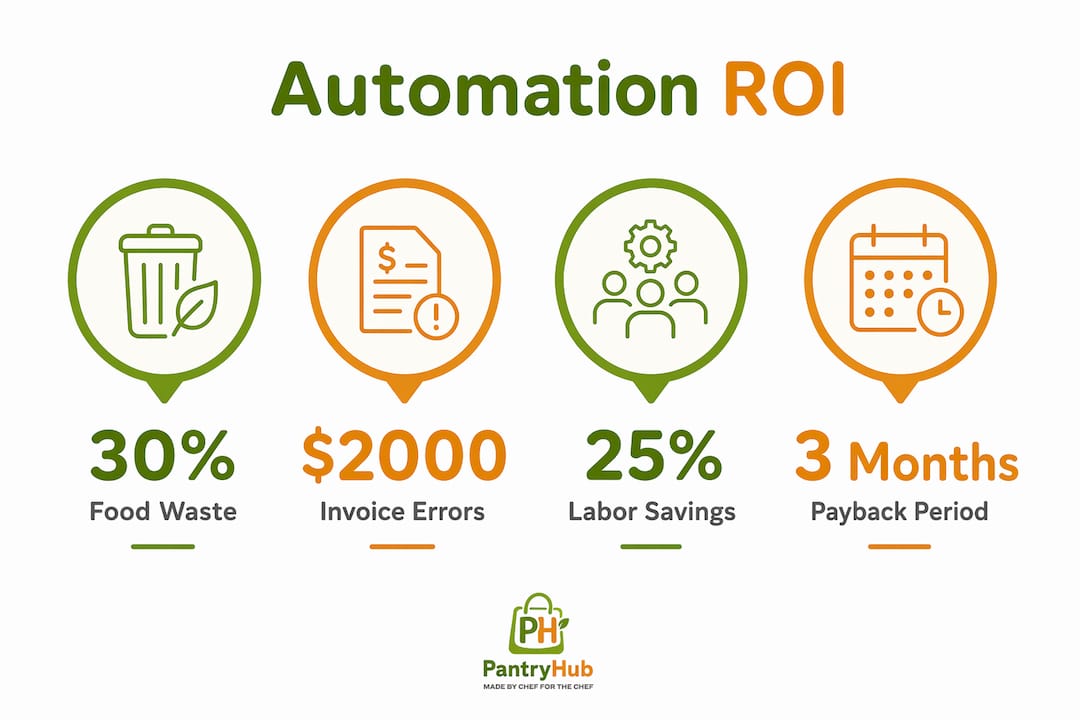
Automation's financial gains compound across cost centers — food waste, labor, and invoice errors each contribute independently. Together, they make the investment case almost self-evident. A restaurant spending $18,400 annually on manual ordering errors alone recovers that figure well within the first quarter after automating.
For most single-location full-service restaurants, a standard automation tier runs $150–$400 per month with implementation costs of $500–$2,000. At that price point, the 6–8 week payback benchmark holds even at conservative savings estimates.
Beyond the numbers: what else changes when you automate ordering
The financial case is clear. But the operational and cultural changes that come with automation often matter just as much to operators who've made the switch.
Staff accountability shifts immediately. Once your team knows that inventory is tracked end-to-end in real time, behavior changes. According to StockTake's ROI analysis, food waste drops 20–30% simply because staff realize discrepancies are visible. That reduction happens before the forecasting models even mature — it's a cultural effect, not a technical one.
Supplier relationships get stronger, not weaker. Automated systems accumulate invoice discrepancy data over months. When you can show a distributor exactly how many times their invoices over-billed on specific SKUs — with timestamps and amounts — you negotiate from data, not gut feel. Operators have used this data to recover thousands in retroactive supplier credits.
Scalability becomes real. For multi-location groups, centralized ordering visibility is the difference between controlled growth and procurement chaos. The National Restaurant Association notes that restaurant groups without centralized oversight pay 8–15% more for identical items across their portfolio. Automation closes that gap by aggregating purchasing power and enabling cross-location surplus transfers before product spoils.
- Inventory visibility across all locations from a single dashboard
- Low-stock alerts that trigger before a stockout affects service
- Centralized supplier management with unified vendor pricing
- Reporting tools that surface food cost trends by location or category
Training is more manageable than operators fear. Smooth adoption means layering digital ordering steps over existing manual processes gradually, allowing kitchen and supplier teams to adjust without disruption. Most platforms support a phased rollout — you don't have to flip a switch and change everything overnight.
Pro Tip: Start automation with your top five suppliers by spend volume. Connecting the accounts that represent 80%+ of your purchasing first captures the majority of available savings and gives your team a controlled environment to build confidence before expanding.
Pantryhub is built with exactly this kind of gradual adoption in mind. Its supplier integration tools, real-time stock control, and low-stock alerts are designed to fit into how your kitchen already works — not force a complete operational overhaul from day one.
Case study: how one restaurant chain cut food waste by 30% with automation
The numbers from industry benchmarks are compelling. What they look like in practice is even more convincing.
A multi-location restaurant chain facing mounting food costs and inconsistent ordering across sites implemented full supplier ordering automation over a five-week period. The results, documented in a 2026 case study, show what's achievable when automation is configured properly.
The challenge before automation: Manual ordering meant each location manager placed orders independently, with no visibility into what other sites had in stock. Surplus at one location spoiled while another placed an emergency order for the same item. Invoice reconciliation happened weekly, by hand, and discrepancies often went unchallenged.
The automation rollout, step by step:
- Weeks 1–2: POS-to-inventory integration connected sales data to ingredient-level depletion tracking, eliminating the need for manual stock counts after each service.
- Weeks 3–4: Supplier portal integration linked the top suppliers via electronic ordering. Purchase orders generated and transmitted automatically when inventory hit par levels.
- Week 4–5: Cross-location inventory visibility activated, enabling surplus transfers between sites before spoilage occurred.
- Ongoing: Centralized demand forecasting analyzed sales patterns across all locations to adjust ordering chain-wide.
The results after 90 days:
Those figures come directly from the Three Forks case study published by US Tech Automations. The 80% stockout reduction benchmark from MarketMan data held here too, with service disruptions from missing ingredients becoming rare rather than routine.
The lesson for any operator: the biggest gains don't come from any single feature. They come from connecting your POS data, inventory levels, and supplier ordering into one loop — so every purchase decision is driven by actual demand, not a manager's best guess at 7 AM.
Efficient food waste reduction starts with knowing what you have before you order what you don't need. That visibility is the foundation everything else is built on.
Pantryhub gives you real-time control over every supplier order
Cutting food waste by 30% and recovering thousands in invoice errors sounds like something reserved for large restaurant groups with dedicated procurement teams. Pantryhub makes it accessible to any operator — whether you run a single café or a six-location group.
Built "by the chef for the chef," Pantryhub's hospitality inventory software connects your stock levels, supplier ordering, and food cost reporting into one platform. You get low-stock alerts before a stockout hits service, automated purchase orders sent directly to your suppliers, and real-time visibility across every location from your phone or desktop. No spreadsheets. No missed deliveries. No end-of-month invoice surprises.
The platform is designed for gradual adoption — you can start with the features that solve your biggest pain point today and expand as your team builds confidence. For operators who've been managing procurement manually, the shift to Pantryhub typically pays for itself within the first few weeks through waste reduction and labor savings alone.
Ready to see what that looks like for your operation? Start a free trial and take control of your pantry from day one.
Key Takeaways
Automating supplier ordering reduces food waste by 25–40%, eliminates thousands in annual ordering errors, and pays for itself within 6–8 weeks — making it the fastest-returning technology investment available to restaurant operators.
| Point | Details |
|---|---|
| Time savings are immediate | Automation cuts weekly ordering time from 8.6 hours to under one hour per manager on average. |
| Manual errors cost real money | Technomic data puts manual ordering error costs at $18,400 per year for a full-service restaurant. |
| Payback period is weeks, not months | The NRA's 2025 benchmark puts full payback at 6–8 weeks across restaurant types. |
| Cultural gains compound financial ones | Real-time inventory tracking reduces food waste 20–30% through improved staff accountability alone. |
| Pantryhub delivers this for any operator | Pantryhub connects stock levels, supplier ordering, and food cost reporting in one platform built for hospitality. |