
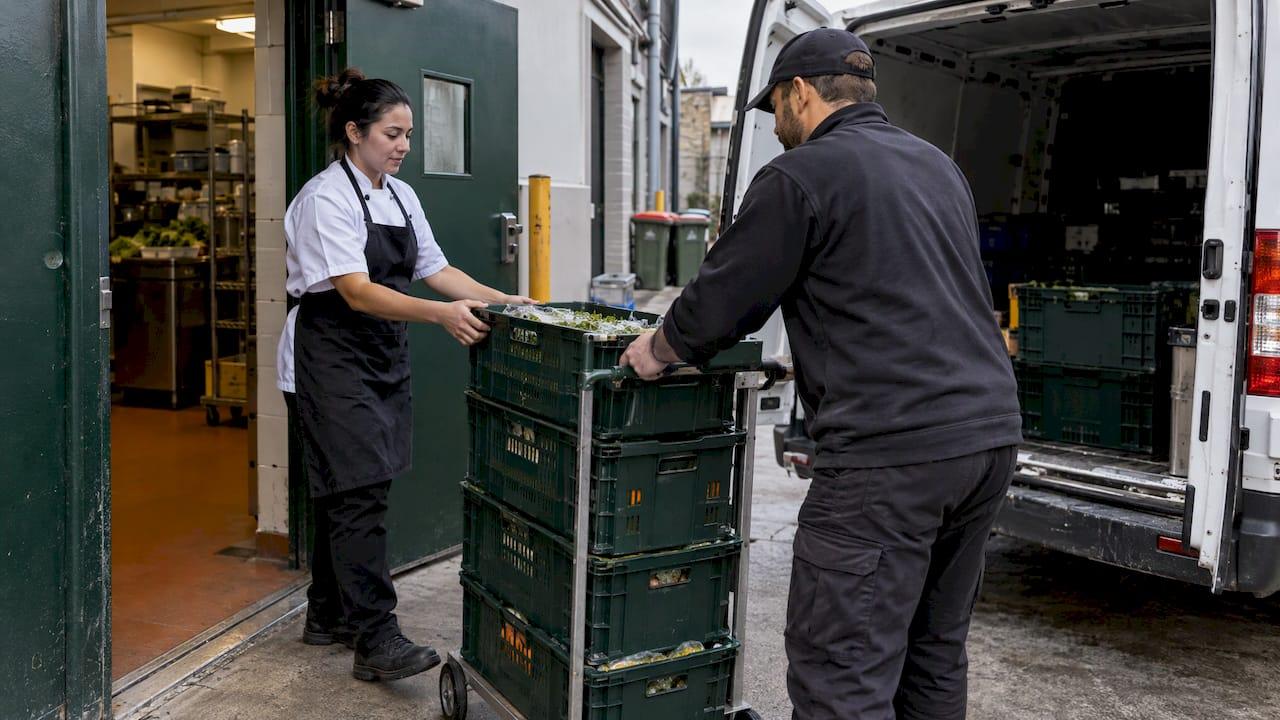
A return to supplier is the process of sending stock back to the business that sold it to you and getting your money back as a credit note or refund. For a café, pub, club or restaurant, it works when you check deliveries at the door, write the problem on the docket, get the supplier's approval, and track the credit until it lands. We built Pantryhub to keep stock and supplier ordering in one place, because returns usually go wrong in the gaps between the back door, the office and the books.
TL;DR
- Check every delivery before you sign. A fault noted on the docket at the door is the strongest claim you can make.
- Do not send anything back without the supplier's approval. Many suppliers require a return authorisation number and written consent first.
- Quarantine affected food before you decide to reject, return, accept or bin it.
- Log every claim until the credit note arrives, and match it to the next invoice.
- In your books, a return reduces what you owe the supplier and reduces your inventory by the same amount.
Table of Contents
- When a venue sends stock back
- The supplier returns process, step by step
- Food safety decides what happens to the stock
- Your rights when the supplier pushes back
- What to record on every return
- How the return hits your books
- Cut returns at the source
- Our view: returns are a data problem
- Keep stock, orders and costs in one place
- FAQ
- Sources
When a venue sends stock back
Goods returned to a supplier are products you bought and now give back, whether because they arrived wrong, damaged or out of temperature, or because you ordered too much. The supplier then owes you money. MYOB's Australian support page describes this as a supplier debit: money the supplier owes you, for example when damaged goods are returned and the supplier refunds the purchase value or applies it to your other unpaid purchases. In everyday hospitality language, that is a credit note.
The situations that come up most in a kitchen or bar are:
- Short delivery. You ordered 10 cases and 8 arrived.
- Damaged or out-of-temperature goods. Crushed cartons, a thawed pallet of chips, dairy that left the cold chain.
- Wrong product or substitution. Something you did not order, or a dearer item swapped in.
- Price mismatch. The invoice does not match the price you agreed.
- Date or labelling problems. Short-dated stock, missing dates or missing paperwork.
Note that a short delivery or a price mismatch usually needs a credit note rather than a physical return. The steps below cover both.
The supplier returns process, step by step

1. Check the delivery before you sign
The docket is your evidence. Whoever receives stock should count it against the order, look at packaging and dates, and take temperatures on chilled and frozen lines. This is the moment the claim is won or lost.
Where it goes wrong: a rushed signature on a clean docket tells the supplier everything arrived in order. If something is off, photograph it, write the exact discrepancy on the docket (for example "2 cartons milk short" or "cheddar substituted, not ordered") and ask the driver to initial it. A noted, initialled, photographed docket is a claim. A clean signature is the supplier's defence.
It also helps to know when deliveries arrive and who is on the door. Our guide to four checks before stock is stored covers a receiving routine you can set up around your delivery schedule.
2. Quarantine the affected stock
Put the problem stock aside, labelled, and away from usable product. FoodSafety HQ's Australian guide advises quarantining affected stock, recording the non-conformance with evidence, notifying the supplier, and then deciding whether to reject it, return it, accept it under conditions or destroy it.

Where it goes wrong: stock that is "probably fine" gets shelved with everything else, then it cannot be proven which batch was faulty, and it may end up on a plate.
3. Tell the supplier straight away
Contact your rep or the supplier's accounts or customer service line the same day, while the delivery is fresh in everyone's mind. Give them the invoice or docket number, the product, the quantity, what is wrong, and your photos. Say what you want: a credit note, a replacement or a refund.
Where it goes wrong: a vague phone call with no reference. Put it in writing, by email or through your ordering channel, so there is a date-stamped record.
4. Get approval and a return number
Do not send goods back on your own. Supplier terms commonly require approval first. For example, Dixie Cummings Australia's terms and conditions state that goods must not be returned without written consent from an authorised officer and a return authorisation number being allocated. They also say that when a return is accepted, the goods go back at the customer's expense in good and saleable condition, and the supplier credits the invoiced value.
Terms differ between suppliers, so read yours. Two points are worth checking: who pays freight, and whether stock must be unopened and in saleable condition. For perishables, most returns are really credit claims, with the supplier asking you to bin the product and send photos.
5. Arrange collection or return
If the supplier wants the goods back, agree how. Often the driver collects on the next run. Hand over the stock against a signed note quoting the return number, and keep your copy.
Where it goes wrong: product leaves the building with nothing signed, and the credit later "cannot be found".
6. Chase the credit note
A promised credit is not money until it appears on a statement. Set a follow-up date. When the credit note arrives, check it against your claim: right product, right quantity, right price, and any GST shown correctly. Then confirm it is applied to your next invoice or refunded.
7. Reconcile and review
At month end, match every claim to a credit note. Look at the log for patterns: if one supplier is short on the same line every few weeks, that is a conversation to have, and a reason to compare options. Our supplier onboarding checklist is a good place to set expectations on credits and returns before a supplier's first delivery.
Food safety decides what happens to the stock
Returns in a food business are not only about money. Under Standards 3.2.2 and 3.2.2A of the Food Standards Code, as FoodSafety HQ explains, a food business must receive only food that is safe and suitable. A supplier problem such as out-of-temperature stock, damaged packaging, missing dates, undeclared allergens, the wrong product or missing paperwork should be treated as a food safety event, with the stock quarantined before any decision is made.
That means the choice of reject, return, accept under conditions or destroy is a food safety call first and a commercial one second. If in doubt on a safety issue, do not serve it. Your local council's environmental health officer is the right contact for questions about your obligations in your state.
It also helps to have a clear ordering and receiving workflow for fresh food, so the person receiving stock knows what to check and who decides when a delivery arrives damaged, out of temperature or incorrect.
Your rights when the supplier pushes back
Most suppliers sort out genuine faults without a fight. When they do not, it helps to know where the law sits, and that it is less straightforward for food businesses than for shoppers.
- Consumer guarantees can cover business purchases. The WA Small Business Development Centre explains that a business qualifies for consumer guarantees on goods bought for the business that cost under $100,000, with remedies including repair, replacement, refund, compensation or cancellation of contract. For a minor problem the seller chooses the remedy. For a major problem the buyer chooses.
- Food bought to use up is usually outside the regime. HWLE Lawyers notes that consumer guarantees do not apply to goods acquired for resupply or to be used up or transformed in production, which means many hospitality food and beverage purchases fall outside them. For that stock, your supplier agreement and its credit terms are what count.
- Suppliers can limit their liability for some goods. HWLE also explains that Section 64A of the Australian Consumer Law lets suppliers limit liability for goods not ordinarily bought for personal, domestic or household use to replacement, repair or the cost of either, excluding consequential loss. That affects how much you can recover for non-food equipment.
- Reform is under way. Treasury Ministers announced in November 2025 that the consumer guarantees and supplier indemnification framework is being strengthened, with civil penalties and wider regulator powers. Treasury's December 2025 Decision Regulation Impact Statement recommends penalties and enforcement options for consumer guarantee failures. Check the Treasury and ACCC pages for what has taken effect.
For a significant dispute, such as a large equipment purchase or a supplier refusing a credit you are owed, speak to a lawyer or your state's small business commissioner or fair trading office. For day-to-day stock claims, a clear paper trail does most of the work.
What to record on every return
FoodSafety HQ recommends a short report for every non-conformance. Combine that with a simple claims log and you have everything you need for the supplier, the food safety record and the bookkeeper.
| Field | Why it matters |
|---|---|
| Date and time of delivery | Ties the claim to a specific drop |
| Supplier and invoice or docket number | The supplier's reference for the credit |
| Product, pack size, batch or lot code, quantity | Traceability and exact credit value |
| What was wrong | Short, damaged, warm, wrong item, price |
| Evidence | Photos, probe readings, the annotated docket |
| Action taken | Rejected, returned, accepted under conditions, destroyed |
| Return authorisation number | Proof the supplier approved the return |
| Amount owed | What you expect on the credit note |
| Status | Raised, credit promised, credit received, reconciled |
The FoodSafety HQ guide also notes that Australian food businesses are expected to know one step back (who supplied a product, and its batch) and one step forward (where it went). It adds that supplier invoices, dockets and batch records should be kept for the period your state or territory requires, so check your state's rule.
A status column matters most. Credits are easy to promise and easy to forget. Reviewing the open items weekly means nothing sits unresolved for months.
How the return hits your books
For the accounting side, a return of goods is the reverse of the purchase. OpenStax's Principles of Financial Accounting shows that when inventory is returned to a seller, accounts payable and inventory are both reduced by the value returned. In journal terms:
- Debit Accounts Payable (you owe the supplier less)
- Credit Inventory (you hold less stock)
So returning $300 of goods produces a $300 debit to Accounts Payable and a $300 credit to Inventory. In accounting software, MYOB's process is to record a debit transaction first, then record its settlement, either by applying it to an unpaid bill or marking it as a refund.
The GST component follows the credit note, so give your bookkeeper or accountant the supplier's credit note as issued. Your food cost report also needs the return recorded, or it will show food cost higher than it really was. If you want a quick benchmark, our free food cost calculator lets you check a dish or a period in AUD.
Cut returns at the source
The cheapest return is the one you never need. Most claims trace back to ordering mistakes, unclear catalogue items or unmanaged substitutions. Three habits help:
- Keep supplier catalogues and pack sizes accurate, so you order the right product the first time. See supplier catalogue management for Australian venues.
- Require approval on purchase orders, so one person has checked what is being ordered. Our piece on purchase order approvals shows how to stop double entry at the same time.
- Order against par levels so you are not overbuying and then trying to return surplus. Here is how to automate café stock ordering and cut waste.
Our view: returns are a data problem
Most venues treat a supplier return as a one-off annoyance: a phone call, a note on a docket, a hope that the credit turns up. We see it differently. A return is a stock movement, a cost adjustment and a supplier performance signal all at once, and it only works when those three things are recorded together.
Pantryhub was built by a chef for chefs, and that shapes how we think about this. The person at the back door should not need a spreadsheet to know what was ordered, what arrived and what is owed. When stock levels, supplier ordering and cost reporting sit in one platform, the order is on hand when the delivery arrives, and your numbers reflect what you actually kept.
For Australian venues, that also means AUD pricing, GST-ready reporting and local support, with mobile-first design for the person standing in the loading dock. Whether you run one café or several sites, we believe keeping your stock, your suppliers and your costs connected is the surest way to stop quiet losses eating into margins.
the author
Keep stock, orders and costs in one place
Pantryhub is a hospitality inventory and ordering platform for restaurants, cafés, bars, pubs, clubs and commercial kitchens. It gives you real-time stock tracking, supplier ordering, waste and cost reporting, team access controls and multi-location visibility, with integration with Australian suppliers.
Plans are billed monthly: Starter is $39 AUD per month, Regular is $69 AUD per month and Pro is $99 AUD per month, and you can start with a free trial. See the plans and pricing, or start your free trial and see how hospitality inventory software fits your kitchen.
FAQ
What are returned goods?
Returned goods are products a buyer sends back to the seller, or credits the seller gives for products that were faulty, wrong or not delivered. In hospitality, they usually appear as a credit note against a future invoice rather than a physical return, especially for fresh and chilled food.
How do I send goods back to my supplier?
Check the delivery, note the fault on the docket, quarantine the stock and tell the supplier the same day with photos. Get their approval and any return authorisation number before anything leaves your premises. Then hand over the goods against a signed note and follow up the credit.
What is the journal entry for goods returned to a supplier?
Debit Accounts Payable and credit Inventory for the value of the goods returned. This reduces what you owe the supplier and the stock you hold by the same amount, as OpenStax's accounting text shows. Your bookkeeper will also handle the GST shown on the credit note.
Who pays for the return freight?
That depends on your supplier's terms. Some supplier terms put return costs on the buyer when a return is accepted as a courtesy. For a supplier error, such as a wrong item or short delivery, agree collection with the supplier up front and ask for it in writing.
How long should I keep return records?
Keep invoices, dockets, batch records and non-conformance reports for the period your state or territory requires. Your local council or state food authority can confirm the period for your venue.
Sources
- Purchase returns, debits, and refunds (MYOB Australia)
- Handling Supplier Non-Conformance in Food (FoodSafety HQ)
- Terms and Conditions Australia (Dixie Cummings Australia)
- Product or service problem? Here's what to do (WA Small Business Development Centre)
- Consumer guarantees in trailer supply arrangements (HWLE Lawyers)
- Stopping unfair trading (Treasury Ministers, 23 November 2025)
- Decision Regulation Impact Statement, December 2025 (Treasury)
- 12.2 Analyze, Journalize, and Report Current Liabilities (OpenStax)