
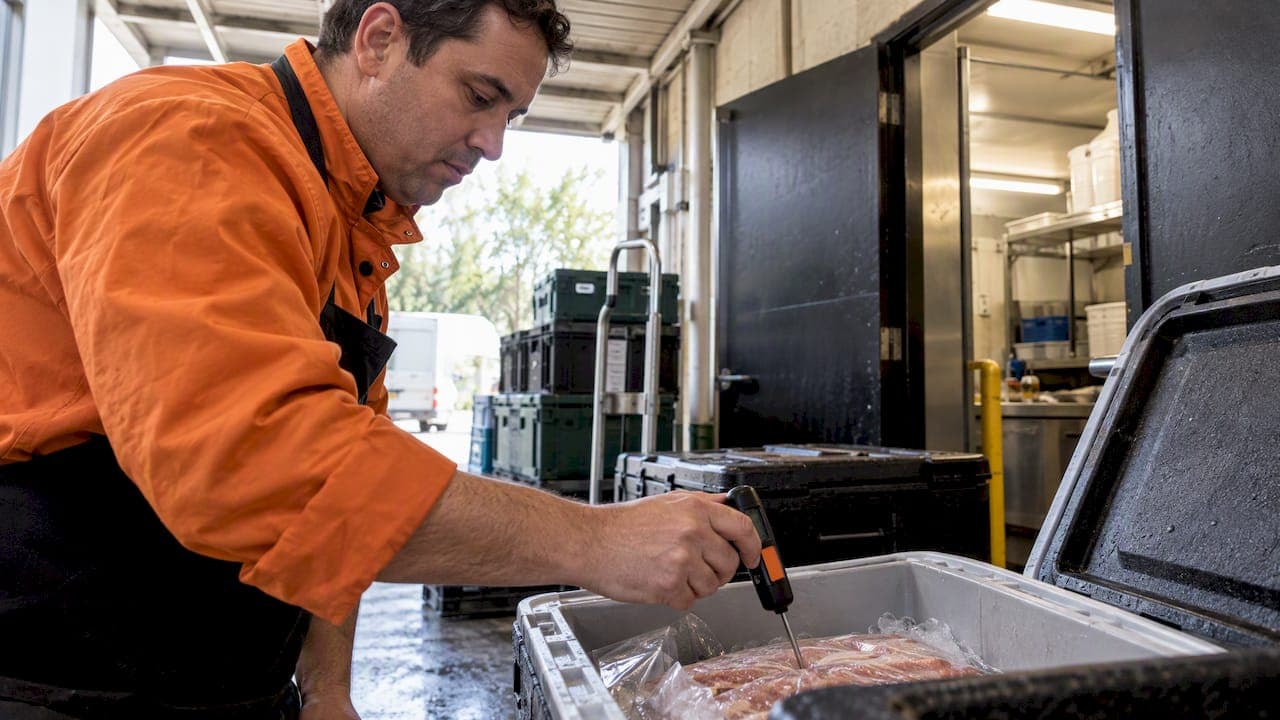
Schedule orders to match each supplier's delivery days, set par levels and safety stock for every line item, assign a named receiver for every delivery window, and record temperatures the moment goods arrive. Chilled items need to land at 5°C or colder, hot food at 60°C or hotter, and frozen stock frozen solid. Tools like inventory management platforms help run this routine day to day, but the discipline behind it matters more than any single app.
TL;DR:
- Use four weeks of sales to set par levels, subtract confirmed incoming stock, and account for supplier case packs and minimum orders.
- Schedule a safety stock check one or two days before each cutoff; order perishables frequently and shelf stable goods in bulk when storage costs are low.
- Reject deliveries outside safe temperature limits unless you can document a safe time window; goods unrefrigerated in transit for over two hours generally require refrigerated transport throughout.
- For missed deliveries, check backup suppliers and substitutes before removing menu items, then alert front of house once the change is confirmed.
- Spend 15 minutes each week reviewing late deliveries, temperature failures, and substitutions; two or three incidents from one supplier in a month warrant reassessment.
Table of Contents
- A ready-to-use delivery schedule template and checklist
- Designing schedule rules: cadence, par levels and cutoff logic
- Receiving and cold-chain checks: temperature, documentation and compliance
- Managing exceptions: missed deliveries, off-temperature loads and last-minute changes
- Scaling the schedule for multi-site groups or central purchasing
- An operations manager's week with the delivery schedule
- How PantryHub helps you run this schedule day to day
- FAQ
- Sources
A ready-to-use delivery schedule template and checklist
A weekly schedule matrix gives your whole team one source of truth instead of three different sticky notes on the fridge. Build one row per supplier with these columns: supplier name, delivery days, order cutoff time, minimum order value, pack size, assigned receiver, and expected unloading window.
For example:
- Dry goods supplier: delivers Tuesday and Friday, cutoff 2:00 PM the day before, minimum order $150, received by the kitchen manager, unloading window 7:00 to 8:00 AM.
- Fresh produce supplier: delivers daily except Sunday, cutoff 4:00 PM, no minimum, received by the sous chef, unloading window 6:00 to 6:30 AM.
- Meat supplier: delivers Monday, Wednesday, Friday, cutoff noon the prior business day, minimum order two cases, received by the head chef, unloading window 8:00 to 9:00 AM.
Pair the schedule with a receiving checklist used at every delivery:
- Check the temperature of chilled, hot, or frozen items against safe limits before anything leaves the dock.
- Inspect packaging for damage, leaks, or signs of thawing and refreezing.
- Confirm the invoice matches the supplier and the order placed.
- Move perishable stock into correct storage within minutes, not after the truck leaves.
Keep the template somewhere the whole team actually opens, whether that is a shared spreadsheet, a laminated delivery book at the back door, or a simple digital form logged through an inventory platform. The format matters less than whether someone owns it every single delivery.
Designing schedule rules: cadence, par levels and cutoff logic
Supplier delivery days are usually fixed, so treat cadence as a constraint you plan around rather than something you negotiate weekly. Build your ordering calendar from each supplier's set days, then place a safety-stock review point a day or two ahead of the cutoff so you're never placing a panic order at the last minute.
A four-week sales history gives you a realistic demand baseline for setting par levels. From there, scale safety stock up for suppliers with longer lead times or inconsistent delivery windows, and scale it down for items that turn over fast and spoil quickly.
- Convert case-pack and minimum-order rules into par targets you can actually order against, not theoretical ideal numbers.
- Subtract confirmed incoming stock from your on-hand count before deciding what to order, so you don't double-order the same case.
- Set a firm cutoff time per supplier and name who signs off on the order before it goes out.
- Favor frequent smaller orders for high-turnover perishables and bulk orders for shelf-stable goods where storage cost is low.
Pro Tip: Keep one order guide per supplier per site listing cutoff time, delivery days, minimum order, pack size, par target, usable on-hand stock, and confirmed incoming stock. It stops orders from falling through the cracks when someone is away.
Receiving and cold-chain checks: temperature, documentation and compliance
FSANZ guidance sets the baseline: chilled potentially hazardous food should arrive at 5°C or colder, hot food at 60°C or hotter, and frozen food should be frozen hard. Deliveries that don't meet these limits should be rejected rather than accepted and hoped for the best.
One checkpoint that gets missed often: if a delivery spends more than two hours outside refrigeration in transit, FSANZ guidance generally calls for refrigerated transport to have been used throughout. That two-hour mark is worth flagging on your receiving checklist.
The receiving flow itself follows a consistent sequence:
- Inspect packaging and check use-by or best-before dates before unloading continues.
- Verify the supplier and cross-check the invoice against what's on the dock.
- Spot-check temperatures on representative items, checking front, middle, and rear pallet positions when the delivery is large.
- Note departure and arrival times where available, since gaps point to cold-chain breaks.
- Move chilled and frozen stock into storage immediately rather than leaving it staged.
Keep a delivery book, temperature logs, and an Approved Supplier Register on site, alongside supplier invoices, so records are ready if an inspector asks. For cold-chain evidence, request in-transit temperature logs from your transport provider; the Australian Cold Chain Guidelines recommend recording pallet temperatures at dispatch and minimizing the time goods spend out of refrigeration at handover.
Managing exceptions: missed deliveries, off-temperature loads and last-minute changes
Every schedule needs a fallback plan for the day something goes wrong. If a delivery arrives outside safe temperature limits, reject it on the spot unless you can document it's been within a safe time window, and photograph the reading before the driver leaves.
- Notify the supplier immediately and log the incident with time, temperature, and item details.
- For a missed delivery, run your emergency top-up list first and swap in substitute items before cutting menu items.
- Tell front-of-house about any menu impact as soon as a substitution is locked in, not after the first table orders it.
- Track repeat incidents by supplier; two or three in a month is a signal to revisit cadence or switch suppliers for that category.
A kitchen that keeps a short list of backup suppliers for its highest-risk items rarely gets caught flat-footed.
Scaling the schedule for multi-site groups or central purchasing
Central purchasing works only when it doesn't lose sight of what's happening at each venue. Head office needs visibility into per-site par levels, confirmed inbound stock, local receiving windows, and any substitutions a site manager has already approved.
- Keep one authoritative ordering record per site so a central buyer and a local manager never place duplicate orders for the same delivery.
- Centralize categories like dry goods and disposables where volume pricing helps, but keep fresh produce and other locally sourced items under site-level control.
- Require a receiving sign-off at every site, even when the order itself was placed centrally.
- Nominate a local rep per site who can approve substitutions without waiting on a head-office call.
Pro Tip: Build a consolidated report that shows every site's par status and incoming deliveries on one screen. It's the fastest way to catch a site running low before it becomes a service problem. Our guide on centralizing multi-venue inventory control goes deeper on setting up that governance layer.
An operations manager's week with the delivery schedule

The daily routine is simple once it's a habit: the receiving lead runs the checklist on every delivery, and the manager reviews supplier performance once a week. A 15-minute Friday review covering on-time delivery rates, temperature compliance, and how often substitutions happened is usually enough to catch a supplier drifting off track.
When a menu changes or a big event lands on the calendar, par levels need a quick manual bump for the affected items a few days ahead, not a scramble the morning of service. That small adjustment, done consistently, prevents most of the stockouts that catch kitchens off guard. For broader waste-reduction tactics that pair well with tighter par levels, Spaceman's guide to preventing restaurant food waste covers practical angles worth borrowing.
— Admin
How PantryHub helps you run this schedule day to day
Running the workflow above by spreadsheet works until a receiver is away sick or a supplier changes its delivery day without warning. We built inventory management software to carry that operational load: supplier calendars that track delivery days and cutoffs automatically, low-stock alerts that fire before you hit a stockout, digital delivery logs your receiving lead can fill in from a phone at the dock, and multi-site visibility so head office sees every venue's par status in one view.
Our purchase order templates and reporting tools plug straight into the schedule and checklist described above, so you're not rebuilding the system from scratch. If you want to pilot it, start with the Starter plan at $39 AUD per month and test your delivery template and receiving checklist against a couple of your highest-volume suppliers first. You can also start a free trial to see how the alerts and supplier calendars fit your current routine before committing to a plan.
FAQ
What temperature should chilled food be at on delivery?
Chilled potentially hazardous food should arrive at 5°C or colder, and deliveries that don't meet this should be rejected rather than accepted. Hot food should arrive at 60°C or hotter, and frozen food should be frozen solid with no signs of thawing.
How often should I review supplier delivery schedules?
A short weekly review, around 15 minutes, is usually enough to catch late deliveries, temperature failures, or repeated substitutions before they become a pattern. Adjust cadence or par levels only after seeing an issue repeat rather than reacting to a single incident.
What records do I need to keep for deliveries?
Keep a delivery book, temperature logs, and an Approved Supplier Register alongside supplier invoices for traceability. These records should be available on site for inspection at any time.
How do I set par levels for a new menu item?
Start with a short observation period, ideally a few weeks of actual sales, before fixing a par level based on real demand rather than a guess. Adjust the par upward a few days ahead of any menu change or event rather than waiting for a stockout to force the decision.
What should I do if a delivery arrives off-temperature?
Reject potentially hazardous food that doesn't meet safe temperature limits, and document the reading and time before the driver leaves. Notify the supplier immediately and log the incident so repeated problems from the same supplier are easy to spot.
Sources
- Receiving food | Food Standards Australia New Zealand
- Australian Cold Chain Guidelines
- NSW Cold Store Food Safety Program