
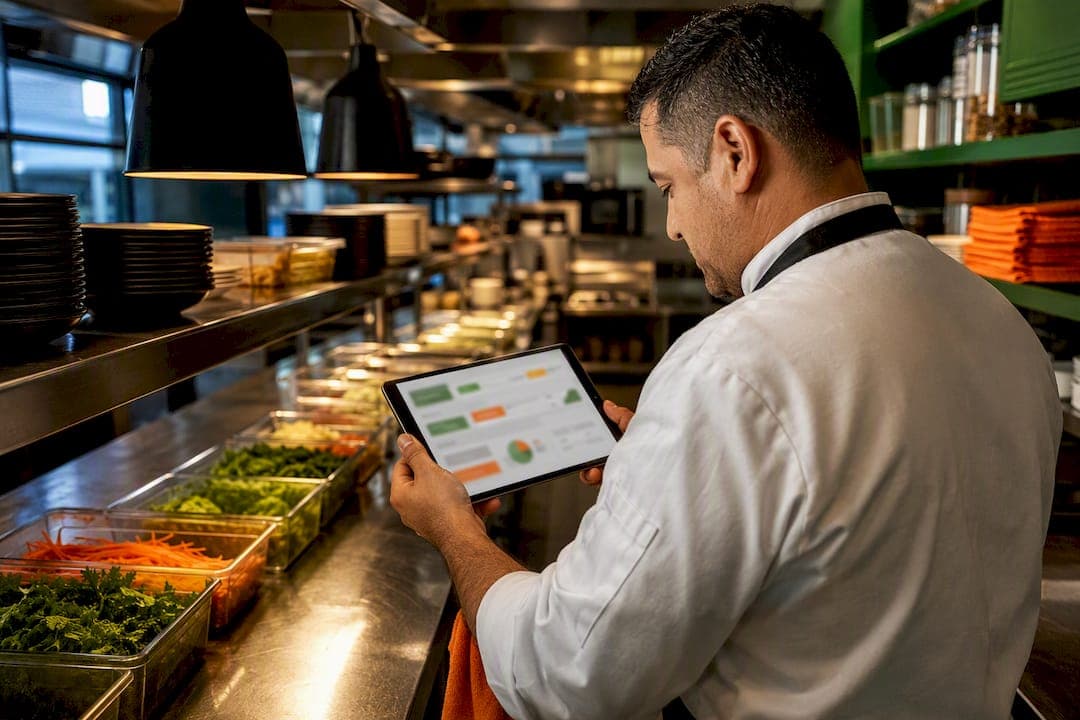
A perpetual inventory system updates stock counts and Cost of Goods Sold every time a sale or purchase happens; a periodic system waits until a scheduled physical count to update either one. Perpetual provides real-time COGS and margin visibility, whereas periodic only updates this information at period end, meaning daily decisions rely on less current data.
TL;DR:
- Perpetual systems provide real-time visibility of costs and margins, suitable for high-volume, multi-location, or thin-margin businesses needing frequent updates.
- Periodic systems are simpler and cheaper to implement, making them ideal for small businesses with low transaction volume and less need for immediate inventory data.
- Transitioning to perpetual inventory requires clean SKU data, POS integration, and regular cycle counts to prevent discrepancies caused by theft, spoilage, or human error.
- The choice of inventory valuation method (FIFO, weighted average) remains independent of whether the system is perpetual or periodic, but IFRS disallows LIFO.
- Operational benefits of perpetual inventory in hospitality include improved recipe costing, waste reduction, and faster decision-making, especially across multiple venues.
Table of Contents
- Perpetual vs Periodic Inventory: What Perpetual Actually Means
- What a Periodic Inventory System Looks Like
- Perpetual vs Periodic System: Key Differences at a Glance
- How COGS and Journal Entries Differ Between the Two Systems
- Pros, Cons, and How to Decide Which System Fits
- Implementing and Reconciling Your Inventory System
- Financial Reporting and Tax Implications
- Software and Technology Considerations
- How Each System Shapes Day-to-Day Decisions
- Why Hospitality Operators Lean Toward Perpetual Tracking
- Bring Real-Time Inventory Control to Your Kitchen
- A Practical Note on Choosing Between the Two
- Sources
Perpetual vs Periodic Inventory: What Perpetual Actually Means
A perpetual inventory system records every purchase and sale the moment it happens. There's no waiting for a count at the end of the month to know what's on the shelf or what it cost you to sell it.
The mechanics depend on technology doing the heavy lifting. A point-of-sale system talks to an inventory module in real time, and barcode or RFID scanning captures movement at the item level, as shown by the Restaurant CRM & Analytics Dashboard capabilities that integrate POS and inventory data seamlessly. Every transaction posts to the ledger instantly rather than sitting in a holding account.
That constant updating changes the accounting itself. Inventory and Cost of Goods Sold both adjust at the point of sale, which is exactly why perpetual systems require two journal entries per transaction instead of one, as standard accounting textbook examples show.
Perpetual tracking doesn't eliminate physical counts, though. Cycle counts remain necessary because software records rarely match what's actually sitting on the shelf, thanks to theft, spoilage, or plain human error, according to Investopedia's breakdown of perpetual systems.
What perpetual systems typically require:
- POS integration that feeds sales data directly into inventory records
- Barcode or RFID scanning at receiving and prep stations
- An inventory management module linked to the general ledger
- Scheduled cycle counts to catch variance software alone can't see
What a Periodic Inventory System Looks Like
A periodic inventory system only updates stock and cost figures at scheduled intervals, monthly, quarterly, or annually, depending on how the business operates. Between those counts, the books simply don't reflect what's actually on hand.
Purchases don't hit the Inventory account directly under this method. They flow into a temporary Purchases account instead, and Cost of Goods Sold gets calculated only when the counting period ends, using Beginning Inventory plus Purchases minus Ending Inventory.
That formula is elegant on paper but blind in practice. You genuinely don't know your COGS or gross margin until the count is done and the math runs.
Periodic still makes sense for a specific kind of operator:
- Small businesses with a narrow product range and low transaction volume
- Venues where a full-time inventory system's cost outweighs the benefit
- Operations with tight software budgets and simple supply chains
- Businesses that can tolerate not knowing margins in real time
Perpetual vs Periodic System: Key Differences at a Glance
Seeing both systems side by side makes the trade-offs concrete rather than abstract.
| Factor | Perpetual system | Periodic system |
|---|---|---|
| Update timing | Continuous, at each transaction | Scheduled counts only (monthly/quarterly/annual) |
| Journal entries at sale | Two entries: Sales and COGS | One entry: Sales only |
| Purchase handling | Debited directly to Inventory | Debited to a temporary Purchases account |
| COGS visibility | Available in real time | Known only after period-end calculation |
| Startup cost | Higher (POS, scanners, software) | Lower, often just a ledger and a count |
| Ongoing effort | Cycle counts plus system upkeep | Full physical count at each interval |
| Reconciliation needs | Frequent, smaller cycle counts | Infrequent, larger full counts |
| Best-fit profile | High turnover, multiple SKUs, multiple locations | Low volume, single location, tight budget |
If daily margin control matters to your business, perpetual is the clear fit. If you're running a low-volume operation where a monthly count is genuinely enough, periodic still gets the job done without the added software cost.
How COGS and Journal Entries Differ Between the Two Systems
The clearest way to see the difference is to watch what happens on the ledger when a sale occurs.
Under a perpetual system, a sale triggers two entries. First, debit Accounts Receivable or Cash and credit Sales for the sale price. Second, debit Cost of Goods Sold and credit Inventory for the item's cost, recognizing the expense immediately. A purchase debits Inventory directly, since the system tracks stock value continuously.
Under a periodic system, the sale entry only records revenue: debit Cash or Accounts Receivable, credit Sales. Purchases go to a Purchases account rather than Inventory. COGS doesn't show up until an adjusting entry at period-end calculates it from Beginning Inventory plus Purchases minus Ending Inventory.
Pro Tip: Don't confuse the recording method with the valuation method. Whether you use FIFO or weighted average, that choice sits on top of perpetual or periodic tracking, not inside it, and both systems can pair with either formula.
One constraint applies regardless of which system you run: IFRS explicitly disallows LIFO as a valuation method, permitting only FIFO and weighted average cost formulas. If your business reports under IFRS, that rules out LIFO entirely, no matter how you're recording transactions day to day.
- Perpetual: two entries per sale, Inventory debited at purchase
- Periodic: one entry per sale, Purchases account used, COGS calculated at period-end
- Valuation method (FIFO, weighted average) is independent of the recording system
Pros, Cons, and How to Decide Which System Fits
Neither system wins outright. The right call depends on how your business actually operates, not on which one sounds more sophisticated.
Perpetual's biggest advantage is that you always know your margin. Multi-location operators get visibility across every site without waiting for a consolidated count, and shrinkage or theft tends to surface faster because variances show up between counts rather than only at year-end. The cost of that visibility is real: software, hardware, and staff training all add up before you see a return.
Periodic's advantage is simplicity. Bookkeeping is straightforward, upfront cost is minimal, and a small operation with a handful of SKUs may not need anything more sophisticated. The trade-off is that you're flying without instruments between counts, and shrinkage can go unnoticed for months.
Run through this checklist before you decide:
- Transaction volume: high turnover favors perpetual; low volume tolerates periodic.
- SKU complexity: dozens or hundreds of ingredients push toward perpetual.
- Margin sensitivity: thin margins need real-time COGS to catch problems early.
- Number of locations: multi-site operations struggle to consolidate periodic counts.
- Budget for software and training: perpetual only pays off if you can absorb the setup cost.
A hybrid approach also works well during transition. Tracking unit movement perpetually by SKU while calculating dollar values of ending inventory periodically reduces general ledger complexity while you're still getting stock accuracy right.
Implementing and Reconciling Your Inventory System
Moving to a perpetual system, or tightening a periodic one, comes down to a handful of concrete steps rather than a leap of faith.
Start with data cleanup: consistent SKU coding across every ingredient and product avoids the duplicate or mismatched entries that undermine software before it even launches. Integrate POS and inventory modules early, and train staff on scanning discipline before go-live, not after.
- Clean and standardize SKU data before migration
- Integrate POS and inventory systems, then pilot with one location or department
- Set a cycle count schedule (weekly for high-turnover items, monthly for the rest)
- Investigate variances immediately rather than letting them accumulate
- Budget for a training period; most teams need a few weeks to build scanning habits
Watch for the two most common failure points: sloppy SKU data and inconsistent scanning at receiving. Both quietly wreck accuracy no matter how good the software is.
Financial Reporting and Tax Implications
The recording method you choose changes what your balance sheet and income statement show at any given moment, which has real consequences of bookkeeping neatness.
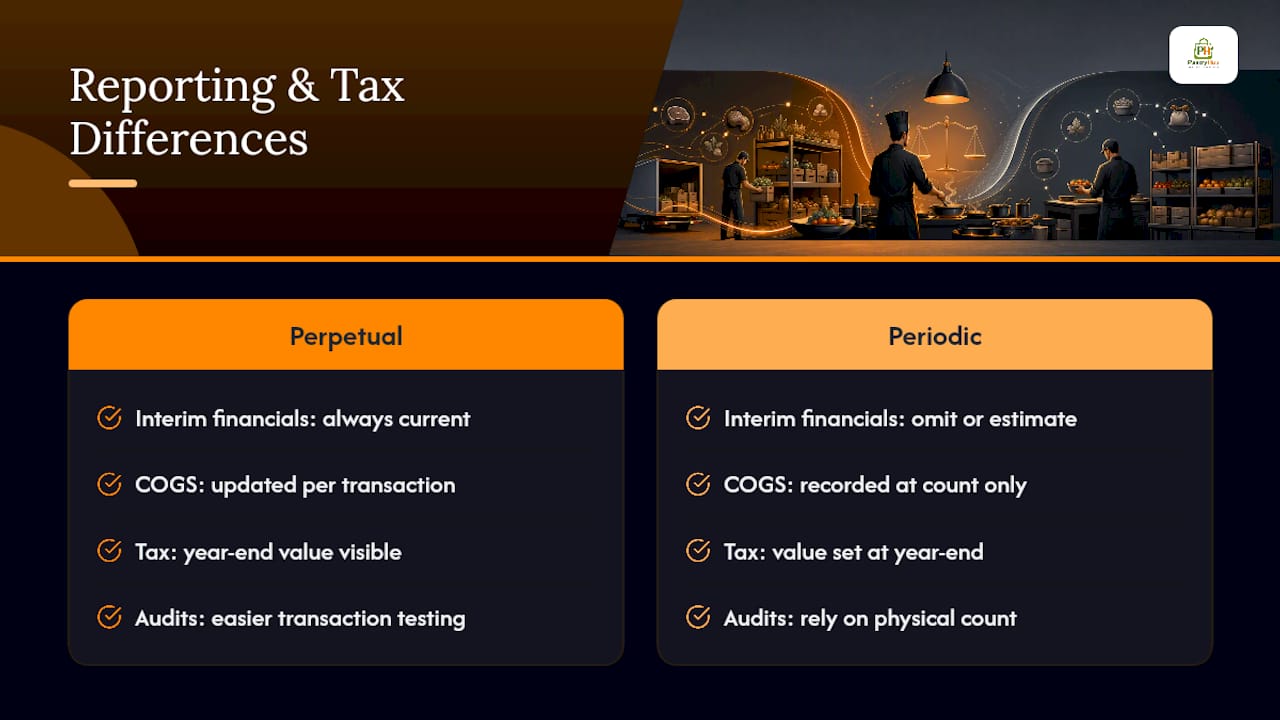
Perpetual systems produce inventory and COGS figures that are always current, so interim financial statements, monthly or quarterly, reflect an accurate gross margin without adjustment. That matters if you're reporting to lenders, investors, or a franchisor who wants numbers between formal close periods. Periodic systems can't offer that; any interim statement either omits COGS or relies on estimates until the next physical count closes the gap.
Tax reporting adds another layer, since your inventory valuation method interacts directly with taxable income regardless of whether you're perpetual or periodic. The Australian Taxation Office's guidance on trading stock makes clear that businesses need to value trading stock at the end of each income year, and that valuation feeds straight into assessable income. A perpetual system doesn't change what you owe, but it does mean you're never surprised by the number, because you've been watching it accumulate in real time rather than discovering it in one lump at year-end.
There's also an audit dimension worth naming. Auditors generally find perpetual records easier to test because transaction-level detail exists throughout the period, not just at two snapshot dates. Periodic systems put more weight on the accuracy of a single physical count, which means one bad count can distort an entire period's reported profit. Neither system is inherently more compliant. What changes is how much reconciliation work happens continuously versus all at once.
Software and Technology Considerations
The software layer is where perpetual and periodic systems diverge most in practice, even though both can technically be run on paper.
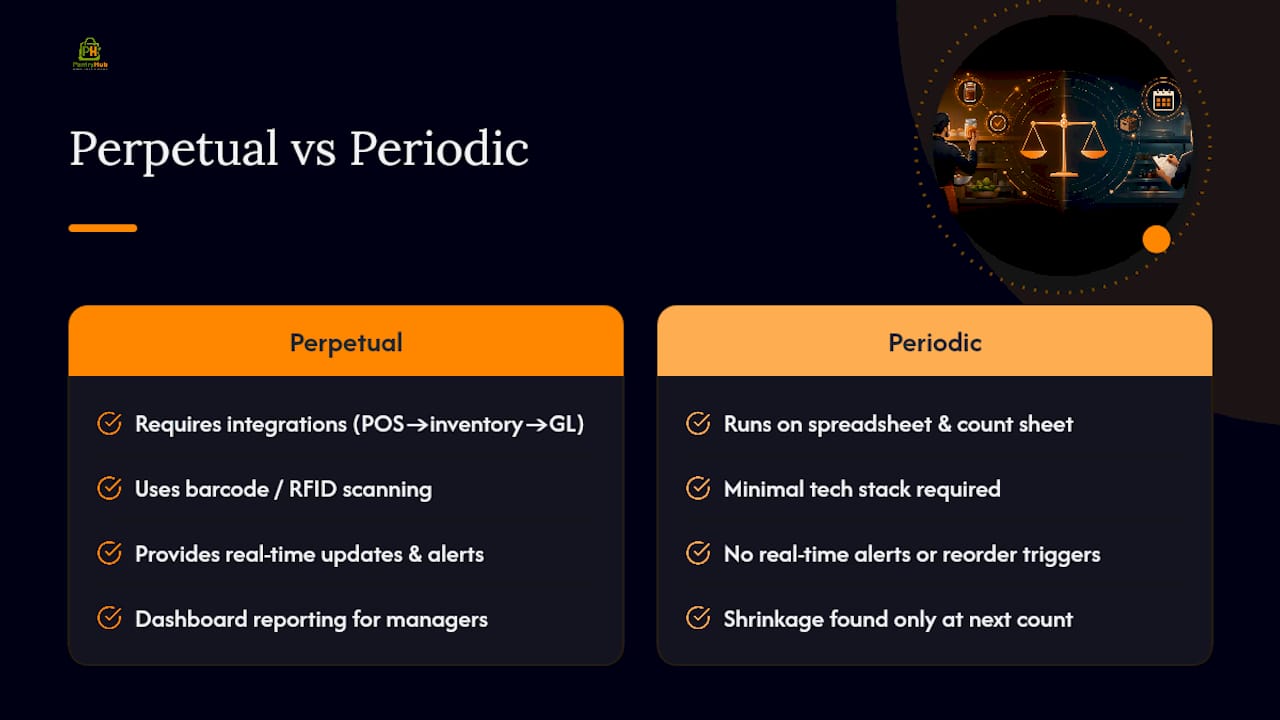
Perpetual systems depend on integration. A POS terminal needs to talk to an inventory module, and that module needs to update the general ledger without a human retyping numbers between systems. Barcode and RFID scanning remove the manual entry step that introduces most errors, and dashboard reporting turns raw transaction data into something a manager can actually read at a glance, which is where tools like Xero's inventory management guidance point operators toward automation for exactly this reason.
Periodic systems ask much less of your tech stack. A spreadsheet and a count sheet can technically run the whole method, and plenty of small operators do exactly that. The trade-off is obvious: no real-time alerts, no automatic reorder triggers, and no way to catch a shrinkage problem until the next count reveals it.
Restaurant and hospitality operations sit closer to the perpetual end almost by necessity. Ingredient-level tracking, where each item on a recipe maps back to a specific stock unit, only works with software that updates continuously, because restaurant kitchens burn through stock faster and in more directions than most retail environments. Recipe costing, supplier ordering, and multi-location comparisons all depend on data that's current, not data that's a month stale.
Choosing software isn't just about price. It's about matching the update frequency of the tool to the update frequency your business actually needs to make good decisions.
How Each System Shapes Day-to-Day Decisions
The recording method you pick doesn't just affect your books. It changes how fast you can respond to problems and opportunities on the floor.
With perpetual tracking, a manager can check margin on any dish or product at any point in the week, not just at month-end. That means a sudden ingredient price spike or an unexpected sales pattern shows up while there's still time to adjust a menu, renegotiate with a supplier, or fix a portioning issue before it eats into a full month of profit. Reorder points can trigger automatically when stock crosses a threshold, which prevents both stockouts and the overordering that ties up cash in excess inventory.
Periodic systems push those same decisions to the end of the counting cycle. A margin problem that started in week one might not surface until the month-end count, by which point it's already cost real money. That lag doesn't make periodic systems useless. It just means the businesses that choose them need to be comfortable with slower feedback loops, usually because their volume or complexity doesn't justify anything faster.
Multi-location operators feel this most acutely. Comparing performance across sites requires consistent, current data, and periodic counts staggered across locations make that comparison nearly impossible to do with confidence. Perpetual systems solve this by putting every location's numbers on the same real-time clock.
Why Hospitality Operators Lean Toward Perpetual Tracking
Kitchens burn through inventory in ways retail rarely does, ingredients get portioned, combined, and wasted in the same shift. That's why the value of perpetual inventory in hospitality tends to be operational first, accounting second: accurate recipe costing, less waste, and real stock control across multiple sites.
Pantryhub was built around exactly that reality. Ingredient-level tracking ties every recipe to actual stock movement, low-stock alerts catch shortages before service gets disrupted, and supplier ordering closes the loop without a manager chasing invoices. Multi-location visibility means a group with three venues sees all three the same day, not three counts staggered across a month.
Bring Real-Time Inventory Control to Your Kitchen
If the comparison above made one thing clear, it's that perpetual tracking only pays off when the software behind it actually fits how a kitchen operates, not how a warehouse does. Pantryhub was built specifically for that gap: ingredient-level SKU mapping, recipe costing, and supplier ordering all run through the same system instead of three disconnected tools.
That matters most for the migration checklist covered earlier. Clean SKU data, POS integration, and cycle-count scheduling are exactly what Pantryhub's setup process walks you through, so the jump from periodic guesswork to perpetual visibility doesn't require hiring a consultant. Multi-location reporting comes standard, which means comparing margin across venues stops being a month-end project.
Operators in Adelaide can check out Pantryhub's restaurant inventory software built for local kitchens, and anyone ready to see actual numbers should look at pricing starting from $39 per month before committing. A free trial is the fastest way to see whether real-time stock control changes how your team makes decisions.
A Practical Note on Choosing Between the Two
The debate between perpetual and periodic inventory often gets framed as a technology question, but that's the wrong lens. It's a question about how much a delay in information actually costs your specific business.
For a corner store with forty SKUs and stable turnover, a monthly count might genuinely be enough. Nothing about that business changes fast enough to justify real-time software, and periodic tracking probably represents good judgment, not a shortcut. The mistake is assuming that logic scales up. Once you're running multiple locations, dozens of perishable ingredients, or margins thin enough that a single bad week matters, the delay built into periodic systems stops being a minor inconvenience and starts being an actual blind spot.
What gets underestimated most is how much perpetual tracking's real value sits in daily behavior, not year-end reporting. Hospitality operators who've adopted it consistently point to recipe costing accuracy and waste reduction as the payoff, ahead of any accounting convenience. That's a meaningfully different argument than the one most comparisons make, and it's worth sitting with before assuming periodic is fine just because it's cheaper to set up.
The honest advice: don't pick a system to match your comfort with spreadsheets. Pick it to match how fast your business needs to know it has a problem.
— Admin
This article is general information, not a substitute for advice from a qualified financial advisor. Consult a qualified financial professional about your own circumstances before acting on anything here.
Sources
- Principles of Financial Accounting — OpenStax
- Perpetual inventory definition — Investopedia
- Accounting inventory methods — AccountingTools
- IAS 2 Inventories — IFRS (2025)