

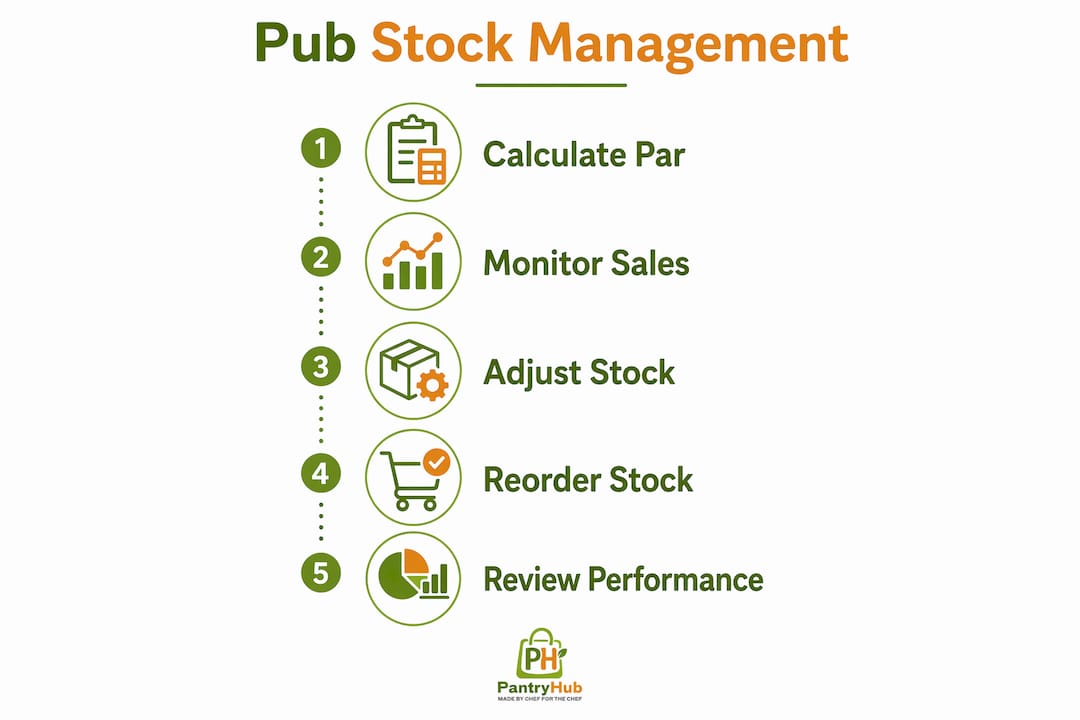
Pub stock management is the process of maintaining optimal inventory levels by calculating par levels, setting data-driven reorder points, and monitoring stock continuously to prevent shortages and overstocking. Understanding how pub stock management works is the foundation of controlling cash flow, cutting waste, and keeping service running without interruption. The industry standard par level formula combines average daily usage, supplier lead time, and a 20% safety stock buffer to protect against demand spikes and supply delays. Get this right, and your pub runs leaner and more profitably.
How pub stock management works: par levels explained
Par levels are the minimum quantity of each item you must have on hand before placing a reorder. The standard formula is: average daily usage × supplier lead time + safety stock. That safety stock buffer sits at a recommended 20% of your calculated minimum. That buffer exists because demand is never perfectly predictable and suppliers occasionally run late.
Here is a practical example. Say your pub sells 30 pints of lager per day on average, and your supplier takes two days to deliver. Your base stock need is 60 pints. Add 20% safety stock (12 pints), and your par level is 72 pints. When stock drops to 72, you reorder. No guessing, no last-minute panic calls to your rep.

Par levels also act as automated reorder triggers when connected to inventory software. That removes the need for manual oversight on every product line. For a pub carrying 80 to 150 SKUs across beer, wine, spirits, and food, that automation is the difference between a controlled operation and a reactive one.
Pro Tip: Review par levels for your top 20 products every month. Supplier lead times shift, and a par level set in january can be dangerously low by july if your trading volume has grown.
Seasonal and event-based par level adjustments
Static par levels fail pubs. A quiz night, a major sports broadcast, or a summer bank holiday can double your normal throughput in 24 hours. Seasonal trading patterns can change par levels dramatically, which means your reorder thresholds need to move with your calendar.
The practical fix is to maintain two par level sets: a standard week baseline and an event week baseline. Flag upcoming events in your inventory system at least five days out, switch to the event par levels, and communicate the change to your team and suppliers. This prevents both the stockout on a Saturday night and the surplus of slow-moving stock on a quiet Tuesday.
How does real-time data integration improve pub inventory accuracy?
Connecting your point-of-sale system to your inventory software creates what operators call a "single source of truth." Every sale recorded at the till automatically deducts from your stock count. POS integration automates stock depletion recording, eliminating the errors that come from manual data entry at the end of a busy shift.
Without that connection, pubs suffer from data drift. Manual spreadsheets cause data drift because actual usage rarely matches recorded stock when waste, spillage, and comp drinks go untracked. Over a week, a small daily discrepancy compounds into a stock count you cannot trust. That means reorder decisions are based on fiction, not fact.
A perpetual inventory system solves this by updating stock counts in real time rather than waiting for a weekly or monthly stocktake. The operational benefits are concrete:
- Low-stock alerts fire automatically when any item hits its par level
- Reorder suggestions generate without a manager manually reviewing every shelf
- Variance reports flag where recorded stock and physical stock diverge, pointing directly to waste or theft
- Supplier orders can be sent directly from the system, cutting the phone call and email chain
"Inventory management is a strategic ongoing process, not a one-time event. Regular review of KPIs ensures cash isn't trapped in dead stock." — Inventory Control Complete Guide
The shift from periodic stocktakes to continuous monitoring changes how pub managers spend their time. Instead of spending Sunday morning counting bottles, you spend it reviewing variance reports and acting on the numbers that matter.
Which stock management techniques reduce waste and improve efficiency?
No single method covers every pub's needs. Successful operations combine multiple techniques tailored to their sales patterns and stock profiles. Three methods consistently deliver results in pub environments: FIFO, ABC analysis, and reorder point strategy.
FIFO for perishables and high-turn items
FIFO (First In, First Out) means the oldest stock gets used before newer deliveries. For a pub, this applies directly to draft beer kegs, fresh garnishes, bottled mixers with short shelf lives, and food prep ingredients. Rotating stock on delivery prevents spoilage and keeps product quality consistent for the customer.
ABC analysis for focusing your effort
ABC analysis divides your entire stock list into three tiers based on revenue contribution. 20% of products typically drive 80% of revenue in most hospitality settings. Those are your A items: your top lager, your house wine, your most-ordered spirit. B items are mid-value, moderate-volume lines. C items are low-value, slow-moving products.
The practical payoff is focus. You count A items more frequently, set tighter par levels for them, and negotiate harder with suppliers on pricing. C items get reviewed quarterly and cut if they are not earning their shelf space.
Reorder point strategy and KPI monitoring
A reorder point is a calculated stock threshold that triggers a purchase order automatically. Reorder points remove uncertainty by basing replenishment on average sales velocity and lead time rather than gut feel. Pair reorder points with KPI monitoring and you have a complete picture of stock health.
The key KPIs for pub inventory control are:
- Stock turnover ratio — how many times you sell through your average stock in a period. A low ratio signals dead stock tying up cash.
- Variance percentage — the gap between theoretical usage (based on sales) and actual usage (based on physical counts). High variance points to waste, theft, or measurement errors.
- Days on hand — how many days your current stock will last at current sales velocity. Keeps you from over-ordering.
- Pour cost percentage — the cost of goods sold as a percentage of revenue for beverages. The benchmark varies by venue type, but tracking it weekly catches problems early.
Pro Tip: Run a full physical stocktake at least once a month and spot-check your top 10 A items weekly. The weekly spot-check catches variance before it becomes a financial problem.
How can pub managers adapt stock control for seasonal demand?
Demand forecasting for pubs is not a complex science. It is pattern recognition applied to your own trading history. A pub that broadcasts Premier League matches knows its Saturday throughput doubles. A venue with a summer beer garden knows june through august requires 40% more keg stock than february. The data is already in your POS history.
The practical steps for adapting pub supplies management to seasonal and event-driven demand are:
- Pull the same trading period from the previous year and use it as your baseline forecast
- Identify your top 10 volume items and calculate their event-week par levels separately
- Contact suppliers at least one week before a major event to confirm availability and lead times
- Brief your bar team on which items are on tighter stock and where substitutes sit
Adjusting par levels when supplier lead times change is non-negotiable. A supplier who normally delivers in two days may take four days over a public holiday. That doubles the stock you need on hand before reordering. Miss that adjustment and you run dry at the worst possible time.
The table below shows how par levels shift between a standard week and a major event week for three common pub items.
| Item | Standard week par level | Event week par level | Adjustment driver |
|---|---|---|---|
| Lager keg (50L) | 4 kegs | 8 kegs | Doubled sales volume |
| House red wine (case) | 3 cases | 5 cases | Increased table service |
| Bottled water (24-pack) | 6 packs | 10 packs | Higher food covers |
Staff communication is the step most pub managers skip. Your team needs to know which items are running low and what the approved substitutes are. A bartender who knows the backup lager before the main keg blows handles the situation cleanly. One who finds out mid-service creates a customer service problem.
Key takeaways
Pub stock management works by combining par level calculations, real-time data integration, and proven techniques like FIFO and ABC analysis to maintain optimal stock, reduce waste, and protect cash flow.
| Point | Details |
|---|---|
| Par levels prevent stockouts | Calculate par levels using average daily usage × lead time + 20% safety stock buffer. |
| POS integration eliminates data drift | Connecting your POS to inventory software automates stock updates and removes manual counting errors. |
| ABC analysis focuses your effort | Your top 20% of products drive most revenue; count and manage them more frequently than low-value lines. |
| Seasonal adjustment is non-negotiable | Revise par levels before major events and public holidays to match actual expected demand. |
| KPI monitoring catches problems early | Track stock turnover ratio, variance percentage, and pour cost weekly to act before losses compound. |
The part most pub managers get wrong
The biggest mistake I see in pub inventory control is treating the stocktake as the system. Managers count once a week, update a spreadsheet, and feel like the job is done. It is not. The stocktake is just a data collection moment. The system is everything that happens between counts.
Pubs that run tight operations use their POS data daily. They check variance reports every morning the way a chef checks prep lists. They know which lines are drifting before the weekly count confirms it. That daily habit is what separates a pub with a 68% gross profit margin from one running at 58%.
The technology investment argument is also misunderstood. Pub managers often resist digital stocktake tools because of upfront cost. But the cost of one week of undetected over-pouring, one missed reorder that empties the cellar on a Friday night, or one month of dead stock sitting in a cool room almost always exceeds a year of software fees. The ROI is not theoretical. It shows up in your next profit and loss statement.
The other thing I would push back on is the idea that stock management is a back-office function. Your best bar managers understand par levels, know which items are on event par, and flag anomalies to you without being asked. Training your team on the basics of inventory control is one of the highest-return investments you can make in your operation.
— Admin
Pantryhub makes pub inventory control practical
Running a tight cellar and a profitable bar requires more than a spreadsheet and a weekly count. Pantryhub is built specifically for hospitality venues that need real-time stock visibility, automated par level alerts, and direct supplier ordering from a single platform.
With Pantryhub, every sale updates your stock count automatically, low-stock alerts fire before you run out, and your team can complete bar stocktakes on a mobile device in minutes rather than hours. The platform connects your POS data to your inventory records, eliminating the data drift that costs pubs money every week. Whether you manage one venue or several, Pantryhub gives you the stock control tools that make a real difference to your bottom line. See how hospitality inventory software can work for your pub.
FAQ
What is a par level in pub stock management?
A par level is the minimum stock quantity that triggers a reorder. It is calculated as average daily usage multiplied by supplier lead time, plus a 20% safety stock buffer.
How often should a pub do a stocktake?
A full physical stocktake should happen at least once a month. Spot-checking your highest-volume items weekly catches variance and waste before they compound into significant losses.
What does FIFO mean for pub inventory?
FIFO (First In, First Out) means using older stock before newer deliveries. Pubs apply it to kegs, bottled mixers, and perishables to prevent spoilage and maintain consistent product quality.
How does POS integration improve stock accuracy?
Connecting your POS to inventory software automatically deducts each sale from your stock count, creating a real-time record that eliminates the errors caused by manual data entry.
What KPIs matter most for pub stock control?
Stock turnover ratio, variance percentage, days on hand, and pour cost percentage are the four metrics that give pub managers the clearest picture of inventory health and cash flow efficiency.