

Australia's hospitality industry, formally classified as Accommodation and Food Services under the Australian Bureau of Statistics, is one of the country's largest employment sectors. As of February 2026, the sector employs 967,200 workers across cafes, restaurants, pubs, bars, accommodation venues, and clubs — making it a critical pillar of the national economy and a sector that touches nearly every community across the country.
The main sub-sectors you'll find in the official data are:
- Cafes, restaurants, and takeaway food services (the largest sub-sector)
- Pubs, taverns, and bars
- Accommodation (hotels, motels, short-term rentals)
- Clubs (licensed, sporting, and community clubs)
- Catering and events (often overlapping with the above categories)
Key Takeaways
Australia's hospitality industry employs 967,200 workers across Accommodation and Food Services as of February 2026, with a market valued at USD 37,454.48 million in 2025 and a projected CAGR of 7.35% through 2034.
| Point | Details |
|---|---|
| Sector scale in 2026 | 967,200 workers in Accommodation and Food Services; cafes and restaurants account for — a large share of those jobs. |
| Market growth trajectory | The Australian hospitality market is projected to grow at a 7.35% CAGR from 2026 to 2034, reaching USD 70,933 million. |
| Top 2026 operational priorities | AI inventory tools, hyper-local sourcing, and tighter menus are the three levers most directly tied to margin improvement. |
| Workforce response | SaCSA's 2025 Workforce Plan and DEWR's Fee-Free TAFE windows are the primary funded pathways for addressing occupational shortages. |
| Pantryhub for operators | Real-time stock tracking, automated ordering, and GP reporting by menu item give Australian venues the data they need to protect margins in 2026. |
Table of Contents
- What does the 2025–2026 data tell us about the sector's size?
- Which businesses actually make up the hospitality industry?
- What are the biggest hospitality trends shaping Australia in 2026?
- How bad is the staffing shortage, and what can you do about it?
- How do you protect margins when costs keep rising?
- What policy and regulatory issues should you track in 2026?
- What should you expect from the rest of 2026?
- How do AI operations and local sourcing actually change your margins?
- What actually matters most in 2026
- Pantryhub gives you the real-time control 2026 demands
- Sources
What does the 2025–2026 data tell us about the sector's size?
The numbers here are worth bookmarking. IMARC Group valued the Australian hospitality market at USD 37,454.48 million in 2025, with projections pointing to USD 70,933.81 million by 2034 — a compound annual growth rate of approximately 7.35% over the 2026–2034 period. That trajectory reflects a sector recovering strongly from pandemic disruption and now riding domestic travel demand and rising international arrivals.
On the employment side, the February 2026 Jobs and Skills Australia data breaks down as follows:
967,200 Australians work in Accommodation and Food Services as of February 2026, making it one of the top five employing industries in the country.
A short note on data methodology: the ABS is currently running a Labour Force Survey modernization program that affects the timing and comparability of industry employment releases. Some figures use February 2026 as the reference period because that aligns with the most recent Jobs and Skills Australia publication cycle. When you cite these numbers, always check the release date and methodology notes.
Which businesses actually make up the hospitality industry?
The Accommodation and Food Services classification covers more ground than most operators realize. Here's how the sub-sectors map to real-world business types:
- Cafes, restaurants, and takeaway: Full-service restaurants, fast-casual venues, cafes, food trucks, dark kitchens, and quick-service takeaway outlets. This sub-sector accounts for roughly 72% of total sector employment.
- Pubs, taverns, and bars: Licensed venues serving alcohol, often with food, entertainment, and gaming. Many operate as community anchors in regional areas.
- Accommodation: Hotels, motels, serviced apartments, bed-and-breakfasts, and short-term rental operators. This sub-sector overlaps heavily with tourism.
- Clubs: Licensed sporting clubs, RSLs, and community clubs. These venues often combine food service, bar operations, and event hosting under one roof.
- Catering and events: Contract caterers, event hospitality providers, and venue-based event teams. SaCSA (Skills and Careers in the Sector) frames catering and events as part of the broader hospitality workforce picture, with the SIT Tourism, Travel and Hospitality training package covering all of these business types.
The overlap between tourism and hospitality is real and deliberate. Accommodation venues, event caterers, and food-and-beverage operators all contribute to the visitor economy, which is why workforce plans and policy responses tend to treat them together.
What are the biggest hospitality trends shaping Australia in 2026?
Industry reporting for 2026 identifies four dominant themes: AI-powered kitchens, hyper-local and Indigenous ingredient sourcing, experience-led dining, and tighter menu strategies. Here's what each one means for your operation:
- AI and automation in the kitchen: AI tools are now being applied to rostering, inventory forecasting, and ordering workflows. The practical payoff is fewer unnecessary labor hours and better cost-of-goods visibility. Venues that integrate these tools early are reporting measurable operational improvements.
- Experience-led and immersive dining: Guests are choosing venues that offer a story, a setting, or a social-media moment — not just a meal. This shifts investment toward design, theater, and personalization rather than pure throughput.
- Hyper-local and Indigenous ingredients: Hyper-local sourcing has moved from a niche marketing claim to a mainstream consumer expectation. Indigenous ingredients — from wattleseed to finger lime — are gaining genuine traction on mainstream menus, not just fine-dining ones.
- Tighter menus and plant-based second wave: Operators are pruning menus to reduce waste, simplify prep, and protect margins. Plant-based options are entering a more mature phase, with quality and integration replacing novelty as the driver.
- Dynamic pricing and digital loyalty: Revenue management tools borrowed from the hotel sector are appearing in food-and-beverage operations. Digital-first loyalty programs are replacing stamp cards, with data-driven personalization as the goal.
- Culture-led workforce retention: A younger, more flexible workforce responds to culture, flexibility, and career development rather than wages alone. Venues investing in team culture and training pathways are seeing lower turnover.
Pro Tip: Before chasing every trend, pick one and measure it. If you're testing hyper-local sourcing, track your food cost percentage and guest feedback scores for 60 days before expanding. Data beats intuition every time.
How bad is the staffing shortage, and what can you do about it?
The workforce pressure is structural, not cyclical. Cafes, restaurants, and accommodation venues are all reporting difficulty filling kitchen, front-of-house, and supervisory roles. The problem compounds in regional areas where the candidate pool is smaller and housing costs for workers are rising.
Staffing remains the single most cited operational challenge for Australian hospitality operators in 2026, with shortages concentrated in trade-qualified cooks, chefs, and venue managers.
SaCSA's 2025 Workforce Plan update positions the SIT Tourism, Travel and Hospitality training package as the central national skills framework. The plan identifies specific occupational shortages and coordinates training quality projects across registered training organizations. For operators, this means the national training infrastructure is actively being updated — but the gap between training completions and industry demand remains wide.
Practical actions you can take now:
- Fee-Free TAFE: Several jurisdictions still have Fee-Free TAFE windows available for hospitality qualifications. Check your state's current eligibility before these windows close.
- Apprenticeships and employer incentives: DEWR's Jobs and Skills Councils framework includes employer-facing incentives for taking on apprentices and trainees. The application process is straightforward for most venues.
- Recruit from hospitality education pipelines: Torrens University, TAFE networks, and private RTOs all produce job-ready graduates. Building a relationship with a local training provider gives you early access to candidates.
- Retention over recruitment: Replacing a trained staff member costs more than retaining one. Flexible rostering, clear career pathways, and a genuine team culture reduce churn faster than a pay rise alone.
Pro Tip: Post your roles on industry-specific job boards (Seek's hospitality category, Scout Talent) rather than general boards only. Hospitality-specific platforms attract candidates who understand the work conditions and are less likely to drop out before their first shift.
How do you protect margins when costs keep rising?
Australian hospitality venues operate on narrow net margins. Food cost inflation, energy prices, and labor as a percentage of revenue are all squeezing GP. The operators managing this best are doing three things consistently.
First, they know their numbers in real time. Delayed data — a weekly stocktake, a monthly P&L — means you're making decisions on yesterday's reality. Real-time inventory visibility and automated ordering let you catch a cost blowout before it becomes a month-end problem.
Second, they've tightened their supplier relationships. Direct relationships with local producers reduce supply-chain risk and often improve pricing consistency. Consolidated product ranges (fewer SKUs, higher volume per SKU) give you more leverage with suppliers and reduce the cognitive load on your kitchen team.
Third, they've pruned their menus. A shorter menu reduces prep complexity, lowers waste, and makes training faster. Every item that doesn't earn its margin is a cost you're carrying.
- Track COGS by menu item, not just as a total percentage.
- Set par levels and automate low-stock alerts so ordering decisions aren't made under pressure.
- Review your supplier terms quarterly — pricing agreements that made sense 12 months ago may not reflect current market conditions.
Pro Tip: Combine menu pruning with automated inventory forecasting. When you reduce your SKU count and set accurate par levels, your ordering becomes predictable and your waste drops. The two levers work together.
What policy and regulatory issues should you track in 2026?
Three areas deserve your attention this year.
Fair Work and Modern Award compliance is the most immediate risk for most operators. Underpayment claims in hospitality have attracted significant regulatory attention, and the Fair Work Ombudsman has increased audit activity in the sector. Compliance tooling — rostering software with award interpretation built in, payroll platforms that flag penalty rate triggers — is no longer optional for venues with more than a handful of staff.

Sustainability and seafood regulation is moving. Anticipated 2026 legislative developments around sustainable seafood sourcing and food labeling will affect menu descriptions and supplier documentation requirements. If you're making provenance claims on your menu, make sure your supplier agreements support them.
Training funding windows are closing. Fee-Free TAFE availability varies by jurisdiction and qualification, and some windows are scheduled to end or be revised in 2026. Check current eligibility through your state training authority before assuming funded places are still available.
Primary sources to bookmark:
- ABS — Labour Force Survey and industry employment data
- Jobs and Skills Australia — Accommodation and Food Services profile
- SaCSA — Hospitality workforce plan and training package
- DEWR — Jobs and Skills Councils and skills reform
Check publication dates on all ABS employment data. The LFS modernization program means some releases carry revised methodology notes that affect year-on-year comparability.
What should you expect from the rest of 2026?
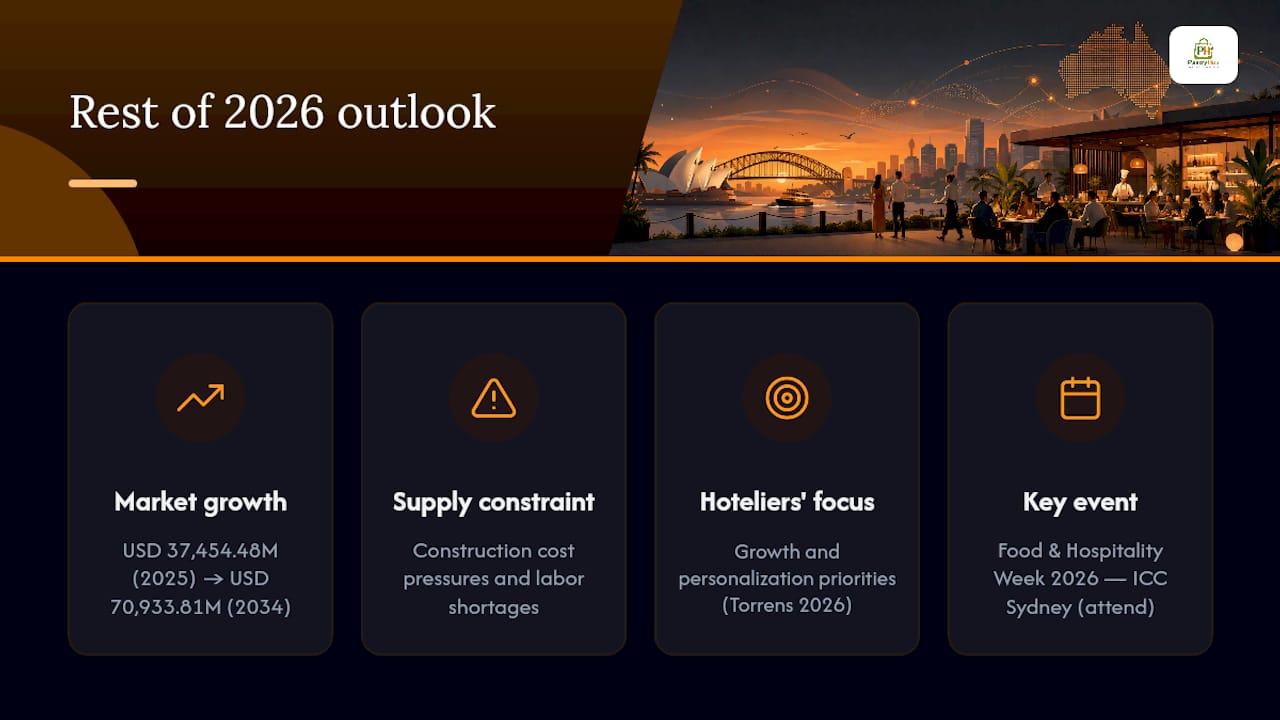
The near-term outlook is genuinely positive, with a few important caveats. CBRE's Hotels Australia: Overview and Outlook 2026 documents strong RevPAR growth across major city markets, event-driven occupancy uplift, and a constrained new room pipeline — the result of construction cost pressures and ongoing labor shortages in the building sector. That supply constraint is actually good news for existing hotel operators: fewer new rooms means less competitive pressure on occupancy rates.
Torrens University's 2026 industry commentary forecasts a strong year for the hotel sector overall, with growth and personalization identified as the priorities hoteliers should focus on. The Food and Hospitality Week 2026 at ICC Sydney is a key event for operators tracking supplier innovation and industry direction — worth attending if you're making procurement or tech investment decisions this year.
The IMARC Group projects the Australian hospitality market to grow from USD 37,454.48 million in 2025 toward USD 70,933.81 million by 2034, a trajectory that reflects sustained domestic demand and a recovering international arrivals pipeline.
International arrivals are recovering, domestic leisure travel remains strong, and the Brisbane 2032 Olympic pipeline is already generating infrastructure and hospitality investment in Queensland. Regional operators near major event corridors stand to benefit from both the construction phase and the eventual visitor uplift.
How do AI operations and local sourcing actually change your margins?
This is where the 2026 trends stop being abstract and start affecting your P&L. Operators who have combined AI-assisted inventory management with hyper-local sourcing strategies are seeing two compounding benefits: lower supply-chain risk (fewer substitutions, more predictable pricing) and better COGS visibility (because local supplier relationships tend to involve more direct communication and fewer invoice surprises).
Industry reporting confirms that AI-powered kitchens and hyper-local sourcing are among the dominant operational themes for 2026. The practical implication is that these aren't separate initiatives — they reinforce each other. A tighter supplier list is easier to manage with automated ordering. Automated ordering is more accurate when your menu is tighter. And a tighter menu is easier to cost when you have real-time GP tracking by item.
Operators using real-time inventory and ordering data are better positioned to act on cost changes immediately rather than discovering them at month-end when the damage is already done.
Pro Tip: If you're choosing between investing in operations tech or sourcing changes first, start with the tech. Real-time data tells you where your sourcing problems actually are — rather than where you assume they are.
What actually matters most in 2026
The data points to a sector that is growing, under pressure, and differentiating fast. Here's the honest short list of what deserves your attention:
- Margins are the priority. Revenue growth means nothing if food cost and labor percentages are eating it. Know your GP by menu item, not just in aggregate.
- Staffing is structural. The shortage won't resolve quickly. Build your own pipeline through apprenticeships and training provider relationships rather than waiting for the market to fix itself.
- Tech is now table stakes. Hospitality software platforms in Australia have matured to the point where real-time inventory, rostering, and GP tracking are accessible to single-venue operators, not just groups.
- Local sourcing is a margin lever, not just a marketing story. Direct supplier relationships reduce substitution risk and often improve pricing consistency over time.
- Track the data cadence. ABS and Jobs and Skills Australia release updated employment and industry data on a rolling basis. Operators who check these figures quarterly make better hiring and investment decisions than those who rely on year-old snapshots.
- Test one change at a time. Automated rostering trial, menu pruning, or a new supplier relationship — pick one, measure it for 30–60 days, then decide whether to expand.
Pantryhub gives you the real-time control 2026 demands
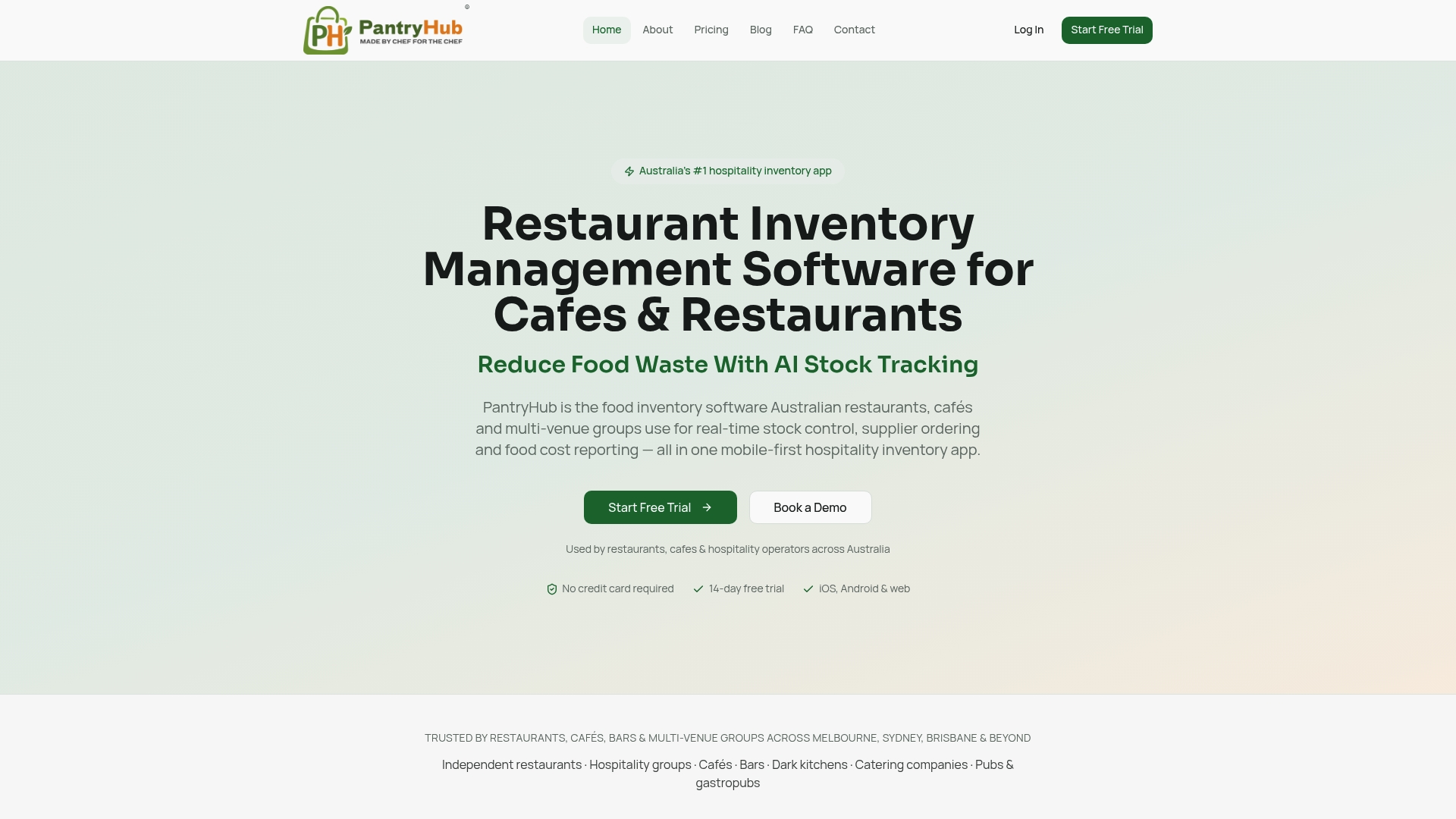
The margin pressure, the staffing constraints, and the supply-chain complexity described above all share a common fix: better operational data, faster. Pantryhub is built specifically for Australian restaurants, cafes, bars, and commercial kitchens — giving you real-time stock visibility, automated purchase orders, low-stock alerts, and GP tracking by menu item, all in one platform.
- 📦 Real-time inventory tracking across one venue or multiple locations
- 🔔 Automated low-stock alerts so you order before you run out, not after
- 🛒 Supplier ordering integration with Australian suppliers built in
- 📊 Food cost and GP reporting by menu item, not just as a total
The result: less waste, faster ordering, and clearer supplier relationships — without the spreadsheets. Whether you run a single café or a multi-location group, Pantryhub gives you the visibility to act on cost changes before they hit your P&L. Start your free trial and see what real-time control looks like for your kitchen.
Sources
Use these primary sources when you need to verify figures, check policy updates, or cite data in your own reporting:
- Accommodation and Food Services
- Australia Hospitality Market Size & Report
- From Indigenous ingredients to AI kitchens: The biggest hospitality trends set to shape the next 12 months - Restaurant Business
- Hospitality
- Hotel career and industry trends for 2026
Publication dates matter here. The ABS LFS modernization means some historical series have been revised. Always confirm the reference period before citing employment figures in external documents.