

What is hospitality software for Australian operators?
Hospitality software is cloud-based technology that connects the core operations of your venue — kitchen inventory, supplier ordering, POS, workforce scheduling, and financial reporting — into one system. For Australian restaurant, café, and bar operators, that means less time chasing spreadsheets and more time running a kitchen that actually works.
Here is what a well-built platform covers:
- Real-time inventory tracking across food and beverage stock
- Automated supplier ordering triggered by par levels
- Low-stock alerts to prevent mid-service shortages
- POS and accounting integration for accurate food cost reporting
- Multi-location reporting for groups managing more than one venue
Integrated hospitality software can significantly reduce front-office workload, while giving kitchen teams real-time visibility across every department.
Key features your kitchen management software should have
Most platforms advertise a long feature list. The ones that actually help Australian kitchens prioritize back-of-house workflows, not just guest-facing tools.
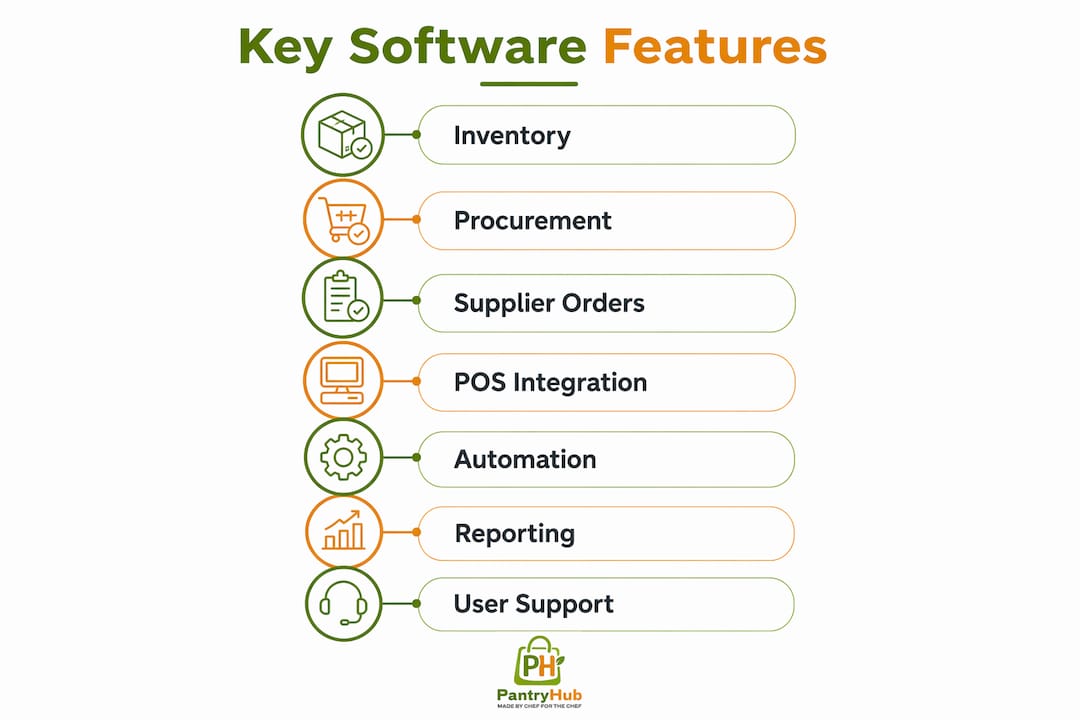
- Inventory synchronization: Stock levels update automatically after every order received or ingredient used.
- Supplier order management: Send purchase orders directly from the platform, with full order history and delivery tracking.
- POS integration: Sales data flows into inventory automatically, so your stock counts stay accurate without manual entry.
- Accounting compatibility: Connects with Xero or MYOB for GST-compliant reporting.
- Workforce scheduling: AI-powered scheduling and mobile self-service help teams handle last-minute callouts without the chaos.
- Cloud access: Manage your venue from any device, anywhere, at any time.
Pro Tip: Vet every platform for its back-of-house depth before you commit. Many generalist tools treat kitchen inventory and supplier ordering as secondary modules, not core features.
Why integration and automation matter more than feature count
The best hospitality management software does not just collect data. It connects it. When your inventory system talks to your supplier portal, your POS, and your accounting software, you eliminate the duplicate entry that causes errors and wastes hours every week.
Automation takes that further. Supplier orders triggered by par levels, stock counts updated after every delivery, and cost reports generated without manual input — these are the workflows that free your team to focus on food, not admin.
- Centralized data removes fragmented systems and gives one source of truth.
- Automated reordering prevents stockouts and over-ordering in the same move.
- Real-time sync keeps kitchen flow intact during peak service.
Pro Tip: Strong integration with your existing supplier and accounting ecosystem matters more than the number of features on a pricing page. Choosing software for integration rather than feature count is the advice most experienced operators give after their first platform switch.
Local considerations every Australian buyer should check
Australian hospitality software buyers face requirements that generic platforms often overlook. GST reporting, Fair Work compliance, and WHS guidelines are not optional extras — they are baseline requirements for operating legally.
- GST compatibility: Your platform must generate GST-compliant invoices and reports without manual workarounds.
- Fair Work and WHS alignment: Payroll and scheduling modules need to reflect Australian award rates and workplace health standards.
- Supplier schedules: Australian kitchen suppliers often operate on tight delivery windows. Your ordering system should match that rhythm.
- Local support: A vendor with Australian-based support means faster resolution when something breaks at 6:00 AM before a breakfast service.
Platforms developed with Australian market knowledge reduce the friction of adapting a foreign system to local compliance needs. That local context is worth prioritizing when you evaluate your shortlist.
How the right software improves kitchen operations and supplier coordination
Centralized inventory tracking cuts waste by flagging discrepancies before they become write-offs. When your stock counts update in real time, you catch over-ordering early and plan menus around what you actually have on hand.
Supplier coordination gets faster too. Automated purchase orders, digital delivery confirmations, and full order histories replace the phone calls and email chains that slow purchasing down. For operators managing hospitality inventory software across multiple locations, that visibility is the difference between controlled costs and margin bleed.
Better kitchen data also supports menu planning. When you can see which ingredients move fastest and which sit in the cool room, you make smarter purchasing decisions every week.
What does hospitality software actually do at its core?
At its core, hospitality management software is an operational platform that replaces disconnected tools with one connected system. A property management system (PMS) handles reservations and front desk operations. A kitchen and inventory module tracks stock, manages recipes, and controls food costs. Supplier ordering tools automate purchasing. Workforce management handles scheduling, time tracking, and payroll compliance.
For restaurant and café operators, the modules that matter most are inventory, procurement, and POS integration. These three functions, working together, give you accurate food cost data, controlled purchasing, and real-time stock visibility — the foundation of a profitable kitchen.

How do hospitality software vendors compare for Australian venues?
The Australian market includes both local and international platforms. Local vendors bring built-in GST compliance, Australian award rate support, and support teams operating in Australian time zones. International platforms often offer broader integrations and larger development budgets but may require configuration to meet local compliance requirements.
When comparing vendors, focus on these criteria rather than brand names:
| Criteria | What to look for |
|---|---|
| Back-of-house depth | Inventory valuation, recipe costing, supplier ordering |
| Compliance | GST reporting, Fair Work, WHS integration |
| Integration | POS, Xero/MYOB, supplier portals |
| Support | Australian-based, available during service hours |
| Pricing model | Per-location or per-user, with no hidden setup fees |
Over 7,000 verified Hotel Tech Report reviews from 2026 show that usability and support reliability are the top priorities for hospitality buyers — ahead of feature count.
Cloud-based vs. on-premise: which suits Australian venues?
Cloud-based platforms are the practical choice for most Australian venues. You access your data from any device, updates happen automatically, and there is no server hardware to maintain. For multi-location operators, cloud-based kitchen management means every site runs from the same data set in real time.
On-premise systems offer more control over data storage and can run without internet connectivity. That matters in regional areas with unreliable connections. The trade-off is higher upfront cost, manual updates, and limited remote access.
For most city and suburban venues, cloud deployment is the faster, lower-cost path to getting your kitchen operations under control.
Data privacy and security under Australian law
Australian hospitality operators collecting customer data are subject to the Privacy Act 1988 and the Australian Privacy Principles (APPs). Any platform storing guest payment data, loyalty program information, or staff records must comply with these requirements.
When evaluating vendors, confirm that data is stored on Australian servers or in a jurisdiction with equivalent protections. Check that the vendor holds SOC 2 certification or equivalent, and that their data breach notification process aligns with the Notifiable Data Breaches (NDB) scheme. These are not negotiable points — they are legal obligations.
What does hospitality software cost for Australian operators?
Pricing varies by platform type and venue size. Most cloud-based platforms use a subscription model, billed monthly or annually per location or per user.
Entry-level platforms suited to single-site cafés typically start at lower monthly rates, while multi-location or enterprise platforms carry higher fees reflecting broader functionality. Setup and onboarding fees vary widely. Some vendors include them in the first year; others charge separately.
Watch for costs that are not listed publicly: integration fees for connecting to your existing POS or accounting software, data migration charges, and per-transaction fees on supplier orders. For procurement-focused platforms like those covering restaurant inventory systems, confirm whether supplier integrations are included or billed as add-ons.
Support and training options for Australian operators
Local support availability is one of the most practical factors in a platform decision. A vendor with Australian-based support means your team gets help during actual service hours, not at 3:00 AM when a US-based team comes online.
Look for vendors offering onboarding training, video libraries, and live chat. For kitchen-focused platforms, hands-on onboarding from someone who understands back-of-house workflows makes adoption faster and reduces the time your team spends figuring out the system mid-service.
What Australian operators say about using hospitality software
Operators who move from manual stock counts and phone-based ordering to a connected platform consistently report the same outcomes: fewer stockouts, faster purchasing, and better visibility into food costs. The shift from reactive to proactive kitchen management is the most common benefit cited.
For venues managing multiple locations, the ability to compare stock usage and supplier costs across sites in one report is a capability that spreadsheets simply cannot replicate. Procurement tools that connect directly to supplier portals, like those available through kitchen procurement platforms, reduce the back-and-forth that slows purchasing down.
Pantryhub gives your kitchen real control, not just more software
Running a tight kitchen means knowing your stock levels before service, not after. Pantryhub is built specifically for Australian restaurants, cafés, and bars — by chefs who have worked the same shifts you have. It connects inventory tracking, supplier ordering, low-stock alerts, and food cost reporting in one platform, without the complexity of a hotel management system you do not need.
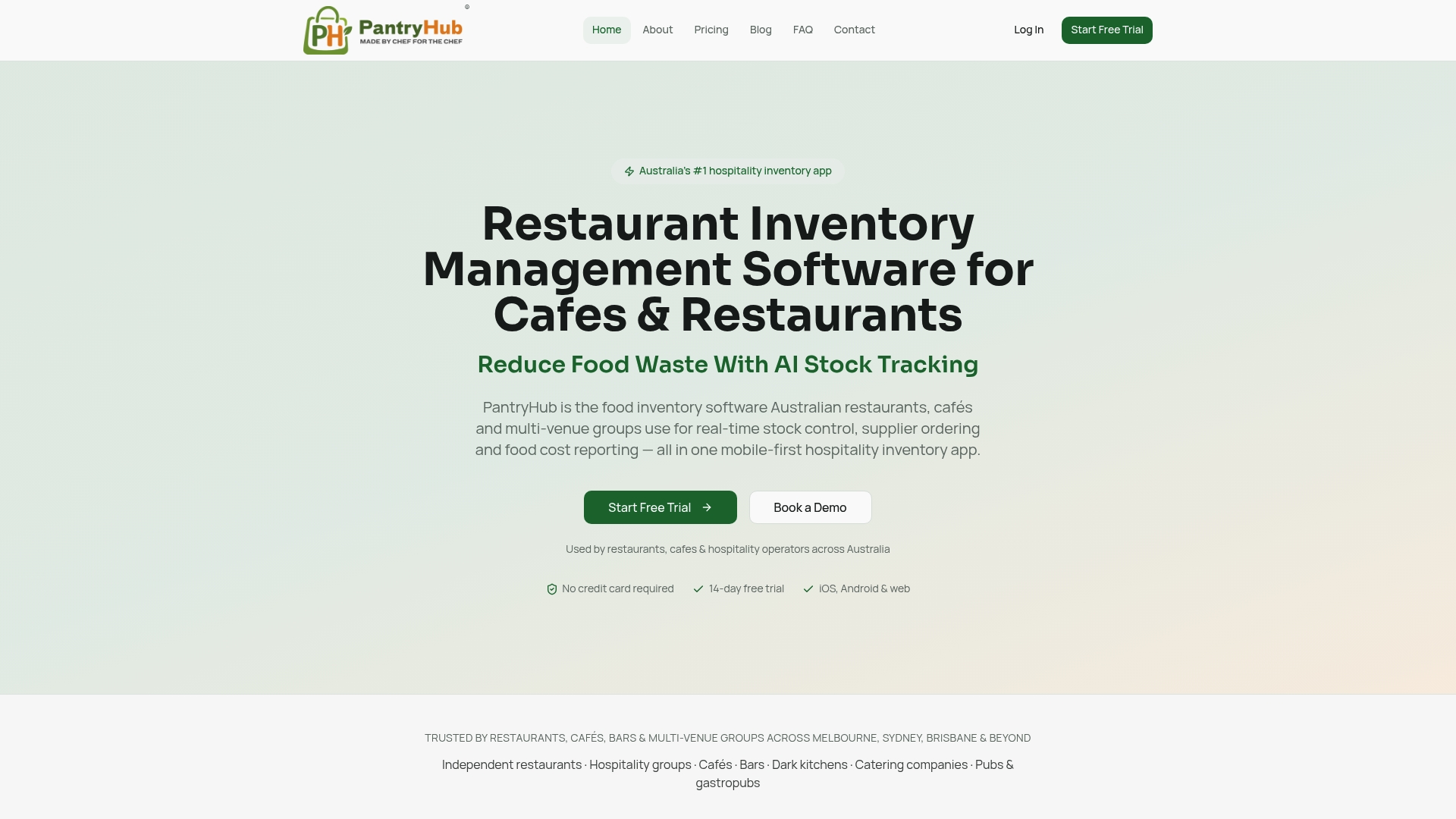
Where generic platforms treat back-of-house as an afterthought, Pantryhub puts it front and center. You get real-time stock visibility across one or multiple locations, automated purchase orders sent directly to your suppliers, and reporting that tells you exactly where your food costs are going. No manual entry. No guesswork on par levels.
Ready to see it in action? Start a free trial and get your kitchen running the way it should.
Key Takeaways
Hospitality software for Australian operators delivers the most value when it connects kitchen inventory, supplier ordering, and compliance into one cloud-based platform rather than patching together separate tools.
| Point | Details |
|---|---|
| Cloud deployment wins for most venues | Cloud platforms offer remote access, automatic updates, and real-time multi-location data without server hardware. |
| Back-of-house depth is non-standard | Many generalist platforms treat kitchen inventory and supplier ordering as secondary modules — vet these features specifically. |
| Workload reduction is measurable | Integrated software can significantly reduce front-office workload, per Sage Australia. |
| Local compliance is a baseline requirement | GST reporting, Fair Work, and WHS alignment must be built in, not bolted on after purchase. |
| Pantryhub is built for this | Pantryhub connects inventory, supplier ordering, and food cost reporting specifically for Australian kitchens. |