

The leading hospitality software platforms in Australia for 2026 are purpose-built to handle inventory, ordering, and operational workflows for restaurants, cafés, bars, and commercial kitchens. Here are the top options worth your attention:
- Pantryhub — All-in-one inventory and ordering platform built specifically for Australian venues, with real-time stock visibility, supplier integration, and local support
- RMS Cloud — Sydney-founded property management system trusted by over 10,000 properties globally, with native AUD and GST tax-invoice compliance
- ️ Matradee AI — Australian-made platform for restaurants and bars, focused on QR ordering, loyalty programs, and guest workflows
- ️ Sage Intacct — Cloud accounting and hospitality management software with strong multi-location reporting for Australian operators
- Cloudbeds — Global cloud PMS with a growing Australian presence, strong channel management, and AUD billing
- Oracle Hospitality OPERA Cloud — Enterprise-grade solution used by major Australian hotel chains including Accor and Marriott
Table of Contents
- What does the Australian hospitality software market look like in 2026?
- Key features that define the best hospitality platforms in 2026
- Why operational fit matters more than a feature checklist
- How Pantryhub solves the real challenges Australian operators face
- Operational benefits your kitchen will feel immediately
- How to choose the right hospitality software for your venue
- What hospitality software actually costs in 2026
- User experience and support: what Australian operators actually need
- Pantryhub gives Australian venues real control over their kitchen
- Key Takeaways
What does the Australian hospitality software market look like in 2026?
Australia's hospitality software market sits at an interesting crossroads. Locally built platforms compete directly with global giants, and the gap between them has narrowed considerably.
Two homegrown champions anchor the local market. RMS Cloud, founded in Sydney, serves over 10,000 properties across 70+ countries and dominates Australian independent hotels, motels, and serviced apartments. Matradee AI is built alongside real Australian venues, designed for the pace of service-first hospitality. Global platforms like Cloudbeds and Oracle OPERA Cloud hold strong positions at the mid-market and enterprise levels respectively.
The clearest trend in 2026 is consolidation. Operators want fewer tools, not more. Platforms that unify property management, distribution, and guest workflows are winning because they reduce manual errors and cut the friction that comes from stitching together disconnected systems. GST compliance, ATO tax-invoice requirements, and integration with local OTAs remain non-negotiable for any platform serving Australian venues.
Multi-venue scalability is also driving decisions. Whether you run two cafés or a regional restaurant group, the ability to manage stock, staff, and reporting from a single dashboard is now a baseline expectation, not a premium feature.

Key features that define the best hospitality platforms in 2026
The platforms pulling ahead share a specific set of capabilities. Not every feature matters equally, but these are the ones that show up in every high-performing venue:
- Unified inventory and ordering — Real-time stock updates across every location, with automated low-stock alerts that trigger before you run out
- ☁️ Cloud-based with offline reliability — Cloud systems with offline support prevent double bookings and keep service running during internet outages, a real risk in both metro and regional Australian venues
- POS and accounting integration — Direct connections to your existing point-of-sale and accounting tools eliminate double entry and keep your numbers accurate
- Supplier order management — Automated purchase orders sent directly to suppliers based on par levels, cutting the time your team spends on manual ordering
- Mobile-friendly interfaces and QR ordering — Table-side and QR code ordering reduce front-of-house friction and speed up service
- Commission-free direct ordering — Native commission-free ordering bypasses third-party fees and protects your margins
- Hospitality-specific reporting — Food cost reports, waste tracking, and supplier spend analysis built for kitchen managers, not generic accountants
Why operational fit matters more than a feature checklist
A long feature list looks impressive in a demo. It rarely predicts how well software performs during a Friday dinner rush. The platforms that actually stick are the ones that fit how your venue runs, not just what your venue needs on paper.
Venue size, service style, and existing workflows all shape which platform will work for you. A 10-seat café and a 200-seat restaurant group have fundamentally different needs, even if both want inventory tracking. Offline functionality and local support are particularly critical in Australia, where connectivity disruptions affect both city venues and regional operations.
Multi-channel inventory syncing is another area where operational fit gets tested. Careful rule configuration is what separates a smooth rollout from a stock error nightmare. Most operators underestimate this step.
Pro Tip: When evaluating platforms, ask your shortlisted vendors to walk you through a real stock discrepancy scenario. How the software handles that moment tells you more than any feature comparison.
How Pantryhub solves the real challenges Australian operators face
Pantryhub was built by chefs, for chefs. That origin shapes everything about how it works. Where generic platforms bolt inventory onto a broader hospitality suite, Pantryhub puts stock control and supplier ordering at the center of the product.
For Australian restaurant, café, bar, and commercial kitchen managers, Pantryhub delivers:
- Real-time stock visibility across single and multi-location operations, so you always know what's on hand without a manual count
- Smart low-stock alerts that notify your team before critical ingredients run out mid-service
- Direct supplier integration with automated ordering based on your par levels, cutting hours of weekly admin
- Commission-free ordering that keeps third-party fees out of your cost structure
- Mobile access so you can check and manage inventory from anywhere, not just the back office
- Local Australian support and offline reliability, so a dropped connection doesn't stop your kitchen
Pantryhub's hospitality inventory software is purpose-built for the operational pace of Australian venues. The platform's thought leadership resources, including detailed guides on restaurant software integrations and inventory best practices, reflect deep knowledge of how Australian kitchens actually run.
Operational benefits your kitchen will feel immediately
The right platform changes how your team works every day. For restaurant and café managers, real-time stock control means fewer 86'd menu items and less waste at the end of service. For bar managers, automated reorder points mean you stop running out of your top-selling products on a Saturday night.
Commercial kitchen managers gain the most from food cost reporting tied directly to supplier invoices. When your actual spend matches your theoretical cost, you know your recipes and portions are on track. When they diverge, the data tells you exactly where to look.
Multi-location operators get the biggest operational lift. Centralizing inventory across venues means your head chef or operations manager can spot a stock issue at any location without driving there or waiting for a manual report.
How to choose the right hospitality software for your venue
Start with your biggest operational pain point. If stock management and supplier ordering are costing you hours every week, prioritize platforms built specifically for inventory. If your main challenge is channel distribution and reservations, a property management system with strong channel connectivity fits better.
Key criteria to evaluate:
- Operational coverage — Does it handle your actual workflows, not just the ones in the demo?
- Integration depth — Will it connect cleanly to your existing POS and accounting tools?
- Local support — Can you reach a real person in your time zone when something breaks?
- Offline capability — Does it keep running when your internet drops?
- Total cost — What are the setup, training, and ongoing subscription costs combined?
What hospitality software actually costs in 2026
Pricing across the Australian market varies widely by platform type and venue size. Entry-level cloud platforms for small venues typically start at subscription tiers priced per property or per location per month. Enterprise platforms like Oracle OPERA Cloud are quote-based, reflecting the complexity of large-chain deployments.
Beyond the subscription fee, factor in setup costs, data migration, staff training, and any integration fees for connecting to your POS or accounting software. These costs can equal or exceed the first year of subscription fees for complex deployments. Platforms with local Australian support teams tend to reduce training time because onboarding is handled in your context, not a generic global template.
Pantryhub's pricing is designed to be accessible for independent venues and groups alike, with no hidden fees eating into the value you get from day one.
User experience and support: what Australian operators actually need
Software that slows down service is worse than no software at all. The best platforms in 2026 are fast, obvious, and reliable once the doors open. As Matradee AI puts it, good hospitality software should "get out of the way" during service.
Local Australian support is a genuine differentiator, not a marketing point. When a stock discrepancy appears at 6 PM on a Thursday, you need someone who understands Australian venue operations and can help you fix it before service. Platforms with offshore-only support often fall short here.
Look for vendors who offer onboarding handled alongside your team, not just a video library and a help center. The mobile ordering and inventory tools that perform best in Australian venues are the ones where the vendor understood local operational pace from the start.
Pantryhub gives Australian venues real control over their kitchen
If inventory waste, manual ordering, and stock surprises are eating into your margins, Pantryhub is the direct solution. It's not a broad hospitality suite with inventory added on. It's an all-in-one platform built from the ground up for Australian restaurant, café, bar, and kitchen operators who want complete control of their pantry without the spreadsheet chaos.
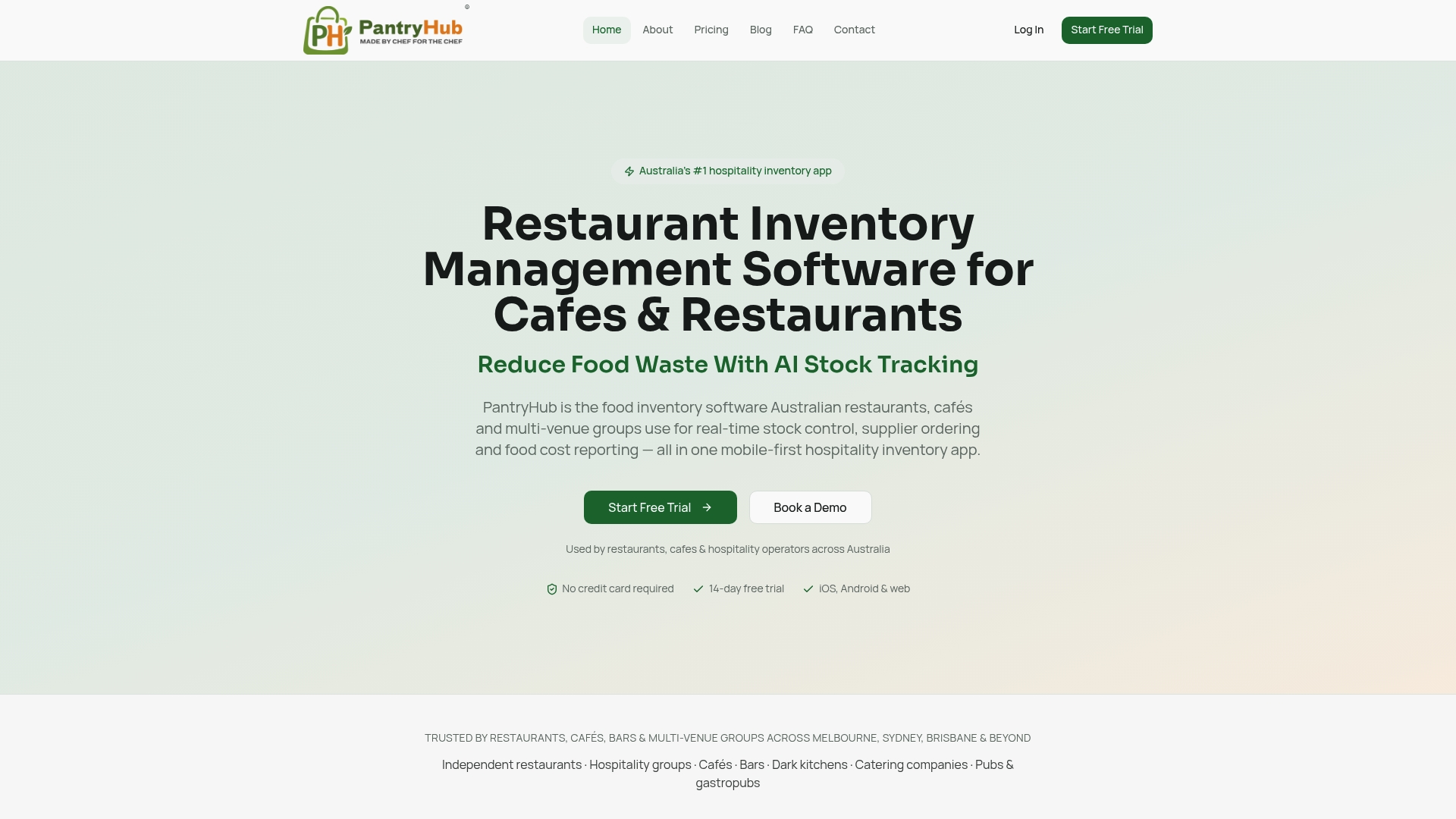
Pantryhub connects your stock levels, supplier orders, and food cost reporting in one place, with local Australian support behind it. Whether you run one location or ten, the platform scales with you and keeps your kitchen running on accurate numbers. Start your free trial at pantryhub.com.au and see what real inventory control feels like.
Key Takeaways
The most effective hospitality software platforms for Australian venues in 2026 prioritize operational fit, offline reliability, and inventory-first workflows over broad feature lists.
| Point | Details |
|---|---|
| Operational fit beats feature lists | Choose software that matches your venue's actual workflows, not just the longest capability checklist. |
| Offline reliability is non-negotiable | Australian venues need platforms that keep running during connectivity disruptions, in both metro and regional locations. |
| Commission-free ordering protects margins | Native commission-free and QR ordering removes third-party fees that silently eat into profitability. |
| Total cost includes more than subscription fees | Factor in setup, training, and integration costs, which can match or exceed the first year of subscription fees. |
| Pantryhub for inventory-first venues | Pantryhub is purpose-built for Australian restaurants, cafés, bars, and kitchens needing real-time stock control and supplier ordering. |