
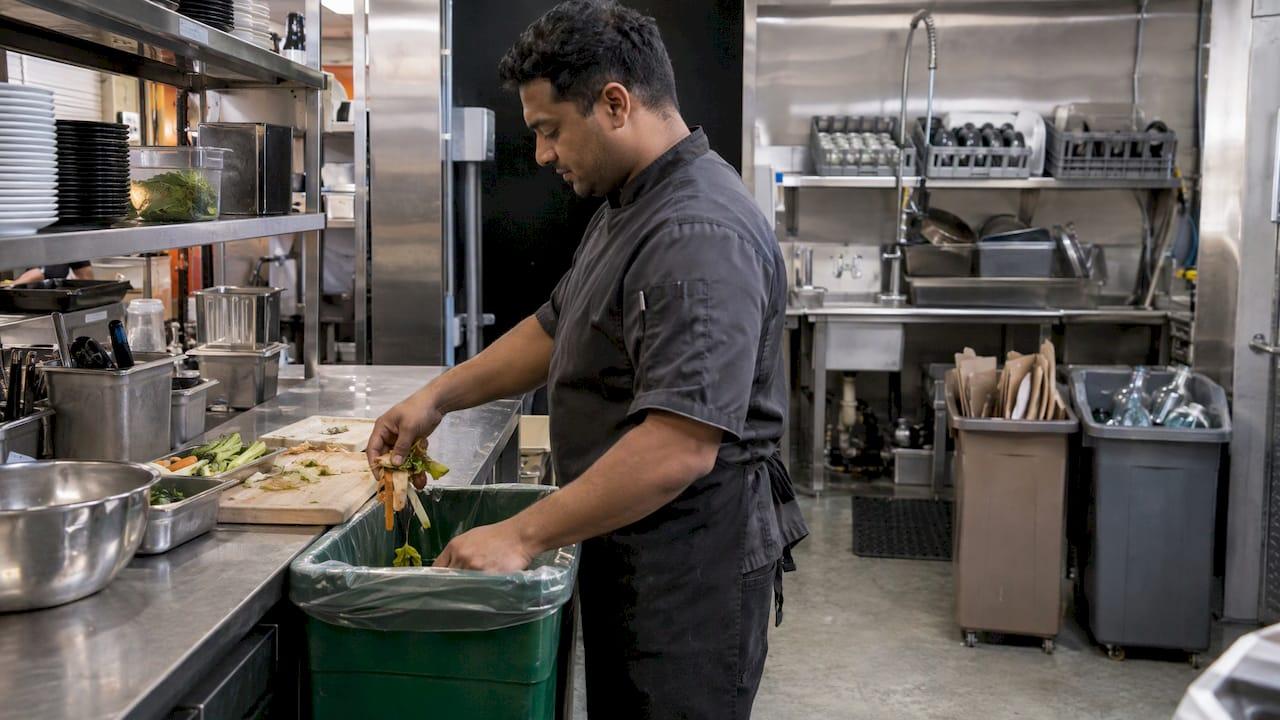
Waste segregation in a restaurant means sorting waste at the point it is created into separate streams: food scraps, recyclables, general waste and used cooking oil. Each stream gets its own labeled container and its own collection. Get the bins in the right spots, label them clearly and train every shift on what goes where. Then check whether your state or council now requires you to separate food waste. In NSW, some venues already must.
This guide covers the streams to separate, the rules that apply in Australia, how to set up and clean your bins, and how to keep sorting consistent when service gets busy.
TL;DR
- Most venues need at least three streams: food organics, recycling and general waste. Used oil needs its own pathway.
- In NSW, food businesses with large weekly general waste capacity must separate food waste from 1 July 2026. Smaller sites follow in 2028 and 2030.
- Put containers where waste is made, such as next to prep benches and the dishwasher, and label every one.
- Contamination comes from unclear streams, badly placed bins and mismatched collection schedules. Training and placement fix most of it.
- Measuring what goes in the bin shows you where food cost is leaking. That is where segregation pays for itself.
Table of Contents
- What waste segregation means in a commercial kitchen
- The waste streams to separate
- Do the rules apply to your venue?
- Setting up bins that staff will actually use
- Storing and cleaning waste safely
- Used cooking oil and grease
- Keeping sorting consistent during service
- Our perspective: segregate, then measure
- Put your waste data to work with PantryHub
- Turning segregation into savings
- A simple rollout plan
- FAQ
- Sources
What waste segregation means in a commercial kitchen
Segregation is simply keeping waste types apart at the source, instead of tipping everything into one bin and sorting it never. In a kitchen that means the prep cook who trims vegetables has a food scraps container within arm's reach. It also means the dish pit has a place for cardboard and glass, and fryer oil goes into a dedicated container rather than down the sink.
It matters for three reasons. Food scraps mixed into general waste go to landfill. Clean recycling contaminated by food loses its value. And a growing number of Australian jurisdictions are writing separation into regulation. The Maribyrnong (Vic) food premises kit, for example, describes commercial waste as general waste, recyclables, organic waste and waste oil, all of which must be able to be held on site before collection.
The waste streams to separate
As a baseline, a commercial kitchen needs three core streams: food organics, general waste and recycling. Some sites also separate garden organics or set up a food donation pathway.
| Stream | What goes in | Where it is made |
|---|---|---|
| Food organics | Food scraps, meat, bones, fish, dairy, bread, leftovers | Prep benches, dish pit, plate scrapings |
| Recycling | Cardboard, glass, cans, rigid plastics, clean paper | Receiving area, bar, dry store |
| General waste | Soiled wrappers, non-recyclable packaging, anything that fits nowhere else | Throughout |
| Used cooking oil | Fryer and cooking oil | Fry station |
What counts as food organics is narrower than many staff assume. In NSW, the EPA states that only food, compostable liner bags that meet Australian Standards for commercial composting, and fibre-based liners such as newspaper are allowed in food waste bins. Everything else goes to mixed recycling or general waste. That means no ordinary plastic bags, no cutlery, no napkins with sauce and no takeaway containers in the food bin.
Do the rules apply to your venue?
Rules differ by state and often by council, so start with your own council and waste contractor. NSW is the clearest example right now.
NSW food waste separation
Under the NSW rules, businesses that sell or handle food must separate food waste from general waste once they hit a size threshold. The EPA's business food waste page sets the phases by weekly general waste capacity:
- From 1 July 2026: 3,960 L or more per week (for example 16 x 240 L bins or 6 x 660 L bins).
- From 1 July 2028: 1,980 L or more (for example 8 x 240 L bins or 3 x 660 L bins).
- From 1 July 2030: 720 L or more (for example 3 x 240 L bins or one 660 L bin).
The first phase is already in force. The City of Sydney says businesses are likely to be in the first phase if they fill about one 660 L bin a day or have multiple bins collected several times a week. A single café may sit under today's threshold but inside the 2030 one, so plan ahead rather than scramble.
The EPA also runs support programs for businesses, including Bin Trim for on-site equipment. Funding amounts and open rounds change, so confirm what is currently on offer from the EPA before you budget.

Victoria, Queensland, WA and the rest
Outside NSW, expect council-level requirements rather than one statewide rule. A few examples of what councils already set:
- Maribyrnong (Vic): commercial properties get one 240 L general waste bin and one 240 L recycling bin, collected weekly. Extra bins are available for an annual fee, but extra weekly pickups cannot be purchased.
- Toowoomba (Qld): the standard service is a 240 L general bin weekly and a 240 L recycling bin fortnightly. For commercial kitchens, extra storage for waste cooking oil and more frequent service may be needed to limit odor complaints in summer.
- Stirling (WA): food businesses must apply for a trade waste permit before discharging waste to the wastewater system, and the notification form must cover bin storage enclosures and wash-down facilities.
If you are opening a new venue, ask your council for its food premises guidelines early. Bin storage space is far cheaper to plan on paper than to retrofit.
Setting up bins that staff will actually use
Sorting fails when it takes effort. The NSW EPA recommends putting bins and buckets near kitchen benches or dishwashers, close to where food waste is generated. It also suggests containers small enough to lift, with frequent transfers so they never overfill. Wheelie bins suit venues with the space.
A workable layout looks like this:
- Prep stations: a food scraps container at every bench, and a general waste bin beside it, so nobody walks across the kitchen.
- Dish pit: a scraping station feeding the food bin, plus a recycling bin for glass and cans from the bar.
- Receiving area: a cardboard collection point, ideally with flattening space.
- Fry station: a labeled used oil container, kept apart from food scraps.
- Front of house: clearly marked bins with colored lids and openings shaped for the stream. Signage, colored lids and intuitive openings guide customers to sort correctly. Back-of-house containers need to be durable and high capacity for rough daily handling.
Use the same colors and wording everywhere. If the food bin is green in the kitchen, it should not be a different color at the bar.
Labeling and storage rules
Some councils set labeling rules. The City of Sydney requires businesses to label bins with the business name and address and the waste contractor's name, store them inside the premises, keep lids fully closed and bring bins back in straight after collection. Waste left outside a bin is treated as illegal dumping.
Storing and cleaning waste safely
Segregation only works if the storage is hygienic. Council guidance gives a clear picture of what inspectors expect:
- Containers should be durable, rigid, leak-proof, easy to clean and fitted with close-fitting lids to keep pests out. Plastic bags are for lining bins or bagging waste before it goes into rigid containers.
- Under the Kiama guideline, bins and bin areas are washed regularly with hot water and detergent, and wash water must not run into street stormwater. It goes to a mop sink or sewer drain.
- The same guideline says external bin areas need a hot and cold hose tap, an impervious paved surface graded to sewer, and protection from stormwater contamination.
Build bin washing into your closing checklist, not an occasional job. A food bin that sits half full for days in a Queensland summer is a pest and odor problem.
Used cooking oil and grease
Oil is the stream most often forgotten. Cooking oil and grease should never go down the drain. In Sydney Water's area, venues that cook or serve hot food need a grease trap and a trade waste agreement, with traps sized between 1,000 and 5,000 litres. In WA, the Water Corporation says commercial kitchens produce much higher and less diluted fat, oil and grease loads than homes, so it generally requires pre-treatment at the source, usually a grease trap.

One more point for kitchen fit-outs: the Whitsunday Regional Council says in-sink food waste disposal units are not permitted in commercial settings because of the load they put on sewerage. Check your own council's position before installing one.
Keeping sorting consistent during service
The most common failure is not a lack of bins. According to one commercial bin supplier's FOGO guide, contamination comes down to unclear waste streams, poor bin placement in low-traffic spots and collection schedules that do not match volume. The fixes are straightforward:
- Make it part of onboarding. Walk every new starter through the streams on day one, with the bins in front of them.
- Use photo signs. A picture of a chicken bone on the food bin beats a paragraph of text.
- Nominate a closer. One person per shift checks bins and flags contamination.
- Match collections to volume. Talk to your waste provider about bin sizes and collection frequency. The City of Sydney suggests exactly this, along with using the EPA's Bin Trim tool to see what your business throws away.
- Arrange your own collections. In Sydney, businesses organize their own commercial waste contracts and must show the contract if asked. The council also recommends having the contractor collect from inside the storage area and return bins immediately.
If you want to see how a food waste pickup works end to end, this explainer on a food waste collection service walks through the typical flow from bin to processing.
Our perspective: segregate, then measure
We built PantryHub by the chef, for the chef, so we have stood at the pass while the bins fill up. Segregation is the right first step, and it is a good one. But sorting waste only tells you where it goes. It does not tell you why you are producing it.
The kitchens that get the most from a segregation system treat the food bin as data. If one prep station fills its scraps container twice as fast as the others, that is a prompt to look at trim yields, par levels or over-ordering. That is why we pair waste handling with real-time stock control, supplier ordering and waste and cost reporting in one platform.
Our approach is designed to turn what you throw out into a number you can act on. Set par levels, track what comes in, log what goes out, and compare actual usage against what the recipes say you should have used. Then the compliance work you are doing anyway starts to cut your food cost.
the author
Put your waste data to work with PantryHub
Segregation shows you what you throw away. PantryHub helps you work out why, and stop ordering it in the first place.
📦 Real-time stock tracking across one or multiple venues 🔔 AI-powered low-stock alerts so you order what you need 🛒 Supplier ordering with integration to Australian suppliers 📊 Waste and cost reporting built for GST-ready Australian operations
Plans are published at $39, $69 and $99 per month for Starter, Regular and Pro. You can start a free trial and bin the spreadsheets. If you run a café, pub, club or restaurant group, our hospitality inventory software and kitchen inventory app for iPhone and Android are built for the way your team already works.
Turning segregation into savings
Separating food waste is a compliance task for some venues and an opportunity for all of them. Once scraps are in their own container, you can see them. Weigh or count what lands in the bin for a couple of weeks and patterns appear: over-prepped items, trim waste, plates coming back full.
Our guides walk through each step. Start with a restaurant waste audit, then separate prep waste from plate waste. Set up daily waste tracking and a waste allowance policy with a named officer. Use that history to predict food waste and order more accurately. For a wider view, see our guide on how to reduce food waste in restaurants.
There is a broader case too. This operator guide to sustainability in food services covers the business and environmental reasons hospitality operators give for separating food waste. Food waste is also a large share of what businesses send to landfill: the City of Sydney says it makes up around a quarter of business waste sent to landfill in NSW.
A simple rollout plan
- Check your threshold. Add up your weekly general waste bin capacity and compare it with the NSW phases, or ask your council what applies in your state.
- Call your waste contractor. Confirm whether they offer food organics collection, which bin sizes suit you and how often they collect.
- Map your kitchen. Mark where waste is created and place containers there.
- Label and train. Same colors and wording across the venue, and a walk-through for every team member.
- Plan storage. Space for bins, a wash-down point, and a closing routine for cleaning.
- Measure. Track what goes in the food bin for two weeks, then adjust ordering and prep.
FAQ
Which waste streams should a restaurant separate?
At minimum, food organics, recycling and general waste. Used cooking oil needs its own container and a licensed pathway or grease trap arrangement. Some sites also separate garden organics or set up food donation. Your council and waste contractor will confirm what they accept.
Do I have to separate food waste in my café?
In NSW it depends on how much general waste you produce each week. The thresholds step down from 3,960 L in July 2026 to 1,980 L in 2028 and 720 L in 2030. Other states set requirements mostly through councils, so ask yours directly.
What can go in a food waste bin?
Food of all kinds, including meat, bones, fish, dairy and bread, plus compostable liners that meet Australian Standards for commercial composting and fibre-based liners such as newspaper. Ordinary plastic bags, packaging, cutlery and cups do not belong in it.
How do I stop staff putting waste in the wrong bin?
Place bins where the waste is created, label them with pictures, and use the same colors across the venue. Include sorting in onboarding and give one person per shift the job of checking bins. Review collection frequency with your provider so bins do not overflow.
Can I pour cooking oil down the drain?
No. Commercial kitchens generally need pre-treatment such as a grease trap and a trade waste arrangement with the local water authority. Collect used oil in a dedicated container. Contact your water utility, such as Sydney Water or Water Corporation, for the requirements in your area.
Sources
- Business food waste, NSW EPA
- NSW steps up food business recycling with new rules, NSW EPA
- Check when your business needs to follow food waste rules, City of Sydney
- Businesses and waste services, City of Sydney
- New Food Premises Information Kit, Maribyrnong City Council
- Technical guideline for waste storage and collection, Toowoomba Regional Council
- Health approvals for businesses, City of Stirling
- Waste Management, City of Ryde
- Food & Drink Premises Guideline, Kiama Council
- Plumbing for retail food businesses, Sydney Water
- Food outlets acceptance criteria, Water Corporation
- Trade Waste Environmental Management Plan, Whitsunday Regional Council
- FOGO Compliance in NSW: How Businesses Can Prepare Now
- Food Waste Collection Service
- Sustainability in Food Services: 2026 Operator Guide