

Australian hospitality payroll breaks in seven predictable places: award and classification errors, stacked penalty rates and loadings, time and attendance failures, onboarding and record-keeping gaps, payroll tax across multiple venues or states, superannuation and payday-super timing, and rostering inefficiencies that quietly bleed margin. Each of these shows up in almost every venue we talk to, from a single suburban café to a five-site group.
Here's the quick rundown:
- Award coverage and classification — the wrong award or role level poisons every pay calculation downstream
- Penalty stacking and loadings — casual loading, weekend penalties, and night allowances compounding on the same hours
- Time and attendance errors — rostered hours treated as actual hours, manual timesheet gaps, untracked swaps
- Onboarding and record-keeping — missing payslip fields, incomplete new-starter data, incorrect pay periods
- Payroll tax and multi-state allocation — thresholds and grouping rules that differ venue to venue
- Superannuation and payday-super timing — missed payment windows now flagged almost instantly by the ATO
- Rostering inefficiencies — overstaffing and unmanaged overtime that never show up as a "compliance" problem but still cost you
If you only fix one thing this week, fix classification. It's the challenge most likely to trigger a Fair Work investigation. If you only fix one thing to protect your margin, fix rostering. It rarely gets you in legal trouble, but it's the slowest, quietest way to lose money in hospitality.
Key Takeaways
Correct award classification, real-time attendance capture, and disciplined reconciliation together address the largest sources of Australian hospitality payroll risk.
| Point | Details |
|---|---|
| Classification comes first | Verify award and classification per role, not per venue, since this drives every downstream pay calculation. |
| Watch for penalty stacking | Casual loading, weekend penalties, and night allowances can legitimately combine on a single hour. |
| Capture actual hours | Payroll must reflect actual start and finish times, not rostered hours, to stay compliant. |
| Fix onboarding data at hire | Incomplete TFN, super, or ABN details create separate contraventions even when pay amounts are correct. |
| Allocate wages by state | Multi-venue operators must apply payroll tax thresholds and grouping rules per jurisdiction. |
| Reduce manual re-entry | Platforms like Pantryhub help connect staffing and operations data so payroll relies on fewer manual handoffs. |
Table of Contents
- Why Is Payroll Harder in Hospitality Than Other Industries?
- What Happens When Award Coverage or Classification Is Wrong?
- Why Do Penalty Rates and Loadings Get Miscalculated?
- Why Do Timekeeping and Rostering Cause Payroll Errors?
- What Onboarding and Record-Keeping Mistakes Create Compliance Risk?
- How Do Payroll Tax Rules Complicate Multi-Venue Operations?
- How Much Do Payroll Mistakes Actually Cost in Hospitality?
- What Controls Actually Prevent These Payroll Failures?
- Where Can You Verify These Rules Yourself?
- Sources
Why Is Payroll Harder in Hospitality Than Other Industries?
Payroll complexity in hospitality comes down to four operational realities: trading hours that stretch across evenings, weekends, and public holidays; a workforce that's mostly casual; shifts that split across multiple roles or time blocks; and rosters that change hours before they're worked. Retail and office-based businesses rarely stack all four at once. Hospitality does it every single week.
Each driver creates its own kind of payroll mess:
- Extended trading hours mean a single Friday night shift can cross into evening penalty rates, then tip into Saturday, then into a public holiday, all inside one pay cycle
- High casual headcount means loadings apply constantly rather than occasionally, and any error multiplies across dozens of workers instead of a handful
- Split shifts and multi-role work (someone who works front-of-house lunch service, then kitchen prep, then bar service that night) requires payroll to apply different rates to different blocks of the same shift
- Last-minute roster changes create a gap between what was scheduled and what was actually worked, and only the actual hours are legally payable
Those drivers show up as concrete, repeatable errors: a manager pays a casual a flat $28 an hour regardless of when they worked, a roster gets adjusted at 4pm for a 6pm shift and payroll never sees the update, or a timesheet gets filled in from memory two days later. None of these are exotic mistakes. They're the default failure mode when a venue relies on manual processes during a busy trading week.
Pro Tip: Triage your venues by roster complexity and casual turnover, not by revenue. A high-revenue venue with a stable, mostly full-time team is lower payroll risk than a smaller venue running a rotating casual roster across split shifts and weekends.
What Happens When Award Coverage or Classification Is Wrong?
Getting the award or classification wrong is the single most common trigger for downstream pay errors in hospitality, because every penalty rate, allowance, and loading calculation depends on that first decision. Get it wrong, and you're not making one mistake. You're making the same mistake on every shift, for every affected employee, for as long as the error goes uncorrected.
The Hospitality Industry (General) Award sets base rates, penalty rates, allowances, and classification levels for most cafés, restaurants, bars, and clubs. But it's not automatically the only award in play. A venue running a function center, retail-attached bottle shop, or accommodation component may have staff correctly covered by a different award entirely, and misclassification across those boundaries is a recognized driver of underpayment.
Run these three checks immediately:
- Confirm the correct award applies to each role, not just the venue as a whole. Kitchen staff, front-of-house staff, and management-level roles can sit under different classification structures even in the same building.
- Verify classification level against actual duties performed, not the job title on the roster. A "team leader" doing supervisory work belongs at a higher classification than a casual doing the same shift duties.
- Check whether junior, apprentice, or trainee rates apply correctly, since these carry their own percentage-based rate structures tied to age or training stage.
Here's how it plays out in practice: a bar classifies all casual bar staff at the base level when two of them are actually running the bar unsupervised on weekend nights, a duty that sits at a higher classification. Multiply that rate gap across 18 months of weekend shifts for two employees, and you're looking at a back-pay calculation that dwarfs what a correct classification would have cost from day one.
Why Do Penalty Rates and Loadings Get Miscalculated?
Penalty stacking is where hospitality payroll goes wrong more than anywhere else, because a single hour worked can legitimately attract casual loading, a weekend penalty, and a late-night allowance all at once. Spreadsheets and manual pay runs routinely apply one or two of these layers and miss the third.
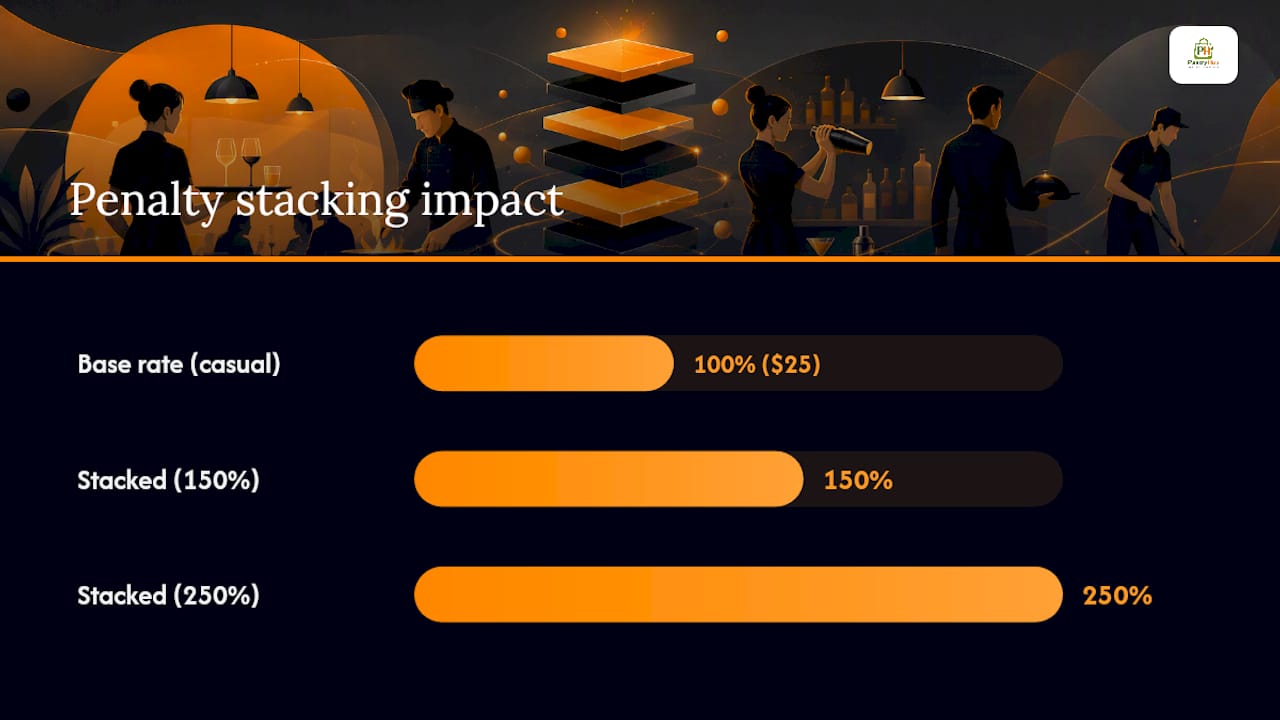
Here's what that looks like in dollars. A casual employee's base rate might sit around $25 an hour. Add casual loading, then a Saturday penalty rate, then a late-night allowance for hours worked after 10pm, and that same hour can legitimately cost 150% to 250% of the base rate once every applicable loading is stacked correctly. Pay that hour at a flat casual rate instead, and you've underpaid it, sometimes significantly.
The recurring calculation mistakes we see:
- Flat dollar amounts applied where a percentage-based loading is required, especially for public holiday and weekend rates that scale with the base rate rather than sitting at a fixed dollar figure
- Late-night allowances left off entirely because rostering software shows shift start time but not the specific hours that cross into the allowance window
- Split-shift allowances missed when an employee works two separate blocks in one day, since many payroll setups only recognize a single continuous shift
- Overtime miscalculated for casuals who don't accrue overtime the same way permanent staff do under the award
Pro Tip: Before finalizing any pay run, pull a sample of five weekend or public-holiday shifts and manually trace every loading that should apply. If your payroll software's output doesn't match your manual trace, you've found a stacking error worth investigating across the whole pay period, not just those five shifts.
Why Do Timekeeping and Rostering Cause Payroll Errors?
Payroll must be based on actual hours worked, not rostered hours, and the gap between the two is the single biggest operational source of error in hospitality payroll. A roster tells you what was planned. Fair Work requires payment for what actually happened, down to genuine start and finish times.
The common failure points:
- Roster-to-actual mismatches, where a shift scheduled for 5pm to 11pm actually ran 4:45pm to 11:30pm and nobody updated the record
- Manual re-entry errors, where hours get typed from a paper timesheet or a text message into a payroll system, introducing transcription mistakes
- Untracked shift swaps, where two casuals trade shifts informally and payroll pays the person on the original roster rather than the person who actually worked
- Missed or unrecorded breaks, which can trigger missed-break penalties under the award if not properly logged
Attendance-to-payroll integrations close most of this gap because they capture clock-in and clock-out data directly and push it into payroll without a manual step in between. Operators who integrate attendance capture directly into payroll see fewer last-minute pay-run corrections, largely because manual re-entry between separate systems is where most errors originate.
Pro Tip: Before you approve a pay run, spot-check ten shifts by comparing the roster, the time-and-attendance record, and the final payslip side by side. If all three tell a different story for even one shift, you likely have a systemic gap worth investigating further.
What Onboarding and Record-Keeping Mistakes Create Compliance Risk?
Incomplete or incorrect onboarding data creates its own, separate contraventions, independent of whether the actual pay calculation is correct. A wrong ABN, a missing payslip field, or an incorrect pay period reference can be a violation on its own, even if the employee was paid the right amount.
Capture these at the point of hire, every time:
- Full legal name, date of birth, and residency status, since age and visa conditions affect junior rates and work-rights checks
- Tax file number declaration, completed correctly before the first pay run, not retrofitted afterward
- Superannuation fund details, including checking for a stapled fund before defaulting to your default fund
- Bank account details verified against the employee's own name, not a shared account
- Signed employment terms confirming award coverage and classification level, matching what you determined in your classification review
On the superannuation side, Payday Super now requires super to be paid at each payday rather than quarterly, and reported through Single Touch Payroll. Missing that payment window can trigger the Superannuation Guarantee Charge. Common pitfalls include failing to check for a stapled super fund, capturing an incorrect TFN that delays processing, and underestimating how tightly payday super timing now needs to run alongside your actual pay cycle.
Fair Work's record-keeping requirements require you to retain actual start and finish times, pay rates, leave balances, and super contributions for seven years. Failing to maintain those records is a contravention in its own right, separate from any underpayment finding.
Pro Tip: Build a single onboarding checklist that new hires and their manager both sign off on before the first shift is rostered. It's a five-minute conversation that prevents weeks of retrospective data cleanup.
How Do Payroll Tax Rules Complicate Multi-Venue Operations?
Payroll tax is one of the most consistently underestimated costs for operators running venues across more than one jurisdiction, because thresholds, rates, and grouping rules differ by state and don't line up neatly with how hospitality groups actually structure their operations. What clears the threshold easily in one state can trigger a liability in another once wages from related entities are grouped together.
The practical actions that keep this manageable:
- File separate returns per jurisdiction where your venues cross state lines, rather than assuming one return covers the group
- Allocate wages accurately to the state where the work is actually performed, especially for staff who move between venues
- Check grouping rules carefully, since related businesses can be grouped for payroll tax purposes even when they trade under different names, which changes which threshold applies
Pro Tip: Keep wage records separated by venue and state from day one, even if you currently sit under every threshold. Retrofitting that allocation after you've grown to three or four venues is a far bigger job than building it in from the start.
How Much Do Payroll Mistakes Actually Cost in Hospitality?
Civil penalties for Fair Work contraventions can reach up to $93,900 per contravention as of 2026, and the Fair Work Ombudsman can pursue underpayment claims going back several years. That look-back period is what turns a small, ongoing error into a large remediation bill. A modest weekly underpayment across a rotating casual team, left uncorrected for a few years, compounds fast once you're calculating back-pay across every affected shift and employee.
Enforcement patterns worth knowing about:
- Industry-wide sweeps targeting hospitality specifically, since the sector's award complexity makes it a recurring focus area for regulators
- A small-business safe harbour for genuine, promptly corrected errors, which rewards operators who self-audit and fix issues quickly
- Criminal penalties now apply to intentional wage theft, a sharper line than honest miscalculation, which generally remains a civil matter
Picture a mid-sized venue underpaying ten casual staff by roughly $30 a week each through a stacking error that goes unnoticed for two years. That's a modest weekly gap that turns into a five-figure remediation bill once back-pay, superannuation shortfalls, and interest are calculated across every affected employee.
What Controls Actually Prevent These Payroll Failures?
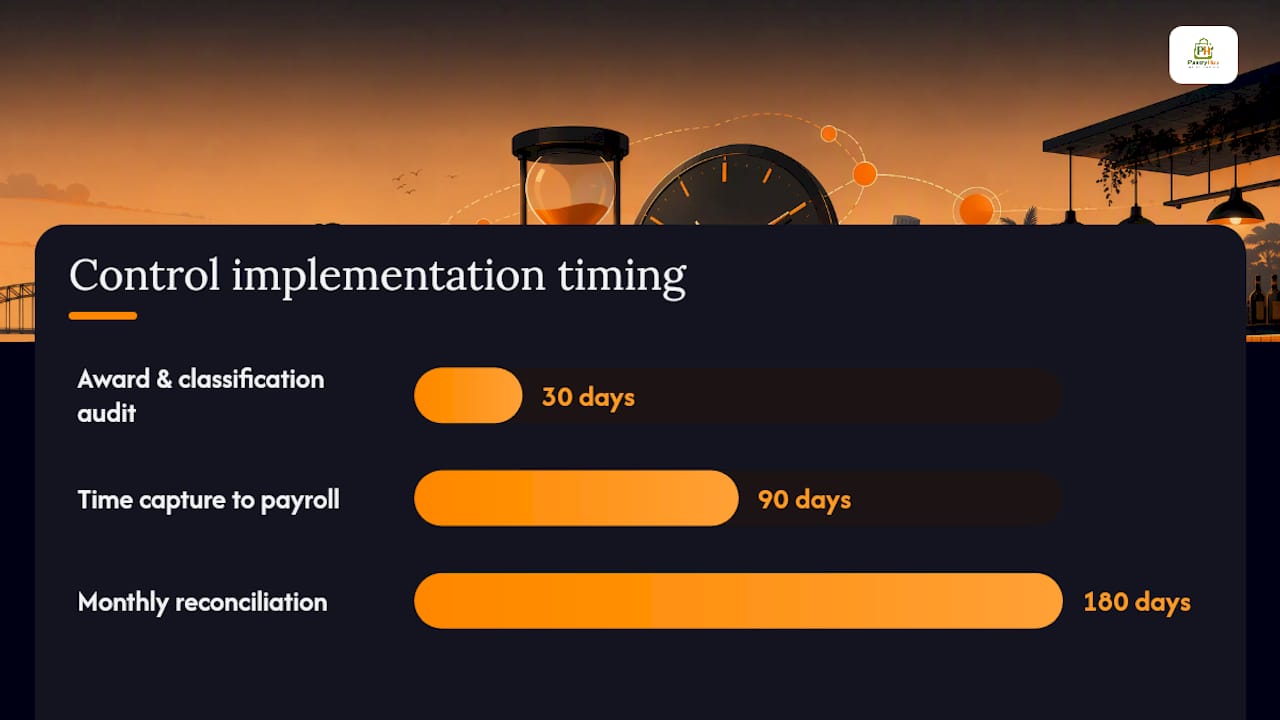
Three controls do most of the work: a periodic award and classification audit, direct integration between time capture and payroll, and a structured reconciliation step before every pay run is finalized. Everything else in a hospitality payroll system supports these three.
A realistic rollout looks like this:
- In the next 30 days, audit award coverage and classification for every role, and correct any obvious mismatches before they compound further.
- In the next 90 days, connect your time-and-attendance capture directly to payroll so actual hours flow through without manual re-entry.
- In the next 180 days, build a monthly reconciliation routine that checks payroll tax allocation, superannuation timing, and record completeness against Fair Work requirements.
Ongoing controls worth locking into your process:
- Monthly spot-audits comparing rostered hours, actual hours, and paid hours
- Automated validation that Single Touch Payroll reporting matches actual pay run data
- Quarterly payroll tax allocation checks if you operate across more than one state
If you're evaluating automation to support this, prioritize systems that integrate time capture with payroll directly, handle multi-role and split-shift rate changes automatically, and produce an auditable correction trail. That last point matters more than it sounds: keeping audit-grade records with a clear correction history is what separates an honest, quickly-fixed mistake from one that draws harder regulatory scrutiny.
What Do Operators Actually Fix First?
The most common owner mistake is treating classification review as a one-time task instead of a recurring one, and putting off automation until an error forces the issue. In practice, operators who tackle this seriously fix classification, connect time capture to payroll, and build a reconciliation habit first. Those three moves cut error rates fast, usually within the first pay cycle after implementation.
A Practical Next Step: Fixing Payroll Friction at the Source
Most of the payroll errors covered above trace back to the same root cause: data that has to be re-entered manually between your roster, your time clock, and your payroll system. Every manual handoff is a chance for a shift to get logged wrong or a rate to get missed. Integrated operations software closes that gap by keeping shift and role data connected across your systems, so payroll works from accurate, real-time information instead of a rostered guess.
If your venue is juggling multi-role shifts, split rosters, or more than one location, it's worth evaluating whether a connected platform would reduce that manual load before your next classification audit or busy season. Pantryhub was built for exactly this kind of hospitality operation, giving owners and managers real-time visibility across stock, staff access, and multi-location operations from one place. Take a look at Pantryhub's hospitality platform to see whether it fits how your venue actually runs.
Where Can You Verify These Rules Yourself?
- Fair Work's Hospitality Award summary for current rates and classifications
- ATO guidance on Payday Super for timing requirements
- State payroll tax threshold pages for grouping rules
Talk to a payroll specialist or employment lawyer once an issue involves back-pay calculations or multi-state grouping. These guides are the right starting point, not the final word.
This article is general information, not a substitute for advice from a qualified financial advisor. Consult a qualified financial professional about your own circumstances before acting on anything here.