

A price rise letter from a supplier lands, and most operators do one of two things: accept it because the order is due tomorrow, or ring around in a panic. There is a better route. Check the rise against your own invoices, read what your terms allow, negotiate with evidence, then re-cost every affected dish so you know what it does to margin. Doing that quickly depends on having your prices, recipes and orders in one place, which is what PantryHub is built for: stock levels, supplier ordering and cost reporting for Australian restaurants, cafés, pubs and clubs.
TL;DR
- Check the rise before you accept it: compare unit prices from an older invoice with a recent one, and rule out pack-size and usage changes.
- Read your supplier's trading terms. Many distributors reserve the right to lift prices on short notice, so know the notice period and your right to walk away.
- Ask for the increase in writing, a price hold while you re-cost, and an offset such as a better price on another line.
- Re-cost dish by dish. Absorb small rises on dishes well under your target food cost, and reprice the ones already near the limit.
- Speed is the real advantage: the sooner a price change reaches your recipe costs, the less margin leaks away.
Table of Contents
- Why suppliers keep raising prices
- Is a 10% increase too much?
- What your supplier's terms actually allow
- How to negotiate a supplier price increase
- Work out what the rise does to your margin
- Catch the next increase before it reaches your margin
- Our view: speed beats size
- Put your supplier prices in one place
- FAQ
- Sources
Why suppliers keep raising prices
Understanding the cause tells you how hard to push back. Some rises are real pass-through of costs the supplier cannot control. Others are padding.
The Australian Bureau of Statistics found that among businesses planning price increases, 92% cited the cost of products or services and 78% cited fuel and energy, with other overheads and staff costs further down the list. That is the supplier's own cost chain, and it is why a rise often arrives as a flat percentage across a whole catalogue.
The wider numbers are also moving. KPMG's September 2026 Retail Health Index reports that final-demand producer prices rose 3.6% over the year to the June quarter 2026, largely reflecting earlier energy cost increases, and that prices for cafés, restaurants and takeaway food services rose 4.0% over the same year. Producer price data is published quarterly, so treat any figure as a snapshot of its period, not a live reading.

Category matters more than the headline. Restaurant Business, reporting industry purchasing data for FY25, put foodservice inflation at 7.77%, up from 2.79% the year before. The spread was wide: alcohol up 44% because of CPI-indexed excise, baked goods up 12.2%, dairy and eggs up 8.1%, fruit and veg up 4.9%, seafood up 3.0%, meat and poultry up 2.6% and pantry lines up 0.7%. Olive oil jumped 35.2% to an average of $15 a litre on the back of drought in Spain.
Two practical lessons follow:
- A supplier quoting a blanket 7% or 10% is averaging categories that moved very differently. Your job is to find which lines actually justify a rise.
- Forward warnings are not confirmed rises. Small Business Network reported on 12 November 2026 that a national distributor was warning of possible 7% price rises, citing fuel, energy, labour, borrowing and compliance costs. That figure is an estimate, so use it to prepare, not to concede.
Is a 10% increase too much?
There is no universal answer. Ten percent on olive oil in a year when the category rose by a third may be fair. Ten percent on pantry staples, which rose under 1% on average in FY25, deserves questions. Whether it is justified depends on the line, the period and what else changed.
Such rises are not automatically unlawful either. The ACCC explains that high or suddenly increased prices are not necessarily illegal, so the leverage is commercial, not legal: your volume, your payment record and your willingness to move.
Test the claim against your own invoices
Take an invoice from about a year ago and a recent one for the same supplier. Then:
- Compare unit prices (per kilo, litre or carton), not line totals, and compare them before GST so the tax does not blur the picture.
- Rule out changes in how much you ordered, pack sizes and brands. A "price rise" that is really a smaller carton is a different conversation.
- Separate market-driven lines, such as fresh produce and seafood, from stable ones like dry goods and cleaning products.
- List only the lines that rose, with old price, new price and dates.
That list is your negotiating document. A supplier can wave away "your prices are too high". It is much harder to wave away "these 14 lines rose between March and October, and here are the old and new prices".
For lines that track a commodity, verify against independent market data where it exists. Commodity analysts advise checking independent price indices before accepting a distributor's unexplained rise, so the claimed increase can be matched to what the market actually did.
If you are not sure how your own numbers stack up, our free food cost calculator gives you a dish-level baseline in Australian dollars.
What your supplier's terms actually allow
Before you argue about the price, read the paper. Most suppliers' trading terms already say when they can change prices, and the wording differs more than operators expect.
- Reward Hospitality's trading terms say it may increase prices before issuing an invoice to cover rises in energy, materials, labour, equipment or delivery beyond its reasonable control, to cover customer-requested order changes, or to correct pricing errors.
- GWF's April 2025 Australian terms allow price amendments on at least 7 days' notice before delivery for specified costs outside its control, including tax or levy changes and exchange-rate movements. A customer who rejects an amendment may cease future orders.
- A different model again: Restaurant Equipment Online binds its quotes for 30 days unless stated otherwise, but allows reasonable rises for supply-cost changes between order and delivery, with notice as soon as reasonably practicable and a right to cancel without penalty.
These are examples, not a rule for every supplier, but they show what to look for in yours:
- Notice period. How many days before a rise takes effect?
- Quote validity. How long is a quoted price held?
- Your exit. Can you cancel or stop ordering without penalty if you reject the change?
- What counts as a trigger. Fuel, currency, tax and "costs beyond our control" are common. Ask which ones the supplier is actually relying on.
- Price basis. Fixed, cost-plus or tied to a published index. Each handles increases differently.
If your terms are silent or vague, that is a reason to ask for clarity in writing, not a reason to assume you are stuck.
How to negotiate a supplier price increase
Pantry staples and dry goods are where negotiation works best, because the supplier has room. Here is the routine, step by step, with where it tends to go wrong.

Step 1: Do not accept on the phone
Ask for the increase in writing, with the lines affected, the new prices and the start date. Reps who say "it's across the board" often adjust once asked to put specific lines in an email. The common mistake is agreeing verbally on delivery day, which leaves you with no record of what you agreed to.
Step 2: Know your spend
Your leverage is volume. Pull 90 days of invoices and work out the total monthly spend per supplier and your real cost per kilo, litre or case. Suppliers respond to numbers like "I spend $X a month with you" far more than to general complaints. This is the step that eats the most time when invoices live in email folders and spreadsheets.
Step 3: Make a specific ask
Vague requests get vague answers. Better asks include:
- A price hold of 30 to 60 days while you re-cost your menu.
- A price lock on volatile items such as oil, coffee or produce staples for an agreed period.
- An offset: a lower price on another line, lower minimum order values or reduced delivery fees.
- A volume or early-payment discount in return for consolidating more of your orders with them.
Paying on time and warning the supplier about big orders, such as a function or event, gives you more to trade.
Step 4: Get a comparison quote
The same product can be priced quite differently between wholesalers. A second quote on your top 15 lines by spend is often enough to move the first supplier, or to show you that the rise is in line with the market. Pitcher Partners' 2025 report found that 35% of Australian businesses in 2024 renegotiated or changed suppliers rather than simply absorbing or passing on increases, so you would be in good company.
Even large buyers need time for this. In its FY26 report to its Code Mediator, Woolworths recorded 2,395 supplier price-increase notifications, 867 of which needed further negotiation, and 637 of those took longer than 30 days to conclude. Your own negotiation will not be that formal, but the lesson holds: a rise is an opening position, and settling takes weeks. That is why the price hold in step 3 matters.
Step 5: Put the outcome in your costs the same day
Whatever you agree, update the price in your recipes immediately. This is where PantryHub fits: it has recipe and pricing standardisation, waste and cost reporting, and integration with Australian suppliers, so the new price flows into the cost of every dish that uses the ingredient, rather than waiting for a month-end review.
Work out what the rise does to your margin
The decision to absorb or pass on a rise should be made dish by dish, not across the menu. The Restaurant & Caterers Association's 2025 benchmarking report shows food costs averaging 38% of turnover and beverage costs 26%, with wages, super and salaries at 40.25% in 2024-25. With labor that heavy, there is little slack in the remaining lines. The same report found over 80% of operators expect to raise menu prices in the next year.
A worked example
This is an illustrative dish, not a client figure. A pub sells a chicken schnitzel meal for $24. Ingredients cost $7.20, which is a 30% food cost. The chicken portion costs $3.00, and the supplier lifts chicken by 10%.
- Chicken cost rises by $0.30 per plate.
- Ingredient cost becomes $7.50.
- Food cost becomes 31.25% of the $24 price.
If your target is 32%, you can absorb that. But a dish already running at 33% sits at about 34.3% after the same rise, and that one needs a reprice, a smaller portion or a cheaper accompaniment. Same supplier increase, opposite decisions.
Multiply small amounts by volume and they stop being small. Across 200 plates a week, that 30 cents is $60 a week, or $3,120 a year, from one dish.
Absorb, pass on or both
Pitcher Partners cautions against passing on every rise or absorbing every rise without first looking for efficiency gains. Their analysis found that hospitality businesses needed to lift a draught beer by 30 cents to preserve a comparable gross margin after CPI and brewery cost rises. Practical ways to split the difference:
- Protect gross profit dollars on high-volume items such as coffee or schooners with small price moves.
- Hold the margin percentage on food, where a 50 cent adjustment on a main is easier for guests to accept.
- Swap a rising ingredient for a stable one on the plate, or rebalance the menu toward lines where inflation is low.
- Review prices on a regular schedule so you avoid one jarring jump after years of small absorbed rises.
How guests react to price moves is its own question. This analysis of raising menu prices and customer retention looks at what menu price increases do to repeat visits at a large chain, and is useful context when you decide how big a step to take.
For the arithmetic behind these decisions, see our guide to food cost percentage for restaurants in Australia and our restaurant cost control strategies.
Catch the next increase before it reaches your margin
You usually cannot stop a supplier raising prices. What you can control is how long it takes you to notice. Price creep tends to hide in four places:
- Staples used across many dishes, where a few cents per kilo touches half the menu.
- Consumables such as packaging, gloves and cleaning products, which rarely get checked.
- Substitutions, where an out-of-stock item is replaced with a dearer equivalent.
- Freight and small-order surcharges, including fuel levies that move with the diesel price.
A routine that works for a single café or a group:
- Compare each delivery's invoice with the last price you paid, line by line.
- Re-cost recipes the day a key ingredient moves, not at month-end.
- Run a full menu cost review every quarter.
- Keep a short list of backup suppliers for your top 15 lines.
Doing this by hand across several suppliers and venues is where it falls over. PantryHub tracks stock in real time, sends AI-powered low-stock alerts, handles supplier ordering and offers multi-location inventory management with team access controls, so one set of prices and recipes serves every venue. Our guide to price change alerts for restaurants and cafés covers the practical side, and the 2026 hospitality inventory benchmarks give you figures to measure against.
Our view: speed beats size
Most operators we talk to about supplier increases focus on the size of the rise. We think the gap between the increase landing and the menu reflecting it matters more.
A 6% rise noticed on delivery day and re-costed the same afternoon costs you one service. A 3% rise nobody spots for two months costs you eight weeks of margin, and it never shows up as a single line you can point to.
PantryHub was built by a chef for chefs, and it is designed around that gap: stock, recipes, supplier ordering and cost reporting in one platform, with Australian pricing, GST-ready reporting and local support. When your ordering and your costing sit together, a price change stops being a surprise and becomes a number you act on.
Bin the spreadsheets, check the invoice, re-cost the dish, then have the conversation with your supplier.
the author
Put your supplier prices in one place
PantryHub is a hospitality inventory and ordering platform for restaurants, cafés, bars, pubs, clubs and commercial kitchens, with plans for a single venue up to multi-location groups. Plans are published at $39 per month for Starter, $69 per month for Regular and $99 per month for Pro, and you can begin with a free trial.
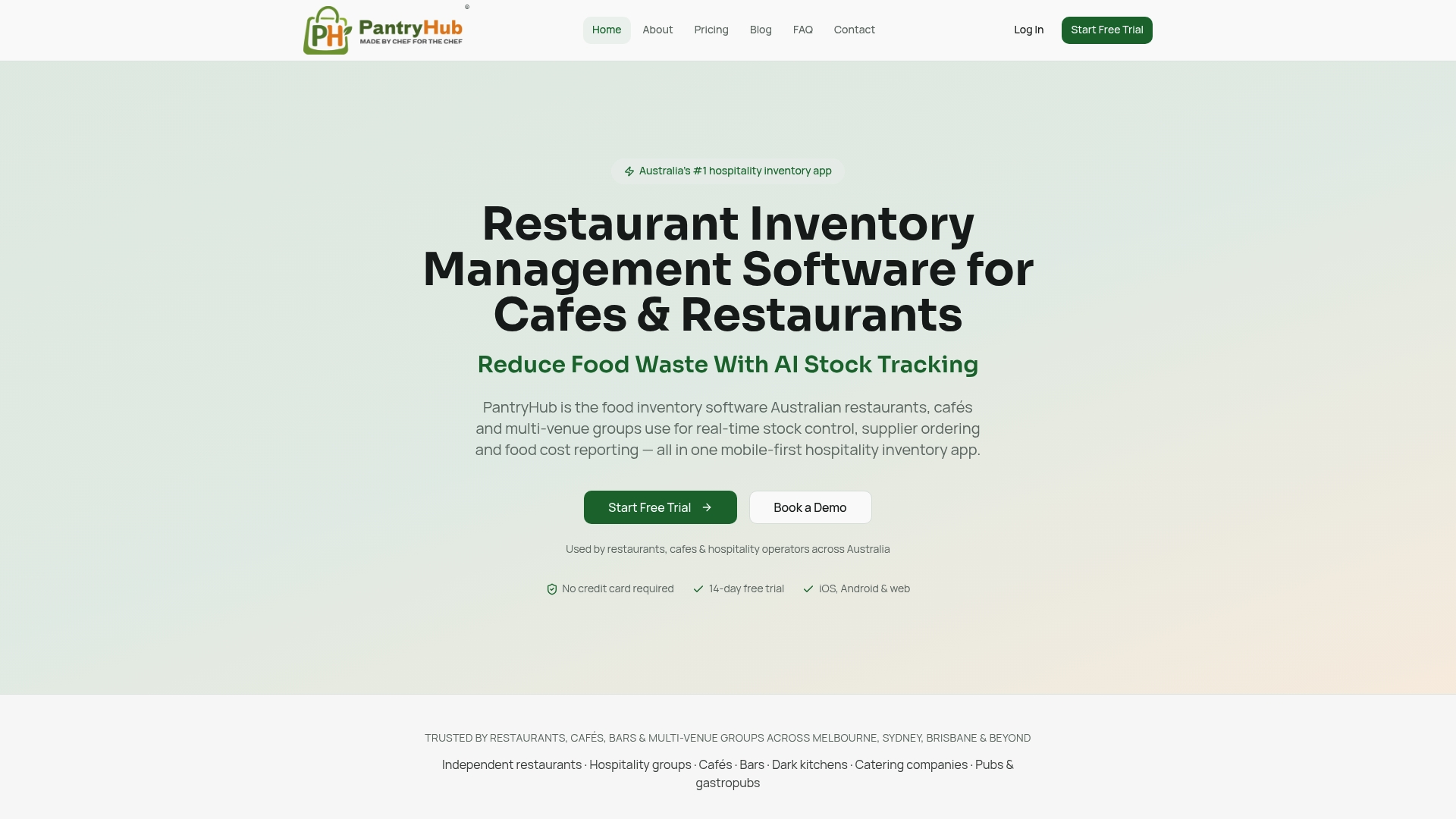
If the next price letter is already on your desk, start your free trial and load your top suppliers first. You can also see how it works for venues like yours on our hospitality inventory software page.
FAQ
Is a 10% price increase too much?
It depends on the product and the period. Compare unit prices against an older invoice, and check what the category did in the market. A 10% rise on a volatile line like oil or produce may be defensible, but on stable dry goods it deserves a written explanation and a comparison quote.
Can my supplier raise prices whenever it likes?
Only as far as your trading terms and any agreement allow. Some Australian distributors' terms permit increases with short notice, such as 7 days before delivery, for costs outside their control, and may let you stop ordering if you reject the change. Read your supplier's terms and ask for the notice period in writing.
Should I absorb a supplier increase or raise menu prices?
Decide dish by dish. If a dish sits comfortably under your target food cost, you can often absorb a small rise. If it is already near or above target, reprice, change the portion or swap an ingredient. Review all prices at least yearly so changes stay small.
How do I spot price creep early?
Compare each invoice with the last one by unit price, check substituted items and surcharges, and re-cost recipes when a key ingredient changes. Software that holds your supplier prices and recipes together, like PantryHub, makes this a routine instead of an end-of-month surprise.
Sources
- Cost pressures continue to impact businesses (ABS)
- Retail Health Index September 2026 (KPMG)
- Foodservice inflation nears 8%, as alcohol costs surge 44% (Restaurant Business)
- Food Distributors Warn of Possible 7% Price Rises (Small Business Network)
- Stabilize restaurant costs: 2026 supplier negotiation guide (Fastmarkets)
- Terms and Conditions (Reward Hospitality)
- Terms of Supply, April 2025 (GWF)
- Terms and Conditions (Restaurant Equipment Online)
- Why it pays to consider the bigger picture on pricing increases (Pitcher Partners)
- Woolworths 2026 Code Mediator Report
- 2025 Industry Benchmarking Report (Restaurant & Caterers Association)
- Does raising menu prices hurt customer retention?