

Plate cost = Σ(ingredient quantity × unit cost after yield) × (1 + waste%) + labor per plate + overhead per plate. Labor and overhead are optional add-ons; the ingredient math and waste allowance are the non-negotiable core.
Here's that formula working on a real dish. A grilled chicken plate uses $2.10 of chicken (after trimming for yield), $0.40 of rice, and $0.55 of vegetables, for an ingredient subtotal of $3.05. Skip labor for now and sell that plate at $14.
-
Core to every calculation: ingredient quantities, unit costs, yield percentage, waste factor
-
Optional but useful: labor per cover, overhead allocation, contribution margin analysis
Key Takeaways
Plate cost accuracy depends on yield-adjusted unit costs, a realistic waste allowance, and regular reconciliation against actual purchase data, not a one-time spreadsheet calculation.
| Point | Details |
|---|---|
| Use the core formula | Sum yield-adjusted ingredient costs, apply a 5 to 10% Q-factor, then add labor and overhead if needed. |
| Recost one dish weekly | Pick your highest-volume item and verify its recipe card against a weighed sample portion. |
| Measure yield, don't guess it | Run a trim test on any cut or product you haven't costed before recording a yield percentage. |
| Compare dollars, not just percentages | A higher food-cost dish can still deliver stronger contribution margin than a "cleaner" percentage. |
| Automate price updates with Pantryhub | Pantryhub links recipes to live supplier pricing and stock counts to catch drift before it hits your margins. |
Table of Contents
- How Do You Cost Every Ingredient on a Plate?
- Why Does Yield Change Your Real Ingredient Cost?
- What's the Formula for Portion Cost and Q-Factor?
- How Do You Add Labor and Overhead to Plate Cost?
- How Do You Turn Plate Cost Into a Menu Price?
- How Do You Catch Plate Costing Errors Before They Hurt Margins?
- How Does Software Keep Plate Costs Accurate Automatically?
- Sources
How Do You Cost Every Ingredient on a Plate?
Every plate cost calculation starts with one small piece of math: unit cost = purchase price ÷ pack size. A 5kg bag of rice at $9.50 gives you a unit cost of $1.90 per kilogram, or $0.0019 per gram. That sounds trivial until you're costing 40 dishes and every gram counts toward your bottom line.
The trap most kitchens fall into is unit mismatch. You buy oil by the liter but the recipe calls for milliliters. You buy flour by the kilogram but weigh portions in grams. Get this wrong and your plate cost calculation for plates across the whole menu drifts silently out of alignment.
Here's the conversion cheat sheet worth pinning above the pass:
- Weight: 1kg = 1,000g; 1 pound = 453.6g; 1 ounce = 28.35g
- Volume: 1L = 1,000mL; 1 US gallon = 3.785L; 1 cup = 237mL
- Mixed units: Convert everything to the recipe's base unit before multiplying by unit cost, never after
Worked example: you buy olive oil in 4L jugs for $38. Unit cost per mL is $38 ÷ 4,000mL = $0.0095/mL. A recipe using 15mL of oil costs $0.14 for that ingredient alone. Multiply that across 200 covers a week and it adds up to real money, which is exactly why unit-cost precision matters more than most line cooks assume.
Update these unit costs weekly, or immediately when a supplier invoice shows a price change. Record the invoice date next to each cost entry. Six months from now, when your food cost percentage climbs and you can't figure out why, that dated record is what lets you trace the drift back to a specific delivery instead of guessing.

Why Does Yield Change Your Real Ingredient Cost?
Yield is the usable portion left after trimming, cooking loss, or peeling, expressed as a decimal. A whole beef tenderloin might cost $28/kg on the invoice, but after removing silverskin and fat, your usable yield could be 80%. That means your actual unit cost = purchase unit cost ÷ yield, or $28 ÷ 0.80 = $35 per usable kilogram.
Potatoes tell the same story. Your real cost per usable kilo becomes $1.41, not $1.20.
- Whole fish: yield often falls between 45% and 55% after cleaning and filleting
- Leafy greens: yield can drop to 70% or lower after trimming stems and wilted leaves
- When a recipe uses a cut or product you haven't measured before, run a controlled trim test rather than borrowing a generic percentage from a chart
Skipping yield adjustment is one of the fastest ways to understate plate production cost, because purchase-weight math always looks cheaper than what actually lands on the plate.
What's the Formula for Portion Cost and Q-Factor?
Portion cost follows a simple rule: portion cost = portion size × unit cost after yield. A 150g portion of chicken costed at $14/kg after yield adjustment runs $2.10. A 120g scoop of rice at $1.90/kg costs $0.23. A 60g vegetable garnish at $3.50/kg adds $0.21.
- Cost each component separately: protein, starch, vegetable, sauce, garnish
- Sum every component into one ingredient subtotal for the plate
- Apply the Q-factor to that subtotal to cover items too small or too variable to cost individually
The Q-factor exists because seasoning, cooking oil, plate garnishes, and takeout packaging rarely get itemized on a recipe card, yet they still cost money every single service. A Q-factor between 5% and 10% is standard across most calculators, with the low end suiting simple plates and the high end suiting dishes with heavy sauce work or multiple small garnishes. Use a fixed percentage when you're moving fast, but switch to a measured waste percentage once you have a few months of stocktake data to back it up.
How Do You Add Labor and Overhead to Plate Cost?
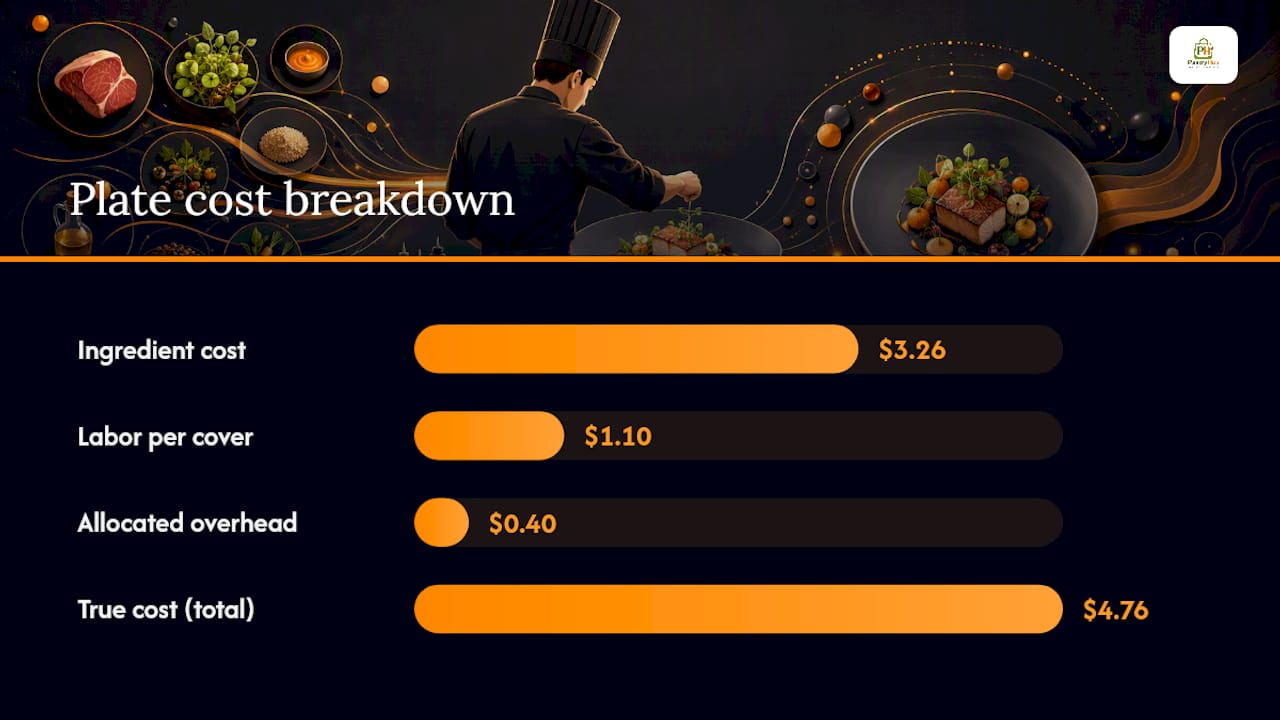
Most kitchens stop at ingredient cost, which is fine for a quick menu check but incomplete for real profitability decisions. Labor and overhead close that gap.
Two simple allocation methods work without a finance degree:
- Labor per cover = total hourly kitchen labor ÷ covers served per hour
- Overhead per cover = monthly overhead (rent, utilities, insurance) ÷ expected covers for the month
Say your $3.26 plate from earlier gets $1.10 in labor per cover and $0.40 in allocated overhead. Your true cost jumps to $4.76, a meaningfully different number than the $3.26 ingredient-only figure when you're deciding whether that $14 price point actually supports your margins.
Pro Tip: Keep ingredient cost and true cost as two separate line items on your recipe cards. You'll want the pure ingredient number for fast menu comparisons and the true cost for actual profitability calls.
How Do You Turn Plate Cost Into a Menu Price?
Once you know plate cost, two formulas do the heavy lifting for pricing strategy:
- Food cost % = plate cost ÷ menu price
- Target price = plate cost ÷ target food-cost %
Using our $3.26 plate cost and a 30% target, the target price calculation gives you $3.26 ÷ 0.30 = $10.87, which most operators round to $10.95 or $11.
Here is where percentage alone misleads you; for deeper insights, explore strategies on event marketing for restaurants that actually fill seats and support profitable menu pricing.
- Compare dishes by contribution margin (dollars), not just food-cost percentage
- A high-percentage dish with strong dollar contribution can outperform a "clean" 25% dish that barely moves the needle on covers
How Do You Catch Plate Costing Errors Before They Hurt Margins?
Theoretical plate cost and actual spend drift apart for predictable reasons: stale supplier prices, inconsistent portioning between shifts, garnishes left off recipe cards, and yield percentages nobody's actually measured.
Run these checks routinely:
- Weigh three to five sample portions of your top-selling dish and compare against the recipe card
- Pick one or two high-cost SKUs and run a focused stocktake instead of waiting for the full monthly count
- Compare theoretical consumption (recipe cost × units sold) against actual purchase volume for the same period
A documented recipe-cost template with fields for purchase unit, yield percentage, and invoice date makes this reconciliation far faster than chasing numbers across scattered spreadsheets. Anything beyond that calls for a physical recount before you touch your menu prices.
Pro Tip: *Seasonal ingredient swings, produce especially, deserve a mid-season recost rather than waiting for your usual quarterly review.
How Does Software Keep Plate Costs Accurate Automatically?
Manual plate costing degrades the moment a supplier changes a price and nobody updates the spreadsheet. Linking recipes directly to invoice data and live stock counts closes that gap, because unit costs update the moment a new price hits your system instead of weeks later.
Look for these features when evaluating a costing tool:
- Ingredient-level stock tracking tied to actual purchase records
- Live supplier price feeds that flow straight into recipe costs
- Recipe-to-invoice linking so yield and portion math updates automatically
- Low-stock alerts that flag reorders before a shortage forces a substitution
Pantryhub's free food cost calculator applies this exact structure to real supplier pricing.
A note from the pass
Plate costing separates chefs who run a kitchen from chefs who merely cook in one. This week, weigh and cost your highest-volume dish start to finish, then compare it against what's on the recipe card.
— Admin
Stop Recosting Plates by Hand Every Time a Supplier Invoice Changes
Pantryhub links your recipes directly to live supplier prices and ingredient-level stock counts, so a price change on Tuesday's delivery updates every recipe that uses that ingredient automatically, instead of sitting stale in a spreadsheet until someone notices margins slipping.
That means the yield-adjusted unit costs and Q-factor math covered above stop being a once-a-quarter exercise and become numbers you can trust on any given Tuesday. The Pantryhub hospitality inventory platform handles recipe linking, low-stock alerts, and supplier ordering from one dashboard, whether you're running a single café or coordinating costs across multiple venues. Run your top three dishes through the free food cost calculator this week and see where your actual numbers land against your menu prices.
Sources
- Free Cost Per Plate Calculator for Restaurants | DishCost
- Chapter 7 – Recipe and Menu Costing
- Recipe Plate Cost Calculator | Free Tool by Tabby