
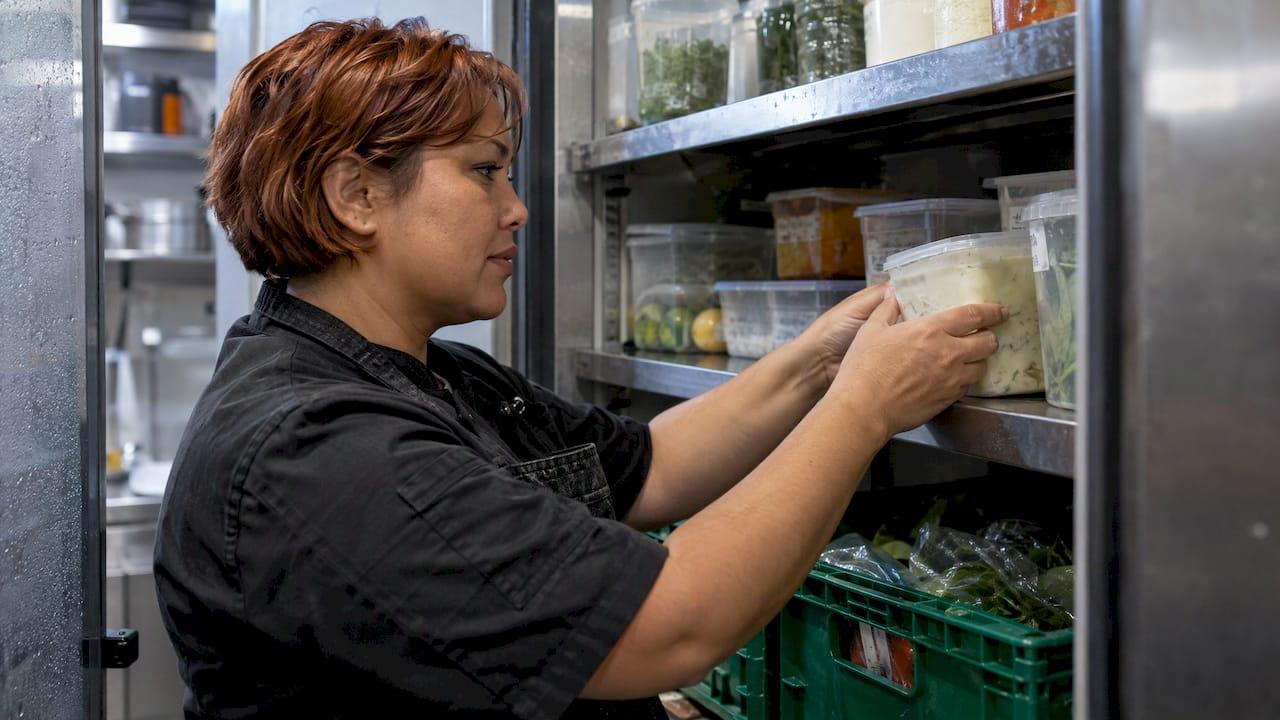
In Australia, packaged food with a shelf life of two years or less must carry a date mark. That mark is either a use-by date, which means you can never sell the food after it, or a best-before date, which you can sell after the date if the food is still fit to eat. The rules sit in Standard 1.2.5 of the Food Standards Code. For a café, pub, club or restaurant, the practical job is to check dates on everything that arrives, rotate stock so older product goes first, and label what you prepare in-house. That job is far easier when your stock is tracked in one place and not in people's heads.
TL;DR
- Packaged food with a shelf life of two years or less needs a date mark. Use-by is for safety-critical food, best-before is for everything else.
- Food past its use-by date cannot legally be sold. Best-before food can be sold after the date if it is still fit for human consumption.
- Food you make and pack on your own premises, and unpackaged food, is generally exempt from date marking, but safe storage times still apply.
- Suppliers set the date marks. You are responsible for checking them, storing food correctly and not selling anything unfit.
- A simple receive, label, rotate and discard routine, backed by real-time stock tracking, keeps you compliant and cuts waste.
Table of Contents
- Which foods must carry a date mark
- Use-by vs best-before: the difference that matters
- How a date must be written
- Who is responsible for what
- Date marking on the line: what the rules mean day to day
- Where date marking goes wrong in venues
- Have the rules changed?
- Making date checks easier with PantryHub
- Our view: compliance is a stock control habit
- FAQ
- Sources
Which foods must carry a date mark
The baseline rule is simple. SA Health states that food products with a shelf life of two years or less must have a date mark. Under Standard 1.2.5, the date mark is the use-by date if one applies, and otherwise the best-before date. Bread is the one special case: bread with a shelf life under seven days can carry a baked-for or baked-on date instead.
The Food Standards Code is the national rulebook, shared with New Zealand and run by Food Standards Australia New Zealand (FSANZ). State and territory health authorities enforce it, which is why you will see the same rules explained on NSW, Queensland, SA, WA and ACT government pages.
Foods that do not need a date mark
The NSW Food Authority lists the main exceptions:
- Food with a best-before date of two years or more, such as some canned goods.
- Individual portions of ice cream or ice confection.
- Foods in small packages (less than 100 square centimetres), unless a use-by date applies.
- Foods exempt from the Code's general labelling provisions.
If a product does not need a date mark, it still has to be identifiable. SA Health notes that lot identification must be included in that case, although a date mark plus the business name and address can do the same job.
What hospitality venues are exempt from
This is where most operators get confused. Date marking is about packaged food sold to the customer. SA Health's labelling guide lists exemptions that cover a lot of what a venue does every day: unpackaged food, food made and packaged on the premises, food packaged in front of the purchaser, fresh produce, and food sold from a display cabinet with assisted service. Information such as allergens, ingredients and storage conditions must still be available on request.
So your house-made sauce, the sandwiches you wrap on site and the pies in your display cabinet do not need a manufacturer-style use-by label under the Code. That does not mean you can leave them undated. Safe storage rules still apply, and a dated label is how your team knows when to throw something out. We cover that routine below.
Use-by vs best-before: the difference that matters
The two dates look similar on a carton but carry very different legal weight.
| Use-by | Best-before | |
|---|---|---|
| What it means | Food must be eaten before this time for health or safety reasons | Food is at its best quality until this date |
| Can you sell it after the date? | No, it is illegal | Yes, if it is still fit for human consumption |
| Typical foods | Milk, raw meat, sliced meats | Cereals, grains, biscuits, sauces, chocolate, sugar, flour, frozen foods |
FSANZ explains that use-by food can't legally be sold after the date, while best-before food can be sold after the date provided it is fit for human consumption. It may have lost some quality but should still be safe. HealthyWA's date marking page gives the typical food lists in the table above and adds that best-before food can only be sold after its date if it is not damaged, deteriorated or perished.
When a use-by date applies
The Australian Food and Grocery Council's best practice guide says a use-by date is used where a food is a sole source of nutrition with degradable vitamins (infant formula is the example), where a perishable food may become unsafe without cooking that removes the concern, or where a perishable food rapidly becomes unsuitable after the date. The same guide warns that storing food against its stated conditions, or damaging the packaging, makes the date mark null and void.
That last point matters in a kitchen. A sealed tub of cream with a use-by date three days out is only good for those three days if it has stayed in the cold chain. A tub left on a loading dock for an hour does not carry the supplier's date with it.

Best-before is not a free pass
A best-before date tells you when food is in its best condition, not when to bin it. The AFGC guide itself notes that these dates can be ambiguous for that reason. For a venue, this means a quality call: if the product is in date for safety but flat, stale or off in flavor, it does not belong on a customer's plate. Set a house rule for how long past best-before you will keep each dry-goods category in service, and write it down so every shift makes the same decision.
How a date must be written
If you receive, repack or sell packaged goods, it helps to know what a compliant mark looks like. Standard 1.2.5 sets these presentation rules:
- The wording must be "Best Before", "Use By", "Baked For" (or "Bkd For"), or "Baked On" (or "Bkd On"), followed by the date or a reference to where it is printed.
- The day must be a number. The month can be a number or letters. The year must be a number, in full or the last two digits.
- If the date is no more than three months away from when it is applied, at least the day and month must appear (for example 23 Dec).
- If the date is more than three months away, at least the month and year must appear (for example Dec 2026).
- The numbers must be arranged so it is clear which is the day, month and year.
Storage conditions count as part of the label too. The ACT Government says specific storage conditions needed for food safety must appear on the label, with ice cream below -18 degrees Celsius as its example. Conditions such as "refrigerate after opening" are what the date depends on, and a date mark only holds when they are followed.
Who is responsible for what
The split of responsibility is clearer than many operators expect. The NSW Food Authority says manufacturers are usually responsible for determining date marks and proving they are accurate. NSW Fair Trading says suppliers are responsible for putting a use-by or best-before date on food, and retailers must make sure the food they sell is not contaminated and is fit for consumption. CSIRO adds that determining shelf life lies with the manufacturer or packer, ideally through properly constructed storage trials.
In plain terms: the supplier sets the date, and you own everything that happens after the delivery arrives. If a use-by item is on your shelf past its date, that is your breach, not the supplier's.

Date marking on the line: what the rules mean day to day
The legal rules are short. The daily practice is where venues get caught. FSANZ's storing food safely guidance tells staff to check date marks on stock, sell older food first and discard food past its use-by date. It also sets out the storage basics:
- Potentially hazardous food (the kind that supports bacterial growth, such as cooked meat, dairy and cut produce) must be stored at 5°C or colder.
- Raw meat and seafood must be stored separately from, or below, ready-to-eat food.
- Unpackaged potentially hazardous ready-to-eat food should generally not be stored for more than five days.
- Food containing raw or low-cooked eggs should generally not be stored longer than 24 hours.
Those last two limits are the reason in-house labels matter, even where the Code exempts you from a formal date mark. Your aioli, your cut fruit and your cooked rice need a made-on or discard-by date so a closing cook on a Sunday night can make the right call without guessing.
A five-step routine that holds up
- Check at receiving. Look at every use-by and best-before date when the delivery lands. Reject anything that arrives with too little life left for how you use it, and check that chilled goods arrive at 5°C or colder.
- Label what you open or prepare. Add the date opened or made, and a discard-by date, to every decanted, portioned or prepped item. Use one label format across the whole kitchen.
- Store to the conditions on the pack. Follow the storage instructions printed on the label. Raw below ready-to-eat, cold items in the fridge, not on the bench.
- Rotate first in, first out. Put new stock behind old stock. Sort shelves so the earliest dates sit at the front.
- Discard on the date, every time. Anything past use-by comes off the shelf the same day and is recorded as waste, so you can see what it cost you.
Our guides on shelf life management for restaurants and cafés and a kitchen labeling system go step by step through how to set this up, and QR code labels for kitchens shows how to track stock and expiry from a single scan.
Training the team
A routine only works if every cook and the casual on a Friday night follow it. Build date checks into onboarding and into opening and closing checklists. Formal food handler training courses can help your staff learn what the exemptions mean and what they must still do when preparing, packing and serving food.
Where date marking goes wrong in venues
The same mistakes keep turning up in busy kitchens:
- Treating all dates the same. A best-before on a bag of flour and a use-by on a tray of sliced ham are not equal. Only the second one is a hard stop.
- Ignoring storage conditions. A date is only valid while the stated conditions are met. Product left out of the fridge during a rush no longer has the supplier's shelf life.
- Skipping labels on prepped items. The in-house exemption covers the date mark, not the five-day and 24-hour storage limits.
- Over-ordering. Buying more than you can use before the date is the quiet way date marks eat into margins. Stock that expires unused is cash in the bin.
- Relying on memory. One person knows which tub is oldest. Then that person has a day off.
The last two are inventory problems as much as compliance problems. If you know what you hold, how fast it moves and what is near its date, you order closer to what you will actually sell.
Have the rules changed?
No. The October 2025 compilation of the Food Standards Code keeps the same Standard 1.2.5 framework: use-by dates for safety-critical food, best-before dates for shelf life under two years, baked-for or baked-on dates for bread under seven days, and no sale of food after its use-by date. Queensland's food labelling page and the ACT Government's page repeat the same rules. The Code is amended from time to time, so check the FSANZ site or your state health authority when you update your food safety program. Date marking itself has been a legal requirement for packaged food in Australia since 1978.
Making date checks easier with PantryHub
Date marking is a daily discipline, and discipline is easier when the system does some of the remembering. PantryHub is a hospitality inventory and ordering platform built by a chef for restaurants, cafés, bars and commercial kitchens. It gives you real-time stock tracking, AI-powered low-stock alerts, supplier ordering, team access controls, and waste and cost reporting, across one venue or several.
Here is how that lines up with the routine above:
- 📦 Know what you hold. Real-time stock levels mean you are not guessing what is at the back of the cool room before you order.
- 🛒 Order to what you use. Supplier ordering from one place helps you buy closer to your needs, so less stock ages out.
- 🔔 Get low-stock alerts. Alerts help you reorder on time without padding every order.
- 📊 See the cost of waste. Waste and cost reporting shows what discarded stock is costing the business.
- 👥 Set team access. Control who can adjust stock and orders at each venue.
Plans are published in Australian dollars: Starter at $39 per month, Regular at $69 per month and Pro at $99 per month. You can start a free trial and see how it fits your kitchen. If you run a bar, our bar inventory software page covers pour cost and stocktake, and Melbourne operators can see the restaurant inventory software for Melbourne page.
We also keep a library of practical kitchen guides on the PantryHub blog, including storage capacity planning for venues that are short on cool room space.
Our view: compliance is a stock control habit
We built PantryHub because we came from kitchens, and in kitchens date marking never fails on the day someone reads the rule. It fails on the day the walk-in is chaos, a delivery is half checked, and nobody is sure what came in on Tuesday.
The law is short: use-by means do not sell it, best-before means use judgment. What takes effort is the habit around it. That habit is knowing what you hold, ordering what you will use, and moving older stock first. Those are inventory skills, and they are the ones we have designed PantryHub around.
When you can see stock levels in real time, get alerts before you run low, order from your suppliers in one place, and see the cost of waste in a report, date discipline stops being a chore bolted on at the end of a shift. It becomes part of how the kitchen runs. For a single café or a multi-location group, that is the difference between hoping the cool room is in order and knowing it.
Bin the spreadsheets, set up your routine once, and let your whole team work from the same numbers.
the author
FAQ
Can I sell food after its best-before date?
Yes, if the food is still fit for human consumption. FSANZ says it may have lost some quality but should still be safe. Food that is damaged, deteriorated or perished should not be sold, so check packaging, smell and appearance before it goes to a customer.
Can I serve food after its use-by date if it looks and smells fine?
No. Selling food after its use-by date is illegal, whatever it looks like. The NSW Food Authority is clear on this, and FSANZ tells staff to discard food past its use-by date. Remove it from the shelf on the day.
Do I need to date mark food I make and package in my own kitchen?
Generally no. SA Health lists food made and packaged on the premises, unpackaged food and food packaged in front of the customer among the labelling exemptions. Information such as allergens and ingredients must still be available on request. Internal date labels are still the best way to meet the storage limits, such as the general five-day limit for unpackaged potentially hazardous ready-to-eat food.
What date format is used on Australian food?
The day must be a number, the month a number or letters, and the year a number. If the date is within three months, show at least the day and month. If it is further away, show at least the month and year. The Standard 1.2.5 text sets the detail.
Sources
- Use-by and best-before dates, FSANZ
- Standard 1.2.5 Information requirements, date marking, legislation.gov.au
- Food labelling guide for businesses, SA Health
- Labelling: date marking, storage conditions and directions, NSW Food Authority
- Date marking, HealthyWA
- Best practice guide, date marking, Australian Food and Grocery Council
- Food labelling, ACT Government
- About food labels, Queensland Government
- Storing food safely, FSANZ
- Food and drinks safety standards, NSW Government
- Shelf life, CSIRO
- Food Standards Code Compilation, October 2025, FSANZ